Crystal Healing Basics: How It Works
May 14, 2026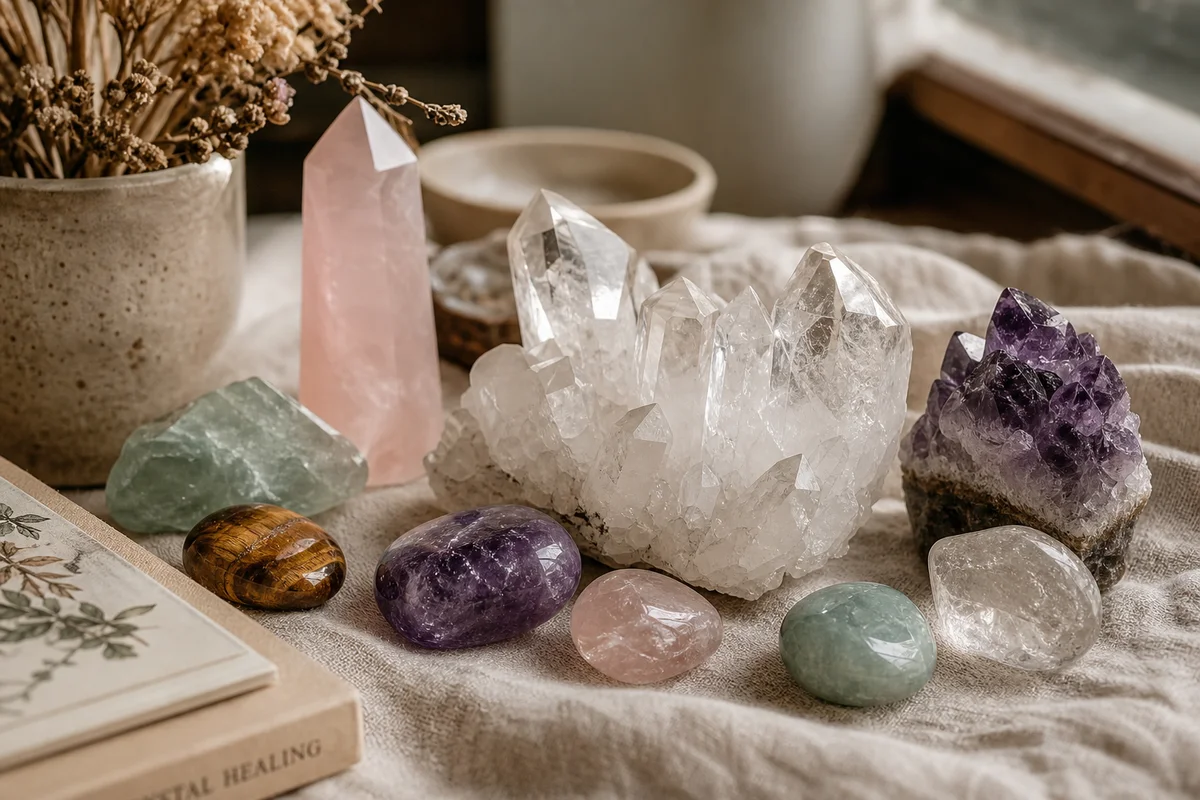
Crystal Healing and Energy Work: A Practical Guide That Goes Beyond the Hype
Crystal healing sits at a strange intersection. On one side, there are thousands of years of human tradition — ancient Egyptians lining tombs with lapis lazuli, Chinese emperors valuing jade above gold, Ayurvedic practitioners prescribing gemstones for specific ailments. On the other side, there is a modern wellness industry that has turned crystals into a billion-dollar market, sometimes with claims that outpace what the evidence supports.
This guide lives in the middle. We are not here to tell you that a piece of rose quartz will fix your life, nor are we here to dismiss the genuine comfort, focus, and ritual that people find in working with stones. What we can do is walk you through what crystal healing actually involves, what the science says, and how to build a practice that feels meaningful to you — whether that means a single stone on your nightstand or a full meditation setup with singing bowls and grids.
Below, you will find eight sections covering the full scope of crystal healing and energy work. Each one links out to detailed articles on our site, so you can go as deep as you want on any topic that catches your interest.
1. The Science and Psychology Behind Crystal Healing
Let us start with the question everyone asks first: does any of this actually work? The honest answer is complicated. Crystals do not generate energy fields that have been measured in controlled scientific settings. But that does not mean the experience of working with them is meaningless. The placebo effect is real, powerful, and physiologically measurable — it is not "fake" healing, it is your brain healing itself with the help of a physical anchor.
What the Science Actually Says About Crystal Healing takes a close look at the existing research, which is sparse but not entirely empty. Studies from the University of London found that people holding real crystals reported the same sensations (warmth, tingling) as those holding fake ones — suggesting the experience comes from belief and expectation rather than the stone itself. But that finding is more interesting than dismissive, because it tells us something about how the mind-body connection operates.
The placebo effect and crystals: Why people believe they work (and why that matters) digs deeper into why the placebo effect matters in crystal healing specifically. If holding a piece of black tourmaline lowers your anxiety because you believe it will, the anxiety reduction is still real. Your nervous system does not care whether the mechanism is piezoelectric energy or a psychological ritual.
A Skeptic's Guide to Crystals: What the Science Actually Says and Why Crystal Skeptics Are Missing Something Important present both sides of the skeptic-practitioner debate. The key takeaway: being honest about what crystals can and cannot do actually strengthens your practice rather than weakening it.
For a broader look at how crystals fit into alternative medicine traditions, Crystals in Alternative Medicine: Where Tradition Meets Science is worth reading. And The psychology of why people collect crystals explores the deeper psychological drivers that make crystals compelling regardless of any healing claims.
2. Crystal Cleansing, Charging, and Daily Care
Before you do anything with a crystal — meditate with it, place it on an altar, carry it in your pocket — most practitioners recommend cleansing it. The idea is that stones absorb energy from their surroundings and previous handlers, and that clearing this residual energy gives you a clean starting point. Whether you take this literally or as a mindfulness ritual, the practice of pausing to "reset" a stone before use has real psychological value. It forces you to be intentional rather than passive.
7 Crystal Cleansing Methods Compared: Which Ones Actually Work compares seven popular cleansing methods — running water, salt, smoke, moonlight, sound, breath, and burying — and ranks them by practical effectiveness. Spoiler: some of the most popular methods (leaving stones in moonlight) are hard to verify, while others (smudging with sage) have cultural roots worth understanding.
Crystal Cleansing Myths I Used to Believe (And What I Do Instead Now) covers common misconceptions, like the idea that you must cleanse every stone after every use. Why I Stopped Cleansing My Crystals (And What Actually Changed) takes a contrarian position and explains what changed when one practitioner stopped obsessing over cleansing schedules entirely.
Charging — the process of "programming" a crystal with an intention — is even more controversial. How to Charge Crystals: 8 Methods Ranked by How Well They Actually Work ranks eight charging methods by how well they work in practice. Crystal Charging Myths: What Actually Happens and What Doesnt and Crystal Charging: 10 Questions About Whether It Actually Does Anything tackle the most common questions head-on.
For practical cleansing without buying special tools, How to Cleanse Your Crystals Without Buying Anything Special shows how to use things you already have at home. And if you want to compare different clearing stones, Selenite vs Clear Quartz vs Apophyllite: Which Clearing Crystal Works Best? puts three popular options head to head.
Understanding what happens physically to your stones matters too. Can Crystals Break if You Drop Them? What to Do Next and Can Crystals Really Interact with Each Other, and What Happens If They Do? answer practical questions about crystal durability and whether stones stored together affect each other. 7 Crystals That Are Actually Just Common Minerals Under a Fancy Name is a reality check on marketing.
3. Meditation and Mindfulness With Crystals
Meditation is where crystal healing gets the most practical and the least theoretical. You do not need to believe in energy fields to benefit from holding a stone while you sit quietly. The weight, temperature, and texture of a crystal give your hands something to focus on, which makes it easier to stay present. For people who struggle with traditional breath-based meditation, having a physical object as an anchor can be the difference between a frustrating session and a productive one.
Best Crystals for Meditation: A Practical Guide for Beginners covers which stones work best for different meditation goals — relaxation, focus, emotional release — with specific recommendations for beginners. Crystal Meditation for Beginners: 5 Techniques That Actually Work walks through five techniques that go beyond "hold a stone and breathe."
For a first-person account, Crystal Meditation for Beginners: An Honest Take After One Month of Practice describes what happened after one month of daily crystal meditation practice. How I Set Up My Crystal Meditation Practice at Home shows how to create a meditation space at home, and How to Use Crystals During Meditation: 5 Practical Techniques provides five more practical techniques.
Crystal meditation for skeptics: why it might work even if you do not believe explains why crystal meditation might work even for people who do not believe in it — the mechanism is attention anchoring, not magic. Meditation With Crystals vs Without: Does It Actually Make a Difference? compares sessions with and without crystals to see if there is a measurable difference.
A practical crystal self care routine — morning and evening rituals that take 5 minutes brings it all together into a daily self-care practice with morning and evening rituals that take just five minutes each.
4. Crystals for Emotional and Mental Well-Being
The most common reason people pick up crystals is emotional support. Not because they expect miracles, but because having a physical reminder of an intention — "I want to feel calmer," "I want to let go of this grief," "I want to be more confident" — makes that intention harder to ignore. The crystal becomes a tangible commitment device.
Crystals for anxiety: what the research actually says (and what it doesn't) and Healing Crystals for Anxiety: What Actually Works tackle anxiety specifically, looking at what the research says and what practitioners report. Crystals Aren't Medicine — But They're Not Nothing Either frames the question honestly.
For grief and loss, 7 Crystals That People Actually Use for Grief and Loss and Using crystals during grief and loss — what actually helps and what doesnt share what stones people actually use during mourning. The Morning I Stopped Crying Long Enough to Walk Into a Crystal Shop is a raw, personal account of turning to crystals after a painful relationship ended.
Confidence and self-esteem get covered in Crystals for confidence and self esteem — what the science of habit says, which connects crystal work to the science of habit formation. Best Crystals for Empaths: What Actually Helps When You Feel Everything and Crystals for empaths — which stones actually help with emotional overwhelm focus on empaths and which stones help create emotional boundaries.
Focus and concentration are addressed in Crystals for Focus and Concentration: What the Evidence Actually Shows and Why Students Turn to Crystals in the First Place, both of which look at why students and professionals turn to crystals for mental clarity. Why people keep crystals on their desk and what science says explores the desk-stone phenomenon specifically.
Do Crystals Actually Help With Manifestation? An Honest Look takes an honest look at manifestation practices. And I Used Gratitude Crystals Every Day for 30 Days — Here Is What Actually Happened describes a 30-day gratitude crystal experiment with genuine shifts in daily perspective.
5. Sleep, Dreams, and Nighttime Crystal Practices
Sleep is one area where crystal practitioners report surprisingly consistent results. The mechanism is probably simple: having a bedtime ritual that involves placing specific stones near your bed signals to your brain that it is time to wind down. That signal, repeated nightly, becomes a powerful sleep cue — similar to how dimming lights or drinking chamomile tea works.
Crystals for Better Sleep: A Practical Guide That Actually Works provides a practical overview of which stones people use for sleep and how to use them. Why Sleep Is Harder Than It Should Be explains why sleep is harder than it should be for many people and how crystals fit into a broader sleep hygiene strategy.
I Tried Sleeping With Crystals Under My Pillow for Two Weeks documents a two-week experiment with crystals under the pillow — what worked, what did not, and whether it was worth repeating. Why I Even Tried This adds another personal perspective. For setting up a more structured approach, How to Set Up a Crystal Grid for Better Sleep shows how to build a grid specifically designed for better rest.
I Used Crystals for Stress Relief for 90 Days (Here Is What Actually Changed) covers a longer 90-day experiment using crystals for stress management, which naturally includes sleep improvements. Crystal Singing Bowls Changed My Evening Routine (Here's What Happened) describes how incorporating singing bowls into an evening routine changed one practitioner's sleep quality.
6. Sound Healing, Chakra Work, and Energy Centers
Sound healing with crystals — primarily through singing bowls made from quartz — has a more direct physical mechanism than most crystal practices. Singing bowls produce audible vibrations that you can feel in your body. Whether those vibrations are "healing" in a medical sense is debatable, but the relaxation response they trigger is genuine and measurable.
Sound Healing With Crystals: What Actually Happens When a Singing Bowl Sings and Sound Healing With Crystals: What Happens When You Strike a Singing Bowl Near a Stone take two different approaches to the same question. The first focuses on the experience, the second on the physics. Crystal singing bowls: sound, science, and what actually happens bridges the gap between the two.
Chakra work is one of the oldest frameworks for understanding energy centers in the body. The Crystal Chakra Guide: 7 Stones for 7 Energy Centers (And What Science Says) maps seven stones to seven energy centers and explains what science has to say about the chakra concept specifically.
For practical application, Crystal Singing Bowls Changed My Evening Routine (Here's What Happened) shows how to incorporate sound healing into a daily practice. And Smudging with sage and crystals: cultural context and practical tips provides important cultural context for smudging — a practice that predates the modern crystal movement by thousands of years and deserves to be treated with respect.
7. Crystal Grids, Altars, and Sacred Spaces
A crystal grid is a geometric arrangement of stones designed to focus intention toward a specific goal. An altar is a dedicated space for your crystal practice — a physical reminder that this is something you take seriously. Both serve the same psychological function: they make your practice visible and tangible, which makes it harder to neglect.
Crystal Grids for Beginners: A No-Nonsense Guide That Actually Works is the place to start if you have never built a grid. How to Build Your First Crystal Grid: A Beginner Walkthrough and How I Set Up My First Crystal Grid (And What I Learned After Making Every Mistake) provide step-by-step instructions and a catalog of mistakes to avoid.
Crystal grids and sacred geometry: the math behind the mysticism explores the mathematical principles behind sacred geometry in grids. 15 Frequently Asked Questions About Crystal Grids, Answered by Someone Who Actually Uses Them answers the questions most beginners are afraid to ask.
For specific goals, My First Crystal Grid Was a Mess (And What I Learned About Gridding for Abundance) shares lessons from an abundance grid, and What Crystal Gridding Actually Looks Like in Practice shows what gridding actually looks like in day-to-day practice rather than in staged photos.
Altars get their own treatment in Building a Crystal Altar That Actually Means Something (Not Just an Instagram Photo Op), What a Crystal Altar Actually Is, and How to Build Your First Crystal Altar: A No-Nonsense Guide — three perspectives on building a space that has genuine meaning. I Put Crystals in Every Room of My House for a Month documents what happened when one practitioner placed crystals throughout their entire home.
8. Crystal Profiles: The Stones You Will Actually Use
Some stones show up in nearly every crystal healing practice. They are the ones that are affordable, widely available, and have enough anecdotal support to make them worth trying. Here are profiles of the most commonly used healing crystals.
Clear Quartz is the universal stone — affordable, durable, and used for everything from meditation to grid-building. Clear Quartz Benefits: Why This Universal Crystal Deserves a Place in Your Collection explains why it deserves a place in any collection. I Spent a Month Wearing a Quartz Crystal Necklace Every Day documents a month-long experiment wearing quartz daily.
Rose Quartz is associated with love, emotional healing, and self-compassion. Rose Quartz Benefits: The Complete Guide to the Stone of Unconditional Love, Rose Quartz Meaning, Uses & Benefits: Your Complete Guide, and Rose Quartz Bracelet: Benefits, Which Hand to Wear, and How to Choose the Right One cover the stone from every angle.
Black Tourmaline is the protection stone most practitioners recommend first. Black Tourmaline: The Crystal Every Beginner Should Buy First explains why, and I Carried a Black Tourmaline in My Pocket for 30 Days — Here's What Happened documents a 30-day carry experiment with real observations. Obsidian Crystal Meaning and Uses: The Ultimate Protection Stone Guide and Do Protection Crystals Actually Work? An Honest Look at the Evidence cover other protection options.
Citrine is linked to abundance and confidence. Citrine Crystal Benefits: The Complete Guide to the Merchant's Stone covers its properties and uses. Tiger's Eye is another confidence stone — Tiger's Eye Crystal Benefits: Courage, Confidence, and the Stone of the Mind explains its history and practical applications.
Black Onyx (Black Onyx Crystal: Complete Guide to Meaning, Properties, and Uses), Chrysocolla (Chrysocolla Healing Properties: The Communication Stone Explained), and Blue Lace Agate (My Month With Blue Lace Agate: What I Noticed (And What I Didn't)) each have specific emotional and communicative associations. Iolite (Iolite Bracelet Benefits: Does This Violet Stone Actually Work for Focus and Vision?) is less common but gaining attention for focus work.
For comparing similar stones, Jade vs Aventurine: Which Green Stone Should You Choose? and Chalcedony Stone Guide: Why This Ancient Gem Is Making a Comeback in Modern Jewelry help you make informed choices. The First Decision Every Crystal Beginner Faces walks through the practical differences between tumbled and raw stones. And for understanding how gems are assigned meaning, The History of Birthstones: How Each Month Got Its Gem and 12 Crystal Books That Are Actually Worth Reading (I Read 30+ So You Don't Have To) provide helpful context.
9. Building Your Crystal Practice: Collections, Journals, and Real Experiments
The most valuable thing you can do with crystals is build a consistent practice. Not a complicated one — just something you return to regularly. That might mean meditating with the same stone every morning, journaling about your experiences weekly, or carrying a crystal that reminds you of a specific intention.
How to Build a Crystal Collection That Actually Means Something: A Beginner's Roadmap helps you build a collection with intention rather than impulse. My First Crystal: What Happened When I Started Collecting shares one person's origin story. How to Start a Crystal Journal and What to Write in It shows how journaling about your crystal experiences deepens their impact — not because the writing is magical, but because reflection turns a passive habit into an active one.
Real-world experiments are where this guide's content shines. I Rearranged My Entire Apartment With Feng Shui Crystals for 30 Days — Here Is What Actually Changed, I Tried Crystal Bathing for a Week — Here's What Actually Happened, I Used Crystals for Stress Relief for 90 Days (Here Is What Actually Changed), and I Used Gratitude Crystals Every Day for 30 Days — Here Is What Actually Happened each document what happened when someone committed to a specific crystal practice for an extended period.
How I Learned to Use a Crystal Pendulum (Without Taking It Too Seriously) introduces pendulum work as another form of practice. Crystal Gifts for Your Partner: What Actually Works and What Just Looks Pretty on a Shelf covers giving crystals as meaningful gifts. And Why Do People Wear Crystal Bracelets? The Real Reasons explains the growing trend of wearable crystals.
For understanding the industry behind the stones, How Crystal Decoding Became a Billion-Dollar Industry, The Crystal Industry Does Not Want You to Know These Things, and The Crystal Industry Has a Transparency Problem, and Here Is What Buyers Should Know pull back the curtain on sourcing, pricing, and marketing practices.
10. History, Culture, and Water: The Deeper Context
Crystal healing did not start with Instagram wellness influencers. The use of stones for healing, protection, and spiritual purposes stretches back at least 6,000 years across multiple civilizations. Understanding this history gives your practice depth and helps you separate genuine tradition from modern marketing.
Older Than Any Single Civilization and How Different Cultures Have Used Crystals for Thousands of Years provide overviews of how different cultures have used crystals. The Jade That Changed Everything focuses specifically on jade in Chinese culture — a stone that has been valued longer and more consistently than almost any other. The Surprising History of Lapis Lazuli, from Egyptian Pharaohs to Renaissance Painters traces lapis lazuli from Egyptian tombs to Renaissance paint pigments.
I Visited a Crystal Mine in Arkansas and Saw How Quartz Is Actually Extracted provides a rare first-person look at where crystals actually come from — the mines, the workers, the environmental impact.
Crystal-infused water is one of the most popular and potentially dangerous practices. Crystal Water Elixirs: Which Stones Are Actually Safe and Which Could Poison You is essential reading before you put any stone in water — some crystals contain toxic minerals that can leach out. Crystal water bottles: are they safe or a waste of money evaluates commercial crystal water bottles. The Problem With Crystal-Infused Water, and Why Most of It Is Just Expensive Water takes a critical look at the industry.
Moon water — water charged under moonlight, often with crystals — is a gentler practice. Moon Water with Crystals: The Complete Guide to Making and Using It and How to Make Moon Water with Crystals (Without Ruining Your Stones) explain how to make it safely. Moon phases and crystals: astronomy meets marketing adds a critical perspective on how lunar cycles are marketed in the crystal world.
Finally, if you are introducing crystals to children, 15 Crystals That Are Actually Safe for Kids (And 5 to Keep Away from Small Hands) and Crystals and Kids: A Safety Guide Parents Actually Need to Read are non-negotiable reads. Some crystals are safe for kids; others contain lead, arsenic, or other toxic elements that make them dangerous for small hands.
Moving Forward With Your Crystal Practice
Crystal healing and energy work sit at the intersection of ancient tradition, modern psychology, and personal ritual. The best approach is an honest one: use what resonates, remain skeptical of extraordinary claims, and pay attention to what actually changes in your experience. The articles linked throughout this guide represent hundreds of hours of research, experimentation, and honest reporting. They are here whenever you want to go deeper.
Start small. One stone, one practice, five minutes a day. See what happens. The crystal community has a saying that is actually worth listening to: the right crystal is the one you are drawn to. Trust that instinct, then do the work.
Frequently Asked Questions
How can I identify the best crystal for my specific emotional issue?
Start by researching the metaphysical properties of different crystals. Look for those that are known to support the specific emotional state you wish to address. Our crystal profiles section includes details on how each stone can assist with various emotional challenges.
What is the right size of crystal for energy healing work?
The size of a crystal for energy healing can vary based on personal preference and the purpose of the work. Smaller crystals are suitable for direct placement on specific chakras or points of concern, while larger crystals are often used for environmental clearing or meditation. Experiment to find what size resonates with you and the space you are working in.
How often should I clean my crystals to maintain their energy?
Cleaning your crystals regularly helps maintain their energy and purity. A general guideline is to cleanse them monthly, but you may need to do it more often depending on the crystals’ exposure to outside influences. We provide guidance on different cleansing methods in our crystal care section.
Are there any crystals that are not suitable for beginners?
Not all crystals are recommended for beginners. High-vibration stones or those with strong healing energies might be overwhelming for those new to crystal healing. Always refer to resources on crystal properties to avoid any stones that are particularly powerful for beginners.
Can I use a crystal for healing if I don't practice meditation or mindfulness?
Absolutely! While meditation and mindfulness can enhance your connection to your crystal’s energy, crystals have a subtle yet powerful energy that can support your healing practice without them. Simply holding or wearing a crystal can bring its benefits into your life, regardless of whether you incorporate formal meditation practices.
Comments