Crystal singing bowls: sound, science, and what actually happens
A bowl is a bowl, until it's not
Walk into any wellness shop in 2025 and you will find them on a shelf: translucent bowls made from quartz, priced anywhere from $40 to $2,000, marketed with words like "healing" and "frequency." The singing bowl industry has grown into a roughly $1.8 billion global market, and quartz crystal bowls account for a significant slice of that. People buy them. People run them around the rim with a mallet. A sound comes out — a sustained, wavering tone that fills a room and hangs in the air long after the mallet lifts away.
What actually happens when that sound hits your ears? That is the question worth answering, and the answer is more interesting than either the marketing or the skeptics would have you believe.
How crystal singing bowls produce sound
Crystal singing bowls are typically made from 99.9% pure quartz silica. The manufacturing process is straightforward: crushed quartz gets heated to roughly 4,000 degrees Fahrenheit in a centrifugal mold, spinning at high speed until it fuses into a bowl shape. The wall thickness, diameter, and exact proportions of each bowl determine its pitch.
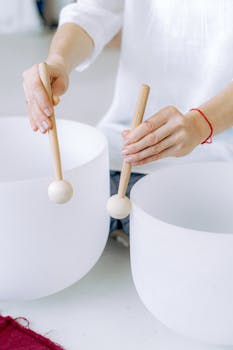
When you drag a suede-covered mallet around the rim, friction creates vibration. The entire bowl resonates — it has no bell, no clapper, no reed. The sound comes from the silica structure itself vibrating at a natural frequency determined by its physical dimensions. A 12-inch bowl might produce a tone around 528 Hz. A 16-inch bowl drops closer to 396 Hz. Bigger bowls make lower sounds. Thinner walls make louder ones. There is nothing mysterious about the physics here. It is the same principle that makes a wine glass hum when you rub its rim.
The resulting tone is not a single frequency. Spectrograms of crystal bowl recordings show a fundamental pitch with multiple harmonic overtones — additional frequencies stacked on top of the base note. This harmonic complexity is what gives singing bowls their characteristic "shimmering" quality. A Tibetan bronze bowl produces a similar effect, but the crystal version tends to have cleaner, more sustained overtones because quartz is a more uniform material than hand-hammered bronze alloy.
What the science actually says about sound and the body
Sound is mechanical vibration traveling through a medium — air, water, bone. It is not abstract. When a singing bowl produces a sustained tone at 432 Hz, that vibration moves through the air, enters your ear canal, vibrates your eardrum, and gets converted into electrical signals in your cochlea. Your brain processes those signals as sound. This part is well understood. The question is what happens next.
Research on sound-based interventions has expanded considerably since 2010. A 2023 meta-analysis published in the Journal of Integrative and Complementary Medicine reviewed 17 studies on singing bowl interventions and found moderate evidence for reductions in anxiety, tension, and reported pain. The effect sizes were not enormous — typically in the small-to-medium range — but they were consistent across studies. A 2020 study in the Journal of Evidence-Based Integrative Medicine found that a single 30-minute singing bowl session reduced tension and anxiety scores in 62 participants, with effects lasting at least 24 hours.
But here is the problem with that research: most of these studies have small sample sizes, no active control groups, and rely heavily on self-reported outcomes. When you sit someone in a quiet room with dim lighting and play them sustained tones for half an hour, of course they report feeling more relaxed. The question that remains difficult to answer is whether the specific frequencies of the bowls matter, or whether any sustained, pleasant sound would produce similar results.
The binaural beats question
A common claim in crystal bowl marketing is that specific frequencies correspond to specific effects. The number 528 Hz appears constantly — it is sometimes called the "DNA repair frequency" or the "love frequency." There is no published, peer-reviewed evidence that 528 Hz repairs DNA. That claim appears to originate from a single researcher's unpublished work in the 1990s and has been repeated so many times online that it has taken on the appearance of fact.
Binaural beats, a related concept, have better research behind them. When you play slightly different frequencies in each ear (say, 200 Hz in the left ear and 210 Hz in the right), your brain perceives a 10 Hz "beat" that corresponds to alpha brainwave activity. A 2019 review in the journal Neuroscience found that binaural beats can influence brainwave patterns and may have modest effects on anxiety and focus. But crystal singing bowls, played in a room, do not produce binaural beats. They produce a single shared frequency that reaches both ears simultaneously. The binaural beat mechanism does not apply here.
Vibroacoustic therapy is a real field
There is legitimate scientific work happening at the intersection of sound and health, and it does not involve quartz bowls directly. Vibroacoustic therapy uses low-frequency sound waves (typically 20-120 Hz) transmitted through a bed, chair, or mat that the person sits or lies on. The sound vibrations pass directly into the body through physical contact, not just through the air.
Researchers at the University of Toronto, the National Institutes of Health, and several European universities have published studies on vibroacoustic therapy for conditions including chronic pain, fibromyalgia, and Parkinson's disease tremors. A 2017 study in the Journal of Music Therapy found that vibroacoustic treatment reduced pain scores by an average of 2.3 points on a 10-point scale in patients with chronic lower back pain. That is a meaningful result.
The key difference: vibroacoustic therapy delivers sound directly to the body at specific, calibrated frequencies through physical contact. A crystal singing bowl in a room delivers sound through the air at whatever frequency the bowl happens to be. The physics are different. The evidence base is different. Lumping them together is inaccurate.
What about the placebo effect?
The word "placebo" gets thrown around dismissively, but that dismissal is itself a mistake. The placebo effect is real, measurable, and powerful. A 2022 review in the journal Pain found that placebo interventions produced clinically meaningful pain relief in roughly 35% of participants across studies. Brain imaging studies have shown that placebos activate real opioid pathways in the brain — you are not imagining the relief, your brain is producing actual pain-relieving chemicals in response to the expectation of relief.
If someone buys a crystal singing bowl, believes it will help them relax, plays it, and then genuinely feels more relaxed — the outcome is real regardless of the mechanism. The bowl functioned as a focus for attention and intention. Meditation researchers call this a "scaffold" — an external object or practice that supports an internal state. Prayer beads, mandalas, and breathing apps all function as scaffolds. A singing bowl is no different in principle.
The social and ritual dimension
Something else happens when people gather for a sound bath that has nothing to do with acoustics. You lie on the floor in a group, close your eyes, and listen to sustained tones for 45 minutes. You are not checking your phone. You are not talking. You are not planning dinner. For most people, that experience of uninterrupted stillness is genuinely rare in modern life.
A 2018 study in the journal Health Psychology Review analyzed group wellness practices and found that the social component — shared silence, collective ritual, the presence of a trusted facilitator — accounted for a significant portion of the reported benefits. The sound itself was only part of the equation. The container matters as much as the content.
This is not a criticism. Ritual is one of the oldest technologies humans have invented for managing emotional states. The fact that a crystal bowl sound bath borrows from older traditions (Tibetan Buddhist practices, in particular) and repackages them for a wellness-market audience does not invalidate the experience. It just means we should be honest about what we are actually doing.
So should you try one?
If you find the sound of a crystal singing bowl pleasant, there is no reason not to play one or attend a sound bath. The worst case is that you spend an hour lying on a floor listening to pretty sounds. The best case — supported by some evidence — is that you experience a measurable reduction in anxiety or tension that lasts at least a day.
What you should not do is treat crystal singing bowls as a substitute for evidence-based medical treatment. No frequency of sound cures cancer, repairs cellular damage, or treats any diagnosed condition on its own. The bowl industry has a marketing problem, and that problem is the gap between what manufacturers imply and what the research supports.
A quartz bowl is a piece of resonant silica. It makes a sound when you rub it. That sound might help you relax. It probably will not heal you, but relaxation itself has real, documented health benefits — lower cortisol, reduced blood pressure, improved sleep quality. If a bowl helps you get there, the bowl has done its job. The rest is marketing.
Comments