Smudging with sage and crystals: cultural context and practical tips
The Target aisle that started a conversation
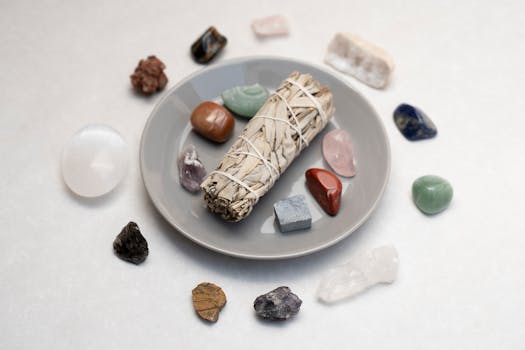
In 2020, Target started selling small bundles of dried white sage wrapped in colorful thread for $4.99 each. They sat on shelves between the candles and the essential oils, marketed alongside "smudge kits" that included an abalone shell and a feather. Native American activists responded quickly, and the conversation that followed revealed a lot about how spiritual practices get commercialized and stripped of their meaning.
I bought one of those sage bundles back then. I burned it in my apartment because I'd seen it on Pinterest and thought it would smell nice. I didn't know at the time that the practice I was casually copying is sacred to multiple Indigenous nations, has specific protocols, and has been under threat of legal restriction for decades. I know now, and I think that matters.
This article is about smudging with sage and crystals — the history, the cultural context, the safety concerns, and how to do it in a way that respects the traditions it comes from.
What smudging actually is (to the people who created it)
Smudging is a ceremonial practice used by many Indigenous peoples of North America, including the Lakota, Navajo (Diné), Ojibwe, and many others. It involves burning specific sacred plants — most commonly white sage (Salvia apiana), cedar, sweetgrass, and tobacco — and using the smoke to cleanse people, objects, and spaces.
In Lakota tradition, smudging with sage is called "wápe wanáği" and is part of the larger practice of prayer. The smoke is believed to carry prayers to the Creator and to purify the mind, body, and spirit. It's not a casual air freshener. It's a religious ceremony with specific protocols: who can perform it, when it's appropriate, what words are spoken, and how the materials are gathered and handled.
In Navajo tradition, burning sage is part of ceremonial practices that can last for days and require the guidance of a medicine person (Hatałii). These ceremonies are not DIY projects. They're complex rituals that require training, permission, and community participation.
The key point: smudging is not a generic "burn herbs and feel zen" practice. It's a set of specific, sacred ceremonies belonging to specific cultures. The fact that it's been repackaged as a lifestyle product doesn't change what it is to the people who originated it.
Why white sage is in trouble
White sage (Salvia apiana) grows naturally in a relatively small area: the coastal sage scrub of Southern California and Baja California, Mexico. It's not a widespread plant. It grows slowly, doesn't propagate easily from seed, and is highly sensitive to overharvesting.
Before the wellness boom, white sage was harvested sustainably by Indigenous peoples who had done so for thousands of years. They took only what they needed, left enough for the plant to recover, and understood the ecology of the plant intimately. The commercial demand for sage bundles — fueled by Instagram, wellness influencers, and mass retailers — has completely changed this dynamic.
In 2018, conservation groups in Southern California reported that wild white sage populations had declined by an estimated 20-30% in areas with high commercial harvesting pressure. Poaching became a serious problem, with people illegally harvesting sage from protected lands and state parks. The Mojave Desert Land Trust and other organizations have documented cases where entire hillsides were stripped of sage by commercial harvesters.
The California Native Plant Society lists wild white sage populations as "fairly threatened" in parts of their range. While the species isn't officially endangered, the trend is concerning, and many Indigenous leaders have publicly asked non-Native people to stop buying commercial sage bundles.
The cultural appropriation question
This is where things get complicated, and I'm going to try to be honest rather than performative.
Burning plants for their smoke is one of the oldest human practices. Almost every culture on Earth has some version of it: Catholic incense, Hindu dhoop and agarbatti, Japanese koh (incense ceremony), Palo Santo in South American traditions, myrrh and frankincense in Ethiopian Orthodox Christianity. The impulse to fill a space with fragrant smoke as part of a spiritual or contemplative practice is nearly universal.
What makes the commercial smudging trend specifically problematic is the combination of three things: the appropriation of a specific sacred ceremony from cultures that have been systematically oppressed, the overharvesting of a plant that is sacred and ecologically vulnerable, and the complete removal of cultural context, meaning, and protocol from the practice.
Burning dried herbs in your home is not inherently appropriative. Burning white sage while calling it "smudging" and treating it as a generic cleansing ritual — without acknowledgment of where the practice comes from, what it means to its originators, and the ecological cost — is where it becomes problematic.
If you want to burn herbs, there are alternatives to white sage that don't carry the same cultural and ecological weight. Rosemary, lavender, cedar (if sourced sustainably), bay leaves, and garden sage (Salvia officinalis, the culinary herb) are all aromatic when burned and have their own histories of use in European folk traditions. No one's cultural heritage is being appropriated if you burn rosemary from your garden.
Crystals and smudging: how they got connected
The pairing of crystals with smudging is a modern invention. Traditional Indigenous smudging ceremonies don't typically involve crystals. The connection comes from the New Age movement of the 1970s and 1980s, which blended Indigenous practices, Eastern spiritual concepts, and various esoteric traditions into a new, commercialized spiritual framework.
In this blended tradition, smudging is used to "cleanse" crystals — removing "negative energy" that the crystal may have absorbed. The logic goes: if crystals absorb and transmit energy (a claim with no scientific support), then they need periodic cleaning, and smoke from sacred plants is one way to do it.
The more practical explanation for why people clean their crystals is simple hygiene. If you carry a crystal in your pocket for weeks, it gets dirty. Wiping it with a damp cloth works. Blowing smoke on it doesn't actually clean anything, but it looks and feels ceremonial, which is the point.
If you want to combine burning herbs with your crystal collection, that's fine. Just know that you're participating in a modern spiritual practice, not an ancient one. And if you're using white sage specifically, consider the ecological and cultural costs discussed above.
Practical tips for burning herbs at home
Fire safety first
This sounds obvious, but people set their houses on fire with sage bundles regularly enough that fire departments in California and Arizona have issued public warnings about it. Sage bundles stay hot for a long time after you blow them out. The ember can smolder undetected inside the bundle for 30 minutes or more.
Always have a fireproof container — a ceramic bowl, an abalone shell (if you have one), or a cast iron dish — to catch ashes and hold the bundle. Never leave a burning bundle unattended. Always extinguish it completely by pressing the burning end firmly against the fireproof surface or dunking it in water. Check the bundle 10 minutes after you think it's out. Then check it again.
Ventilation matters
Burning any plant material produces particulate matter, carbon monoxide, and volatile organic compounds. A 2017 study in the Journal of Hazardous Materials measured air quality during religious incense burning and found that PM2.5 levels (fine particles small enough to enter the lungs) spiked to 10-50 times the WHO recommended limit during active burning.
If you have asthma, allergies, or any respiratory condition, burning sage in an enclosed space is a bad idea. Open a window. Use a small amount — you don't need to fill the room with smoke. A few minutes of gentle burning is enough to fill a room with scent.
Smoke alarms
Yes, this happens. The smoke from a sage bundle can absolutely set off a smoke detector, especially the sensitive ionization-type detectors common in apartments. Don't burn sage near smoke detectors unless you want to explain yourself to your neighbors and possibly the fire department. Test your detector's sensitivity with a single match first.
Pets
Dogs and cats have much more sensitive respiratory systems than humans. Many essential oils and aromatic plants that are pleasant to us are toxic to them. Sage smoke can irritate their eyes and lungs. Birds are especially vulnerable — their respiratory systems are extremely sensitive to airborne particulates, and smoke can be fatal. If you have pets, burn herbs in a room they're not in, with the door closed, and ventilate thoroughly before they return.
Respectful alternatives
Grow your own herbs
Rosemary, lavender, and garden sage are easy to grow in pots on a windowsill. Harvesting a small sprig, drying it, and burning it connects you to the practice in a personal way that buying a mass-produced bundle doesn't. You know exactly where the plant came from, how it was grown, and nothing was taken from a threatened ecosystem.
Support Indigenous sellers
If you do want to buy white sage, buy it from Indigenous-owned businesses that harvest sustainably. The Native American Rights Fund and First Nations Development Institute maintain lists of Indigenous-owned businesses. Prices are usually higher than mass-market alternatives ($8-15 per bundle versus $5), but the money goes to the communities that hold this practice sacred, and the harvesting is done responsibly.
Learn the actual traditions
If smudging interests you beyond the aesthetic, read about it from Indigenous authors. Robin Wall Kimmerer's Braiding Sweetgrass is a beautiful starting point. So is All Our Relations by Winona LaDuke. Learn about the plants, the protocols, and the cultural contexts. Understanding where a practice comes from makes it more meaningful, not less.
The honest summary
Smudging is a sacred practice with deep cultural roots in multiple Indigenous nations. The commercial version sold in big-box stores and wellness shops is a stripped-down, decontextualized copy that contributes to the overharvesting of a threatened plant and profits from cultures that have historically been exploited. Burning herbs at home is a fine practice — just use herbs that don't carry this specific cultural and ecological weight, source them responsibly, and understand that what you're doing is not the same as a traditional smudging ceremony.
As for crystals and smudging: the combination is modern, not ancient. Crystals don't absorb negative energy (or any energy, really). But if you enjoy the ritual of holding a crystal while burning herbs and taking a moment to breathe, the ritual itself has real psychological value. Just don't pretend it's something it's not.

Comments