<h2>The placebo effect and crystals: Why people believe they work (and why that matters)</h2>
What the placebo effect actually is
The placebo effect isn't "it's all in your head" in the dismissive way people sometimes mean it. It's a measurable, repeatable physiological response. When someone believes a treatment will help them, their brain and body can produce real changes: altered pain perception, reduced anxiety, even measurable immune system shifts.
The neurobiology is fairly well mapped at this point. Functional MRI studies show that taking a placebo painkiller activates the same brain regions as actual painkillers: the prefrontal cortex, anterior cingulate cortex, and periaqueductal gray. The body releases endorphins and enkephalins (natural opioids) in response to the expectation of relief. This isn't imagination. It's neurochemistry triggered by belief.
The effect varies by condition. Pain and depression respond most strongly to placebo interventions, with a 2010 meta-analysis in the New England Journal of Medicine documenting 30-50% response rates. Anxiety shows similar patterns. Placebo effects on objectively measurable conditions like blood pressure or tumor size are much smaller or nonexistent, which is why placebo works better for subjective experiences than for hard physiological outcomes.
There's also the nocebo effect, the mirror image. If you believe something will harm you, it's more likely to. People who expect side effects from a medication often experience them even when taking an inert pill. The belief goes both ways, driven by the same neurological mechanisms.
The Baylor University study on crystal healing
The most directly relevant study on crystals and psychology comes from Baylor University, published in 2020 by Christopher French and colleagues. The study was straightforward: 80 participants were given a task and told that either a real crystal or a fake one was helping them. Half received genuine crystals, half received plain glass objects described as crystals. Neither group was told which was which.
The results were telling. Participants who believed they were holding a real crystal reported stronger effects regardless of what they were actually holding. The "real crystal" group and "fake crystal" group showed no statistically significant difference in their reported experiences. What mattered was belief, not the object itself.
This doesn't mean crystals are "proven fake" in some cosmic sense. The study wasn't designed to test energy fields or metaphysical properties. What it showed is that the reported benefits of crystal use are consistent with a placebo response pattern. The experience is real to the person having it; the mechanism is psychological rather than physical.
A smaller but interesting finding: participants who already identified as believers in crystal healing showed stronger placebo responses than skeptics. Prior belief amplified the effect. This fits with decades of placebo research showing that your pre-existing expectations about a treatment powerfully shape your response to it.
The ritual dimension
Here's where the conversation gets more interesting than "it's just placebo, therefore it's fake." Rituals, the structured, intentional actions people perform around crystals, have independently studied psychological benefits.
Research on mindfulness practices shows that the physical act of setting aside time, focusing attention, and engaging in a repeated behavior creates measurable reductions in cortisol (the stress hormone) and activation of the parasympathetic nervous system. The specific ritual matters less than the fact that you're doing one. Meditation, prayer, journaling, and crystal-focused rituals all produce similar neurological outcomes when performed with genuine intention.
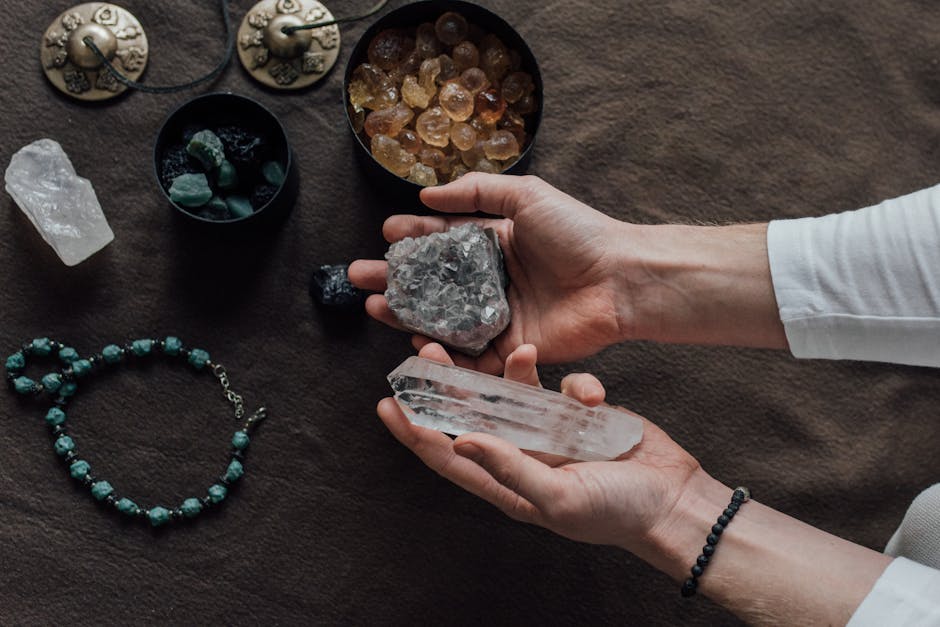
When someone holds a crystal, sets an intention, takes slow breaths, and focuses their attention, they're basically doing a mindfulness exercise with a physical prop. The crystal functions as an anchor, a tangible object that helps maintain focus and creates a sense of personal significance around the practice. Psychological research on "sacred objects" and "transitional objects" (the blanket a child carries, the lucky coin, the wedding ring) shows that humans genuinely derive comfort and focus from physical items invested with personal meaning.
This isn't a new idea. The anthropologist Bronisław Malinowski documented similar phenomena among Trobriand Islanders in the 1920s. Sailors performed rituals before dangerous fishing expeditions and felt more confident, which made them calmer and more competent in genuinely dangerous situations. The ritual didn't change the weather or the fish, but it changed the sailors, and that had real consequences.
Psychological anchoring and self-suggestion
Crystal users often describe specific associations: rose quartz for self-love, citrine for confidence, labradorite for change. From a psychological standpoint, this is classical conditioning in action. If you consistently pair a particular crystal with a particular mental state or intention, your brain starts to associate the two. Over time, simply seeing or touching the crystal can trigger the associated mental state.
This is the same mechanism behind why a particular song makes you nostalgic, or why the smell of a specific food triggers childhood memories. It's associative learning, one of the most fundamental and well-documented processes in human psychology.
The self-suggestion component works similarly. When someone tells themselves "this amethyst will help me feel calm," they're setting an expectation. That expectation primes their attention. They notice calm moments more, interpret ambiguous situations as less threatening, and give themselves permission to relax. It's a form of cognitive framing that has genuine effects on emotional state, even if the crystal itself has no active properties.
The social and cultural factors
Crystal use doesn't happen in a psychological vacuum. There's a strong social component that amplifies individual experiences. When you're part of a community that shares and validates crystal practices, you get social reinforcement: positive feedback from others who take the practice seriously, shared language for describing experiences, and a sense of belonging.
Social support is one of the strongest predictors of mental health outcomes in psychology literature. A 2015 review in Psychiatry found that people with strong social connections consistently show lower rates of depression, anxiety, and stress-related illness. If crystal collecting and use connects someone to a supportive community, that social benefit is real regardless of what's happening with the rocks themselves.
There's also the aesthetic dimension, which gets underrated in these discussions. Crystals are genuinely beautiful objects. Having beautiful things in your environment has documented effects on mood and wellbeing. A 2019 study in the Journal of Environmental Psychology found that natural forms, interesting textures, and visually complex objects reduce stress and increase positive affect. A shelf of crystals isn't just "rocks" any more than a painting is "just pigment on canvas." The aesthetic experience has value.
The cultural history adds another layer. Humans have attributed meaning to stones and crystals for at least 60,000 years. Archaeological evidence from Blombos Cave in South Africa includes deliberately collected and worked ochre pieces that may have had symbolic significance. The ancient Egyptians used lapis lazuli and carnelian in burial goods. Roman soldiers carried engraved hematite amulets. The impulse to find meaning in minerals is deeply human and cross-cultural, not a modern trend invented by Instagram influencers.
The honest conclusion
So where does this leave us? A few things seem reasonably clear.
First, the specific claims about crystal energy fields, vibrational frequencies, and metaphysical properties don't have empirical support from controlled studies. The Baylor research and related work suggest that the reported benefits match placebo and psychological mechanisms rather than any unique property of the minerals themselves.
Second, the placebo effect and related psychological mechanisms are real, powerful, and genuinely beneficial. If holding a crystal helps someone manage anxiety, fall asleep more easily, or feel more centered during a difficult day, that experience is valid. The discomfort some skeptics feel about this ("but it's not real!") misses the point that subjective experience is real to the person having it. Chronic stress reduction and anxiety management have measurable health outcomes regardless of the method used to achieve them.
Third, the ritual, social, and aesthetic dimensions of crystal use provide independent benefits that have nothing to do with whether the stones have special properties. A calming morning ritual, a supportive community, and a beautiful living space all contribute to wellbeing through well-understood psychological pathways.
The reasonable position, then, isn't "crystals are magic" or "crystals are stupid." It's something closer to: crystals are a focal point for psychologically beneficial practices, and the practices themselves have real value even if the metaphysical framework surrounding them isn't empirically supported. Whether that's "enough" depends on what you're looking for. If you want a scientifically validated medical treatment, crystals aren't it. If you want a calming ritual, a beautiful object to focus on, and a community of like-minded people, they might be exactly that.
What matters more than the crystal
If the psychological mechanisms behind crystal use are the actual active ingredients, then the quality of the crystal matters less than the quality of the practice. A cheap tumbled stone from a gift shop and a museum-grade specimen can produce similar psychological effects if the user approaches them with the same intention and attention.
This doesn't mean the physical object is irrelevant. People form genuine attachments to specific stones based on their appearance, how they feel in the hand, and the personal associations built up over time. A crystal given by a friend, found on a meaningful trip, or chosen during a difficult period carries emotional weight that a random replacement wouldn't match.
What probably matters most is consistency and intentionality. A daily five-minute practice of holding a crystal and breathing mindfully will likely produce better results than occasionally buying new crystals and displaying them on a shelf. A 2019 review in Health Psychology Review found that regular, brief mindfulness practices beat sporadic intense ones. The crystal is the prop, not the practice itself.
And honestly, there's nothing wrong with that. Humans have always used objects as anchors for meaning, comfort, and focus. Wedding rings don't have magical properties, but the commitment they represent is real. Photographs of loved ones are just ink on paper, but looking at them changes how you feel. Crystals occupy a similar space. Objects invested with personal meaning can genuinely affect your psychological state through well-understood mechanisms. That's not a debunking. That's an explanation.
Comments