7 Crystals That People Actually Use for Grief and Loss
Why crystals and grief keep showing up together
I spent about three weeks reading through grief support forums, Reddit communities (r/GriefSupport, r/widowers, r/petloss), and crystal-focused discussion groups to understand which stones people actually reach for when they're mourning. Not which ones shops recommend — which ones people use, and why.
The pattern was surprisingly consistent. Across hundreds of threads and thousands of comments, the same names came up again and again. Not because of any book or influencer list — though those exist — but because people tried things, talked about what worked for them, and the recommendations filtered up organically.
I want to be upfront: this article doesn't make health claims. Grief is serious. If you're struggling, a therapist, support group, or hotline is a better first call than a crystal shop. The resources below are a good starting point: the National Suicide Prevention Lifeline (988 in the US), Crisis Text Line (text HOME to 741741), and the Dougy Center for grieving children and families.
With that said, here are the seven crystals that people in grief communities mention most often, along with the reasons they give for choosing them.
Rose quartz
It would almost be strange if rose quartz weren't on this list. It's the most commonly recommended stone for emotional pain of any kind, and grief is no exception.
What people actually say about it in grief forums: "I keep a rose quartz heart on my nightstand and hold it when I can't sleep." "My mom gave me one after my miscarriage and I carry it everywhere now." "It doesn't fix anything but it gives my hands something to do when I'm crying."
The recurring theme is physical comfort. Rose quartz is usually polished smooth, often carved into heart or egg shapes, and the pink color reads as gentle. It's not aggressive or dramatic. People reaching for rose quartz in grief tend to describe wanting something soft — both literally and emotionally. The pink color may also play a role: research on color psychology, while mixed, has found that warm pink tones are associated with comfort and reduced physiological arousal in some contexts (the "Baker-Miller Pink" effect studied in detention facilities in the 1970s, though those findings have been debated).
What's notable is how many people say they didn't choose rose quartz — someone gave it to them. A friend, a family member, a therapist. The stone becomes a physical representation of social support, which is one of the strongest protective factors in grief recovery. Having an object that reminds you that someone else cares about your pain has independent psychological value.
Apache tears (obsidian)
Apache tears are a specific form of obsidian — volcanic glass — that forms as small, rounded nodules, usually black with a translucent edge when held up to light. They look like dark, smoothed pebbles.
The name comes from an Apache legend (there are several versions) about a group of Apache warriors who, facing defeat, rode their horses off a cliff rather than be captured. The tears of their families supposedly turned to stone where they fell. It's a creation story that directly ties the stone to grief, loss, and the impossibility of undoing what's happened.
In grief forums, people who choose Apache tears often mention this legend specifically. "I read the story behind them and it felt like someone understood." "They're literally made from grief, that's why they work for me." The cultural narrative matters here more than the mineral composition. Obsidian is obsidian. But Apache tears come with a story about mourning that resonates with people who are themselves mourning.
Practically, they're small, pocketable, and durable. You can carry one without anyone knowing. Several commenters mentioned keeping an Apache tear in their pocket at work, touching it during difficult moments when they didn't want colleagues to see them struggling. The discreet size makes it a more private grief tool than something you'd display on an altar or wear as jewelry.
Amethyst
Amethyst shows up in grief discussions for a specific reason that surprised me: sleep. Grief wrecks sleep. Study after study confirms it — a 2019 review in Sleep Medicine Reviews found that bereaved individuals experience significantly worse sleep quality, increased insomnia, and more frequent nightmares compared to non-bereaved controls, with effects persisting for months or even years after the loss.
Amethyst is traditionally associated with calm and rest, and people in grief forums frequently mention placing it on their nightstand or under their pillow. "I put an amethyst cluster next to my bed after my dad died. Don't know if it helped but I couldn't sleep without it there." "The purple is calming. I just like looking at it before I close my eyes."
Whether amethyst "helps with sleep" in any meaningful sense is debatable. But creating a consistent bedtime environment — same lighting, same objects, same routine — is one of the evidence-based recommendations for improving sleep in Cognitive Behavioral Therapy for Insomnia (CBT-I), the gold-standard treatment for chronic insomnia. If an amethyst cluster on your nightstand is part of the ritual that signals "time to wind down," it's contributing to sleep hygiene regardless of what you believe about its properties.
Smoky quartz
Smoky quartz is the darker, moodier cousin of clear quartz. Its color ranges from pale brownish-gray to nearly black, caused by natural irradiation of aluminum impurities within the crystal structure. It forms at temperatures between 300-500°C, typically in granite pegmatites.
In grief contexts, smoky quartz gets recommended for a reason that's both metaphorical and practical: it's associated, in crystal lore, with "transmuting" negative energy. But what people in grief forums actually describe is more nuanced. They talk about it as a stone that lets you sit with difficult feelings without being overwhelmed by them.
"Smoky quartz feels different from rose quartz. Rose quartz is like a hug. Smoky quartz is like someone sitting next to you quietly while you cry." That distinction came up multiple times. People who were earlier in their grief — the raw, angry, disbelieving phase — tended to gravitate toward smoky quartz over softer stones. Those who were further along, or whose grief had settled into a quieter ache, preferred rose quartz.
The geology of smoky quartz is interesting in this context: its color literally comes from exposure to radiation. Something that was clear and neutral was transformed by intense conditions into something darker, but also more complex and interesting. The metaphor is so perfect that it feels invented, but it's just how the mineral forms.
Lepidolite
Lepidolite is a lilac-to-pink mica mineral that contains significant amounts of lithium — the same element used in psychiatric medications for bipolar disorder and depression. This geological fact is frequently cited in crystal communities as an explanation for why lepidolite is calming.
Here's the science: lepidolite does contain lithium, usually between 1-5% by weight in the form of lithium aluminum silicate. But the lithium in lepidolite is locked into the mineral's crystal lattice. You cannot absorb lithium from holding a lepidolite stone, any more than you can absorb iron from holding a hematite paperweight. The mineral would need to be chemically processed and the lithium extracted and purified before it could have any pharmacological effect. The idea that lepidolite's lithium content directly influences your mood through skin contact is not supported by evidence.
That said, lepidolite is one of the most commonly recommended grief stones in online communities, and people who use it report genuine comfort. The lilac color is calming. The mica structure gives it a subtle shimmer that catches light in a way that's almost meditative to look at. And the lithium connection, even if it's not mechanistically real, gives people a narrative that feels grounding — "this stone contains something that's used to help with emotional instability, so maybe it can help me too." That's a placebo narrative, and placebo effects in emotional contexts are real and meaningful.
Blue lace agate
Blue lace agate is a banded chalcedony with alternating layers of pale blue and white. It's found primarily in Namibia (where it was first identified in the 1960s), and it's become increasingly popular in crystal communities over the past decade.
In grief discussions, blue lace agate comes up in the context of communication — specifically, the difficulty of talking about grief. A lot of people who are grieving find it hard to express what they're feeling, either because the words don't exist or because they don't want to burden others. Blue lace agate is associated, in crystal tradition, with clear communication and self-expression.
"I started carrying blue lace agate because I couldn't talk about my brother without crying, and I had to give a eulogy." "My therapist suggested I keep something blue near me when I journal. I chose blue lace agate because the bands look like calm water." "It reminds me that it's okay to say the hard things out loud."
The association with communication makes blue lace agate somewhat unique on this list. Most of the other stones are about receiving comfort or sitting with feelings. Blue lace agate is specifically about expressing them. That's a different kind of need, and it's one that's often underserved in grief support.
Howlite
Howlite is a white mineral with grey veining that looks, at first glance, like rough turquoise. It's inexpensive, widely available, and often dyed and sold as imitation turquoise (which is a whole separate issue). Natural howlite is unassuming — not flashy, not rare, not particularly dramatic.
That ordinariness is exactly why people choose it for grief. In forum discussions, howlite comes up most often from people who describe themselves as "not really into crystals" but who were looking for something — anything — to hold during difficult moments.
"I don't believe in crystal healing, I just needed something in my hand during panic attacks after my mom died." "My howlite was $2 from a museum gift shop. It's not fancy but it's mine." "It looks like marble with veins running through it. I trace the veins with my thumb when I'm anxious."
The veining pattern in howlite creates a natural texture that's pleasant to touch, which makes it a good tactile anchor — the same principle as a worry stone. And the low price point removes the barrier to entry. You don't have to commit to a belief system or invest significant money. You just buy a small, pretty stone and carry it. That accessibility is part of why it works for people who might otherwise dismiss crystal practices.
The pattern underneath the list
Looking at all seven together, what's striking is that none of them are particularly exotic or expensive. Rose quartz, amethyst, and smoky quartz are among the most common crystals on Earth. Obsidian is literally volcanic glass. Howlite costs pocket change. Lepidolite and blue lace agate are slightly less common but still widely available.
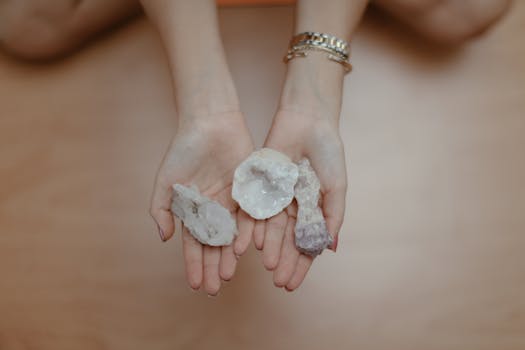
What people are reaching for in grief isn't rarity or luxury. It's familiarity, accessibility, and texture. Something to hold. Something that fits in a pocket. Something that doesn't demand anything from you but is there when you need it.
The best grief tool is the one you'll actually use. For some people, that's therapy. For others, it's a support group, or journaling, or running, or medication. And for some people, it's a small stone that fits in the palm of their hand. All of those are valid.
Comments