I Used Gratitude Crystals Every Day for 30 Days — Here Is What Actually Happened
May 13, 2026
I Tried Using Crystals for Gratitude Practice for 30 Days — Here's What Actually Happened
Gratitude journals are everywhere. You've probably seen the aesthetic Instagram posts — a nice notebook, a cup of tea, maybe a candle. I tried that routine for a while and honestly? It fizzled out after two weeks. Not because I didn't believe in being grateful, but because sitting down with a blank page every morning felt like one more thing on my to-do list.
Then a friend mentioned she pairs her gratitude practice with crystals. Not in a "this rock will change your life" way — more like "holding something gives my brain a reason to slow down." That idea stuck with me. So I picked four crystals, built a simple routine, and tracked my experience for 30 days. This is what happened.
What Is Gratitude Practice (And Why It Works)
If you've never come across this before: gratitude practice is exactly what it sounds like. You deliberately focus on things you're thankful for. Research in positive psychology — particularly work by Dr. Robert Emmons at UC Davis — shows that people who regularly practice gratitude report better sleep, lower stress levels, and an improved sense of overall well-being.
The mechanism is surprisingly straightforward. Your brain has a limited bandwidth for attention. When you consciously direct some of that bandwidth toward positive things in your life, you're essentially training yourself to notice the good more often. It's not magic. It's mental habit-building.
The hard part isn't understanding the science. It's actually doing it consistently. That's where the crystals came in for me.
Why Pair Crystals With Gratitude?
Here's the thing about building any habit: you need a trigger. Something that tells your brain "okay, it's time to do this now." Some people use alarms. Some use sticky notes on the bathroom mirror. I started using crystals as a physical anchor.
The idea isn't complicated. You pick a crystal, hold it in your hand, and while you're holding it, you think of three things you're grateful for. That's it. The crystal becomes a tactile cue — something you can feel, something with weight and temperature and texture — that signals your brain to shift into a reflective state.
There's actually some psychology behind this. It's similar to how a specific smell can instantly transport you to a childhood memory. In behavioral terms, it's called classical conditioning. Pair a physical object with a mental state often enough, and eventually just touching the object triggers the state. Whether you credit the crystal or the conditioning is up to you.
The Four Crystals I Chose (And Why)
I didn't pick these randomly. Each one had a specific role in my practice, based on what they're traditionally associated with and what I wanted to focus on each week.
Rose Quartz — Week 1
Rose quartz is probably the most well-known crystal associated with love and emotional openness. I chose it for the first week because I wanted to start by being grateful for the people in my life — my partner, my friends, my family — the relationships I sometimes take for granted.
There's something about the soft pink color that feels gentle, if that makes sense. Not energizing or intense. Just... kind. If you want to go deeper into this stone, our rose quartz guide covers everything from varieties to care tips.
Citrine — Week 2
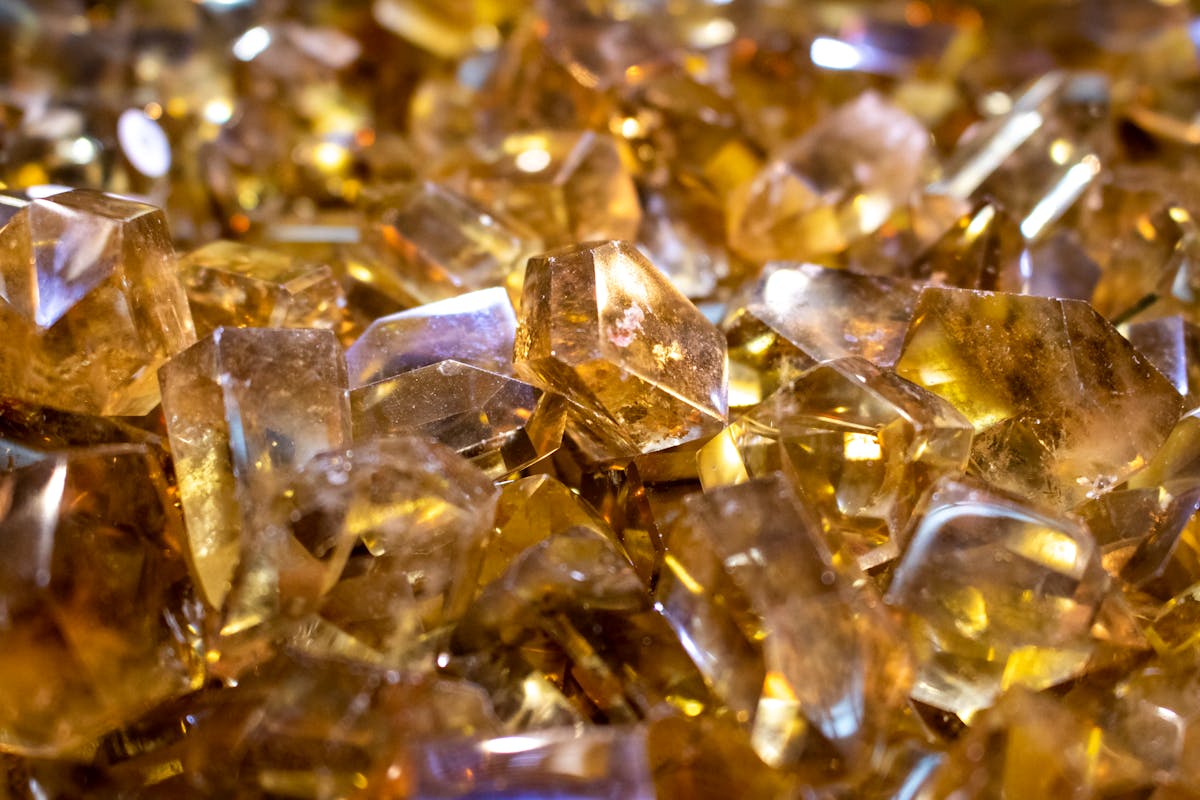
Citrine has this warm, golden-yellow color that just looks like sunshine. It's traditionally linked to abundance and positivity — not in a "manifest wealth" way, but more like noticing the good things that are already present in your life. For week two, I used it to focus on gratitude for opportunities, small wins, and the stuff that's going right. Our citrine crystal guide goes into more detail if you're curious about working with this stone.
Green Aventurine — Week 3
Green aventurine is often called the "stone of opportunity," which sounds a bit dramatic, but I picked it because I wanted to shift my gratitude toward growth and new experiences. By week three, I was running out of the obvious things to be thankful for, and aventurine felt like a good prompt to look a little deeper — to find gratitude in challenges, in lessons learned, in unexpected moments.
Labradorite — Week 4
Labradorite is one of my personal favorites. It has this flash of iridescent blue-green that appears when light hits it at the right angle — like there's more to it than what you see on the surface. I saved it for the final week because I wanted to focus on gratitude for the unknown, the things I can't see yet but trust are coming. If you're not familiar with this stone, our labradorite meaning article is a solid starting point.
Week 1: Building the Habit (With Rose Quartz)
The first few days were genuinely awkward. I'd sit on the edge of my bed in the morning, hold the rose quartz in my palm, and try to think of three things I was grateful for. Some days it came easily — my morning coffee, a text from a friend, the fact that it wasn't raining. Other days I sat there squeezing a pink rock and drawing a blank.
Day 3 was the hardest. I was tired, stressed about a deadline, and honestly not feeling grateful about anything. I held the rose quartz and thought "I'm grateful this day will eventually end." It felt pathetic at the time, but looking back? That counts. Gratitude doesn't have to be profound.
By day 6 or 7, something shifted slightly. My brain started anticipating the routine. I'd see the crystal on my nightstand and automatically start thinking about what I was grateful for before I even picked it up. The physical cue was beginning to work.
Week 2: Noticing Changes (With Citrine)
I switched to citrine on day 8 and immediately noticed the color change affected my mood. Where rose quartz felt calming, citrine felt more energizing — which made sense, since I was now focusing on positive moments and opportunities rather than relationships.
Somewhere around day 10, I caught myself doing something unexpected. I was walking to the grocery store and noticed how nice the light looked through the trees. And instead of just walking past, I actually paused and thought "I'm grateful for this." It was a small thing, but it felt automatic — like the practice was bleeding into the rest of my day.
I also started sleeping slightly better, though I can't say for certain whether that was the gratitude practice, the citrine, or just the fact that I was building a calming morning routine for the first time in months.
Week 3: Surprising Discoveries (With Green Aventurine)
This is where things got interesting. With green aventurine, I started finding gratitude in places I didn't expect. A difficult conversation that forced me to be honest. A project that didn't work out but taught me something important. The quiet hour between work ending and dinner starting that I usually fill with phone scrolling but started using to just... sit.
Day 19 stands out. I had a genuinely bad day — things went wrong at work, I got into an argument, and I came home in a terrible mood. I picked up the aventurine and forced myself to go through the routine. I wrote down: "I'm grateful that bad days end. I'm grateful that I have people who care enough to argue with me. I'm grateful for hot showers." And honestly, after writing that, the day felt less heavy. Not fixed. Just lighter.
That was the moment I realized this practice wasn't about pretending everything is fine. It was about finding something — anything — to hold onto when things aren't.
Week 4: Reflection and Takeaways (With Labradorite)
The final week with labradorite felt different from the start. I wasn't struggling to find things to be grateful for anymore. The practice had become almost reflexive. I'd wake up, see the crystal, and my brain would already be scanning for positive things.
I used this week to reflect on the whole experience rather than just listing daily gratitudes. Some questions I sat with: What surprised me most about this month? What will I keep doing? What was honestly just a phase?
The answers surprised me. I realized that the biggest change wasn't that I felt more grateful — it was that I noticed more. More small moments. More texture in ordinary days. More awareness of the things I'd been speeding past without really seeing.
What Science Says About All This
Let's be real for a second. There's no peer-reviewed study proving that crystals cause gratitude. But there are well-established psychological mechanisms that explain why this combination works for a lot of people.
Habit anchoring: This is straight from James Clear's work on atomic habits. You attach a new behavior (gratitude reflection) to a physical cue (holding a crystal). The crystal becomes the anchor that triggers the behavior. Over time, the behavior becomes automatic.
Classical conditioning: Remember Pavlov's dogs? Same principle. If you consistently pair a physical sensation (the weight and feel of a crystal) with an emotional state (gratitude), your brain starts linking them. Eventually, just picking up the crystal primes your mind for grateful thinking.
Selective attention: Your brain filters out the vast majority of information around you. When you practice gratitude regularly, you're essentially telling your brain "pay attention to positive things." Over time, this becomes your default filter — you literally start seeing more of the good stuff because your brain is looking for it.
The crystal isn't doing the work. You are. But the crystal might be making it easier to start.
My Honest Verdict
After 30 days, here's where I land: I'm going to keep doing this. Not because I believe the crystals have magical properties, but because they solved my actual problem — which was consistency.
Before this experiment, I'd tried gratitude journaling three separate times and quit within two weeks each time. The crystal gave me something a notebook never could: a physical, tactile ritual that felt distinct from the rest of my day. Something about holding a stone and closing my eyes for two minutes hit different than opening yet another notebook.
Do I think you need crystals to practice gratitude? No. A pebble from your garden would probably work the same way, psychologically speaking. But if you're like me and you've struggled to make gratitude practice stick, having a beautiful object that you genuinely want to hold might be the difference between doing it for a week and doing it for a month.
The real question isn't whether crystals work. It's whether you'll actually show up and do the practice. If a piece of rose quartz or citrine helps you show up — honestly, who cares why it works?
Just start. Pick one crystal. Three things you're grateful for. Two minutes a day. See what happens after 30 days. You might be surprised by what you start noticing.

Comments