<h2>15 Frequently Asked Questions About Crystal Grids, Answered by Someone Who Actually Uses Them</h2>
Q1: What exactly is a crystal grid?
A crystal grid is an arrangement of stones placed in a geometric pattern on a surface. Usually there's a written intention or word in the center, a larger "focus stone" placed on top of it, and smaller stones arranged around it in a specific shape. The idea is that the geometric arrangement creates a visual and meditative focal point. That's really all it is at its core: stones on a surface in a pattern. Everything else is decoration.
Q2: Do crystal grids actually work?
There's no scientific evidence that arranging crystals in patterns produces any measurable effect beyond what the stones themselves would do sitting in a drawer. What I can say from personal experience is that the process of choosing stones, arranging them, and spending a few quiet minutes focused on a specific intention is genuinely calming. Whether that counts as "working" depends on what you're expecting it to do. If you're hoping for a calm, meditative practice that gives you a dedicated space to think about something that matters to you, then yes, in my experience, it works for that.
Q3: What shape should I use?
The Flower of Life pattern (overlapping circles forming a flower-like design) is the most popular choice, and you'll see it printed on most grid cloths sold online. Other common patterns include the Seed of Life, Metatron's Cube, and simple geometric shapes like circles, triangles, and hexagons.
After trying several, I've found that simpler shapes work just as well as the complex ones. A basic circle of six stones around a center stone is where I started, and I still go back to it regularly. Don't feel like you need a sacred geometry pattern to make it "real." A circle drawn on a piece of paper works fine.
Q4: What crystals do I need?
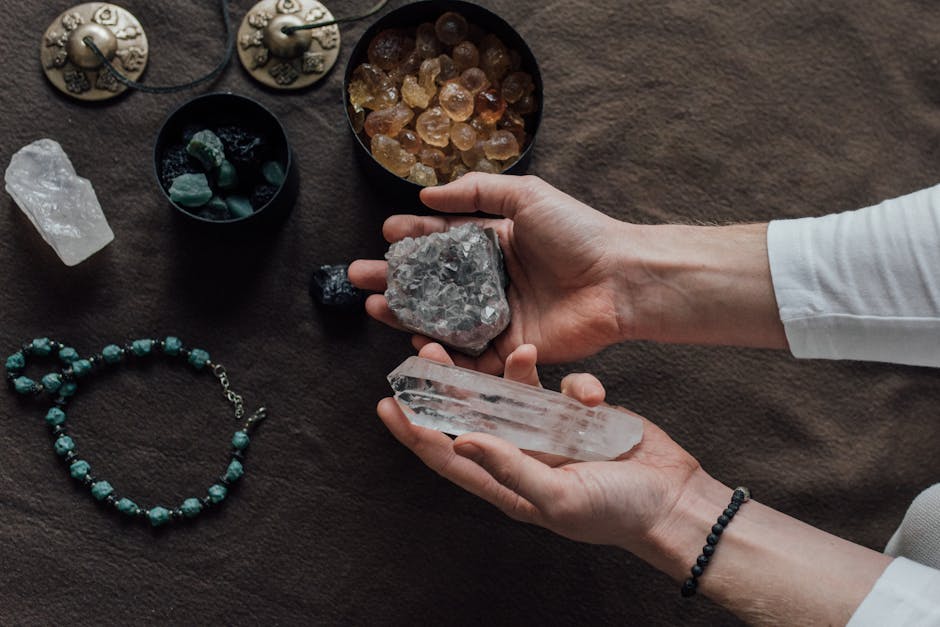
The standard setup uses three categories of stones. A focus stone goes in the center, which is typically the largest piece and the one most connected to your intention. Surrounding stones, sometimes called amplifiers, form the outer ring of the pattern. Quartz (clear, rose, or amethyst) is the most common choice for these because it's affordable and widely available. Pathway stones, the smallest pieces, are placed between the center and the outer ring to visually connect the pattern.
You do not need expensive stones. I've made perfectly functional grids using nothing but tumbled stones that cost $2-3 each. Clear quartz, amethyst, and rose quartz are the three I'd recommend starting with because they're inexpensive and easy to find.
Q5: How long should I leave a grid up?
There are no rules about this. Some people leave their grids up for weeks or even months, treating them as a semi-permanent feature of a room. Others set up a grid for a single meditation session and then take it apart immediately after. I've done both, and I can't say one approach feels more or less effective than the other.
A practical consideration: if you have cats, small children, or a dusty environment, a long-term grid will get disrupted. My cat knocked over a carefully arranged grid within 48 hours of me setting it up, which was annoying but also kind of funny. If you want something permanent, consider a small shadow box or a glass-covered display.
Q6: Do I need to "activate" it?
"Activating" a grid usually means tracing the connections between stones with your finger or a small crystal wand, often while stating your intention out loud or silently. Some people do this elaborate ceremony with specific hand movements. Others just point at each stone in sequence and call it done.
I think the activation step serves a psychological purpose more than anything else. It forces you to slow down, focus, and consciously engage with what you've built. Whether that engagement "activates" the grid in any metaphysical sense is outside my ability to judge. But as a meditative exercise, I find it genuinely useful.
Q7: Can I use any stones?
Yes. People often choose stones based on traditional associations: rose quartz for matters of the heart, amethyst for calm and sleep, citrine for creativity and energy, black tourmaline for protection, and so on. These associations come from various cultural traditions and don't have scientific backing, but they give the practice a framework that many people find meaningful.
If you don't care about traditional associations, just pick stones you find visually appealing. There's no wrong answer here. I've made grids with stones I chose purely because I liked their color, and the experience was no different from grids where I carefully selected each stone for its "meaning."
Q8: Where should I put it?
Anywhere quiet where it won't be disturbed. Common locations include a bedside table, a meditation altar, a desk corner, or a shelf. I keep mine on a small table next to my reading chair. The main requirements are that it's a flat surface, the stones won't get knocked over, and you can see it easily.
Avoid placing grids in direct sunlight for extended periods. Amethyst and citrine can fade with prolonged sun exposure, and the same is true for some other varieties. Near a window is fine, but not where direct sun hits the stones for hours every day.
Q9: How much does it cost to start?
You can put together a basic grid for $20 to $50. That covers a center stone ($5-15), six to eight surrounding stones ($2-4 each), and either a printed grid cloth ($5-10) or a piece of paper with a pattern drawn on it (free). No special tools are required.
The price goes up quickly if you start buying raw specimens, rare minerals, or custom-made grid cloths. But none of that is necessary for a functional and enjoyable practice. I spent about $30 on my first grid, and I still use those same stones today.
Q10: Do the stones need to be "cleansed" first?
Some people cleanse their crystals before using them in a grid. Common methods include running them under water, leaving them in moonlight, smudging with sage, or placing them on a slab of selenite. Whether this matters is a matter of personal belief. There's no evidence that cleansing changes the physical properties of the stones in any way.
I cleanse my stones before the first use mostly because the ritual itself feels like a nice transition from "these are rocks in a box" to "these are part of something I'm building." After that, I don't bother. But if cleansing feels meaningful to you, do it. The practice is personal, and making it feel right matters more than following someone else's rules.
Q11: What kind of grid cloth should I use?
Grid cloths are printed with sacred geometry patterns and sold specifically for this purpose. They range from cheap mass-produced prints ($5-10) to hand-painted silk pieces ($50-100+). You can also print a pattern yourself on regular paper, or skip the cloth entirely and just arrange stones freehand on a flat surface.
I use a basic printed cloth that I bought on Etsy for about $8. It has the Flower of Life pattern and a slight texture that keeps stones from rolling around. After three years of use it's a bit faded and wrinkled, but it still works fine. If you're just starting out, a paper printout is perfectly adequate.
Q12: Can I have more than one grid at a time?
Sure. Some people maintain multiple grids for different purposes: one for general calm near their bed, one for creativity near their workspace, and so on. I've run two grids simultaneously without any issue. The only practical limit is space and how many stones you own.
That said, I'd recommend starting with one grid until you're comfortable with the practice. Adding more before you've established a routine can feel overwhelming and turns something that should be relaxing into a chore.
Q13: Can I combine crystal grids with other practices?
Many people do. I've seen grids incorporated into meditation, journaling, yoga, prayer, and even therapy homework. The grid serves as a visual anchor for whatever practice you're doing alongside it. I usually journal for a few minutes after setting up a grid, writing about the intention I chose. The combination works well for me because the grid gives me something specific to focus on while I write.
If you already have a meditation or mindfulness practice, adding a grid is a low-effort way to introduce a visual and tactile element to it.
Q14: What do I do with the stones when I take the grid down?
Nothing special. I put my stones back in their boxes or a small pouch and store them in a drawer until the next time I set up a grid. Some people keep them on display, leave them on a windowsill, or wear them as jewelry. The stones don't expire or lose anything by being stored.
If the grid was set for a specific event or intention that has passed, some people like to consciously "close" the grid by thanking the stones or simply dismantling it mindfully rather than just sweeping the stones into a box. I've done this and it does feel like a more intentional ending, but it's not necessary.
Q15: What are the most common mistakes beginners make?
Overcomplicating it. The number one mistake I see (and made myself) is trying to build an elaborate, Pinterest-worthy grid on the first attempt with stones you barely know how to use. Start with a circle of six tumbled stones around one center stone. That's it. Once you've done that a few times and gotten comfortable with the process, you can experiment with more complex patterns.
Spending too much before trying. Don't drop $200 on rare minerals for your first grid. Use cheap tumbled stones. If you end up not enjoying the practice (and some people don't, which is fine), you're out $30 instead of $300.
Worrying about doing it "wrong." There is no official crystal grid certification board. There are no rules. If you enjoy the process and it feels meaningful to you, you're doing it right. If someone on the internet tells you that you're using the wrong stones for the wrong pattern, ignore them.
Expecting dramatic results. A crystal grid is a meditative tool, not a magic spell. Setting one up with the intention of "getting a promotion" doesn't mean you'll get a promotion. It means you've spent some focused time thinking about your career goals, which might help you identify actionable steps. The grid itself isn't doing the work. You are.
Comments