Crystal water bottles: are they safe or a waste of money
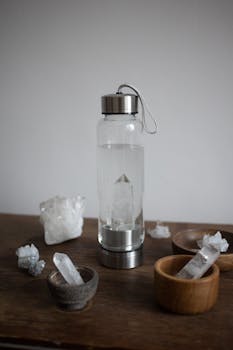
The $60 water bottle that started a trend
In 2019, a company called VitaJuwel started showing up in my Instagram feed with elegant glass water bottles containing gemstone pods at the bottom. They cost between $60 and $130. The claim: water that has been in contact with crystals absorbs their "energetic properties," making every sip a wellness ritual.
Within two years, dozens of competitors flooded Amazon with versions ranging from $15 to $80. By 2023, "crystal water bottle" was generating over 200,000 monthly searches on Google. The market is now estimated at around $25 million annually in the US alone.
I bought a $25 one on Amazon in 2022 — amethyst, because of course — and used it for three months. The water tasted like water. I'm going to explain why that's the expected result, and more importantly, why some of these bottles might actually be unsafe.
How crystal water bottles actually work (mechanically)
Most crystal water bottles have a straightforward design: a glass or stainless steel outer bottle with a removable crystal pod or cage at the bottom. The crystals sit in a separate chamber from the water — either behind a glass barrier or in a stainless steel cage with small holes. Water surrounds the crystals but doesn't directly touch them in most designs.
Some cheaper versions have the crystals loose in the bottle, sitting directly in the water you drink. This distinction matters a lot, and I'll explain why in the safety section.
The claim from manufacturers is that water "infuses" with the crystal's energy through proximity. Some reference the work of Masaru Emoto, a Japanese researcher who claimed that water exposed to positive words formed beautiful ice crystals, while water exposed to negative words formed ugly ones. His work has been thoroughly discredited — his methodology was nonexistent, his sample sizes were tiny, and no independent researcher has replicated his results. Emoto was not a scientist. He was a man with a camera and a freezer.
The actual chemistry of water and crystals
Here's the thing about water: it's a remarkably effective solvent. It dissolves more substances than any other liquid. When water comes into direct contact with minerals, it can leach trace amounts of those minerals into solution. This is real chemistry, not mysticism.
But the rate of dissolution depends on several factors: the mineral's solubility, the surface area exposed, the water's temperature, and the contact time. For most crystals used in water bottles — quartz, amethyst, rose quartz, citrine — the minerals are essentially insoluble at room temperature. Quartz (silicon dioxide) has a solubility of roughly 6-11 parts per million at 25°C. For a 500ml bottle, that's about 0.003 to 0.006 grams — well below any threshold that would affect taste, health, or anything else.
So the chemistry is real, but the effect is negligible. You'd get more mineral content from a single sip of tap water in most cities than from a week of crystal-infused water.
The safety problems nobody talks about
This is the part that actually matters. Some crystals are genuinely dangerous when placed in drinking water, and a surprising number of crystal water bottle companies sell bottles containing them.
Soluble toxic minerals
Copper-based minerals like malachite and azurite contain copper ions that dissolve readily in water. Copper toxicity is real — symptoms include nausea, vomiting, abdominal pain, and in severe cases, liver and kidney damage. The EPA's action level for copper in drinking water is 1.3 parts per million. Malachite can leach well above this level within hours.
Galena (lead sulfide) is sometimes sold as a "grounding" crystal. Lead is a neurotoxin with no safe exposure level, especially for children and pregnant women. There is no scenario where putting galena in your drinking water is a good idea.
Cinnabar (mercury sulfite) is occasionally marketed for "transformation" or "spiritual growth." Mercury poisoning is serious business — it damages the nervous system, kidneys, and digestive system. The World Health Organization lists mercury as one of the top ten chemicals of major public health concern.
Chrysocolla contains copper and can leach it into water. Pyrite (fool's gold) can oxidize and release sulfur compounds. Any crystal that contains heavy metals — lead, mercury, arsenic, cadmium — should never be placed in drinking water.
The "sealed pod" problem
Many crystal water bottles advertise that the crystals are in a "sealed pod" and don't touch the water directly. But sealed is a generous word. Most of these pods are glass chambers with a screw-on lid or a friction-fit cap. They're not vacuum-sealed. They're not rated for food safety. The rubber gaskets degrade over time, and small cracks in the glass can develop with temperature changes and regular washing.
I tested my own bottle by filling the crystal pod with water, sealing it, and leaving it inverted for 24 hours. A small but measurable amount of water escaped. That means minerals from the crystals can also escape, slowly, over time. If your crystals contain copper, lead, or other soluble toxins, they're getting into your water.
Bacterial growth
Crystal water bottles are hard to clean properly. The crystal pod, the narrow neck, the textured surface of the crystals — all of these create pockets where bacteria can grow. A 2021 study in the Journal of Environmental Health tested reusable water bottles and found that 60% contained bacteria levels above EPA drinking water standards. Crystal bottles, with their extra crevices, are likely worse.
The manufacturers recommend hand-washing with mild soap, which is reasonable advice. But hand-washing is less effective than dishwasher cleaning for bacterial removal, and most crystal bottles can't go in a dishwasher because the heat would crack the glass or damage the crystals.
The cost breakdown
Let's do some quick math on whether crystal water bottles are worth the money.
A standard insulated stainless steel water bottle (Hydro Flask, Yeti, Klean Kanteen) costs $25-40 and lasts 5-10 years with proper care. It keeps water cold for 12-24 hours. It's dishwasher safe. It's made from food-grade materials that have been tested and certified.
A crystal water bottle costs $20-130. The glass ones don't insulate at all — your cold water will be room temperature within an hour. The stainless steel ones with crystal pods cost $40-80 and provide insulation comparable to a standard bottle. The crystal pods add nothing to the bottle's function as a water container.
Over five years of daily use, a $35 Hydro Flask costs about $0.02 per use. A $70 crystal water bottle with a replacement crystal pod (many need replacement after 6-12 months due to clouding or bacterial concerns) costs about $0.06 per use. You're paying three times as much for a bottle that performs worse.
What about gem elixirs and the alternative medicine angle?
Gem elixirs — water that has had crystals soaked directly in it — have a long history in alternative medicine traditions. In homeopathy, gem preparations called "gemmotherapy" use dilute extracts of gemstones and plant buds. In Ayurvedic medicine, gem waters (called "ratna jala") have been used for centuries.
In traditional Ayurvedic practice, the process is specific and controlled. Gems are soaked in water overnight, then the water is consumed in small quantities (a few tablespoons) in the morning. Different gems are prescribed for different constitutional types, and the practice is overseen by a trained practitioner. Importantly, many traditional Ayurvedic texts explicitly warn about the toxicity of certain gems and specify which ones are safe for internal use.
Modern crystal water bottles strip away all of this context. There's no practitioner guidance, no dosage control, no consideration of individual constitution, and no screening for toxic minerals. A crystal water bottle with loose malachite stones is not "Ayurvedic" — it's a health hazard in a pretty package.
If you already own one, here's what to do
Check your crystals
If your bottle has loose crystals (not in a sealed pod), identify what they are. If they're quartz, amethyst, rose quartz, citrine, or clear calcite, they're likely safe. If they're malachite, azurite, galena, cinnabar, chrysocolla, or any stone you can't identify, take them out. A quick Google search of "[crystal name] water safety" will tell you what you need to know.
Inspect the seal
Check the pod or cage for cracks, loose gaskets, or gaps. If water can get in, dissolved minerals can get out. Replace the pod if you see any damage.
Clean it properly
Wash the bottle and crystal pod with hot soapy water after every use. Once a week, soak the pod in a vinegar solution (1 part white vinegar to 3 parts water) for 15 minutes, then rinse thoroughly. Let everything air dry completely before reassembling. Replace the bottle if you notice any persistent clouding or odor.
The honest verdict
Crystal water bottles are a mixed bag. As water bottles, most of them perform worse than a standard insulated bottle at a higher price. As wellness tools, they don't do anything that a regular water bottle and a regular meditation practice can't do better. And some of them — the ones containing toxic minerals — are actively dangerous.
The one thing crystal water bottles do well is aesthetics. They look nice on a desk. They make you want to drink more water, which is genuinely good for you. If that's why you use one, fine — but know that you're paying for decoration, not function, and make sure the decoration isn't poisoning you.
If you want the look without the risk, buy a nice glass bottle and keep a crystal on your desk next to it. You get the aesthetic, you get the hydration reminder, and you keep your water clean. Everyone wins.
Comments