Crystal grids and sacred geometry: the math behind the mysticism
Why I got interested in this
Last year I spent a weekend arranging 36 small quartz points on my living room floor in a pattern called the "Flower of Life." It took two hours. It looked beautiful. Did it change my life? No. Did I learn something interesting about geometry? Yes, actually.
Crystal grids sit at the intersection of genuine mathematical beauty and a lot of overblown claims. The geometry is real. The patterns are genuinely fascinating. Some of the historical connections to mathematics and architecture are well-documented. But the idea that arranging stones in a hexagonal pattern "amplifies their vibrational energy by 400%" — that part is made up.
I want to separate the interesting math from the marketing, because the math is cool enough on its own.
The basic idea of a crystal grid
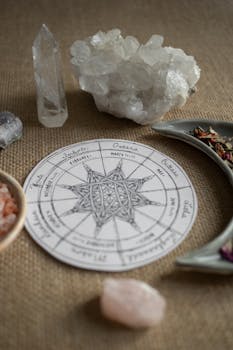
A crystal grid is a specific arrangement of stones on a flat surface, usually following a geometric pattern. The central stone (called the "focus stone") is surrounded by smaller stones placed along lines or at intersections of a geometric shape. Common patterns include the Flower of Life, Metatron's Cube, and various spiral formations.
Practitioners set an intention — a goal, a feeling, a focus — and believe the grid "holds" that intention and amplifies it. The exact mechanism varies depending on who you ask: some talk about sacred geometry creating energy fields, others reference quantum entanglement, and some just say the visual pattern helps them focus their thoughts.
Grids range from simple (5-6 stones in a circle) to elaborate (100+ stones in complex geometric formations). A basic starter grid costs maybe $30-50 for the stones. Elaborate setups with rare minerals can run into thousands.
Sacred geometry: the parts that are actually sacred
Let's talk about the geometry first, because this is where things get genuinely interesting.
The "sacred geometry" movement draws heavily from a small set of geometric patterns that appear in nature, art, and architecture across many cultures and time periods. The most important ones:
The golden ratio (phi)
Phi (approximately 1.618) is a number that appears when you divide a line into two parts so that the ratio of the whole line to the longer part equals the ratio of the longer part to the shorter part. This ratio shows up in the spiral of nautilus shells, the branching of trees, the proportions of the human face, and the arrangement of seeds in a sunflower head.
The Parthenon in Athens, built around 447 BC, uses proportions closely related to phi. Leonardo da Vinci explicitly used golden ratio proportions in the Vitruvian Man (around 1490). Le Corbusier based his entire Modulor architectural system on phi and the human body in 1948.
These aren't mystical coincidences. Phi emerges naturally from the Fibonacci sequence (1, 1, 2, 3, 5, 8, 13, 21...), where each number is the sum of the two before it. The ratio between consecutive Fibonacci numbers converges on phi as the numbers get larger. It's a fundamental property of how growth patterns work in biological systems — not because nature is "trying" to be sacred, but because it's mathematically efficient.
The Flower of Life
This pattern — overlapping circles arranged in a hexagonal lattice — is probably the most popular crystal grid design. It dates back to at least 645 BC, where it appears in the Temple of Osiris at Abydos, Egypt. You can also find it in medieval European manuscripts, Indian temple carvings, and Chinese art.
The math: start with one circle. Add six circles of the same radius, each centered on the perimeter of the first. Then add more circles at every new intersection point. The result is a hexagonal pattern with six-fold symmetry — the same symmetry found in snowflakes, honeycombs, and basalt columns at the Giant's Causeway in Northern Ireland.
From a mathematical perspective, this pattern is efficient. Hexagonal packing covers the maximum area with the minimum perimeter — bees figured this out millions of years before mathematicians proved it. The pattern also creates a visual rhythm that humans find aesthetically pleasing, possibly because our visual cortex is particularly good at processing symmetrical, repeating patterns.
Metatron's Cube
This one is more complex. It starts with 13 circles (one central, twelve surrounding it), then connects every center point to every other center point with straight lines. The result contains all five Platonic solids — the tetrahedron, cube, octahedron, dodecahedron, and icosahedron — within a single two-dimensional diagram.
The Platonic solids are genuinely special in mathematics. They're the only five convex regular polyhedra (shapes where every face is identical, every edge is the same length, and every vertex has the same number of edges meeting). Euclid proved there are exactly five, and no more, around 300 BC. Plato associated each one with an element: fire, earth, air, water, and the cosmos. Kepler tried to use them to explain planetary orbits in 1596 (he was wrong, but it was a beautiful wrong).
So Metatron's Cube is not nonsense. It's a real geometric construction with genuine mathematical depth. The part that's nonsense is the claim that it has mystical powers.
Where the claims go off the rails
Here are some specific claims I've seen on crystal grid websites, with honest assessments:
Claim: "The Flower of Life pattern creates a toroidal energy field that amplifies crystal vibrations."
Reality: No one has ever measured a "toroidal energy field" around a crystal grid. The word "toroidal" describes a donut-shaped magnetic field (like the Earth's). Crystal grids don't generate magnetic fields. Stones sitting on a piece of paper or wood don't produce any detectable electromagnetic radiation above background levels.
Claim: "Hexagonal crystal grid patterns resonate at 528 Hz, the frequency of DNA repair."
Reality: This is a mashup of two separate things. 528 Hz is a frequency in the Solfeggio frequency system, which has no scientific basis. DNA repair happens through enzymatic processes, not sound frequencies. A 2018 review in PLOS ONE examined studies on "DNA repair frequencies" and found that none met basic methodological standards. The 528 Hz claim comes from a book by Dr. Leonard Horowitz that has been widely criticized by geneticists.
Claim: "Crystal grids work through quantum entanglement — the stones become entangled with your intention."
Reality: Quantum entanglement is a real phenomenon where two particles become correlated so that measuring one instantly affects the other, regardless of distance. It has been demonstrated in laboratories using photons, electrons, and even small molecules. But it requires extremely controlled conditions — near absolute zero temperatures, isolated systems, and carefully prepared quantum states. A room-temperature crystal sitting on a shelf is not entangled with anything in any meaningful sense. Physicist Sean Carroll has called this kind of claim "quantum mysticism" and noted that it "uses the vocabulary of physics without any of the physics."
The cultural appropriation problem
This deserves its own section because it matters. Many crystal grid practices and "sacred geometry" frameworks borrow heavily from specific cultural traditions without acknowledgment.
The Flower of Life pattern has deep significance in Egyptian, Hindu, Buddhist, and Celtic traditions. Metatron's Cube comes from Jewish Kabbalistic texts. The use of crystal grids with specific intentions borrows from various Indigenous practices around the world, including Native American, Aboriginal Australian, and African traditions.
When a white wellness influencer on Instagram arranges crystals in a pattern taken from a Kabbalistic text and claims it "manifests abundance," that's cultural extraction, not cultural appreciation. The tradition has been stripped of its religious and cultural context and repackaged as a consumer product.
You can appreciate the geometry and enjoy making patterns without doing this. Credit where patterns come from. Understand the context. And recognize that "sacred" means something different to the cultures that originated these designs than it does to someone selling $200 crystal grid kits on Etsy.
Why people keep making grids despite the lack of evidence
Having criticized the claims, I want to acknowledge why the practice persists, because it's not just gullibility.
First, the process of creating a grid is genuinely meditative. Selecting stones, arranging them precisely, focusing on an intention while you work — this is a structured mindfulness exercise. A 2017 study in Mindfulness found that structured creative activities (like arranging objects, drawing, or crafting) reduced anxiety by 37% more than unstructured relaxation. The grid gives your hands something to do while your mind focuses.
Second, the visual result is satisfying. Humans have an aesthetic preference for symmetry and geometric patterns — it's called the "aesthetic-is-affect" hypothesis in evolutionary psychology. Seeing a well-made grid triggers a small dopamine response, the same way looking at a well-organized bookshelf or a mandala does.
Third, the grid becomes a physical reminder of your intention. If you set up a grid focused on "patience" and keep it on your desk, you'll see it dozens of times a day. Each glance is a micro-moment of remembering what you're working toward. That's not magic — that's environmental design, and it works.
A practical guide for people who like the geometry but want to skip the pseudoscience
Start with the math, not the mysticism
Learn about why hexagonal patterns are efficient. Read about the Platonic solids. Look at Islamic geometric art, which achieves staggering complexity using only a compass and straightedge. The geometry is genuinely beautiful, and understanding it makes the grids more interesting, not less.
Think of it as a creative practice
Call it what it is: a meditative arrangement exercise. You're creating a temporary geometric composition using natural materials. That's closer to ikebana (Japanese flower arranging) or sand mandala creation than to anything supernatural. Those traditions don't need quantum mechanics to justify their value.
Use materials you can afford
Crystal grid culture has a consumerism problem. You don't need $40 tumbled stones from a trendy shop to make a meaningful pattern. River rocks work. Seaglass works. Colored paper cut into geometric shapes works. The geometry is the point, not the mineral composition.
The honest summary
Crystal grids are built on patterns that have genuine mathematical significance. The Flower of Life, Metatron's Cube, and the golden ratio are real, well-studied, and genuinely fascinating. The process of arranging objects in geometric patterns has real psychological benefits — it's meditative, satisfying, and can serve as a focus tool.
What's not real is the energy amplification, the quantum entanglement, the DNA repair frequencies, and the manifestation claims. The geometry does not generate fields, create vibrations, or connect to cosmic consciousness. It's pretty shapes made of pretty rocks, and that's enough.

Comments