The Setup
The Setup
I've been meditating on and off for about eight years. Nothing fancy — ten to twenty minutes a day when I can manage it, usually first thing in the morning before the house wakes up. I started with a basic breath-focus technique and eventually settled into a mix of body scan and open monitoring that works for me. My practice isn't consistent. I skip days, sometimes weeks. But I keep coming back to it because it genuinely helps me manage anxiety and sleep better.
Last year, a friend who's deep into crystal traditions suggested I try meditating with crystals. She gave me a piece of amethyst, told me to hold it in my hands while I meditated, and said I'd notice a difference. I was skeptical. I'd read enough about the placebo effect to know that expectations shape experience. But I was curious enough to try it, and I figured a controlled personal experiment wouldn't hurt.
So I did something that I realize isn't scientifically rigorous, but was good enough for my purposes. I meditated for four weeks with a crystal, then four weeks without one, then four weeks with again. Same time each morning. Same duration. Same technique. The only variable was whether I was holding a crystal or not. I kept notes on how each session felt — not on any mystical level, just basic stuff: how quickly I settled in, how distracted I got, how I felt afterward.
Here's what happened, and what I think it means.
Weeks 1-4: Meditating With Crystals
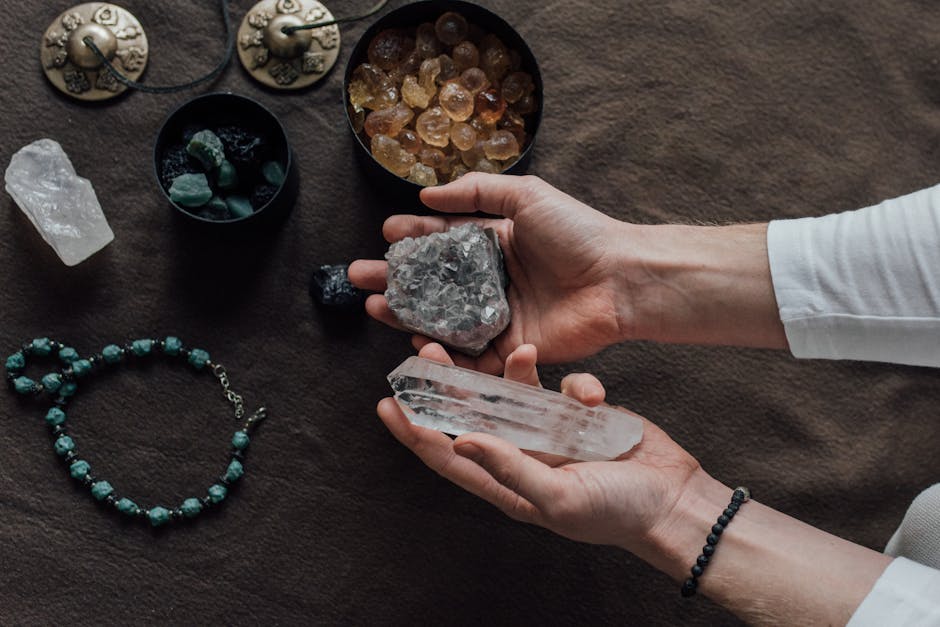
I used the amethyst my friend gave me — a tumbled stone, about the size of a golf ball, smooth and cool to the touch. I held it in both hands, resting them on my lap, palms up. The first few sessions felt normal. I closed my eyes, focused on my breath, and did the same thing I always do. The crystal sat in my hands and didn't do much of anything.
But by the end of the first week, I started noticing something. Not a dramatic shift, but a subtle change in how quickly I settled into the meditation. Normally, it takes me three to five minutes to stop thinking about my to-do list and actually focus on my breath. With the crystal, I seemed to drop into it faster — maybe two minutes instead of five. The sensation of holding something smooth and cool gave my hands something to do, which paradoxically seemed to help me stop fidgeting.
I know that sounds like nothing. But in meditation, the first few minutes are the hardest part. Your mind is racing, your body wants to move, and every small sensation is a potential distraction. Having a physical object to anchor my hands — something with a specific texture, weight, and temperature — gave me one fewer thing to think about.
By week three, I'd developed a small ritual around the crystal. I'd pick it up, feel its weight in my palm, notice the coolness of the stone, and use that brief sensory check-in as a transition from "regular brain" to "meditation brain." It was like a physical cue that said "okay, we're doing this now." The meditation itself didn't feel dramatically different. But the transition into it was smoother.
Week four was the best week. I looked forward to sitting down with the crystal. It had become a small, pleasant ritual — something I associated with calm and quiet. I wouldn't say my meditation was deeper or more profound. But it was easier to start, and I was more consistent. I missed fewer sessions during the crystal weeks than I typically do.
Weeks 5-8: Meditating Without Crystals
I put the amethyst in a drawer and went back to meditating empty-handed. The first session felt off. Not bad, just... different. My hands felt restless. They wanted something to hold. I caught myself pressing my fingertips together, making fists, shifting my palms on my legs. Small movements I'd never noticed before.
Without the physical anchor of the crystal, it took me longer to settle in. Not dramatically longer — maybe an extra minute or two — but noticeably longer. My mind wandered more in the first few minutes. I was more aware of minor discomforts: an itch on my nose, the temperature of the room, the sound of the neighbor's car starting.
By the middle of week five, the restlessness faded. My hands settled. My focus returned to roughly where it had been before the crystal experiment. The meditation itself was fine — same quality, same duration, same basic experience. But the start-up phase was rougher. It felt like I'd lost a small tool that I hadn't fully appreciated until it was gone.
Weeks six, seven, and eight were unremarkable. I meditated normally. My practice was fine. I didn't miss the crystal during the actual meditation — once I was in the zone, the presence or absence of a stone in my hands made no difference. The difference was only in those first few minutes of transition.
One thing I did notice: I skipped more sessions during the no-crystal weeks. Not a lot — maybe two extra missed sessions over four weeks — but enough that I noticed the pattern. The crystal had somehow made the practice more appealing, or at least more consistent.
Weeks 9-12: Back With Crystals
I started holding the amethyst again in week nine. The difference was immediate. From the very first session, I settled in faster. My hands knew what to do. The cool weight of the stone was familiar and reassuring. It felt like putting on a comfortable sweater — not transformative, just... right.
The pattern from weeks 1-4 repeated. Smooth transitions, consistent practice, and a small but real sense that the meditation was easier to begin. Not better during, just easier to start. I also tried a different crystal in week eleven — a piece of rose quartz — and noticed the same effect. The specific stone didn't seem to matter. Having something in my hands did.
By week twelve, I was convinced that the crystal was helping my practice. Not in a mystical sense — I don't believe the amethyst was doing anything supernatural. But as a physical focusing tool, it worked. It gave my hands a job, my mind a transition cue, and my routine a small ritual element that made it more appealing to show up every morning.
What I Think Is Actually Happening
After thinking about this for a while, I believe the benefits I experienced came from three things, none of which require any supernatural explanation.
First, tactile anchoring. Holding a smooth, cool object gives your hands something to perceive, which occupies the part of your brain that would otherwise be scanning for distractions. It's the same principle behind prayer beads, worry stones, and fidget tools. Your hands are busy, so your mind has one fewer input channel to process. This is a well-documented phenomenon in psychology — giving people a physical object to manipulate reduces cognitive load and improves focus.
Second, ritual and habit formation. The act of picking up the crystal became a conditioned stimulus that signaled "meditation time." This is classical conditioning — the same mechanism behind Pavlov's dogs. By consistently pairing the crystal with meditation, I trained my brain to shift into a meditative state more quickly when I picked it up. You could get the same effect with any consistent pre-meditation ritual: lighting a candle, ringing a bell, putting on a specific piece of clothing. The crystal just happens to be a convenient, portable ritual object.
Third, expectation and placebo. I went into the experiment curious but skeptical. Still, I'd heard from multiple people that meditating with crystals improved their experience. That expectation, even if I tried to discount it, probably influenced my perception. This doesn't mean the experience was fake — placebo effects are real effects, with measurable changes in brain activity and subjective experience. But it does mean I should be honest about the fact that my beliefs may have shaped my results.
What Other People Report
I'm not the only person who's tried this. A quick search through meditation forums and crystal communities turns up hundreds of similar accounts. Most people who meditate with crystals report one or more of the following: faster settling-in, deeper focus, more consistent practice, and a greater sense of calm or presence during the session.
Critics point out that these reports are entirely subjective, uncontrolled, and impossible to separate from expectation effects. They're right. There are no large-scale, peer-reviewed studies on meditation with crystals versus without. The existing research on meditation itself is robust, but adding crystals to the equation hasn't attracted serious scientific attention.
There is, however, research on the general principle of using physical objects as meditation aids. Studies on the use of prayer beads in various religious traditions, for example, show that tactile focus objects can reduce anxiety and improve sustained attention during contemplative practices. Mala beads in Buddhism, the rosary in Catholicism, the misbaha in Islam — all of these serve the same basic function. A crystal during meditation is, in this sense, just another bead.
Practical Advice If You Want to Try It
If you're curious and want to try meditating with a crystal, here's what I'd suggest based on my experience.
Pick a stone you like the feel of. The specific mineral doesn't matter as much as the tactile experience. Smooth, cool, and heavy works well. Tumbled stones are ideal because they have no sharp edges. The stone should be large enough to hold comfortably in both hands but not so large that it's awkward — roughly golf-ball sized is perfect.
Hold it in both hands, palms up, resting on your lap. Focus briefly on the sensation — the weight, the temperature, the texture — and then let that sensory input fade into the background as you begin your regular meditation technique. Don't try to "focus on the crystal" as a meditation object unless that's specifically what you want to do. Just let it be there.
Try it for at least two weeks before deciding whether it helps. The first session might feel weird or distracting. Give your brain time to associate the crystal with the practice. If after two weeks you notice no difference — in how quickly you settle in, how consistent you are, or how you feel afterward — then it's probably not adding anything for you. That's fine. Not every tool works for every person.
Don't overspend. A tumbled stone from a local shop or a reputable online dealer costs five to fifteen dollars. You don't need a rare specimen, a perfect point, or a specific origin. The crystal is a focus tool, not an investment.
The Bottom Line
Does meditating with crystals actually make a difference? In my experience, yes — a small but real one. It didn't make me a better meditator or unlock some hidden depth to my practice. But it made the practice easier to start and more consistent to maintain. That's valuable, even if the mechanism is entirely psychological.
If you're already a regular meditator and your practice is solid, adding a crystal probably won't change much. You've already built the habits and transitions that the crystal helps with. But if you're struggling with consistency — if you find yourself skipping sessions, fidgeting through the ones you do, or having trouble transitioning from "regular life" to "meditation mode" — a crystal might help. Not because of any magical property, but because it gives your hands something to do and your brain a reliable cue.
And if you try it and it doesn't work for you? You're out ten dollars and you have a pretty rock for your desk. Not the worst outcome.
Comments