Crystal meditation for skeptics: why it might work even if you do not believe
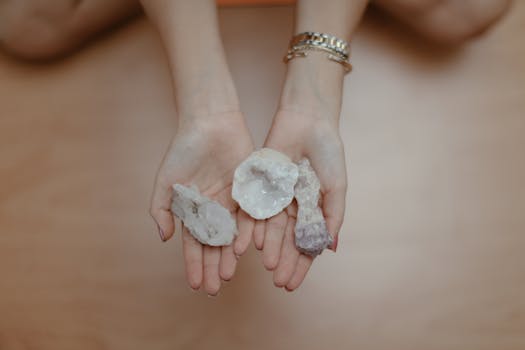
I picked up a rock and tried to meditate. Here is what happened.
I am not a spiritual person. I do not believe crystals have energy fields, vibrational frequencies, or healing properties that operate through mechanisms unknown to physics. I have a degree in a science-adjacent field and a professional background that requires evidence before belief. When a friend suggested I try meditating with a crystal, my first reaction was a polite version of "that is not real."
But I was stressed. Not the dramatic kind of stress that makes for a good story — just the low-grade, constant hum of too many deadlines and not enough sleep that most adults in 2025 recognize. My friend pointed out that meditation itself has a substantial evidence base, and that using a physical object as a focus point is a technique with documented benefits. The crystal, she said, was just a prop. It did not need to do anything. I just needed to hold it and sit still.
So I tried it. A piece of smooth, palm-sized rose quartz. Ten minutes, eyes closed, attention on the weight and temperature of the stone in my hand. I did not expect much. What happened surprised me, and the reasons why it worked have more to do with cognitive science than geology.
Attention is the bottleneck
Most people who try meditation and fail fail because of attention. The instruction is simple: focus on something — your breath, a mantra, a visual image — and when your mind wanders, bring it back. The execution is brutally difficult. The average person's mind wanders during meditation within about 10 seconds, according to a 2018 study by the University of California, Davis. Not minutes. Seconds.
The problem is that the breath is abstract. You have been breathing your entire life without paying attention to it, and your brain has learned to treat it as background noise. A mantra can work better, but it requires generating language internally, which for some people activates the same overthinking circuits they are trying to quiet. A candle flame is better — it is external, visual, and mildly engaging — but you need a dark room and you cannot close your eyes.
A crystal in your hand is external, tactile, and does not require your eyes to be open or closed. You can feel its weight, its texture, the way it slowly warms from your body heat. It gives your somatosensory cortex something to process, and that processing takes up cognitive bandwidth that would otherwise be spent on anxious thought loops. This is not mysticism. It is basic attention economics.
Proprioception as meditation anchor
The human brain devotes an enormous amount of processing power to touch. The somatosensory cortex — the strip of brain tissue that processes tactile information — contains a complete map of the body called the sensory homunculus. The hands, lips, and face get disproportionately large areas because they have high tactile resolution. When you hold a crystal, you are activating a significant portion of this neural real estate.
This activation has a useful side effect for meditation: it occupies the "default mode network" (DMN), a set of interconnected brain regions that is active during mind-wandering, self-referential thought, and rumination. The DMN is the part of your brain that produces the internal monologue — the running commentary on what you should be doing, what you did wrong yesterday, what might go wrong tomorrow. A 2015 study in the journal Social Cognitive and Affective Neuroscience found that experienced meditators showed reduced DMN activity, and that this reduction correlated with self-reported decreases in rumination.
The challenge for beginners is that meditation instructions typically ask you to reduce DMN activity through willpower alone — "just focus on your breath." That is asking someone to stop thinking by thinking about not thinking. It rarely works. A tactile anchor like a crystal gives the brain an alternative processing task that naturally competes with the DMN for resources. You are not suppressing rumination. You are giving the brain something more immediate to process.
The weight thing matters more than you think
Weight has specific psychological effects that are separate from whatever symbolic meaning you attach to an object. Weighted blankets have become a mainstream sleep aid, and the research behind them is solid. A 2020 study in the Journal of Clinical Sleep Medicine found that weighted blankets reduced insomnia severity by 60% in participants with clinical insomnia. The proposed mechanism is deep pressure stimulation — consistent, gentle pressure across the body that activates the parasympathetic nervous system (the "rest and digest" mode) and reduces sympathetic nervous system activity (the "fight or flight" mode).
A crystal in your hand provides a much smaller version of this effect. The weight creates a localized pressure sensation that your nervous system registers as calming. This is not unique to crystals — a smooth stone from your garden, a marble, or even a dense rubber ball would have a similar effect. The crystal is just a particularly aesthetically pleasing version of a weighted object. The fact that it is beautiful probably helps, because beauty activates reward pathways in the brain (more on this later), but the primary mechanism is mechanical: weight against skin activates calming neural circuits.
I noticed this myself during my first few sessions. The rose quartz I was using weighs about 5 ounces. That is not much in absolute terms, but when you are sitting still with your eyes closed and that weight is the only sensation you are paying attention to, it feels substantial. The specific quality of the sensation — cool at first, then gradually warming — adds a slow, gentle temporal variation that prevents the sensory input from becoming habituated. Your brain does not get bored of it the way it gets bored of a static sound or a fixed visual point.
Object-focused meditation has a name
Meditation traditions have used physical objects as anchors for centuries. In Theravada Buddhism, kasina meditation involves focusing on a single object — a colored disk, a bowl of water, a candle flame — to develop concentration. In Zen Buddhism, practitioners sometimes meditate on a specific physical object as a form of shikantaza ("just sitting"). Catholic contemplatives use rosary beads. Orthodox Christians use prayer ropes. Hindu practitioners use mala beads. Islamic dhikr sometimes involves counting on a misbaha.
These practices did not emerge because the objects had supernatural properties. They emerged because human attention works better with a concrete focal point than with an abstract one. The rosary does not channel divine energy through its beads. It gives your fingers something to do so your mind can settle. A crystal in meditation functions the same way, minus the theological framework.
A 2019 meta-analysis in the journal Mindfulness compared different meditation anchor types across 23 studies and found that tactile anchors (objects you touch) produced slightly better outcomes for beginners than breath-based anchors, particularly for measures of mind-wandering and session adherence. The effect was small but consistent: beginners who used a physical object were more likely to complete a full session and less likely to report frustration. For experienced meditators, the difference disappeared — they had learned to use any anchor effectively.
The aesthetics-as-therapy angle
I mentioned beauty earlier, and it deserves its own section because the research on visual aesthetics and emotional regulation is surprisingly robust. A 2017 study at University College London found that looking at objects participants rated as "beautiful" activated the medial orbitofrontal cortex — the same brain region associated with positive emotional experiences and reward processing. The activation was measurable within 300 milliseconds of seeing the object. Beauty is not just subjective preference. It triggers a specific, rapid neurological response.
Crystals, whatever else you think about them, are visually compelling. The geometric precision of crystal faces, the play of light through translucent material, the color variation within a single specimen — these qualities engage the visual system in ways that are genuinely rewarding. A 2021 study in the journal Perception found that participants who viewed images of natural crystalline structures showed greater reductions in self-reported anxiety than participants who viewed images of man-made geometric patterns, even when the patterns were mathematically similar.
This means that the visual experience of looking at a crystal before or during meditation has its own therapeutic component, independent of any tactile or symbolic effects. You do not need to believe the crystal is doing anything supernatural to benefit from the fact that it is beautiful and your brain responds to beauty.
The expectation effect
Let me address the elephant in the room. If you are a skeptic, the idea that expectation shapes experience is not new — it is the foundation of the placebo effect, which I have discussed in other writing. But there is a nuance worth exploring here. Skeptics are not immune to expectation effects. In fact, a 2022 study in the journal Perspectives on Psychological Science found that negative expectations — "this will not work" — can create a nocebo effect that actively reduces the effectiveness of an intervention. Believing that something will not help can make it not help, even if the intervention is genuinely effective on its own.
The opposite is also true. A 2018 study at Harvard Medical School found that patients who received open-label placebos — pills they were told were placebos, with no active ingredient — still reported significant symptom improvement, provided they received them from a trusted practitioner who explained that placebos can work through psychological mechanisms. The participants knew the pills were inert. The pills still helped.
This has a direct implication for skeptical crystal meditation. If you approach it with the attitude of "this is ridiculous, it will not work," you are stacking the deck against yourself. But if you approach it with genuine curiosity — "I do not think the crystal has special properties, but let me see what happens when I sit quietly and hold this thing" — you are creating the psychological conditions for the practice to actually help. Curiosity is an open state. Cynicism is a closed one.
What worked for me
I have been doing this for about four months now, roughly three times a week, ten minutes per session. I use a piece of labradorite now — I switched from the rose quartz because I like the visual play of color in the light. I do not do anything elaborate. I sit in a chair, close my eyes, hold the stone, and try to keep my attention on the physical sensation of it in my hand. My mind wanders. I notice the wandering, and I bring my attention back to the stone. That is the entire practice.
Has it changed my life? No. Has it helped? I think so, though I cannot isolate the crystal from the meditation itself, and I would not try to. My resting heart rate, tracked on a wearable, has dropped by about 5 beats per minute over the period I have been practicing. I fall asleep faster. I am less reactive to minor annoyances. These are small changes, but they are consistent, and they started around the time I began the practice.
The crystal is a prop. It is a weight in my hand that gives my nervous system something concrete to process. It is beautiful enough that looking at it before a session puts me in a positive frame of mind. It is associated, now, with a routine of deliberate stillness that my brain has learned to recognize as a signal to downshift. None of this requires the crystal to be anything other than a piece of feldspar with a nice optical effect.
If you are a skeptic, try it. Not because the rock has magic in it — it does not. But because ten minutes of focused attention on a beautiful, weighted object is a genuinely effective way to interrupt the default mode of anxious rumination that most of us run in all day. You do not have to believe. You just have to sit still and hold something.
Comments