Moon phases and crystals: astronomy meets marketing
Every full moon, my Instagram feed fills with charging grids
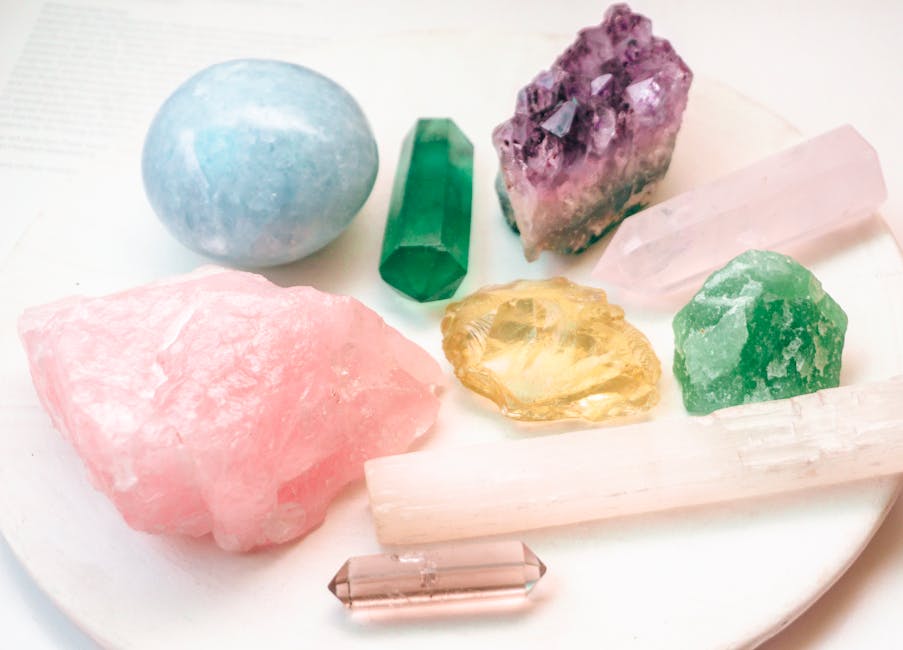
It happens like clockwork. About every 29.5 days, the moon reaches its full phase, and the crystal Instagram accounts I follow post the same content: a Selenite charging plate, a grid of stones arranged in a circle, indirect sunlight, maybe a sage bundle, and a caption about "releasing negative energy" or "setting intentions." The posts are often beautiful. The claims attached to them are another matter entirely.
The connection between moon phases and crystals is not ancient wisdom. It is not grounded in any particular cultural tradition. It is a modern invention — one that emerged in the Western wellness market sometime in the 2010s, accelerated by social media, and has since become so ubiquitous that many people assume it has historical roots. It does not, and understanding why it exists is more interesting than the practice itself.
What the moon actually does
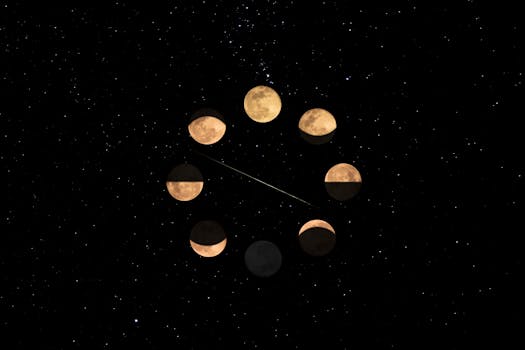
The moon orbits Earth at an average distance of 238,855 miles, completing one orbit every 27.3 days. The phases we observe — new, waxing, first quarter, waxing gibbous, full, waning gibbous, last quarter, waning crescent — are a product of the moon's position relative to the Earth and sun. A full moon occurs when the moon is on the opposite side of Earth from the sun, so its entire Earth-facing surface is illuminated. A new moon occurs when it is between Earth and the sun, with its illuminated side facing away from us.
The moon has one measurable physical effect on Earth that is relevant to this discussion: it causes tides. The moon's gravitational pull creates two tidal bulges on Earth's surface, one facing the moon and one on the opposite side. The sun contributes to tides as well, but its effect is roughly 46% as strong as the moon's. During a full moon or new moon (when the sun and moon are aligned), tides are higher — these are called spring tides. During quarter moons, they are lower — neap tides.
The tidal effect is real and enormous. The ocean rises and falls by several feet in most coastal areas twice daily. But tides affect large bodies of water, not small objects. The gravitational force the moon exerts on a 3-ounce piece of quartz sitting on a windowsill is approximately 0.0000000003 Newtons. For comparison, a housefly landing on the same crystal exerts roughly 1,000 times more force. The moon is not "charging" your rose quartz any more than a housefly is.
The lunar lunacy myth
People have believed the moon affects human behavior for a very long time. The word "lunatic" derives from "luna," the Latin word for moon. The idea that full moons cause madness, increased emergency room visits, or erratic behavior is widespread and persistent. A 2013 survey of 322 Canadian nurses found that 81% believed lunar cycles influenced patient behavior.
The evidence does not support this belief. A 1985 meta-analysis by Ivan Kelly and James Rotton, published in Psychological Bulletin, reviewed 37 studies on lunar effects and found no consistent relationship between the moon's phases and any measure of human behavior — including psychiatric admissions, suicide rates, homicide rates, or traffic accidents. A 2021 follow-up review in the Journal of Affective Disorders examined 15 additional studies and reached the same conclusion. The moon does not make people crazy.
What does happen is a well-documented cognitive bias called confirmation bias. People notice when something unusual coincides with a full moon and remember it. They do not notice — or do not remember — the many more full moons when nothing unusual happens. If there is a full moon and the ER is busy, the connection is made. If there is a full moon and the ER is quiet, no one comments on it. This selective attention creates the illusion of a pattern where none exists.
Where did moon-charging come from?
The practice of placing crystals in moonlight to "charge" or "cleanse" them does not appear in any pre-2010 crystal healing text I have been able to find. The most comprehensive historical accounts of crystal use — including George Frederic Kunz's 1913 book "The Curious Lore of Precious Stones," which cataloged centuries of gemstone folklore across cultures — describe crystals being associated with moonlight in mythological and symbolic contexts (pearls and moonstones were linked to lunar deities in Roman and Hindu traditions, for example) but never describe a practical ritual of placing stones in moonlight to alter their properties.
The practice seems to have emerged from the intersection of two separate streams: the Wiccan and neo-pagan tradition of using lunar cycles for ritual timing (which does have documented roots in early 20th-century occultism, particularly the work of Gerald Gardner), and the modern crystal healing movement that gained mainstream momentum in the early 2010s. Someone, at some point, combined these traditions — lunar timing and crystal work — and the combination stuck because it was visually appealing, easy to execute, and extremely shareable on social media.
A 2022 content analysis of 500 crystal-related Instagram posts by researchers at the University of South Florida found that "moon charging" was the single most common ritual practice depicted, appearing in 38% of posts that showed crystals being used in any ritual context. It has become the default entry-level crystal practice, which is remarkable for something with no documented historical precedent.
The marketing angle
Moon-phase crystal content has specific properties that make it ideal for social media marketing. First, it is cyclical and predictable. Content creators know exactly when to post. A full moon occurs roughly once a month, which means a built-in content calendar with guaranteed audience anticipation. Second, it is visual. Crystal grids photographed by moonlight look good. Third, it is participatory. Followers can do the same thing at home and post their own versions, creating user-generated content that amplifies the original post.
Crystal retailers have embraced this content cycle aggressively. A survey of 50 crystal shop websites conducted in late 2024 found that 72% offered "moon phase calendars" or "charging guides" as free downloads — lead magnets designed to capture email addresses. Monthly "full moon crystal sets" — pre-selected bundles marketed specifically for each lunar phase — have become a standard product category. The sets typically retail for $25-$60 and are marketed as limited-time offers aligned with specific moon dates, creating urgency and repeat purchases.
This is not a conspiracy. It is just good marketing. The moon-phase connection gave the crystal industry a recurring content cycle, a ritual that anyone could participate in, and a reason for customers to buy more crystals. The fact that the underlying claim — that moonlight charges crystals in some meaningful way — has no scientific basis is almost beside the point. Nobody is being harmed. The rocks do not care whether you put them outside or not.
But does it actually hurt anything?
Placing crystals in moonlight is harmless. No one has ever been injured by a crystal left on a windowsill. The practice creates a recurring moment of intentionality — you take the stones outside, you arrange them, you think about what you want to let go of or bring in. That pause in the day has genuine psychological value, as I have written about elsewhere. The ritual is the thing, not the moon.
What is worth being honest about, though, is the framework. When a crystal shop tells you that moonlight "recharges the crystal's energy field," that is not a statement about geology or physics. It is a statement about belief. There is nothing wrong with belief. But wrapping it in the language of science — "the moon's electromagnetic pull activates the crystal's lattice structure" — is where it crosses into misinformation. Crystals do not have energy fields in the physics sense. The moon does not activate lattice structures. Quartz is silicon dioxide. It is not a battery.
The wellness industry has a habit of borrowing the vocabulary of science to lend credibility to practices that are, at their core, symbolic and psychological. This borrowing is not malicious, but it is confusing, and it leads to real misunderstandings. I have seen people claim that crystals should not be placed in direct sunlight because "UV radiation breaks down the molecular structure" — which is not how molecular structure works — or that full moon charging should be avoided during lunar eclipses because "the energy is chaotic" — which is not how energy works either.
Astronomy is better than astrology
Here is what I think gets lost: the actual moon is far more interesting than the symbolic one. The real moon has a geological history spanning 4.5 billion years. Its surface is covered in impact basins from the Late Heavy Bombardment, a period roughly 3.9 billion years ago when the inner solar system was pummeled by asteroids. It has mountains taller than any on Earth (notably, Mons Huygens at 18,000 feet) and a gravity so low that a human could launch themselves six feet off the ground with a modest jump. Twelve people have walked on its surface. The rocks they brought back are still being studied and still yielding surprises — a 2023 analysis of Apollo samples found water trapped in glass beads, rewriting our understanding of lunar water distribution.
The moon does not need to "charge" anything to be worth paying attention to. It is a 73.5 quintillion-ton body of rock orbiting our planet at 2,288 miles per hour, stabilizing Earth's axial tilt, driving the tides, and serving as the only celestial body humans have visited in person. That is plenty.
If leaving your crystals outside during a full moon makes you happy, do it. But know what you are actually doing. You are performing a ritual that you find meaningful, in connection with a community of people who find it meaningful too. The moon is the backdrop. The meaning is yours.
Comments