King of Cups Tarot Card: Complete Meaning Guide
May 17, 2026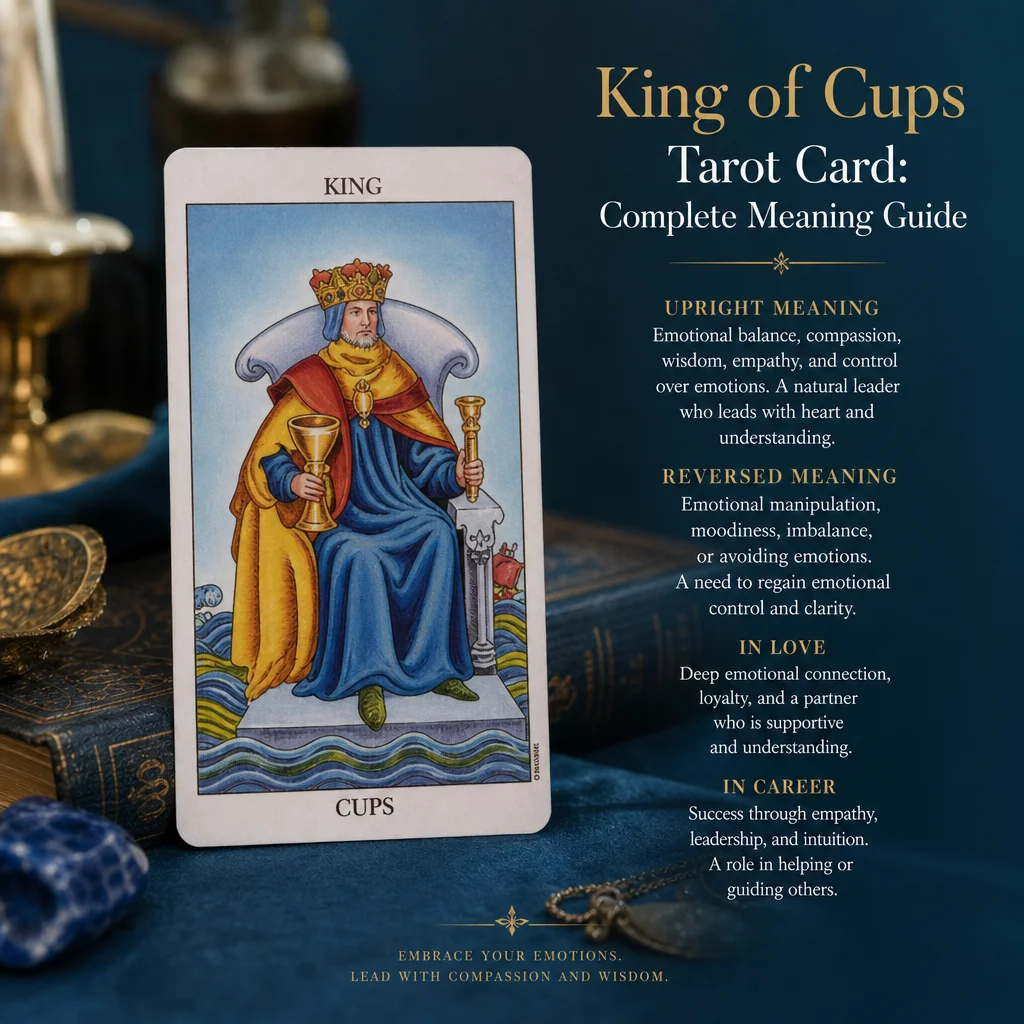
I Pulled the King of Cups and It Made Me Uncomfortable
Here's the thing about the King of Cups: nobody wants to see him show up in a reading. Not really. The Tower? Fine, at least that's dramatic. The Three of Swords? Heartbreak, sure, but it's straightforward. The King of Cups though? He asks you to sit with your feelings without drowning in them, and honestly, most of us would rather just get stabbed by the sword again.
I've been reading tarot for years, and I've watched people's faces when this card lands in their spread. There's this flicker — not of fear exactly, but of resistance. Especially from men. The King of Cups is the card most men are terrified of pulling, and I don't think that's an accident. He represents the one thing our culture has spent centuries telling men they shouldn't master: their own emotional interior.
But here's what I've learned: emotional mastery is the hardest kind of power. Not because feelings are weak — because they're relentless. You can outrun a lot of things in life. You can't outrun yourself. And the King of Cups knows that better than anyone at the table.
If you've pulled this card and you're trying to figure out what it's trying to tell you, let's break it down. I'll walk you through what I've seen in hundreds of readings, what the traditional symbolism actually means (and where I think it falls short), and why this particular royal might be the most important card in the entire deck for the world we're living in right now.
What the King of Cups Actually Looks Like
In the Rider-Waite-Smith deck — which is what most people picture when they think of tarot — the King of Cups sits on a stone throne that appears to float in the middle of the ocean. Not on the shore. Not in a boat. In the water. There are waves around him, there's a fish jumping, there's a ship in the distance riding rough seas. And he just sits there, calm, holding a cup in one hand and a scepter in the other.
Think about that image for a second. The man is literally surrounded by chaos, and he's not just tolerating it — he's ruling from it. The cup represents the emotional world, the unconscious, the deep stuff most people spend their whole lives avoiding. The scepter represents authority and control. Together, they're saying: you can have power and feelings. They're not opposites. They're partners.
The fish that keeps showing up in Cups imagery? That's a symbol of the unconscious mind, the stuff swimming below the surface. In the King's card, the fish is almost leaping — it's active, it's alive, it's not hiding. The King isn't repressing anything. He's looked at what's down there and decided to rule over it instead of pretending it doesn't exist.
One detail I think a lot of guides miss: his robe is blue and orange. Blue is the water element — emotion, intuition. Orange is fire — action, will. He's wearing both because you need both. If you want to understand the broader system behind this, I wrote about how to read tarot cards as a beginner and the element mappings are foundational.
King of Cups Upright: The Man Who Feels Everything and Holds It Together
Emotional Mastery (Not Emotional Suppression)
When the King of Cups comes up upright, the message is usually about emotional balance — but I need to be really specific about what that means, because people get it wrong all the time.
Emotional balance is not the same as emotional suppression. The King doesn't tell you to stop feeling things. He tells you to feel them completely and still keep your hands on the wheel. Think of it like this: you can feel rage so hot it could melt steel, and still choose not to scream at someone. You can feel grief so heavy it bends your spine, and still get up and make breakfast. That's not weakness. That's the most demanding skill there is.
In readings, I see the upright King of Cups most often for people who are in a transition where they need to make a clear-headed decision while emotionally activated. Maybe they're going through a breakup and need to negotiate a lease. Maybe they've just been promoted and everyone expects them to be thrilled but they're actually terrified. The King says: both things can be true. You can feel the terror and take the job.
Wisdom Born From Experience
The King didn't get to be King by being born into it. In the Court Cards, you progress from Page to Knight to Queen to King. He's been the naive Page who cried at everything, the Knight who charged into emotional situations with no plan, the Queen of Cups who held space for everyone else's pain. Now he's integrated all of that. He knows what sadness feels like because he's lived it. He knows what love costs because he's paid for it. And he's still here.
If you're working through the Court Cards, check the Page of Cups and Knight of Cups to see the full emotional arc.
Compassion Without Collapse
One of the King's signature moves is compassion without losing himself in it. He can sit with you while you cry and not start crying himself — not because he doesn't care, but because he's learned that drowning alongside someone doesn't actually help them. This is a crucial distinction.
If the King of Cups shows up in your reading, ask yourself: where in your life are you either walling yourself off from other people's emotions, or getting so absorbed in them that you lose your own center? The King's invitation is to find the middle path. Be present. Be warm. Be human. But don't disappear.
King of Cups Reversed: When the Water Gets Toxic
I used to ignore reversed cards completely. I wrote a whole piece about what happened when I stopped reading reversals for a year, and the short version is: I came back to them because they add nuance. The reversed King of Cups is a perfect example of why.
Emotional Manipulation
The reversed King of Cups is one of the most unsettling cards in the deck. In his worst manifestation, he represents someone who has all the emotional intelligence of the upright King but uses it as a weapon. This is the person who knows exactly what to say to make you feel guilty. The partner who weaponizes your vulnerabilities. The boss who reads the room perfectly and then exploits what they find.
If this card shows up reversed in a reading about a relationship, pay attention. It often signals that someone in the dynamic understands emotions deeply but is using that understanding for control rather than connection.
Emotional Collapse
The other side of the reversed King is someone who has lost their grip on emotional regulation. The cup is tipped over. The water is spilling everywhere. I see this most often in readings for people who have been "the strong one" for too long. The friend everyone leans on. The partner who never complains. At some point, the cup runs over, and the reversal is what that looks like.
Self-Deception About Feelings
Here's one that doesn't get talked about enough: the reversed King of Cups can indicate that you're lying to yourself about how you actually feel. Not other people — yourself. You've told yourself a story about being fine, being over it, being at peace, and underneath that story, there's a whole ocean of unresolved emotion you're refusing to acknowledge.
King of Cups in Love Readings
The King of Cups in a love reading is one of those cards that makes me pause before I interpret it, because context changes everything.
If You're Single
When this card appears for someone who's single and looking, it often means you're ready — or about to be ready — for a relationship that requires genuine emotional presence. Not a fling. Not a situationship. Something real. The King suggests you've done enough internal work to actually be with someone without making them responsible for your emotional state.
But it can also be a warning: don't settle for someone who can't meet you at this level. If you're operating as a King of Cups, you need a partner who speaks the same language. Readings that include the King alongside the Two of Cups are especially potent — that combination usually signals mutual connection where both people show up fully.
If You're in a Relationship
In an established relationship, the King of Cups often points to a period of emotional deepening. Maybe you and your partner are about to have a conversation you've been avoiding. Maybe one of you is going through something that requires the other to step up and hold space. The King says: you can handle this. Stay present. Stay honest. Don't retreat.
If the Relationship Is Struggling
This is where the King of Cups gets uncomfortable. If the relationship is already on shaky ground, this card often shows up as a mirror. It's asking: who in this dynamic is doing the emotional work? Is it balanced, or is one person carrying the entire weight of the relationship's emotional health?
The King of Cups doesn't judge, but he doesn't let you pretend either.
King of Cups in Career Readings
In career readings, the King of Cups is the leadership card that most management books are trying and failing to teach. This is the boss people actually want to work for — not because they're soft, but because they see you as a whole person and understand that sustainable excellence requires emotional intelligence.
If you pull this card in a career context, it usually means one of three things:
- You're being called to step into a leadership role that requires emotional maturity (managing a team through a difficult transition, for example).
- You need to bring more emotional awareness to your current work situation — maybe you've been treating a conflict as purely logical when there are feelings driving it.
- You're considering a career that involves emotional labor (therapy, coaching, teaching, caregiving) and the King is giving you a green light.
The King of Cups in a career spread alongside the Seven of Wands often means you're about to defend an emotionally difficult position at work — standing your ground on something that matters, even when it would be easier to go along with the crowd.
King of Cups as a Daily Pull
When the King of Cups shows up as your card of the day, here's how I'd interpret it: today, your primary assignment is emotional regulation. Not in a boring, clinical way — in a "pay attention to what you're feeling and choose your responses deliberately" way.
Some practical ways to work with this energy:
- Check in with yourself before reacting. Before you send that text, before you snap at someone, before you make that impulse purchase — pause. Ask yourself what you're actually feeling. Then decide what to do.
- Hold space for someone. The King's energy is perfect for being present with someone who's struggling. Listen without fixing. Be warm without being overwhelming.
- Do one thing that connects you to your emotional core. Journal, sit in silence, take a walk without your phone, listen to music that makes you feel something. The King thrives on authentic emotional engagement.
For more structure around working with cards day-to-day, the foundational approach I cover in the tarot shuffling guide — especially the intentional shuffle method — pairs well with daily King of Cups work.
Crystals That Pair With the King of Cups
I'm going to be honest: I'm selective about crystal-card pairings. Some of them feel forced. But the King of Cups has a few natural allies that I've found genuinely enhance the work this card asks you to do.
Aquamarine
The stone of courage through calm. Aquamarine is traditionally associated with the throat chakra and clear communication, but it also has this water-energy quality that mirrors the King's oceanic throne. If you're working with the King of Cups energy and need to express difficult emotions clearly, aquamarine is your companion stone.
Rose Quartz
This one's obvious but worth saying: rose quartz is the stone of unconditional love, and the King of Cups rules from a place of compassion. Together, they're about extending warmth to yourself and others without conditions. If the reversed King shows up, rose quartz can be a gentle way to start reopening.
Lepidolite
Lepidolite contains lithium — yes, the same stuff in the medication — and it's one of the best stones I know for emotional regulation. When the King of Cups shows up and the work feels overwhelming, lepidolite is like a stabilizing hand on your shoulder. It doesn't make the feelings go away. It makes them manageable.
Moonstone
Moonstone connects to the intuitive, cyclical nature of emotion. The King of Cups doesn't just feel things — he understands the rhythms of feeling, the way tides come in and out. Moonstone helps you tune into those rhythms instead of fighting them. I've written about amethyst benefits as well, and amethyst can be a secondary support here for its calming properties.
Why the King of Cups Scares People (Especially Men)
I want to come back to something I mentioned at the top, because it's the through-line of this whole piece and I think it matters.
The King of Cups asks you to feel your feelings and still function. That sounds simple. It is not simple. It is, in my experience, the single hardest thing most adults will ever learn to do. Harder than career success. Harder than physical fitness. Harder than financial discipline. Because there's no external metric for emotional mastery. Nobody claps when you choose not to send that angry email. Nobody gives you a promotion because you sat with your grief instead of drinking it away.
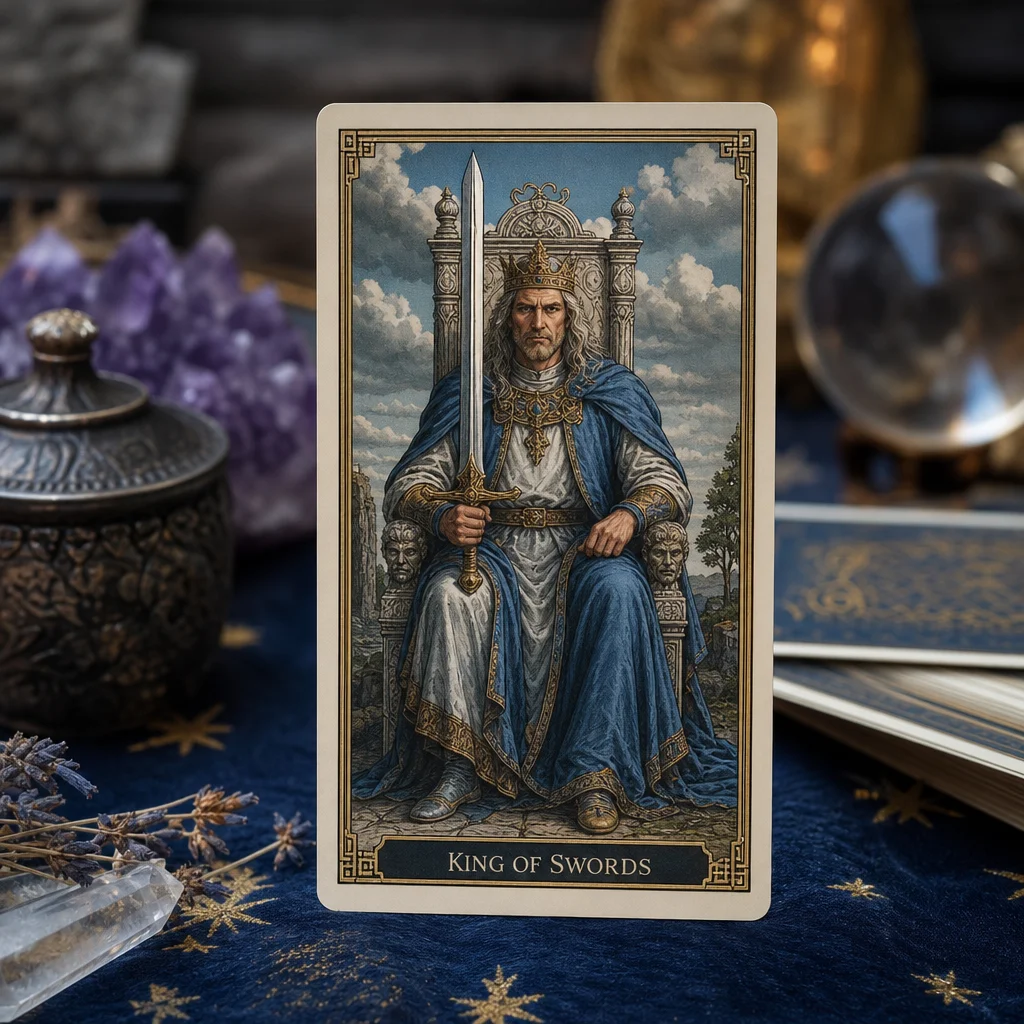
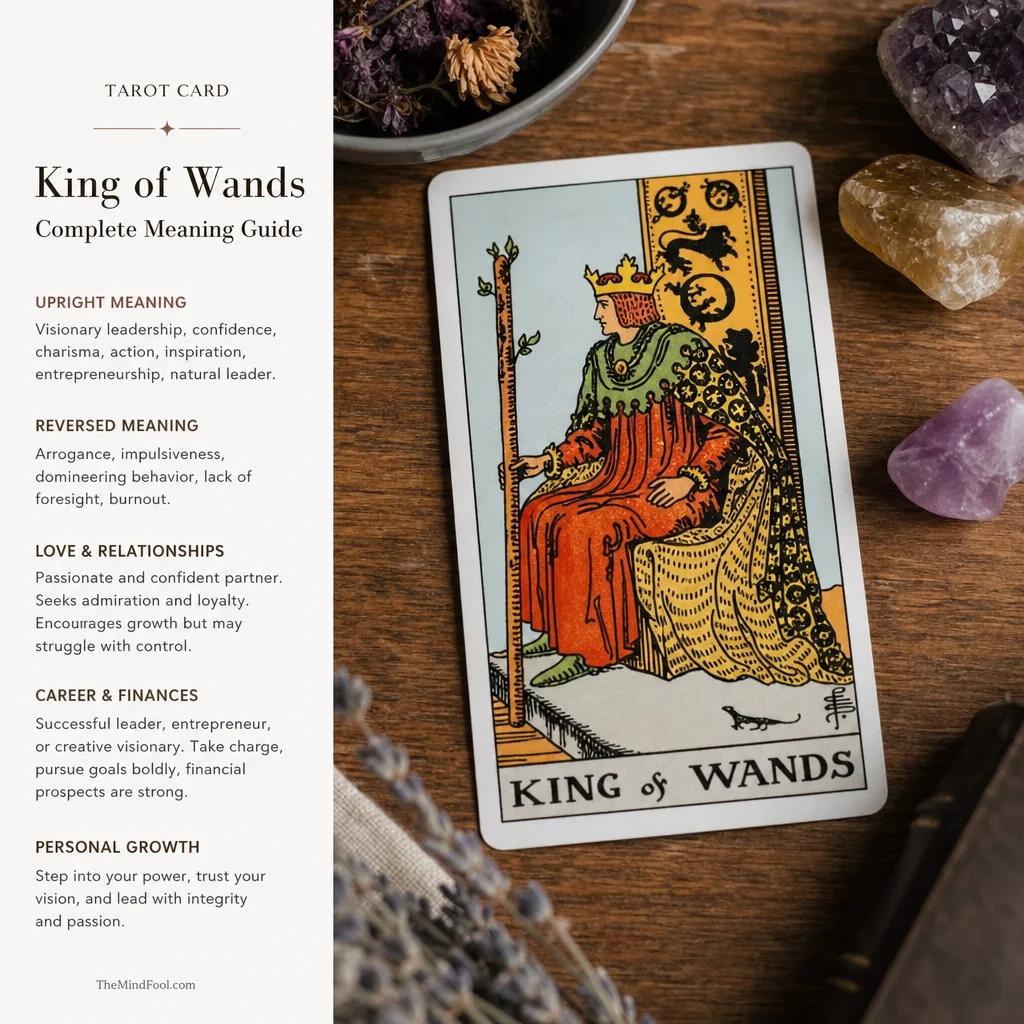
For men specifically, the King of Cups is confrontational in a way that the King of Swords or King of Wands never is. The Swords King is about intellect — society loves that. The Wands King is about passion and drive — society loves that too. The Cups King is about feelings, vulnerability, and the willingness to be seen as emotionally complex. And that, for a lot of men, feels like the opposite of everything they were taught it means to be strong.
But here's what the King of Cups understands that the others don't: real strength isn't the absence of feeling. It's the full presence of feeling, held with intention. The man who can sit with his sadness without running from it is braver than the man who charges into battle without fear. Because the first man has looked at the hardest thing in the universe — his own interior — and decided not to look away.
The King of Cups also shows up in readings about the Six of Cups territory — nostalgia, childhood, emotional memory. When those two appear together, the reading is almost always about someone processing deep personal history.
5 Journal Prompts for Working With the King of Cups
If you pulled this card and want to go deeper, these prompts have come out of actual readings. They work.
- "What emotion am I most afraid of feeling, and what do I think will happen if I let myself feel it?" — This one gets to the core of King of Cups work. The answer is almost always more manageable than the fear.
- "Where in my life am I performing emotional stability instead of actually being stable?" — The King doesn't perform. He's genuine. If you're performing, this prompt will surface it.
- "Who in my life do I trust with my real feelings, and why?" — The King's energy includes discernment about who deserves access to your emotional world.
- "If I stopped managing other people's emotions for one week, what would happen?" — For people who've made themselves the emotional caretaker of everyone around them, this is the breakthrough question.
- "What would my life look like if I treated emotional self-care with the same discipline I apply to my work?" — The King integrates emotion and structure. This prompt helps you find that integration.
Frequently Asked Questions
Is the King of Cups a yes or no card?
In yes/no readings, the King of Cups is generally a yes — but a qualified yes. It's saying "yes, and handle this with emotional intelligence." If you're asking about a decision that involves relationships, feelings, or personal growth, the King says go ahead, but do it with awareness. If you're asking about something where you need to be emotionally detached (like a cold business transaction), the King might be telling you you're too emotionally invested to see clearly.
What does the King of Cups mean for a twin flame reading?
I'll be straight with you: I'm skeptical of twin flame readings as a framework. But if that's the lens you're using, the King of Cups in a twin flame reading usually points to emotional maturity being the key to the connection. If both people aren't operating at a King of Cups level — emotionally self-aware, self-regulated, compassionate without enmeshment — the connection will stay volatile. The card is basically saying: grow up emotionally, and then see what's actually there.
Can the King of Cups represent a specific person?
Yes. Court cards often represent actual people in the querent's life. The King of Cups as a person is someone who is emotionally mature, a good listener, probably the one everyone goes to with their problems. They're warm but not pushovers. They give advice that's compassionate and honest. In a love reading, this can represent a potential partner who's actually ready for something real — not someone who's going to waste your time.
How does the King of Cups differ from the Queen of Cups?
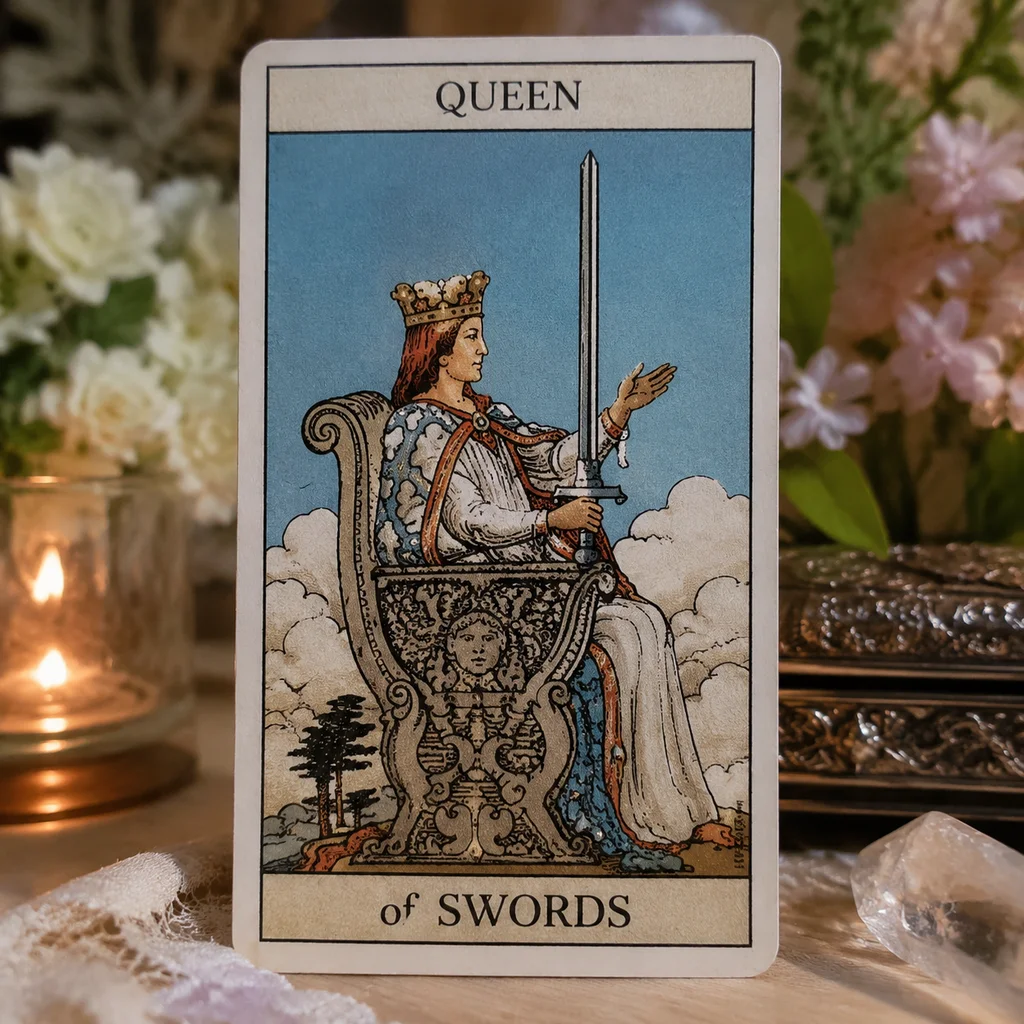
The Queen of Cups is receptive — she feels deeply, she holds space, she intuitively understands what others are going through. The King takes all that emotional depth and adds agency. He doesn't just feel — he acts on what he feels, with intention and structure. The Queen creates the container; the King builds the kingdom around it. Both are necessary. They're complementary, not hierarchical.
The Bottom Line on the King of Cups
The King of Cups isn't asking you to be perfect. He's not asking you to never get angry, never cry, never feel overwhelmed. He's asking you to do something much harder: to feel all of it, know you're feeling it, and still choose how you respond. That's it. That's the whole card.
In a culture that rewards emotional suppression in men and punishes emotional intensity in everyone, the King of Cups is quietly radical. He says: your feelings are not your enemy. Your feelings are information, and you can learn to work with them the way a sailor works with the wind. You don't control it. But you don't have to. You just have to learn to sail.
If this card has shown up for you, take it seriously. Not because it's bad news — it's usually good news, actually — but because it's asking you something. Something only you can answer. Something about what you're willing to feel and what you've been running from.
Stop running. The water's fine. That's what the King would say.
Frequently Asked Questions
What zodiac sign is associated with the King of Cups?
The King of Cups is traditionally linked to water signs—primarily Scorpio, but also Cancer and Pisces. Scorpio mirrors the card's emotional depth, loyalty, and ability to hold intense feelings without drowning. Some readers connect him specifically to late October through mid November. Pairing this card with water-aligned stones like aquamarine or moonstone can deepen your connection to its calm, intuitive energy during tarot practice.

Comments