Master the Art of Tarot Shuffling: A
May 16, 2026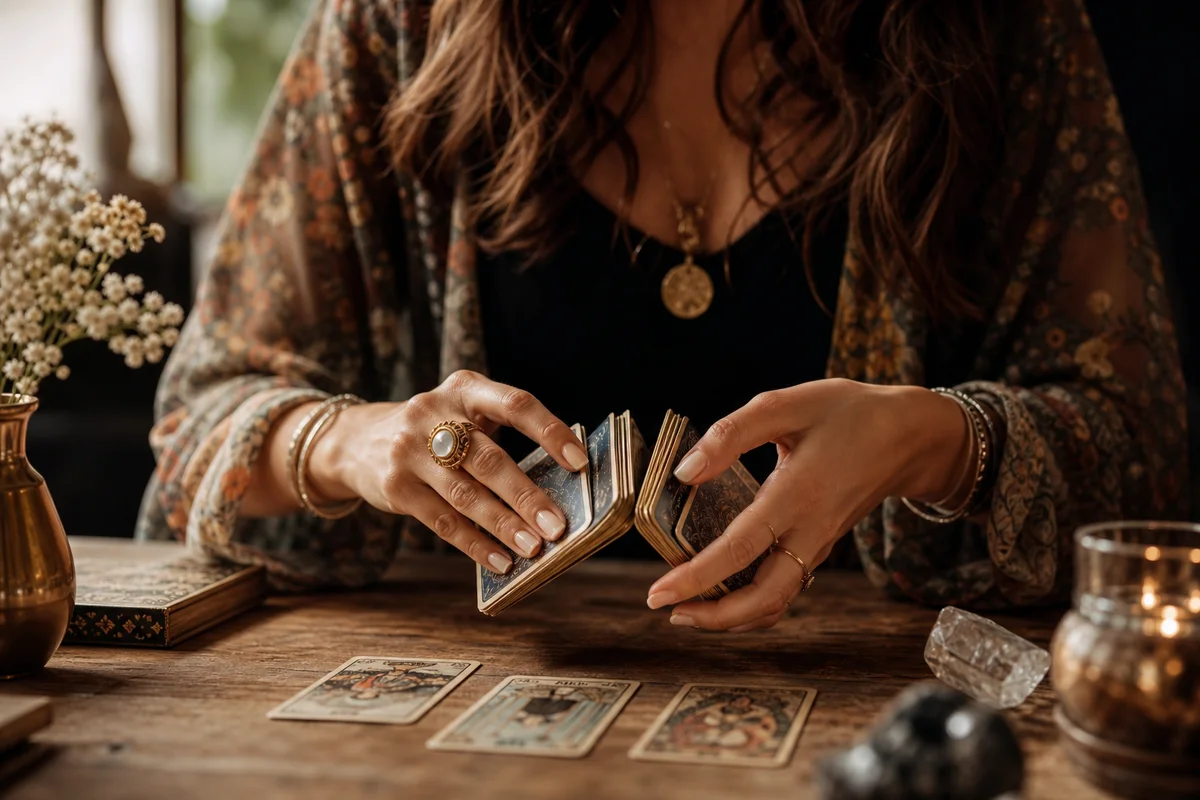
For Six Months I Shuffled Tarot Cards Wrong
For six months I shuffled tarot cards like a normal deck of playing cards. Riffle shuffle, bridge finish, snap the cards back together. I'd learned that move from my grandfather's poker nights — thumbs on the inside edge, let the cards cascade into each other with a satisfying thwip. It felt competent. It felt right.
Then I watched an 80-year-old reader in New Orleans shuffle her deck, and I realized I'd been doing it all wrong.
Her name was Marguerite. She read in a cramped shop on Royal Street that smelled like old paper and something herbal I couldn't identify. When a client sat down, she didn't shuffle fast or flashy. She held the deck in both hands and moved the cards through her fingers slowly, deliberately, like she was having a conversation with each one. Sometimes she paused on a card, felt its edge, then kept going. The whole process took maybe two minutes. When she laid the spread, every single card landed with the kind of precision that makes the hair on your arms stand up.
I asked her afterward how she shuffled. She looked at me like I'd asked how she breathed. "The cards need to know what you're asking," she said. "If you shuffle like you're playing blackjack, they'll give you blackjack answers — fast, sloppy, surface-level."
That conversation sent me down a rabbit hole I didn't expect. I spent the next three months testing different shuffling methods, reading old esoteric texts, watching probably a hundred YouTube videos from readers across different traditions, and paying attention to how the quality of my readings shifted with each approach. What I found surprised me.
The way you shuffle your tarot deck genuinely affects your readings — not because of magic, but because of what shuffling does to your focus, your relationship with the deck, and your ability to stay present with the question you're asking. If you're just starting out with tarot, this is one of those fundamentals that almost nobody teaches but everyone eventually discovers. For a solid grounding in the basics, I'd recommend checking out the complete beginner's guide to reading tarot cards first, then coming back here to level up your shuffle game.
Why Shuffling Matters More Than You Think
Here's the thing about shuffling tarot cards: most people treat it as a mechanical step between asking a question and getting an answer. Shuffle, cut, lay cards, interpret. But the shuffle isn't a transition — it's part of the reading itself.
There are two competing ideas about what shuffling accomplishes. Randomization: you want the cards mixed enough that whatever comes up is genuinely unpredictable. Intentional focusing: the act of shuffling puts you into a mental state where you're connected to the question and paying attention.
These two goals don't always play nice together. The riffle shuffle randomizes beautifully but feels mechanical. The scatter method is terrible for pure randomization but incredible for building focus. Every method trades something off.
Then there's the randomization paradox. If tarot works through synchronicity — meaningful coincidence — then random shuffling is exactly what you want. But if you shuffle so mechanically that you're not engaged with the question, you might miss those synchronicities when they appear.
I've also noticed that how I shuffle changes how I feel about the cards I pull. When I shuffle with attention, I trust the reading more — not because the cards are "better," but because I showed up for the process. If you want to deepen your practice, cleansing your tarot cards between readings serves a similar dual purpose: practical maintenance plus intentional focus.
Method 1 — The Overhand Shuffle
This is where most people start. You hold the deck in one hand and use the other to pull small packets off the top, letting them fall into your palm in a new order. It's the shuffle you see people doing at kitchen tables with a deck of Uno cards.
I used the overhand shuffle exclusively for my first six months of reading tarot. It's gentle on the cards, doesn't require a table surface, and you can do it while holding your question in mind. That last part matters more than I realized at the time — because the overhand shuffle is slow, it gives you space to think. You're not rushing. You can repeat your question mentally with each pass through the deck.
Pros
- Easy to learn, works with any hand size
- Won't damage even flimsy decks
- Good pace for maintaining focus on your question
- Works standing up, sitting down, or in cramped spaces
Cons
- Poor randomization unless you do many passes (7+ for a full mix)
- Can feel tedious if you're doing multiple readings in a row
- Easy to fall into a rhythm that's more mindless than intentional
The overhand shuffle is honest work. It won't impress anyone watching, and it won't give you the fastest randomization, but it keeps you in the room with your reading. For beginners especially, I think this is a fine place to start — just be aware that "fine" and "optimal" aren't the same thing.
Method 2 — The Riffle Shuffle
Split the deck in half. Hold each half with your thumb on one inside edge and your fingers on the other. Lift the edges with your thumbs and let the cards cascade into each other. Bridge them back together. That's the riffle shuffle, and it's what I was doing when Marguerite watched me with barely concealed horror.
Let me be clear about something: the riffle shuffle is the gold standard for randomization. Seven proper riffle shuffles will mix a 78-card tarot deck about as thoroughly as anything short of a computer algorithm. If you want truly random card order, this is your move.
But here's the catch — and it's a big one for tarot specifically. Tarot decks aren't playing cards. Many have matte finishes, gilt edges, or card stock that's softer than what you'd find in a Bicycle deck. Riffle shuffling bends the cards, and over time, that bending takes a toll. I've seen decks develop permanent curves after months of riffle shuffling. If you're working with a $40+ deck with art you love, this matters.
Pros
- Best randomization per shuffle of any method
- Fast — you can fully mix a deck in under a minute
- Feels satisfying if you're used to card handling
Cons
- Bends and potentially damages softer card stock
- Very mechanical — easy to do on autopilot without engaging your question
- Hard on the hands if you have joint issues or small hands
- Some readers consider it disrespectful to the deck (I don't share this view, but it's worth knowing)
I still use the riffle shuffle occasionally when someone's waiting. But I never riffle my nicer decks. If you're going to riffle, consider pairing it with a cleansing practice — these crystal cleansing methods offer a ritual that complements the mechanical nature of the riffle.
Method 3 — The Scatter/Spread Method
This is what Marguerite was doing that day in New Orleans, though she added her own variations I haven't seen anyone else do.
The basic version: spread all 78 cards face-down across your table or floor. Use your hands to swirl them around in loose, circular motions — not flipping them, just moving their positions. When you feel ready, gather them back together into a stack. Some readers gather from the edges, some scoop from the center, some pick cards one by one.
Marguerite's version added a step. After spreading the cards, she would hover her hands over them without touching, moving slowly across the spread. When she felt a "pull" toward a certain area, she'd gather from there first. I'm not going to tell you this is objectively better than random gathering — but I will tell you that when she did it, the readings were uncannily accurate. Take from that what you will.
Pros
- Zero risk of card damage
- Deeply engaging — you can't do this on autopilot
- Creates a ritual atmosphere that's hard to replicate with faster methods
- Easy to incorporate intuitive card selection during the gathering phase
Cons
- Requires a large, clean surface
- Slow — not practical for doing multiple readings back to back
- Harder to control randomization quality
- Cards pick up dust and oils from the table surface
The scatter method changed my readings more than any other single thing I've done with tarot. Not because it's magical, but because it forces you to slow down and be present. When you're moving cards around a table, you can't check your phone. You can't half-listen to a podcast. You're there, with the cards, with your question. That presence carries through the entire reading.
Method 4 — The Hand-Over-Hand (What I Use Now)
After three months of experimenting, I landed on a hybrid I haven't seen formally named anywhere. I call it hand-over-hand, and it's become my default for daily pulls and sit-down readings alike.
Hold the deck in your left hand (or non-dominant hand). With your dominant hand, pull a small section of cards from the center of the deck — not the top, the middle. Place that section on top. Repeat, pulling from different spots each time: middle, bottom third, quarter of the way down, wherever your hand wants to go. Don't follow a pattern. Let your hand decide.
What makes this different from the standard overhand shuffle is the pulling from the middle and the intentional lack of rhythm. A regular overhand shuffle creates a somewhat predictable pattern because you're always pulling from the top. Pulling from random positions in the deck breaks that pattern, which improves randomization significantly without adding the mechanical feel of a riffle.
Why This One Stuck
- Randomization is good — not as thorough as a riffle, but better than overhand
- Zero card damage
- The irregular pulling pattern keeps your attention engaged
- Works sitting on the couch, at a table, anywhere
- After about 90 seconds of hand-over-hand, I feel genuinely ready to read. Something clicks.
I'm not going to claim this method is objectively the best. Tarot is personal, and what works for me might feel awkward to you. But if you're currently shuffling on autopilot, try this for a week and see if your readings feel different. That's really the only test that matters. For more on how different tools and practices complement each other, this guide to tarot and crystal combinations shows how pairing practices can deepen your overall work.
When Cards Jump Out — The "Jumper" Question
Every tarot reader encounters jumpers — cards that fall out of the deck during shuffling, fly across the table, or land face-up when everything else is face-down. The question is always the same: do you read them or ignore them?
My answer: it depends on whether you meant to put them there.
If you're shuffling carelessly and cards are falling out left and right, that's a technique problem, not a message from the universe. Tighten your grip and keep shuffling. But if you're shuffling with focus and a single card separates itself from the deck — cleanly, deliberately, almost reluctantly — I pay attention to those. In my experience, jumpers often carry information the reading itself would have revealed eventually, but in a more direct, unfiltered way.
There's a practical angle too. If a card keeps jumping out, it might mean your deck wants to be cleansed. Sticky cards, clumping cards, or decks that feel "off" in your hands often benefit from a reset before you push through another reading.
Don't build a whole philosophy around jumpers. Notice them, note them, move on. The reading itself is still the main event.
How Long Should You Shuffle?
I've heard every rule. "Shuffle until you feel done." "Shuffle for at least three minutes." "Shuffle the number of your life path number." "Shuffle until a card falls out."
Here's what I actually do. For a daily three-card pull, I shuffle for about 90 seconds using the hand-over-hand method. That's enough time to randomize the deck reasonably well and settle my mind on whatever I'm asking about. For a full Celtic Cross or multi-card spread, I shuffle for two to three minutes. I don't time it. I just pay attention to when the shuffle starts to feel complete — there's a subtle shift where my hands slow down and I know I'm ready to cut.
The "3-minute rule" that floats around tarot forums has some merit, but not for the reasons people think. Three minutes is about how long it takes to genuinely settle into a focused state for most people. It's not magical. It's practical. If you can get there in 90 seconds, great. If you need five minutes, take five minutes. The clock doesn't matter. The state of your attention does.
One thing I'd caution against: rushing the shuffle because you're eager to see the cards. That impatience carries into the reading. I can always tell when I've shortcut the shuffle because I'll get to the end of a spread and realize I wasn't really paying attention to half the cards. The shuffle is where you earn the reading. Skimp on it and you'll get shallow results.
Caring for Your Deck Between Shuffles
A tarot deck that's well cared for shuffles better, lasts longer, and honestly just feels better in your hands. This isn't superstition — it's basic material maintenance. Cards that are warped, sticky, or coated in finger oils don't glide the way they should, which makes every shuffle method harder.
Storage
Keep your deck in something. The original box is fine. A cloth bag works. A wooden box looks nice. What matters is that the deck isn't loose in a drawer getting bumped, bent, or exposed to humidity. I keep my daily-use deck in a silk scarf inside a wooden box, and my backup decks stay in their original shrink wrap until I need them.
Cleansing Between Readings
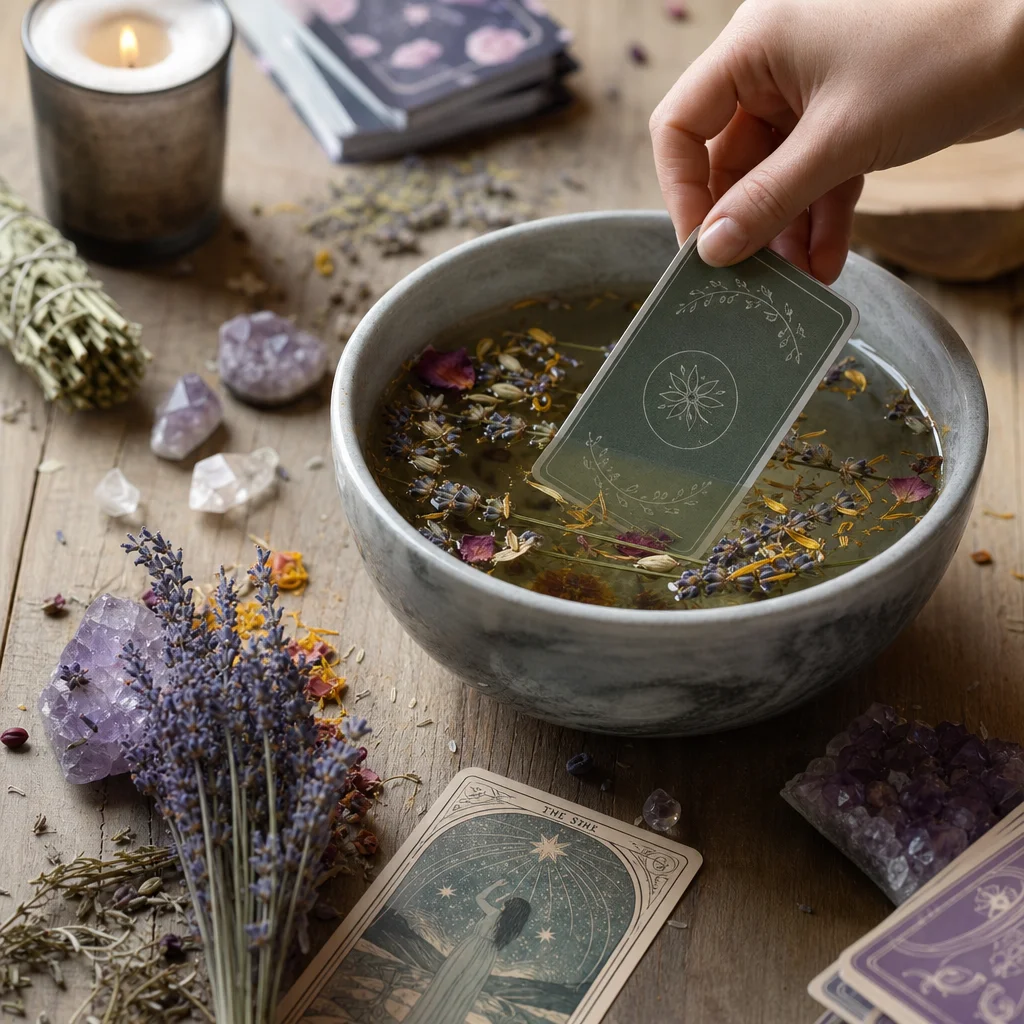
I don't cleanse my deck after every single reading — that feels like overkill to me. But I do a full reset every few weeks, or whenever the deck starts feeling "muddy." My method is simple: I spread the cards out and pass them through incense smoke (sage or palo santo), then knock the deck against the table three times to clear stuck energy. Sound cleansing with a singing bowl works too — similar principles apply whether you're working with crystals or cards.
Handling
- Wash your hands before reading (oils degrade card stock over time)
- Don't eat while shuffling (crumbs and sticky fingers are a deck's worst enemy)
- Keep cards away from direct sunlight (fading is real and irreversible)
- If a card gets bent, place it under a heavy book for 24 hours before it sets permanently
Good deck care saves you from replacing a $50 deck every year. Treat your tools well and they'll serve you well. That's true for crystals, it's true for cards, and it's true for anything you work with regularly.
Frequently Asked Questions
Should I let other people touch my tarot deck?
Some readers are strict about this and some aren't. I let people I'm reading for cut the deck — it gives them a moment of participation and investment in the reading. I don't let random people handle my deck casually. If you're reading for someone who's never had a tarot reading, letting them shuffle or cut can actually make the experience more meaningful for them. Use your judgment.
Do I need to shuffle differently for different types of spreads?
Not the method — use whatever works for you. But I do shuffle longer for bigger spreads. A three-card pull gets 90 seconds. A Celtic Cross gets three minutes. The more cards you're pulling, the more randomized the deck should be, and the more time you should spend settling your focus.
What if I can't shuffle at all because of hand pain or mobility issues?
The scatter method is your friend — it requires almost no grip strength and works on any flat surface. You can also have someone shuffle for you while you focus on the question. Some readers put their deck in a bag and shake it like a maraca. There's no wrong way to shuffle as long as the intent is there. Don't let physical limitations stop you from reading.
Can I shuffle tarot cards the same way I shuffle playing cards?
You physically can, and plenty of readers do. The riffle shuffle works fine on tarot cards — just be aware that tarot card stock is usually softer than playing card stock, so you'll wear the deck out faster. If you're using an expensive or rare deck, I'd recommend a gentler method. For a $15 mass-market deck you replace annually, riffle away.
Related Guides
- How to Clean Crystal Jewelry: A Complete Care Guide
- The Complete Guide to Crystal and Jewelry Care
- 15 Creative Ways to Display and Store Your Crystal Collection
- How to Clean Crystals Without Ruining Them
- Crystal Care 101: How to Clean, Store, and Protect Your Jewelry
- Complete Guide to Crystal Healing and Energy Work
- I Tested Five Crystal Cleansing Methods and Measured the Results
Frequently Asked Questions
How do I know when to stop shuffling my tarot cards?
There's no universal rule, but most readers shuffle until they feel a intuitive sense of "doneness" — sometimes a subtle energy shift or a natural pause. Some practitioners count a specific number of shuffles, like seven or thirteen, to create consistency. If you're new, try shuffling for about thirty to sixty seconds per reading. Over time, you'll develop a rhythm that feels right for you and your deck.



Comments