Unlock the Power of the Seven of Wands Tarot
May 17, 2026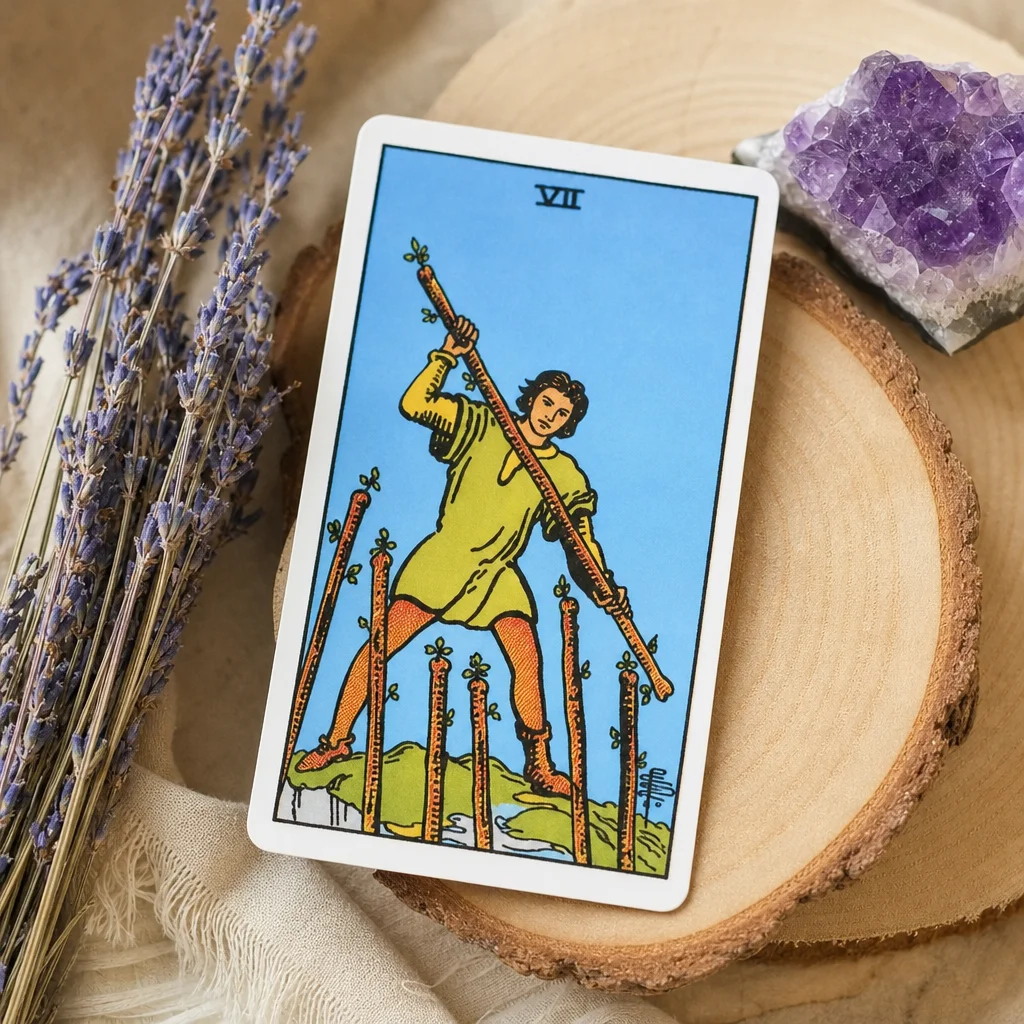
When Everyone Wants You to Fold
I pulled the Seven of Wands the morning after I told my family I was quitting my "real job" to read tarot full-time. Not exactly the warmest reception. My mother asked if I'd lost my mind. My brother changed the subject. My college roommate sent me a link to a job listing — "just in case."
And there I was, shuffling my deck at 6 AM, pulling this card with the one guy standing on a hill looking down at six opponents who very much want him gone. I stared at it for a long time. Because that card was me. That card is most of us at some point.
The Seven of Wands doesn't show up when everything's easy. It shows up when you've made a choice — maybe a brave one, maybe a reckless one — and now the world is pushing back. Hard. It's the card that says: you're outnumbered, but you're not wrong.
I've seen this card in readings for people defending their boundaries with toxic parents. For artists who refuse to dilute their work. For someone who finally said "no" to a boss who'd been taking advantage for years. The details change, but the feeling is always the same: you're holding your ground, your arms are tired, and everyone below you seems to think you should just come down from the hill.
Here's what I've learned from years of sitting with this card: defending yourself isn't the same as being defensive. The Seven of Wands isn't about ego or stubbornness. It's about knowing — deep in your bones — that something matters enough to fight for. Even when you're the only one who sees it. Even when it would be ten times easier to just give in.
If you're reading this, chances are you already know that feeling. Maybe you pulled this card this morning and felt a jolt of recognition. Good. That's the point. The Seven of Wands isn't here to sugarcoat anything. It's here to tell you that the fight is real, your position is valid, and you have more strength than you think.
Let's dig into everything this card has to offer — the imagery, the meanings, the real-life applications — so you can stop second-guessing yourself and start standing firm. If you're brand new to tarot, I'd recommend starting with our complete beginner's guide to reading tarot cards before diving in here.
What's Happening in This Card: A Visual Breakdown
Before we talk meaning, let's actually look at what's drawn on this card, because the Rider-Waite imagery is doing a lot of heavy lifting.
There's one figure standing on elevated ground — a hill, a ridge, some kind of raised position. One foot is higher than the other, which means the ground underneath isn't flat or stable. That detail matters. This person isn't standing on a throne or a fortress. They're on uneven terrain. They chose the high ground, but it's not comfortable up there.
In their hands, they're gripping a single wand, holding it at an angle like they're actively using it to block or deflect. It's not resting. It's not decorative. It's a tool being used in real time. Their posture leans forward slightly — aggressive, yes, but also desperate. This isn't a relaxed defender. This is someone who's been at it for a while and is starting to feel the strain.
Below them, six wands are raised by unseen opponents. We don't see the people attached to those wands — just the wands themselves, jutting up from below like spears. The anonymity is intentional. The opposition doesn't have a face. It could be anyone: your coworkers, your family, society at large, or that voice in your own head that keeps asking whether you're being unreasonable.
The figure's clothing is yellow and blue — colors associated with air and intellect, with a touch of the spiritual. This isn't a brute-force fighter. This is someone defending their position with clarity and conviction. The fight is mental as much as physical.
Notice also that the figure wears different shoes on each foot. Some readers interpret this as being caught between two worlds, or not fully prepared for the battle they're in. I think it's a reminder that defending yourself is rarely a polished, dignified affair. Sometimes you fight in mismatched socks. That's okay. The point is you're still fighting.
Upright Seven of Wands: You're Right, and They Know It
When the Seven of Wands lands upright, it's usually confirming something you already suspect: you're under attack, and you need to hold the line.
This isn't paranoia. The challenge is real. But here's the nuance most guides miss — the Six of Wands came right before this card, and it was a card of victory and public recognition. The Seven of Wands is what happens after you win. You succeed, you get noticed, and suddenly everyone wants a piece of you. Or wants you to share. Or wants to knock you down a peg.
So the first thing to understand about this card upright: you're not losing. You're actually in a strong position. The problem is that success attracts challengers. The higher you climb, the more people want to pull you back down — sometimes out of jealousy, sometimes out of genuine disagreement, and sometimes just because change makes people uncomfortable.
In practical terms, this card can show up when:
- You've set a boundary and people are pushing back against it
- You've achieved something and now face criticism or imitation
- You're holding an unpopular opinion that you know is correct
- You're defending someone or something that can't defend itself
- You've taken a risk and the "I told you so" crowd is circling
The upright Seven of Wands is a green light, but not an easy one. It says: keep going, keep defending, don't back down. But it also acknowledges that doing so will cost you energy. You'll be tired. You'll question yourself at 2 AM. You'll wonder if maybe they're right and you're just being stubborn.
You're not. Or at least, this card is telling you to trust that you're not. For more on how to read cards that deal with tension and opposition, check our guide to the Five of Wands — the card of conflict that usually precedes this one.
One more thing: the upright Seven of Wands often shows up when you're almost through a tough period. You're in the final stretch. The opposition is loud because they know they're losing. Don't give up now.
Reversed Seven of Wands: When the Hill Feels Too High
The reversed Seven of Wands is one of those cards that can feel like a gut punch, because it names something we rarely admit: sometimes defending yourself is exhausting, and sometimes you just... stop.
Reversed, this card can mean several things, and they're not all bad — but they're all honest.
First interpretation: you're giving up. Not in a dramatic, throwing-your-hands-up way. More like a quiet, slow surrender. You've been defending your position for so long that the fight has drained you. The boundary you set six months ago? You've let it slide. The project you believed in? You've compromised it into something you don't even recognize. The opinion you held? You've stopped voicing it because it's easier to nod along.
Second interpretation: you're overwhelmed by the sheer number of people pushing back. The upright Seven of Wands suggests you can handle it. Reversed, it says the opposition has grown beyond what you can manage alone. This isn't weakness — it's a realistic assessment that six wands pointed at one person is a lot, actually.
Third interpretation — and this one's more constructive — you're choosing your battles differently. Sometimes reversing the Seven of Wands means recognizing that this particular hill isn't worth dying on. You've been fighting for something that, on reflection, doesn't matter as much as you thought. Walking away isn't always defeat. Sometimes it's wisdom.
If you're new to reversed cards and want to understand how they work across the entire deck, our beginner's guide to reversed tarot cards breaks down the theory without the fluff.
The question this card asks when reversed is simple: are you retreating because you've lost, or because you've realized there's a better fight waiting for you elsewhere? Your answer to that question determines whether this card is a warning or a relief.
Love and Relationships: Fighting For (and Against) Connection
In love readings, the Seven of Wands is never about effortless romance. It's about the love that requires you to actively defend it — against outside opinions, against your own insecurities, against the gravitational pull of old patterns.
If you're single and pull this card, it often points to a situation where you're defending your standards against pressure to settle. Maybe your friends think you're too picky. Maybe your family keeps setting you up with people who are "perfect on paper." Maybe you've been single long enough that people have started making suggestions that feel more like verdicts. The Seven of Wands says: your standards aren't the problem. Don't lower the bar just because people think you should.
If you're in a relationship, this card can indicate that the relationship itself is under external pressure. This could be disapproval from family, judgment from friends, or simply the exhaustion of maintaining a bond that other people don't understand or support. Interfaith relationships, long-distance relationships, relationships with significant age gaps — the Seven of Wands shows up a lot in readings for couples who face social pushback.
Less commonly, this card can also appear when you're internally defending the relationship — convincing yourself to stay, rationalizing problems, or fighting against the growing suspicion that you're defending something that's already lost. If the surrounding cards are negative (Three of Swords, Tower, Ten of Swords), the "defending" might actually be denial.
For paired readings, this card interacts beautifully with the Strength card — together they suggest that your position is not just defensible but deeply rooted in genuine inner power.
The bottom line: love under the Seven of Wands isn't easy, but it's real. The relationships worth fighting for are usually the ones people question the most.
Career and Finances: Protecting Your Professional Turf
In career readings, the Seven of Wands is the card of the person who had a good idea in a meeting and now has to defend it against four colleagues who want to modify it into mediocrity. It's the freelancer whose rates are being questioned. It's the manager who made a tough call and now faces a mutiny.
This card shows up when your professional position — your title, your ideas, your reputation, your territory — is being challenged. The nature of the challenge varies:
- Idea theft or credit disputes — someone's trying to pass your work off as theirs
- Competitive pressure — colleagues or rivals are actively undermining you
- Boundary violations — your workload, time, or expertise is being taken for granted
- Unpopular decisions — you made a call that's right but unpopular, and now you're alone
- Imposter syndrome externalized — the voices saying you don't belong have found real-world mouths
The advice here is the same as the card's core message: hold your ground. But in career contexts, I'd add a tactical layer. The Seven of Wands isn't just about stubbornness — it's about strategic defense. The figure on the hill has the advantage of elevation. In career terms, that means leveraging your unique position, your specialized knowledge, your track record. Don't just fight — fight smart.
Financially, this card can indicate the need to defend your resources. Someone — or some institution — is trying to take more than their share. Read your contracts. Check your invoices. Don't assume good faith in negotiations just because you're tired of arguing.
If you're considering a career change and this card appears, it might mean the change itself is worth fighting for — even if everyone around you thinks you should stay put. See also the Fool card for that leap-of-faith energy that often accompanies this kind of transition.
Daily Pull: What It Means When This Card Shows Up This Morning
As a daily card, the Seven of Wands is a heads-up: today, someone or something will challenge you. It might be small (a coworker questioning your method) or significant (a serious conversation you've been avoiding). The card isn't warning you of danger — it's letting you know the terrain so you can prepare.
My favorite way to work with this card as a daily pull is to treat it as a prompt to identify what I'm defending before the challenge arrives. What boundary is most likely to get tested today? What decision am I most likely to second-guess? What conversation am I most likely to back down from?
Once you name it, you've already halfway won. The Seven of Wands as a daily card is less about external battles and more about internal readiness. Suit up. Know what you stand for. And don't be surprised when the universe tests whether you actually mean it.
Crystal Combinations for Seven of Wands Energy
If you work with crystals alongside your tarot practice (and if you don't, our guide to tarot and crystal pairings is a good starting point), these four stones are particularly aligned with Seven of Wands energy:
- Black Tourmaline — The classic protection stone. When you're defending yourself against external negativity, black tourmaline acts as an energetic shield. Keep it in your pocket during confrontations or difficult conversations. It doesn't just block — it grounds, which is crucial when the Seven of Wands has you feeling unsteady on that hill.
- Hematite — This is your anchor. The Seven of Wands can make you feel scattered, defensive, and reactive. Hematite pulls you back into your body and reminds you of your actual position (which, remember, is stronger than you think). It's the "stand your ground" crystal in mineral form.
- Carnelian — Wands are the suit of fire, and carnelian is pure fire energy. When you're defending something that matters, you need fuel. Carnelian reignites motivation when the fight has drained your reserves. It's especially useful if the reversed Seven of Wands has you feeling ready to quit.
- Garnet — The warrior's stone. Garnet doesn't just protect — it strengthens. If you're in a prolonged battle (a legal dispute, a long negotiation, an ongoing boundary war), garnet builds stamina. It's the crystal equivalent of the Seven of Wands figure who's been holding that wand for hours and refuses to lower it.
Journal Prompts for Working With This Card
If you want to go deeper with the Seven of Wands, grab your journal. And if you're building a tarot journaling practice, our beginner's guide to tarot journaling has a full framework. Here are five prompts specifically for this card:
- What am I defending right now, and would I still defend it if nobody was watching? This strips away the ego and gets to whether your position is authentic or performative.
- Where in my life am I exhausted from holding a boundary that nobody respects? Name it. The naming itself is a form of relief.
- What would I have to believe about myself to stop fighting and still feel okay? This one's for when the reversed Seven of Wands shows up and you're wondering if surrender equals failure.
- Who are the six wands below me — and are they actually enemies, or am I projecting? Sometimes the opposition is real. Sometimes it's our own fear externalized.
- If I knew I would win, how would I fight differently? This shifts you from defensive survival mode into strategic confidence.
Frequently Asked Questions
Is the Seven of Wands a yes or no card?
It's a yes — but not an easy yes. The answer is affirmative, but you'll need to fight for it. Nothing about this card suggests smooth sailing. If you're asking whether you should hold your position, the answer is absolutely yes. If you're asking whether it'll be easy, the answer is absolutely not. For ethical considerations on what types of questions to ask, see our tarot ethics and safety guide.
What's the difference between the Five and Seven of Wands?
The Five of Wands is conflict for its own sake — scattered energy, everyone fighting, no clear purpose. The Seven of Wands is focused defense — you know exactly what you're protecting and exactly who's coming for it. The Five is chaos; the Seven is conviction under pressure.
Can the Seven of Wands mean I'm being stubborn?
Sometimes, yes — especially reversed. There's a fine line between defending something worthwhile and refusing to evolve. Ask yourself: am I protecting a value, or am I protecting my ego? The card itself won't judge you, but honest self-reflection might.
What other cards should I look for near the Seven of Wands?
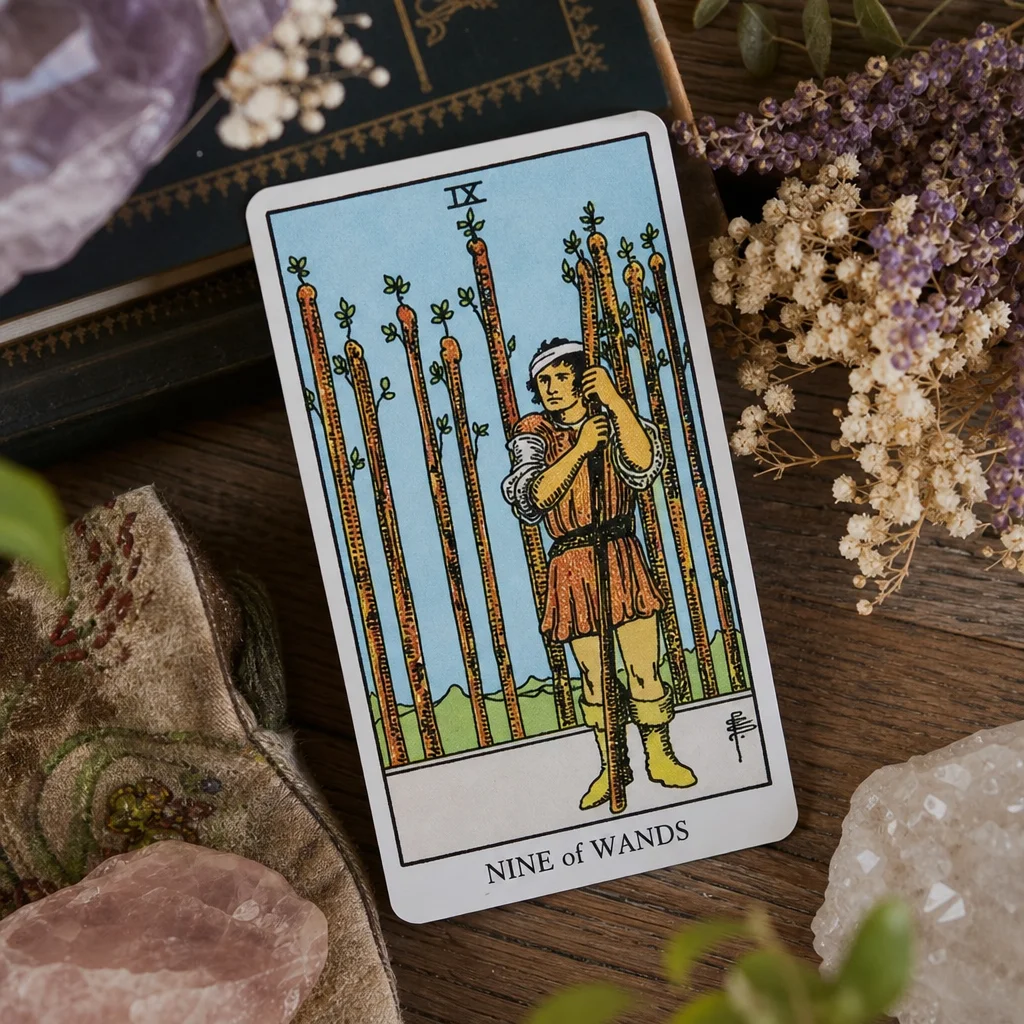
The Strength card confirms your position is backed by genuine inner power. The Tower nearby might mean the thing you're defending is about to collapse whether you like it or not. The Nine of Wands suggests you've been fighting for a while and you're close to the end — don't quit now. The Four of Swords is a recommendation to rest before the next battle.
Related Guides
- Tourmaline Colors Complete Guide
- How to Read Tarot Cards: Beginner Complete Guide
- Crystal Shapes Explained: Tumbled, Raw, Points, Spheres
- 5 Practical Tests to Tell Real Crystals From Fakes
- Complete Crystal Guide: Identification and Meanings
- Crystal Care 101: How to Clean, Store, and Protect Your Jewelry
- How to Tell if a Crystal Bracelet Is Real or Fake
Frequently Asked Questions
What advice does the Seven of Wands give when it appears in a reading?
The Seven of Wands is a card of encouragement dressed in armor. Its core message is simple: hold your ground. You may feel outnumbered or challenged, but this card reminds you that you already have the higher ground. It advises you to trust your convictions, set clear boundaries, and not back down just because others disagree. When this card shows up, it's affirming that your position is valid and worth defending — so stand tall, protect your energy, and keep moving forward with quiet confidence.


Comments