Beginner's Tarot Journaling Guide: 90-Day
May 17, 2026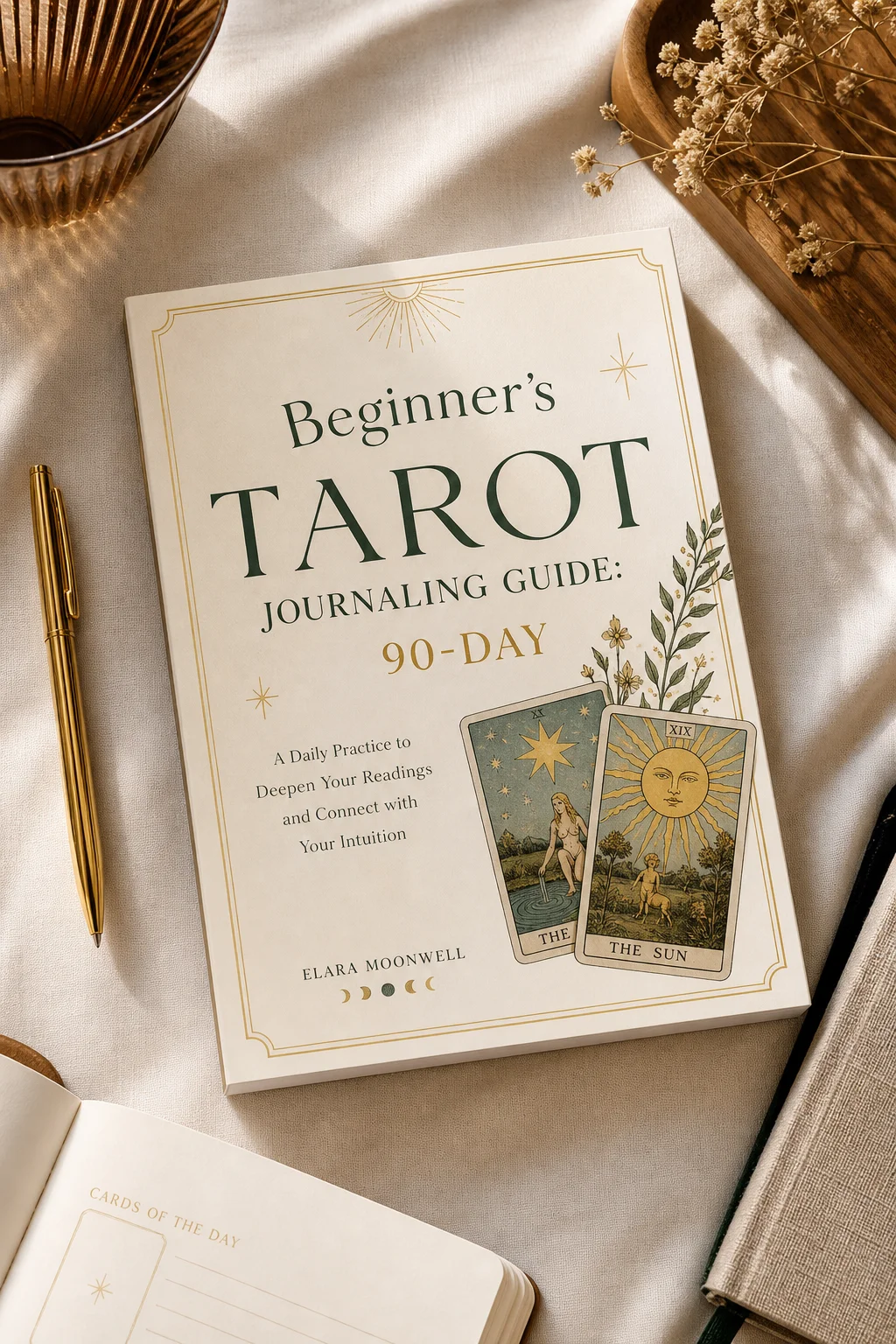
I Kept a Tarot Journal for 90 Days Straight — Here's What Happened
Six months into my tarot practice, I hit a wall. I was pulling cards every morning, nodding at the images, and moving on. The readings felt flat. I started wondering if I was even getting better or just going through the motions.
Then I stumbled on a forum post from a reader who'd been journaling her pulls for three years. She described it as "having a conversation with your future self." That phrase stuck long enough to make me try it.
I grabbed a blank notebook, set a 90-day commitment on my phone, and promised myself I'd write something after every single reading. No minimum word count. No fancy formatting. Just honest recording.
What I didn't expect was how quickly the journal became the most important tool on my desk — more useful than any guidebook, more revealing than any spread I'd learned. Within two weeks, I was noticing things about my readings I'd never seen before. By week four, interpretations felt deeper, more personal, less like parroted meanings.
And then there was day 47. That's when everything shifted. I flipped back through weeks of entries and saw a pattern so obvious I felt silly for missing it. The cards had been telling me something for over a month, and I'd been too close to see it. The journal gave me distance and perspective.
If you're on the fence about journaling, or you've tried and quit after a week (I did that twice), this article is for you. If you're new to tarot altogether, my complete beginner's guide to reading tarot pairs well with the journaling approach I describe here.
Why Journaling Your Readings Actually Matters
Let's be real: tarot is one of those practices where it's easy to fool yourself into thinking you're improving when you're really just memorizing keywords. Journaling forces you to slow down and engage with each card in context, not in isolation.
Pattern recognition is the biggest win. When you pull the Three of Swords three times in two weeks, your journal makes that visible. I once swore I'd never pulled the Tower in a self-reading. My journal said otherwise — four times in six weeks.
Progress tracking matters more than beginners realize. Comparing month-one entries to month-three, the growth is tangible. Early entries are stiff and derivative. Later entries read like actual analysis — connections between cards, trust in gut feelings, willingness to sit with uncomfortable messages.
Intuition development sounds vague but is the most concrete benefit. Writing your first impression before looking anything up creates a feedback loop. Over time, your snap interpretations get more accurate. Learning how to ask the right questions becomes easier when you can review which questions produced useful readings.
Setting Up Your Tarot Journal
You don't need anything fancy. I know readers who use $40 leather-bound journals and readers who use the Notes app on their phone. Both approaches work. What matters is consistency and structure.
Physical vs. Digital
I started physical because I wanted the tactile experience. That lasted two weeks before I admitted I hate writing by hand for more than five minutes. I switched to a digital document and never looked back.
Physical journals work beautifully if you enjoy handwriting or sketching. They feel personal and ritualistic. The downside is searching — finding a specific reading from six weeks ago in a handwritten notebook is painful.
Digital journals are searchable, organized, and always with you on your phone. The downside is feeling less "special" and the temptation of notifications mid-entry.
What Each Page Should Include
Here's the template I landed on after some trial and error:
- Date and time — Readings hit differently at 7am versus 11pm, and tracking this revealed patterns
- Deck used — Different decks produce different energy, and I wanted data on which ones I connected with most
- Question or intention — Even if it's just "what do I need to know today," write it down
- Spread and card positions — Which spread I used and what each position represents. If you're exploring spreads, my guide to 5 essential tarot layouts is a good starting point
- Cards drawn — Listed in order, with position labels
- Initial gut reaction — One or two sentences about my first feeling before any analysis
- Interpretation — My actual reading of the spread, card by card and as a whole
- Action or takeaway — What I plan to do with this information
- Later reflection (added at review time) — How accurate the reading turned out to be, sometimes added days or weeks later
You don't have to fill in every single field every time. Some days I'd just write "morning pull, feeling off, got the Moon, probably need to trust the process." That counts. The point is showing up, not producing literature.
My 90-Day Structure: What Changed, Week by Week
I broke the 90 days into three phases, mostly by accident — but looking back, they map onto a natural learning progression.
Phase 1: The Awkward Weeks (Days 1–30)
The first month was rough. Half my entries were two sentences: "Pulled the Fool. Means new beginnings, I guess." Pure parroting from guidebooks.
Around day 18, I stopped forcing book meanings. I started writing what I saw — colors, body language, mood — before checking references. That shift made entries more honest. I wasn't performing expertise; I was actually looking.
By week three, morning readings had become the most consistent part of my day. Not discipline — the journal gave me a reason to slow down for five minutes before everything else kicked in.
Phase 2: The Deep End (Days 31–60)
This is where things got interesting. I started experimenting with spreads I'd never tried — longer ones, weirder ones, ones I made up on the spot. I also started doing end-of-week reviews, reading back through seven days of entries to see if anything connected.
This phase coincided with me deepening my card cleansing routine — sounds unrelated, but when you're journaling every day, you notice when your deck feels "off" in a way casual pulling never reveals.
Entries from this period are noticeably longer and more personal. I started writing about feelings I hadn't planned to examine. The cards prompted questions I didn't know I had.
Phase 3: Integration (Days 61–90)
The final month felt less like learning and more like refining. My interpretations came faster and with more confidence. I wasn't second-guessing every pull. The journal shifted from a learning tool to a record of a practice that was genuinely becoming my own.
I also started playing with crystal and tarot combinations during this phase, adding a small crystal to my reading space and noting any shifts in my interpretation. Whether or not you believe in crystal energy, the physical act of adding a new element to the ritual made me more present and more curious — both of which improved my readings.
By day 90, I had a document full of insights about myself, my patterns, and my relationship with the cards that no book or course could have given me.
What to Record in Each Reading
Record more context than you think you need. You won't remember details later.
Every entry should capture five things:
The card(s) and their positions. Write it down immediately. Don't trust yourself to remember which card was in the "obstacle" position after staring at the spread for ten minutes.
The question you asked. Critical for reviews. Without the original question, you can't evaluate accuracy. Documenting questions and outcomes helps you learn to ask better ones.
Your initial feeling. Before analyzing, record your gut reaction. "Felt anxious when I saw the 9 of Swords" is more useful than you'd think weeks later.
Your interpretation. Write it out fully. Articulating your reading forces clarity that thinking alone can't achieve.
A later reflection. Come back in days or weeks and note what actually happened. Comparing interpretation to reality is how you calibrate intuition.
The Breakthrough: Day 47
I need to tell you about day 47 because it changed everything about how I use tarot.
Sunday evening, weekly review. I was flipping through the last seven entries when I noticed the Empress had appeared five times in three weeks. Each time I'd interpreted her with the usual keywords — creativity, nurturing, abundance — and moved on. But seeing all five entries together told a different story.
She wasn't about creativity. She was showing up because I was neglecting self-care in a specific, ongoing way. Each reading felt unrelated individually. Together, they painted a picture: I was pouring energy into everyone else and ignoring my own needs, week after week.
The journal made this visible. Without it, each Empress appearance would have stayed an isolated data point. That's when I understood what journaling is for — not recording individual readings, but seeing the story that emerges between them. This kind of breakthrough is why I always recommend readers also deepen their understanding of individual card meanings — the better you know each card, the faster patterns jump out at you during reviews.
Five Journaling Mistakes That Wasted My Time
I made plenty of errors during those 90 days. Here are the five that cost me the most progress:
- Copying book meanings instead of writing my own. For the first two weeks, I'd pull a card, flip to the guidebook, and transcribe the meaning. Useless. The whole point is to develop your own relationship with the cards. Write what you see first, then check references if you want to.
- Skip days and trying to catch up. Missing a day isn't failure. Trying to reconstruct three days of readings from memory on day four is. If you miss a day, just start fresh. Don't fake it.
- Only recording "important" readings. The daily one-card pulls that felt throwaway turned out to be the most revealing entries in my journal. The mundane readings build the pattern library that makes breakthroughs possible.
- Never reviewing past entries. A journal you never re-read is a diary, not a tool. The review process is where the actual learning happens. Set a recurring weekly or monthly date to read back through your entries.
- Being performative instead of honest. Some of my entries are embarrassingly superficial. "Feel good today, got the Sun, nice." But the honest, messy entries — the ones where I admitted confusion or discomfort — are the ones that taught me the most. Write like nobody will ever read it.
Three Sample Journal Entries
Here are three entries from my actual practice, lightly edited for clarity. They show the range of what journaling can look like.
Entry 1: Day 12 — A Simple Morning Pull
Date: Tuesday, 6:45am. One card, no question. Got the Page of Swords. First thought: curiosity, maybe some anxiety. Writing it down, I realize I've been avoiding a conversation with my sister for about a week. The Page feels like a nudge — stop overthinking and just ask the question. Action: text her today.
Entry 2: Day 35 — A Three-Card Relationship Spread
Date: Saturday, 10pm. Question: "What do I need to understand about my working relationship with M?" Pulled the Hierophant (past), Two of Pentacles (present), and the Star (future). Initial reaction: relief — no swords, no conflict energy. Interpretation: we started with a teacher-student dynamic that worked well, right now we're juggling too many projects and it's stretching thin, but the Star suggests there's genuine mutual respect that will carry us through. Need to communicate about workload distribution. Added note: this felt accurate. Will circle back in a week.
Entry 3: Day 78 — The Uncomfortable One
Date: Friday, 8am. Question: "What am I avoiding?" Got the Devil. Honestly, my first reaction was irritation — I didn't want to deal with this card at breakfast. But I sat with it and wrote for about twenty minutes. Realized I've been scrolling social media for an hour every night instead of reading or resting, and I know it makes me anxious and sleep poorly but I keep doing it anyway. That's the chains the Devil shows. Action: phone goes in another room at 9pm, starting tonight. Later reflection (day 85): Actually did it for five nights straight. Felt noticeably better. Then slipped back. Devil showed up again on day 83. Point taken.
How to Review Your Journal
The review process is where journaling transforms from record-keeping into skill development.
Weekly Review (15 minutes)
Every Sunday evening, I read through the past seven entries. I wasn't looking for anything specific — just reading. I'd highlight cards that showed up more than once and note recurring themes.
Monthly Review (45 minutes)
At month's end, I read every entry more carefully, looking for:
- Repeated cards — were they telling me something I kept missing?
- Which questions produced useful versus vague readings
- Accuracy — which interpretations were right, which missed
- Emotional patterns — was a consistent mood coloring every reading?
I'd write a short summary: what I learned, what surprised me, what to focus on next. These summaries became the most valuable pages in my entire journal.
Digital Tools vs. Paper: My Honest Take
I landed on digital for daily recording, paper for reflective reviews.
Typing is faster, and speed matters when capturing gut reactions. Search is essential — ctrl+F "Empress" and seeing every appearance in two seconds is genuinely useful for pattern-spotting.
But for weekly and monthly reviews, I printed entries and sat with paper. The physicality of spreading pages across a table engaged different thinking.
If you pick only one, go digital. Search and portability matter more than aesthetics. But the hybrid approach gives you the best of both.
Frequently Asked Questions
Do I need to journal every single reading?
During the 90-day challenge, yes — that was the commitment. After that, no. I now journal about four or five readings a week, skipping quick one-card pulls unless something about them grabs me. The habit of regular recording matters more than 100% coverage. If you journal most of your readings, you'll have enough data for pattern recognition without burning out on documentation.
What if my interpretations feel wrong?
They probably are sometimes — and that's the point. Wrong interpretations aren't failures; they're data. When I reviewed entries and found readings I'd gotten completely wrong, those were the entries that taught me the most. The gap between what I thought a card meant and what it actually meant in context is where real learning happens. Be wrong on paper. It's safe there.
How long should each journal entry be?
As long as it needs to be. Some of my entries are three sentences. Others run half a page. The length doesn't matter — the honesty does. A short entry that captures a genuine first impression is worth more than a long entry that's just a book report. Write until you've said what you actually think and feel, then stop.
Can I journal for someone else's reading?
You can, and it's great practice for developing your reader skills. When I read for friends, I'd jot down the cards, my interpretation, and any feedback they gave me later. Comparing my reading to their experience helped me understand where my blind spots were. Just be transparent — let them know you're keeping notes for your own learning, and keep their personal details private.
Related Guides
- Crystal Pricing: 7 Tricks Shops Use to Make You Overpay
- Complete Crystal Guide: Identification and Meanings
- 7 Crystal Cleaning Mistakes That Cost Me Hundreds of Dollars
- Crystal Care 101: How to Clean, Store, and Protect Your Jewelry
- 5 Practical Tests to Tell Real Crystals From Fakes
- Crystal Energy Guide: Healing Properties
- How to Clean Crystals Without Ruining Them
Frequently Asked Questions
Do I need to memorize all the tarot card meanings before starting?
Not at all! Journaling is actually one of the best ways to learn tarot. Instead of forcing yourself to memorize guidebook definitions, keeping a daily record helps you connect with the cards intuitively. Hold a grounding crystal like clear quartz or amethyst to center your mind, observe the card's artwork, and just write down the personal feelings and thoughts it brings up.




Comments