Discover Essential Tarot Card Spreads: 5 Key
May 16, 2026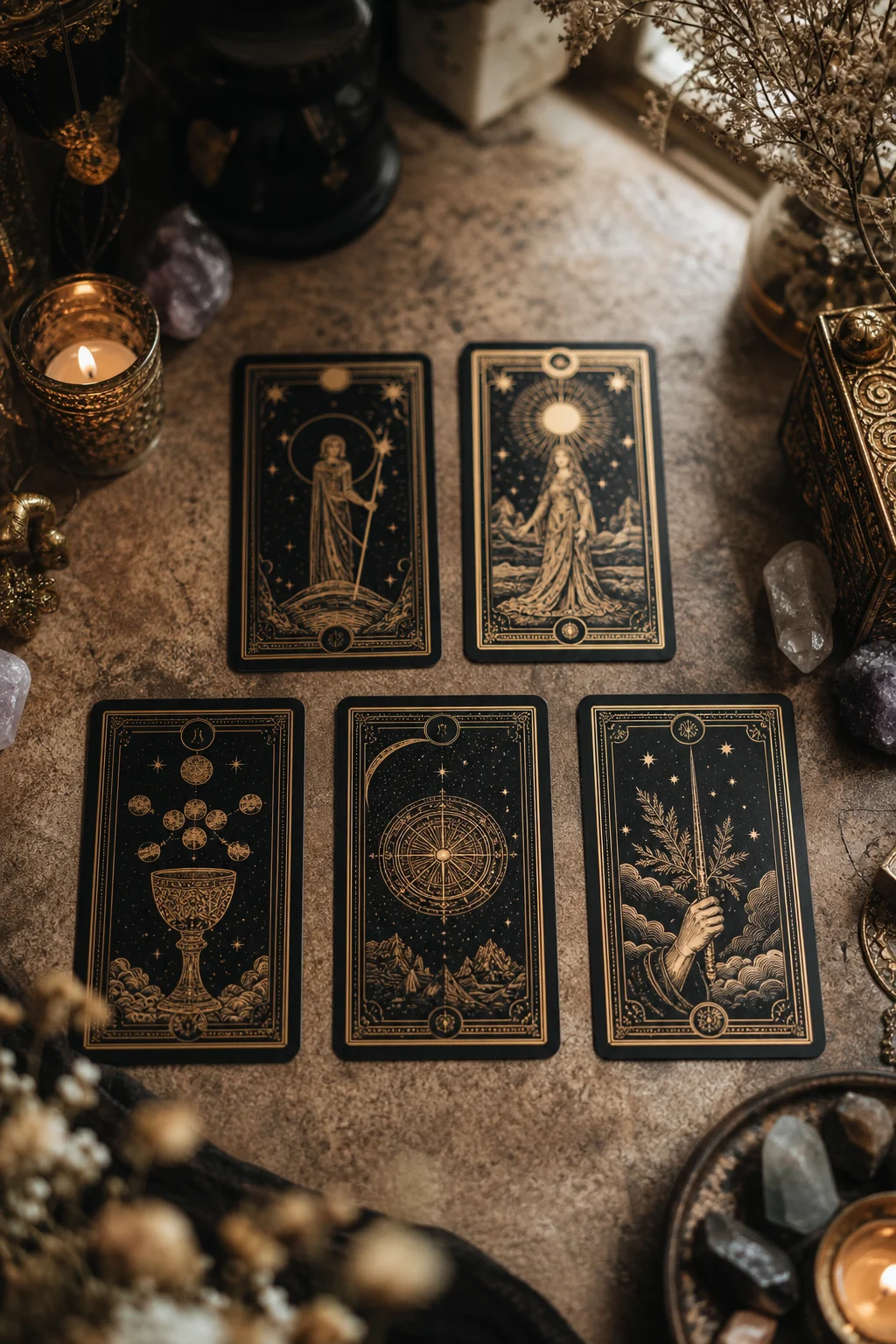
I Drew One Card a Day for Six Months and Learned Almost Nothing
When I first started reading tarot, I did what every beginner does. I pulled a single card each morning, stared at it for a while, and tried to figure out what it meant for my day. The Fool showed up on a Tuesday. Did that mean I should take a risk? Be careless? Start something new? I had no idea, and the card wasn't talking.
This went on for six solid months. I filled a journal with one-card draws. Page after page of cards sitting there with no context, no narrative, no real connection to anything happening in my life. Some days the card felt spot-on. Most days it felt like throwing a dart at a dictionary and trying to write a poem with whatever word you hit.
The breakthrough came from someone I barely knew. I was at a small metaphysical shop in Austin, killing time before a dinner reservation. A reader named Carla was doing walk-in sessions in the back corner. I wasn't planning to get a reading, but the shop owner nudged me — "She's good, and she's got an opening."
Carla didn't pull one card. She laid out ten. The Celtic Cross. And in about fifteen minutes, she told me things about my career situation that I hadn't fully articulated to myself yet. Not psychic hotline nonsense — structured, layered interpretation. Each card's position told her something different. The card in the "crossing" spot explained what was blocking me. The card in the "foundation" spot revealed the root cause. It was like the difference between reading one sentence from a book and reading the whole chapter.
That night, I went home and started learning spreads. Not the fifty-card monster spreads you find in advanced books — the practical ones. The layouts that take a fuzzy question and turn it into something you can actually work with. That's what this article is about. Five spreads I use regularly, explained the way I wish someone had explained them to me when I was still doing that useless one-card daily draw. If you're brand new to tarot, check out my complete beginner's guide to reading tarot cards first, then come back here.
Why Spreads Matter More Than Individual Cards
Here's the thing nobody tells you at the start: a tarot card without a position is just a picture. The Eight of Swords means something very different if it represents "what's happening now" versus "what you're afraid of" versus "the outcome you're heading toward." A spread gives each card a job. It tells the card what question to answer.
Think of it like a sentence. Individual cards are words. A spread is the grammar that turns those words into meaning. "The Tower" by itself is alarming. "The Tower in the position of 'what you need to let go of'" — that's useful. That's something you can act on.
Spreads also solve the biggest problem with tarot: ambiguity. When you draw a single card, your brain fills in whatever narrative it wants. A spread forces structure. It says: here's the past, here's the present, here's where you're headed, and here's what you can do about it.
Working with spreads also helped me learn the cards faster. When you see the same card in different positions across multiple readings, you start understanding its range. The Three of Cups isn't just "celebration." In a past position it might mean "a friendship that shaped you." In an advice position it could mean "reach out to your people." Context teaches you nuance that memorizing guidebooks never will. And if you want to deepen your practice, cleansing your tools regularly keeps the energy clear — yes, I'm one of those people now.
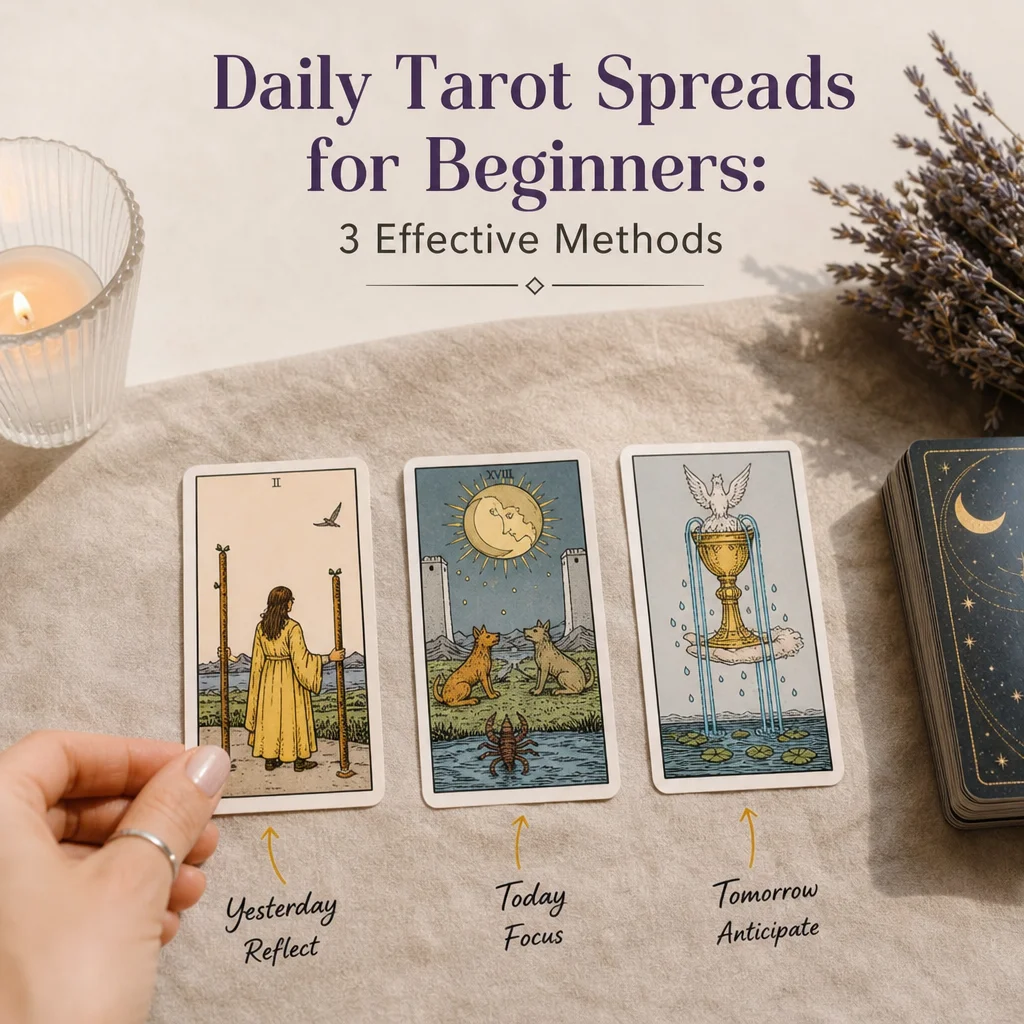
Spread 1: Past-Present-Future (The One That Started It All)
This is the spread Carla showed me first after the Celtic Cross blew my mind. It's three cards. Left, center, right. That's it. But don't let the simplicity fool you — this layout handles about seventy percent of the questions people bring to tarot.
How to Set It Up
Shuffle your deck while thinking about your question. It doesn't have to be a formal question — "what's going on with my job situation" works fine. Cut the deck into three piles, restack them, then deal three cards from the top in a row from left to right.
- Card 1 (Past): What led to this situation. Not necessarily ancient history — could be last week. This card shows influences or events that set the stage.
- Card 2 (Present): Where things stand right now. This is often the most revealing card because it shows you something you're not seeing clearly in the moment.
- Card 3 (Future): Where this is heading if nothing changes. Notice I didn't say "what will definitely happen." It's a trajectory, not a prophecy.
Example Reading
Here's a real reading I did for a friend frustrated at work. She asked: "Is there any point in staying at this company?"
Past — Eight of Pentacles: She'd been grinding. Putting her head down, doing good work, building skills. She'd invested a lot into this role.
Present — Four of Cups: Apathy. Someone offering her something she's not noticing because she's so checked out. I asked if any opportunities had come up recently. She paused — a colleague had mentioned a role at another company last month. She'd barely registered it.
Future — Page of Swords: A new idea or message coming in. Curiosity returning. Not a dramatic exit — more like a shift in mindset that opens a door.
The reading wasn't "quit your job" or "stay forever." It was: you've built something real, but you're numb to new possibilities. Start paying attention. That's what a spread does that a single card can't — it tells a story with a beginning, middle, and direction.
Spread 2: The Versatile Three-Card (Not Just Past-Present-Future)
Here's something I wish I'd known earlier: the three-card spread is a template, not a fixed assignment. The magic is in what you assign to each position. Past-Present-Future is just one configuration. Once you understand that, you've got a Swiss Army knife that handles almost any question.
Some configurations I use regularly:
- Situation / Action / Outcome: Perfect for "what should I do about X" questions. Card one tells you where you are, card two tells you what move to make, card three shows the likely result.
- Me / Them / The Relationship: For questions about another person. Not just romantic — I've used this for work conflicts and family dynamics too.
- Fear / Hope / Advice: When someone is anxious and spinning. This one cuts through the noise by separating what they're worried about from what they actually want.
- Stop / Start / Continue: A practical check-in spread. What's not working, what to try, what to keep doing.
The reason this works so well is that three cards are enough to show a relationship between ideas but not so many that you get lost in interpretation. It's also fast. I can do a three-card reading in five minutes, which means I actually do them instead of saving tarot for some elaborate ritual I never have time for. If you're building a daily practice, try shuffling with intention first, then pulling three cards with the Stop/Start/Continue framework. It turns a random draw into genuine self-reflection.
Spread 3: The Celtic Cross (Demystified at Last)
Every tarot book includes the Celtic Cross. Every beginner stares at it with a mix of reverence and terror. Ten cards. Positions with names like "the crossing card" and "the crown." It's really just a story about your question told from ten different angles.
Here's what each position means in plain language:
The Cross (Cards 1-6)
- Card 1 — The Heart: The core of the situation. What this reading is really about, underneath whatever question was asked out loud.
- Card 2 — The Crossing: The challenge or tension. This card lies sideways across Card 1. It represents what's complicating things. Sometimes it's an external obstacle. Often it's an internal conflict you haven't admitted.
- Card 3 — The Foundation: The root cause. Something from the past that's driving the current situation. Not always obvious — this card frequently surprises people.
- Card 4 — The Recent Past: What just happened or is fading. Context for the present moment.
- Card 5 — The Crown: What's on your mind. Consciously thinking about. This is often what people say the reading is about, while Card 1 is what it's actually about.
- Card 6 — The Near Future: What's coming into the situation soon. The next development.
The Staff (Cards 7-10)
These four cards line up vertically to the right of the cross. They represent your relationship to the situation at different levels.
- Card 7 — You: Where you stand emotionally or psychologically. Your attitude toward the situation.
- Card 8 — Environment: Outside influences. Other people, circumstances, the broader context.
- Card 9 — Hopes and Fears: These often overlap. What you want and what you're afraid of are usually two sides of the same coin.
- Card 10 — Outcome: The most likely result if things continue on their current path. Not fate — a forecast based on present conditions.
How to Actually Use It
Read the cross first (cards 1-6) as a snapshot of the situation. Then read the staff (7-10) as your personal relationship to that situation. The two halves inform each other.
The Celtic Cross isn't for every question. It's overkill for "should I text my ex." It shines for complex situations — a career crossroads, a relationship cycling through the same argument, a big decision with multiple moving parts.
Spread 4: Yes/No Spreads That Actually Give Clear Answers
Yes/no questions are controversial in tarot circles. Some readers refuse to do them. I think that's silly — real life often comes down to "do I or don't I?" The trick is using a spread that gives you yes or no plus context.
My preferred method: draw three cards. Upright cards with positive associations count as "yes." Reversed or challenging cards count as "no." Majority wins. But here's the important part — read the cards as a narrative regardless of the tally. Two Swords cards and a Sun card might technically be "no," but the story is "you're overthinking this, and one option actually looks promising."
Another approach: a five-card spread. Card 1 is the question. Card 2 is "what yes looks like." Card 3 is "what no looks like." Card 4 is what you're not considering. Card 5 is the best path forward — which might not be either/or at all. This version forces you to imagine both outcomes fully before deciding.
Spread 5: Mind-Body-Spirit (For When Life Feels Off)
This is my go-to when someone says "something feels wrong but I can't pinpoint it." Three cards, three positions. Simple. But it tends to cut right to the issue because most problems have a physical component, a mental component, and a deeper component that's harder to name.
- Mind: What's occupying your thoughts. Your conscious concerns, anxieties, or mental patterns. Often shows up as Swords cards for me.
- Body: Your physical situation — health, environment, tangible circumstances. Pentacles frequently land here, and when they don't, that itself is information.
- Spirit: The deeper current. What your intuition knows that your conscious mind hasn't caught up to yet. Cups and Major Arcana tend to show up here.
I use this spread weekly. Sometimes all three areas are aligned — good sign. Sometimes the Mind card is frantic while the Spirit card is peaceful, which tells me I'm overthinking something that's actually fine. The Body card has surprised me by showing up as something I was physically neglecting — poor sleep, too much takeout, skipping walks.
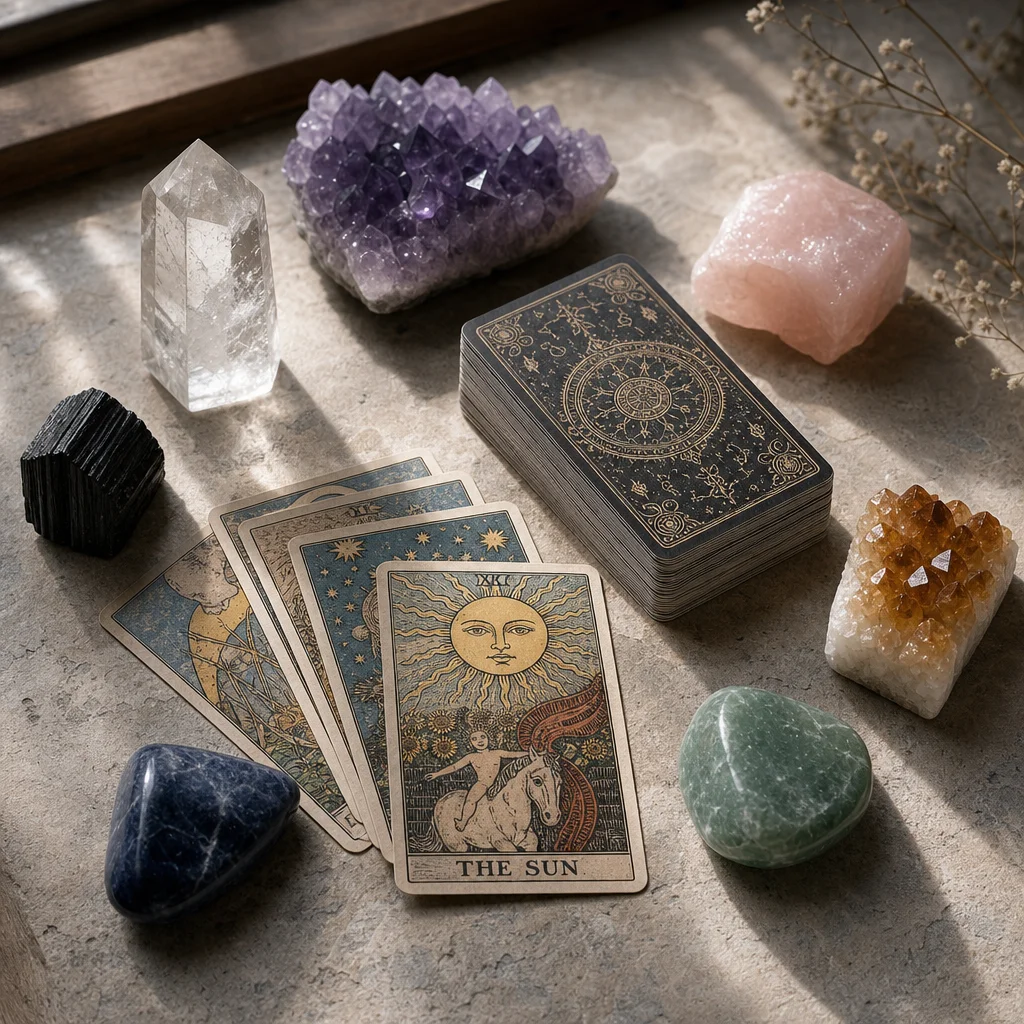
If you combine this with a regular crystal practice, you can assign a different stone to each position. Amethyst for mind, clear quartz for body, rose quartz for spirit. It helps you focus on each area separately instead of blending them together.
How to Choose the Right Spread for Your Question
After doing this for years, I choose spreads based on question type, and it's simpler than people make it:
- "What's going on?" — Past-Present-Future. The bread and butter. Works for anything narrative.
- "What should I do?" — Three-card with Situation/Action/Outcome positions. Direct and actionable.
- "This is complicated and I need to understand all the pieces" — Celtic Cross. Break out the big guns for big questions.
- "Should I or shouldn't I?" — Five-card yes/no with context positions.
- "Something feels off and I don't know what" — Mind-Body-Spirit. Diagnostic.
- "How does this person feel about me / what's happening between us?" — Three-card with Me/Them/Relationship.
Don't overthink it. The best spread is the one you'll actually use. A three-card spread done thoughtfully beats a Celtic Cross rushed through because you felt obligated to do something "proper."
Mistakes I Made (So You Don't Have To)
The biggest mistake beginners make with spreads is treating each position like a standalone reading. Cards in a spread relate to each other. If your Past card is the Three of Swords and your Present card is the Four of Swords, that's a story about heartbreak leading into healing. Read them together.
Another error: drawing too many cards. I've seen beginners lay out Celtic Cross readings twice a day. One good reading with time to sit with it beats five rushed ones.
Skipping the question is also a problem. If you don't have a question, the cards reflect that confusion back at you. Give the spread something to work with. And if you're new, my beginner's guide to reading tarot cards covers question formulation in detail.
Finally: don't reshuffle and redraw just because you don't like the cards. Someone pulls the Tower and immediately reshuffles because "that can't be right." Those challenging cards are often the most important ones. Sit with the discomfort. That's where the actual insight lives.
Three Ways to Practice Spreads Without Driving Yourself Crazy
1. The Weekly Three-Card: Every Sunday, pull Stop/Start/Continue for the week ahead. Write one sentence about each card. After a month, go back and read your entries. You'll see patterns — certain cards showing up repeatedly, themes recurring. That pattern recognition is how you actually get good.
2. Practice Reading on Resolved Situations: Think of a past situation that's already resolved. Do a Past-Present-Future spread about it. You know the outcome, so you can check your interpretation against what actually happened. It trains you to read in context without the pressure of not knowing.
3. The One-Spread Deep Dive: Pick Past-Present-Future or Mind-Body-Spirit and use it every day for two weeks with different questions. Same structure, different situations. You'll learn the positions inside and out. Depth beats variety when you're learning.
Frequently Asked Questions
Do I have to use a spread every time I read tarot?
No. One-card pulls have their place — daily check-ins, quick gut checks, learning individual cards. The problem is when one-card pulls are all you do. If you're trying to answer a real question with real stakes, a spread will always give you more useful information. Think of one-card draws as snacking and spreads as actual meals. Both are fine, but you can't live on snacks alone.
Can I create my own spreads?
Absolutely. Every spread in common use was invented by someone. Start by modifying existing spreads — change the position meanings in a three-card spread, or add a fourth position to Past-Present-Future for "advice." Once you understand why positions work, designing your own becomes intuitive. The key is keeping each position focused on a single question. "Tell me everything about my love life" is not a position. "What am I not seeing about my current relationship" is.
What if the cards in my spread seem to contradict each other?
Contradictions in a spread usually mean you're looking at a genuine tension in the situation, not that the reading is wrong. The Empress in your "fears" position and the Ten of Pentacles in your "hopes" position aren't fighting — they're showing you that your desire for stability and your fear of being tied down are both real and both active. That tension is the reading. Work with it, not around it. For more on asking the right questions that avoid this confusion, see my guide to asking tarot questions that get clear answers.
How long should I wait between readings on the same topic?
Long enough for something to change. If you do a Celtic Cross about your career on Monday and the same spread on Wednesday, you'll probably get similar cards because nothing has shifted. Wait until there's a new development — you had an interview, you made a decision, a week has passed and you've had time to process the first reading. Spreads are most useful when they reflect a moving situation, not a stuck one. Repeated readings on the same static question usually just amplify anxiety rather than provide new insight.
Related Guides
- Crystal Shapes Explained: Tumbled, Raw, Points, Spheres
- The Complete Guide to Crystal and Jewelry Care
- Complete Guide to Crystal Healing and Energy Work
- How to Clean Crystal Jewelry: A Complete Care Guide
- Clear Quartz: The Universal Crystal Guide
- 5 Practical Tests to Tell Real Crystals From Fakes
- How to Read Tarot Cards: Beginner Complete Guide
Frequently Asked Questions
Can I use crystals when doing my tarot spreads?
Absolutely! Pairing your favorite tarot spreads with natural crystals is a wonderful way to enhance your intuition and ground your energy. Simply place a handcrafted clear quartz or amethyst jewelry piece from SagStone next to your deck to clear the energy, or place specific stones directly on the cards. This beautiful ritual helps deepen your connection to the reading and clears away mental static.

Comments