How to Ask Tarot Questions That Actually Get
May 16, 2026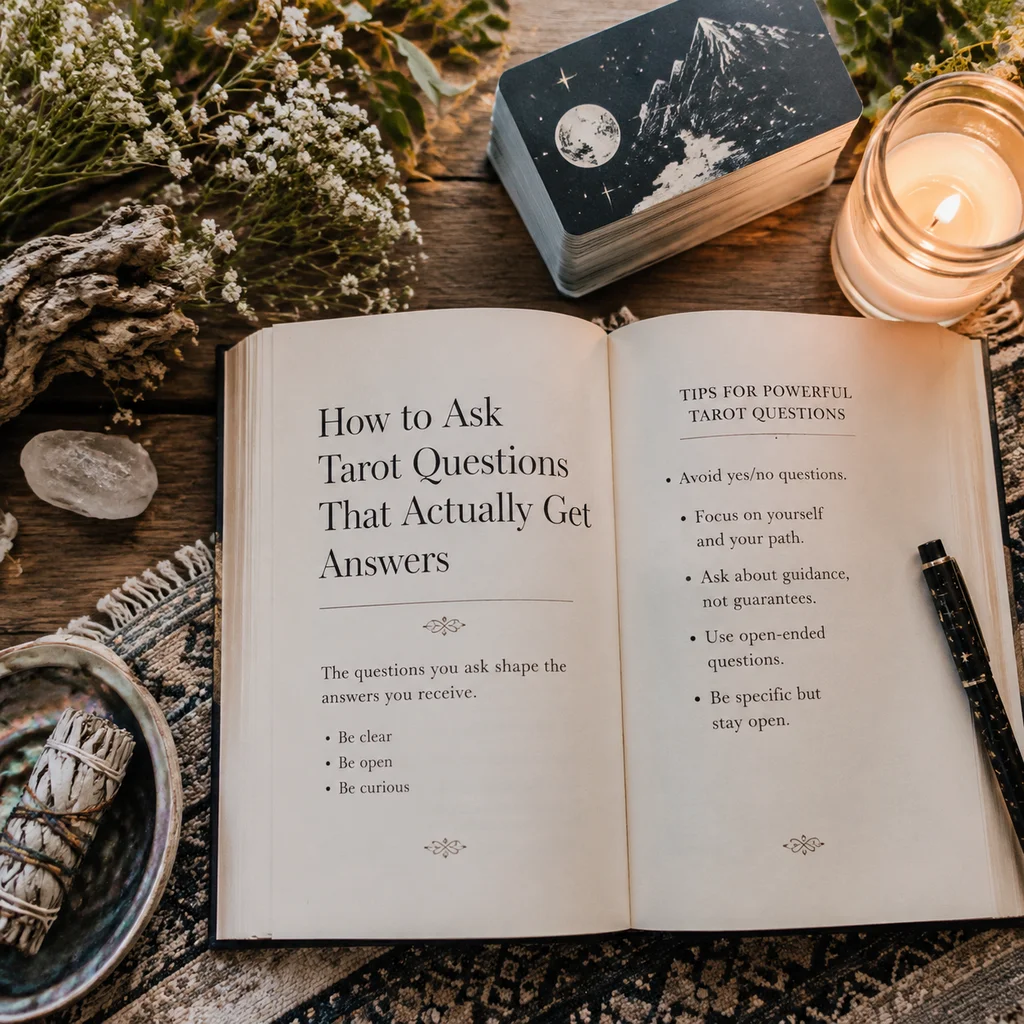
I Spent Years Asking Tarot the Wrong Questions
I used to ask tarot cards "What should I do about my job?" and got answers like "Go with the flow." Not helpful. I'd stare at the cards, shuffle again, ask the same vague question in a slightly different way, and get another non-answer. The Chariot would show up and I'd think "Okay, so I should... move forward? In what direction? At what speed?"
This went on for months. Maybe a year. I kept blaming the deck, blaming my shuffling, blaming the fact that I hadn't cleansed my cards properly. I bought new decks thinking maybe the Rider-Waite just wasn't "clicking" with me. I tried the Thoth deck. I tried a cheap novelty deck from a gift shop. Same result: vague questions produced vague answers, and I'd walk away from readings feeling more confused than when I started.
The problem wasn't the cards. It wasn't the deck, the spread, or whether I'd meditated beforehand. The problem was my questions. Tarot responds to what you actually ask, not what you meant to ask. If your question is muddy, your reading will be muddy. If your question is broad enough to drive a truck through, the cards will give you an answer broad enough to drive a truck through.
I realized this one evening after a particularly frustrating reading about a relationship. I'd asked "What's going on with us?" and pulled the Three of Swords, the Hermit, and the Two of Cups. I spent an hour trying to reconcile heartbreak with solitude with partnership, going in circles. Then I reframed the question: "What can I do this week to improve communication with my partner?" The same cards suddenly made sense. The Three of Swords was pointing to an old hurt that kept resurfacing in arguments. The Hermit was suggesting I needed to sit with my own feelings before trying to talk. The Two of Cups was confirming the connection was still there, just buried under unspoken stuff.
Same cards. Same spread. Completely different reading, because I finally asked a question the cards could work with.
If you're just getting started with tarot and haven't built this habit yet, our beginner's guide to reading tarot cards walks through the basics. But even experienced readers fall into the trap of lazy questions. This article is about fixing that — permanently.
Good Questions vs Bad Questions: A Framework
Here's the thing most tarot books won't tell you: there's no such thing as a "wrong" tarot question, but there are questions that waste your time and questions that earn you clarity. The difference comes down to three dimensions.
Specific vs Vague
A vague question gives the cards too much room to wander. "Tell me about my career" could mean anything — are you asking if you'll get promoted? Whether you should change industries? If your boss likes you? The cards will pick a direction, and it probably won't be the one you cared about.
A specific question narrows the field. "What strengths can I leverage to advance in my current role?" gives the cards something concrete to work with. You might pull the Eight of Pentacles (your dedication to skill-building) or the King of Swords (your analytical abilities). Now you have something actionable.
Open-Ended vs Yes/No
Yes/no questions aren't useless, but they're limited. "Will I get the job?" produces a binary answer that doesn't help you prepare. "What should I focus on during my interview to improve my chances?" gives you homework. One tells you to wait and hope. The other tells you to act.
That said, sometimes a direct answer is what you need. "Is this friendship worth saving?" might give you the honest kick you've been avoiding. Just know that yes/no questions tend to produce less nuanced readings.
Self-Focused vs External
This is the big one. Questions about other people — "Does my ex miss me?" "What is my boss thinking?" — are hit or miss because you're asking the cards to speculate about someone else's inner world. Tarot works best when you ask about yourself: your actions, your feelings, your options. "How can I process my feelings about my ex?" will always produce a more useful reading than "Does my ex still think about me?"
If you're combining tarot with crystal work for deeper self-inquiry, our guide to tarot reading and crystal combinations has practical pairings that sharpen your focus.
Categories of Questions That Actually Work
Here's a cheat sheet of question templates organized by life area. Steal these, modify them, make them yours. They work because they're specific enough for the cards to grab onto and open enough to produce nuanced answers.
Career
- "What's holding me back from advancing in my career right now?"
- "What skills should I develop to move toward the role I want?"
- "How can I improve my relationship with my current manager?"
- "What should I consider before accepting this job offer?"
- "What's the blind spot in my approach to job searching?"
Love and Relationships
- "What patterns am I repeating in my relationships?"
- "How can I show up better for my partner?"
- "What do I need to heal before I'm ready for a new relationship?"
- "What's the real source of the tension between me and my partner?"
- "What am I not seeing about this relationship?"
Health and Wellbeing
- "What's draining my energy that I haven't acknowledged?"
- "How can I build a more sustainable daily routine?"
- "What's one habit I should focus on changing this month?"
- "What's my body trying to tell me that I keep ignoring?"
Notice none of these ask the cards to predict illness or prescribe treatment. Tarot isn't a substitute for medical advice. But it can point out what you've been avoiding — stress you're pretending isn't there, rest you keep postponing.
Personal Growth
- "What belief about myself is ready to be released?"
- "What strength have I been underestimating?"
- "What lesson keeps showing up in my life that I haven't learned yet?"
- "How can I get out of my own way?"
These questions tend to produce the most honest, sometimes uncomfortable readings. That's the point. If your tarot practice never makes you squirm a little, you're probably playing it too safe with your questions.
5 Questions You Should Stop Asking Tarot
These come up constantly in tarot forums, and they almost always produce confusing or misleading readings. Not because the cards are wrong, but because the questions are fundamentally misaligned with how tarot works.
1. "When will I meet my soulmate?"
Tarot is terrible at predicting specific dates. The cards deal in themes, energies, and archetypes — not calendar invites. A better question: "What can I do to become the kind of person who attracts the relationship I want?"
2. "Does [specific person] love me?"
This asks the cards to read someone else's mind, which they can't reliably do. You'll get cards that reflect your own hopes and fears, not the other person's feelings. Reframe it: "What do I need to know about this relationship?"
3. "Will I be rich?"
Too vague, too binary, too dependent on variables tarot can't account for. Try: "What's my current relationship with money, and how can I improve it?"
4. "What's going to happen to me?"
This hands all your agency to the cards. Tarot works best when you're an active participant, not a passive recipient of prophecy. A better approach: "What should I be paying attention to right now?"
5. "Should I [specific action]?"
"Should" questions treat tarot like a magic 8-ball. They skip the thinking part and go straight to seeking permission. Reframe: "What do I need to consider before making this decision?" This gives you information to work with instead of a yes/no verdict.
If you're working on improving your overall tarot practice — not just your questions — check out our guide on how to shuffle tarot cards properly. A good shuffle sets the stage for a good reading, and a good question completes the picture.
How to Frame Questions for Better Answers
Framing isn't about finding the "perfect" wording. It's about understanding what you actually want to know, then asking for that directly. Most bad tarot questions come from not knowing what you're really asking.
Start With Your Emotion, Not Your Situation
Before you even touch the cards, sit with the feeling behind your question. You might be asking about a job offer, but the real question is about security. You might be asking about a relationship, but the real question is about self-worth. When you can name the underlying emotion, your question gets sharper.
"I'm anxious about this job offer" becomes "What's making me feel uncertain about this opportunity, and is that uncertainty justified?"
"I'm lonely" becomes "What's keeping me from building deeper connections with the people already in my life?"
Use "What" and "How" Instead of "Will" and "When"
"What" and "how" questions open doors. "Will" and "when" questions close them. Compare:
- "Will my business succeed?" vs "What's the biggest risk to my business right now, and how can I address it?"
- "When will things get better?" vs "What's one thing I can do this week to improve my situation?"
- "Will I find love?" vs "What patterns in my dating life should I examine?"
The second version of each pair gives you a roadmap. The first version gives you a coin flip.
Add a Time Frame
Open-ended questions without time boundaries tend to produce sprawling readings that cover everything and resolve nothing. Adding a time frame narrows the focus: "What should I focus on in my career over the next three months?" is more actionable than "What does my career future look like?"
Ask One Thing at a Time
Compound questions — "What about my career and my love life and also my health?" — produce muddled answers because the cards can't address three different life areas simultaneously in a single pull. Do separate readings for separate topics.
For more on building a tarot practice that actually supports your daily life, our beginner's guide to crystal meditation pairs well with regular tarot journaling — both are practices that reward consistency over intensity.
Self-Reflection Questions vs Action Questions
Not all tarot questions need to produce a to-do list. Some questions are designed to help you see yourself more clearly. Others are designed to help you decide what to do next. Knowing which type you need changes how you phrase the question.
Self-Reflection Questions
These ask the cards to hold up a mirror. They're about awareness, not action. Examples:
- "What am I refusing to see about this situation?"
- "What part of myself have I been neglecting?"
- "What story am I telling myself that isn't true?"
Expect these readings to be uncomfortable. The cards will show you what you've been avoiding, and that's the point. Self-reflection readings often feature cards like The Moon, The Hermit, and the High Priestess — all cards associated with turning inward and facing what's hidden.
Action Questions
These ask the cards for practical guidance. They're about next steps, not introspection. Examples:
- "What's the most productive way to handle this conflict?"
- "What step should I take first toward [specific goal]?"
- "What should I say in this difficult conversation?"
Action readings tend to bring out cards like The Chariot, the Eight of Wands, and the Page of Pentacles — cards associated with movement and initiative.
There's no rule saying you can't do both in the same session. Just be clear about what you're asking. A reading that starts with "What am I not seeing?" and follows up with "Given that, what should I do?" is a solid two-part structure.
Questions About Timing: What Works and What Doesn't
Tarot and timing have a complicated relationship. The cards can show you the energy around a situation, but they don't work like a calendar. Understanding this distinction will save you from readings that feel like missed predictions.
Present-Focused Questions Work Best
"What's happening in my career right now that I need to address?" gives you a snapshot of current energy. The cards respond well to present-tense questions because they're reading the momentum of what's already in motion.
Near-Future Questions Are Possible With Caveats
"What's likely to unfold in my relationship over the next month if I continue on my current path?" is workable because it's conditional. It's not predicting the future — it's projecting the present trajectory. The caveat: if you change your behavior, the trajectory changes. Tarot shows you the current direction, not a fixed destination.
Distant-Future Questions Are Mostly Noise
"Where will I be in five years?" produces readings so vague they're practically useless. Too many variables, too many decision points between now and then. If you want to use tarot for long-term planning, break it into smaller chunks: "What should I focus on this quarter to move toward my long-term goal?"
Timing Cards Are Real, But Tricky
Some readers associate suits with time frames — Wands for days or weeks, Cups for weeks or months, Swords for months, Pentacles for years. Other readers use the numbers on the cards. These systems exist, but they're interpretive frameworks, not guarantees. Don't base major life decisions on a timing guess from a card pull.
For more on integrating timing awareness into your broader spiritual practice, check out our guide on cleansing crystals during the full moon — lunar cycles are one timing framework that pairs naturally with regular tarot pulls.
5 Journal Prompts to Sharpen Your Tarot Questions
Question-asking is a skill, and like any skill, it improves with practice. These journal exercises are designed to train your brain to formulate better tarot questions before you even touch a deck.
1. The "What Do I Actually Want?" Prompt
Write down the question you're planning to ask the cards. Then write: "What I really want to know is ___." Keep going until you hit the core concern. The first version is usually surface-level. The third or fourth version is the one worth asking.
2. The Reframing Drill
Take five vague questions ("Will I find love?" "What about my career?" etc.) and rewrite each one as a "what" or "how" question. Do this regularly and it becomes automatic. Example: "Will I get promoted?" becomes "What can I do in the next month to demonstrate readiness for the next level?"
3. The Post-Reading Autopsy
After a reading that felt confusing or unsatisfying, don't reshuffle — journal. Write down the question you asked, the cards you pulled, and why the answer didn't land. Nine times out of ten, the problem was the question, not the cards. Documenting these moments trains you to spot weak questions before you pull.
4. The One-Week Question Fast
For one week, before every reading, write your question down and sit with it for at least five minutes. Don't pull cards until you can explain clearly why you're asking this specific question right now. This builds intentionality and prevents lazy, knee-jerk questions.
5. The Emotion-to-Question Bridge
Name one emotion you're feeling today (anxious, hopeful, frustrated, stuck). Then write: "I feel [emotion] because [situation]. What I need guidance on is ___." This exercise connects your emotional state to a focused question, which is exactly what good tarot questions do.
For more on combining journaling with your spiritual practice, our article on crystal journaling covers tracking methods that work just as well for logging your tarot questions and readings.
Frequently Asked Questions
Can I ask the same question twice?
You can, but it's usually a sign you didn't like the first answer. If you feel compelled to ask again, ask yourself why before reshuffling. Are you hoping for a different response? That's a conversation worth having with yourself, not the cards. If the situation has genuinely changed — new information, new circumstances — then a fresh reading makes sense.
Do I need to ask my question out loud?
No. Some readers speak their questions aloud; others hold them silently. What matters is clarity, not volume. I personally write my questions down before a reading because it forces me to be precise. Saying "I don't know what to ask" out loud tends to produce equally vague results as thinking it.
What if I can't think of a good question?
If you're drawing a blank, that's useful information. It usually means you're overwhelmed, disconnected from your feelings, or trying to read about something you're not ready to face. Try pulling a single card with no question at all — just "What do I need to know right now?" The card you get will often point you toward the question you should be asking.
How do I know if my question is good enough?
A good tarot question passes three checks: (1) You could explain it to a friend in one sentence and they'd know exactly what you're asking. (2) It focuses on you, your actions, or your perspective — not someone else's. (3) You're open to hearing an answer you might not like. If your question clears all three, you're ready to pull.
Ready to put these questions into practice? Start with our complete beginner's guide to reading tarot cards and use the question frameworks above in your next session. The difference will be obvious — better questions produce readings you can actually use.
Related Guides
- How to Tell if a Crystal Bracelet Is Real or Fake
- How to Clean Crystal Jewelry: A Complete Care Guide
- Crystal Pricing: 7 Tricks Shops Use to Make You Overpay
- Crystal Care 101: How to Clean, Store, and Protect Your Jewelry
- The Complete Guide to Crystal and Jewelry Care
- Complete Crystal Guide: Identification and Meanings
- How to Cleanse and Charge Your Crystals: Methods That Actually Work



Comments