Mala Beads for Travelers: Sacred Beads for Sa...
June 5, 2026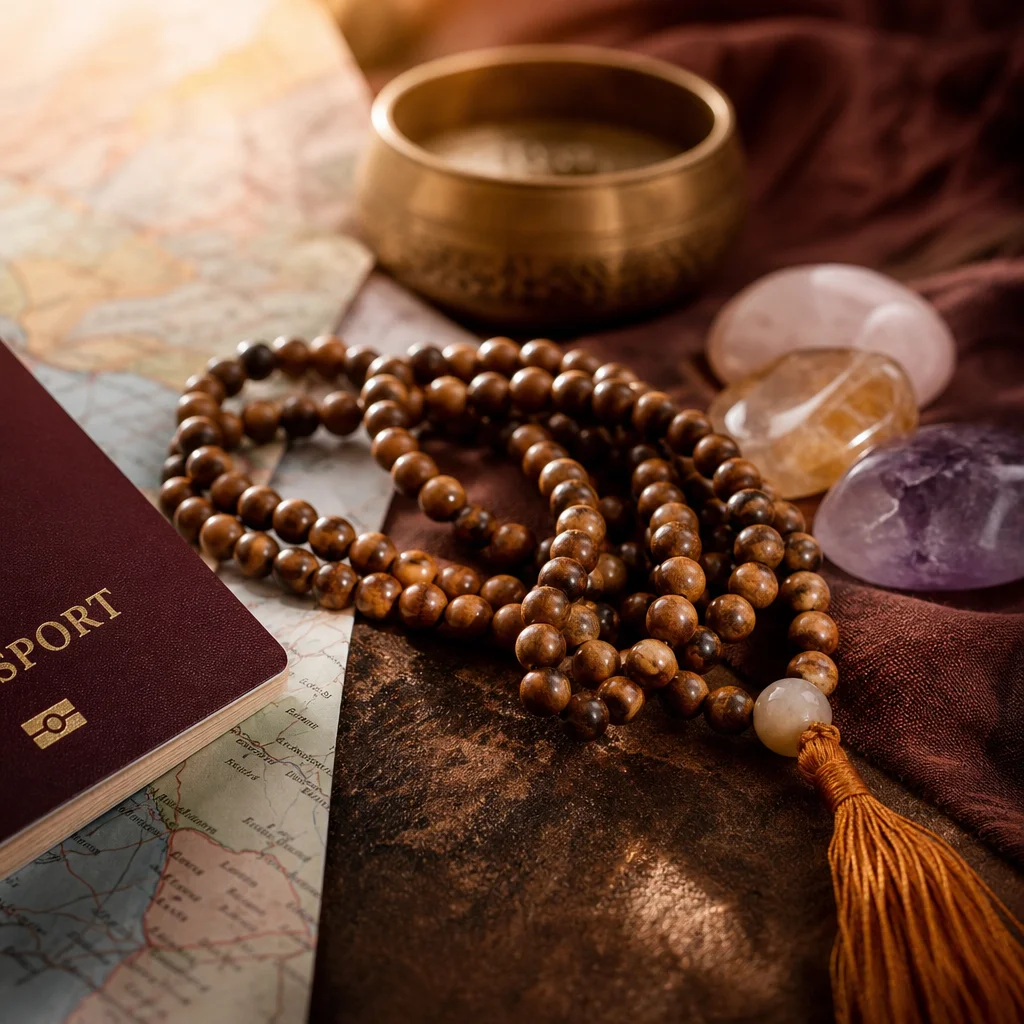
Traveling with Mala Beads: An Ancient Practice
Pilgrimage beads have a long history across spiritual traditions. Buddhist monks walking the Silk Road carried prayer beads through some of the harshest terrain on Earth. Catholic pilgrims on the Camino de Santiago counted rosary beads across hundreds of miles. Hindu sadhus traveling between sacred sites wore Rudraksha malas that accumulated the energy of every temple visited.
The practice makes practical sense beyond the spiritual dimension. When you're in an unfamiliar city, dealing with flight delays, navigating language barriers, or simply adjusting to a new time zone, having a consistent meditation anchor provides genuine psychological stability. The tactile sensation of finger-over-bead creates a familiar, grounding ritual that works whether you're in your bedroom or a hotel room 5,000 miles from home.
This guide covers how to choose travel malas, which stone and wood combinations work best for different types of travel, and practical meditation routines you can do in airports, train stations, and hotel rooms.
Crystals are not a substitute for medical treatment. Always carry necessary medications and follow travel health advisories.
Wrist Mala vs. Full 108: Which Is Better for Travel?
Wrist Malas (16-27 Beads): The Practical Choice
For most travelers, a wrist mala is the better option. They're lightweight (typically 15-30 grams compared to 80-150 grams for a full 108 mala), fit under a sleeve during meditation, and don't draw attention in countries where religious jewelry might be unusual or misunderstood. A 21-bead wrist mala can be used for shorter meditation sessions — three cycles through the beads gives you 63 repetitions, which takes about 8 minutes at a comfortable pace.
Wrist malas also handle the physical realities of travel better. Full 108 malas can get tangled in backpack straps, caught on airplane tray tables, or damaged when shoved into a pocket. A wrist mala stays secure on your wrist throughout the path.
Full 108 Malas: The Deep Practice Choice
If your travel includes a significant meditation or spiritual component — a yoga retreat in Bali, a Vipassana course in India, a temple visit in Kyoto — then a full 108 mala is worth the extra weight. The traditional 108-bead count supports complete Japa meditation sessions, and the full mala loop can be worn wrapped around the wrist as a bracelet when not in active use.
For protection during travel, a full 108 mala worn around the neck creates an unbroken circle of stone energy from the throat down to the solar plexus. Many practitioners find this more effective than a wrist mala for creating a sense of energetic safety during uncertain travel situations.
The Traveler's Dilemma: Durability vs. Fragility
This is the single most important consideration when choosing travel mala beads. Some of the most powerful healing stones are also the most fragile, and travel puts jewelry through conditions that home wear simply doesn't — temperature fluctuations, altitude changes, pressure differences in luggage, and the occasional knock against a door frame or car door.
Stones to Leave at Home
Any stone below Mohs hardness 5 should stay home during travel. This includes:
- Selenite (hardness 2) — can be scratched by a fingernail, fractures easily under pressure
- Celestite (hardness 3-3.5) — fragile crystal structure, shatters if dropped on hard surfaces
- Angelite (hardness 3.5) — absorbs moisture, can dissolve slowly in humid environments
- Azurite (hardness 3.5-4) — sensitive to heat and moisture, color can darken in tropical climates
- Fluorite (hardness 4) — has perfect cleavage planes, can split cleanly along crystal faces when struck
- Malachite (hardness 3.5-4) — contains copper, can release toxic copper compounds if it gets wet and then dries on skin (especially dangerous in humid tropical conditions)
Stones That Travel Well
These hardy stones can handle the bumps and bruises of travel:
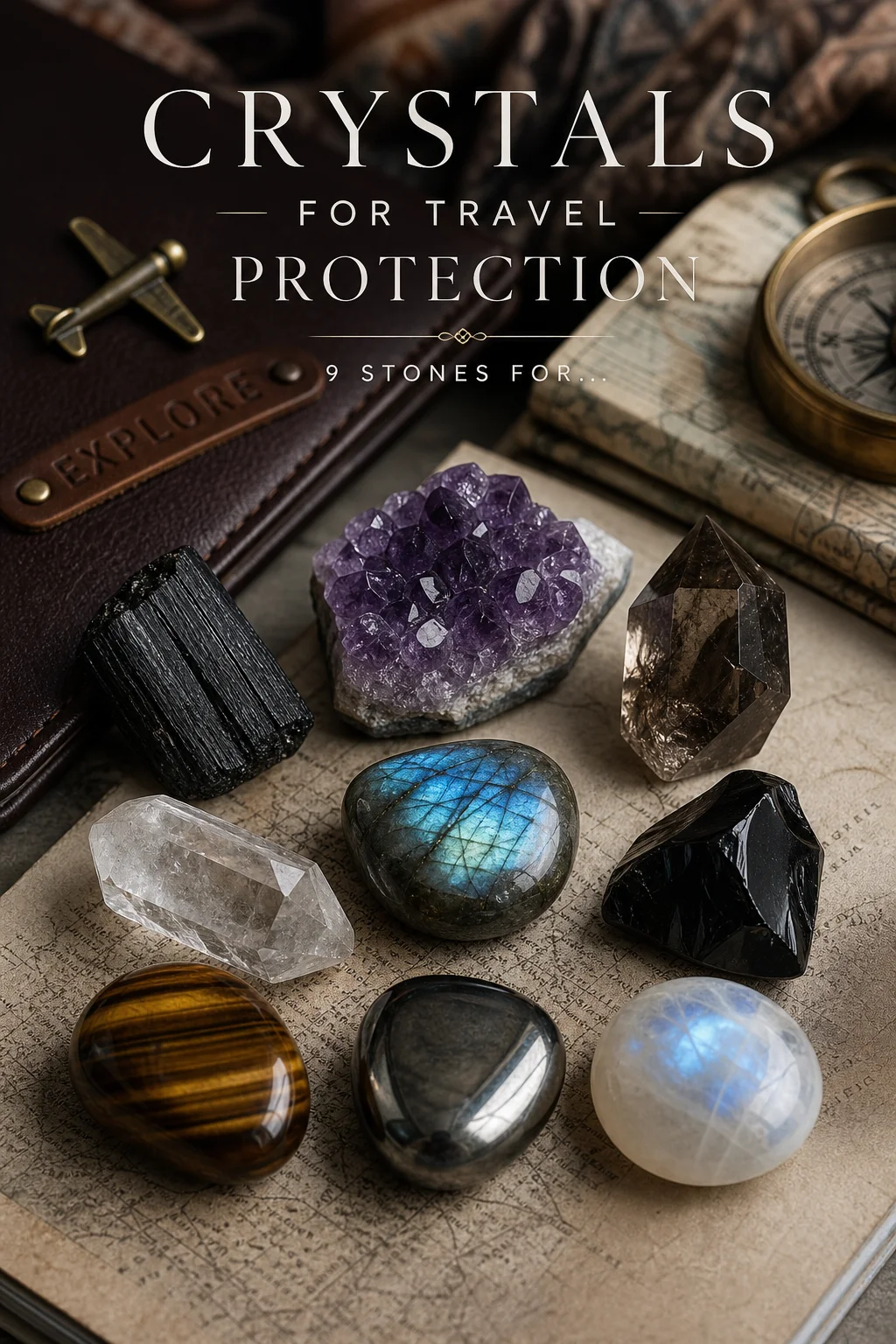
- Black Tourmaline (hardness 7-7.5) — virtually indestructible, excellent for travel protection
- Clear Quartz (hardness 7) — tough and versatile, works well in any mala combination
- Jasper (hardness 6.5-7) — one of the toughest ornamental stones, handles drops and impacts
- Amethyst (hardness 7) — durable enough for travel, though keep it out of prolonged direct sunlight (fading)
- Agate (hardness 6.5-7) — microcrystalline quartz, extremely resistant to chipping
5 Best Mala Combinations for Different Travel Types
1. Long-Haul Flight: Aquamarine + Clear Quartz
Flying creates unique energetic challenges — recycled cabin air, electromagnetic fields from avionics, close proximity to hundreds of stressed strangers, and the disorientation of crossing time zones. Aquamarine, named after the Latin aqua marina meaning "water of the sea," has a long maritime tradition. Sailors carried Aquamarine amulets for safe passage, and the association with water travel extends naturally to air travel in modern practice.
Clear Quartz paired with Aquamarine provides clarity and calm. For a travel wrist mala, alternate 11 Aquamarine and 11 Clear Quartz beads (22 total, a number associated with mastery and achievement in numerology). For a full 108 mala, use a 72 Aquamarine / 36 Clear Quartz split.
2. International Adventure: Jet + Black Tourmaline
Jet is a fossilized wood — specifically, the remains of Araucaria trees from the Jurassic period (approximately 180 million years ago) that were buried under sediment and subjected to intense pressure over millions of years. The Romans valued Jet as a travel protection stone so highly that they carved entire amulets from it. Pliny the Elder wrote about Jet's protective properties in his Natural History (77 CE).
Jet has a Mohs hardness of 2.5-4, which technically places it in the "fragile" category. However, Jet is less prone to shattering than other soft stones because its organic origin gives it a slightly tougher, more fibrous structure. It's warm to the touch and lightweight, making it comfortable for extended wear during travel. Pair it with Black Tourmaline for electromagnetic shielding on long flights. Use Jet as the larger beads and Black Tourmaline as the smaller beads in a wrist mala design.
3. Road Trip: Red Jasper + Tiger's Eye
For ground travel, you want stones associated with the earth element — literally stones that connect you to the ground beneath your wheels. Red Jasper has been used as a protective travel stone across virtually every ancient culture that had access to it. Egyptian craftsmen carved Red Jasper into scarab amulets placed on the chests of mummified pharaohs for protection in the afterlife path. Native American tribes carried Red Jasper on hunting expeditions and long marches.
Tiger's Eye adds the quality of alertness and clear perception — useful when navigating unfamiliar roads or making quick decisions about routes and stops. A wrist mala of 12 Red Jasper and 12 Tiger's Eye beads (24 total) provides enough repetitions for a meaningful practice during rest stops.
4. Spiritual Pilgrimage: Sandalwood + Rudraksha
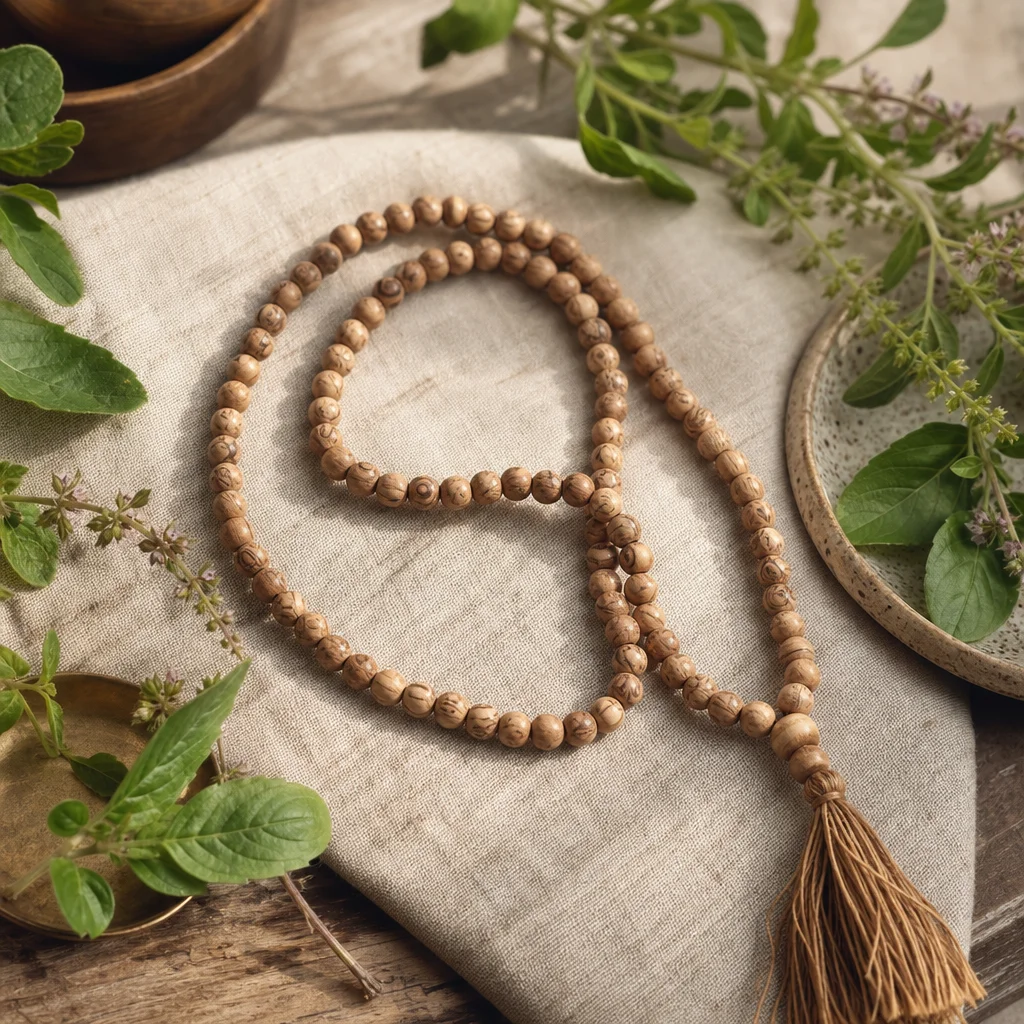
If your travel has a specifically spiritual purpose — visiting temples, attending retreats, sacred site tours — traditional materials carry cultural resonance that crystal malas don't. Sandalwood mala beads release a subtle, calming fragrance when warmed by body heat during meditation. In Buddhist practice, Sandalwood is believed to aid in deepening meditation and creating a protective, sacred atmosphere around the practitioner.
Rudraksha beads, seeds from the Elaeocarpus ganitrus tree, are sacred in Hindu tradition — the name comes from "Rudra" (a form of Shiva) and "aksha" (eyes), meaning "Shiva's tears." They're extremely durable (hardness comparable to hardwood), lightweight, and don't require any special care. A combined Sandalwood and Rudraksha mala is perhaps the most universally accepted travel mala across spiritual traditions.
5. Business Travel: Hematite + Lapis Lazuli
Business travel demands a different kind of energy — you need confidence, clear communication, and the ability to negotiate effectively while managing jet lag and schedule pressure. Hematite provides the grounding stability to stay calm in high-stakes meetings. Lapis Lazuli, prized by ancient Egyptian pharaohs and Renaissance painters alike, is associated with clear communication and intellectual clarity — its deep blue color has symbolized wisdom and truth across cultures for over 6,000 years.
For a wrist mala, use 9 Hematite and 9 Lapis Lazuli beads (18 total, a number associated with completion in many traditions). Note that Lapis Lazuli has a variable hardness of 5-6, so avoid wearing it during rough physical activities — save it for the meeting, not the hiking excursion.
Travel Meditation Routines
The beauty of mala meditation for travelers is that it requires no equipment, no special clothing, and no dedicated space. Here are three routines designed for specific travel moments:
Airport Meditation (5 Minutes)
Find a seat near your gate or in a quiet corner of the terminal. Hold your wrist mala and close your eyes. Breathe deeply three times. Then begin moving one bead per breath — inhale as you touch a bead, exhale as you move to the next. Use a simple mantra like "So Hum" (Sanskrit for "I am that"). A 21-bead wrist mala takes about 4 minutes at this pace. The rhythmic breathing alone will lower your heart rate and reduce cortisol — the stress hormone that spikes during travel anxiety.
Hotel Room Arrival (10 Minutes)
After checking in and unpacking, sit on the edge of the bed or on a cushion. This is your grounding practice after being in transit. Hold your full mala and begin a root chakra grounding meditation. Repeat the bija mantra "Lam" once per bead while visualizing roots growing from the base of your spine into the earth below the hotel. This creates an immediate sense of belonging and safety in an unfamiliar place. 108 repetitions take about 12-15 minutes.
In-Flight Meditation (15 Minutes)
During cruise altitude (when seatbelt signs are off), sit comfortably with your mala wrapped around your fingers. Close your eyes and focus on the sensation of each bead. Move slowly — one bead every 4-5 seconds, coordinating with a slow inhale and exhale. Count your breaths without the mantra for the first 27 beads, then switch to your chosen mantra for beads 28-108. This combination of breath awareness and mantra repetition is deeply calming and helps with the disorientation of time zone changes.
Packing and Security Considerations
A few practical notes that come from real travel experience:
TSA and security checkpoints: Bead malas rarely trigger metal detectors, but if your mala includes metal spacer beads (sterling silver or copper), be prepared to remove it. A quick explanation — "it's a meditation mala" — usually satisfies security personnel. Avoid malas with large metal guru beads or heavy chain tassels that look like weapons on X-ray screens.
Storage during flight: Don't wear a full 108 mala around your neck during takeoff and landing — the sudden pressure changes can affect stone settings and knots. Wrap it gently around your wrist or store it in a soft cloth pouch in your carry-on bag.
Humidity and tropical destinations: Wood malas (Sandalwood, Rosewood, Rudraksha) absorb moisture from humid air. This isn't inherently harmful but can cause the wood to swell slightly, making knots tighter. When you return to a dry climate, the wood contracts again. After tropical travel, let your wood mala air-dry at room temperature — don't apply heat to speed the process.
Altitude and cold: At high altitudes or in cold climates, some stones can feel noticeably colder to the touch. This is normal physics (thermal conductivity varies by mineral) but can be uncomfortable against warm skin. Layer a thin cotton cloth between your mala and skin in very cold environments.
Wood Mala vs. Crystal Mala for Travel: The Final Verdict
For general travel, wood malas (Sandalwood, Rudraksha, Rosewood, Olive Wood) are the most practical choice. They're lightweight, durable, culturally neutral, and don't attract attention. A high-quality Sandalwood mala can last decades with minimal care.
For specific travel purposes — protection during flights, grounding during road trips, confidence during business travel — crystal malas offer targeted energetic support that wood alone doesn't provide. The ideal setup is to travel with both: a durable wood wrist mala for everyday meditation, and a purpose-built crystal mala packed in your carry-on for situation-specific use.
FAQ
Can I take my mala beads through airport security?
In most countries, yes. Mala beads made from wood, seeds, or stone beads strung on thread or silk cord pass through security without issues. If your mala has significant metal components (large silver guru beads, metal tassels, or spacer beads), you may need to remove it at the checkpoint. Keep your mala in your carry-on bag during screening if it has any metal parts.
How do I cleanse my mala beads while traveling?
The simplest method is Selenite — carry a small Selenite wand or palm stone in your bag. Placing your mala on it overnight is enough to reset the energetic charge. You can also use sound cleansing by downloading a singing bowl recording on your phone and playing it near the mala for 3-5 minutes. For quick resets between meditation sessions, simply hold the mala in both hands, take 10 deep breaths, and set the intention to clear the accumulated energy.
What if my mala breaks while traveling?
If the string breaks, gather all the beads you can find and store them in a pouch until you can restring. Many practitioners see a broken mala as a sign that it has absorbed a significant amount of negative energy and protected you from something harmful — a message that its protective work for this path is complete. If you lose only one or two beads, you can often continue using the mala by tying a knot to bridge the gap until proper restringing.
Frequently Asked Questions
What are the best crystals for travel protection malas?
When selecting a handcrafted crystal mala for your journeys, Black Tourmaline, Amethyst, and Tiger's Eye are exceptional choices. Black Tourmaline is renowned for shielding against negative energies in crowded spaces. Amethyst promotes calm during stressful flights, while Tiger's Eye keeps you grounded and confident while exploring unfamiliar destinations. Choose the natural stones that best align with your personal travel intentions.
Can I wear my mala beads in the ocean or pool while on vacation?
It is best to remove your handcrafted mala before swimming. Saltwater, chlorine, and sunscreen can damage the threading cord and degrade natural crystals. Many softer stones become brittle or lose their polish when submerged in water. To preserve the physical beauty and energetic integrity of your artisan jewelry, always store your mala in a dry pouch while enjoying the beach or pool on your vacations.
Comments