Crystal Activities Kids Can Do Without Buying
May 14, 2026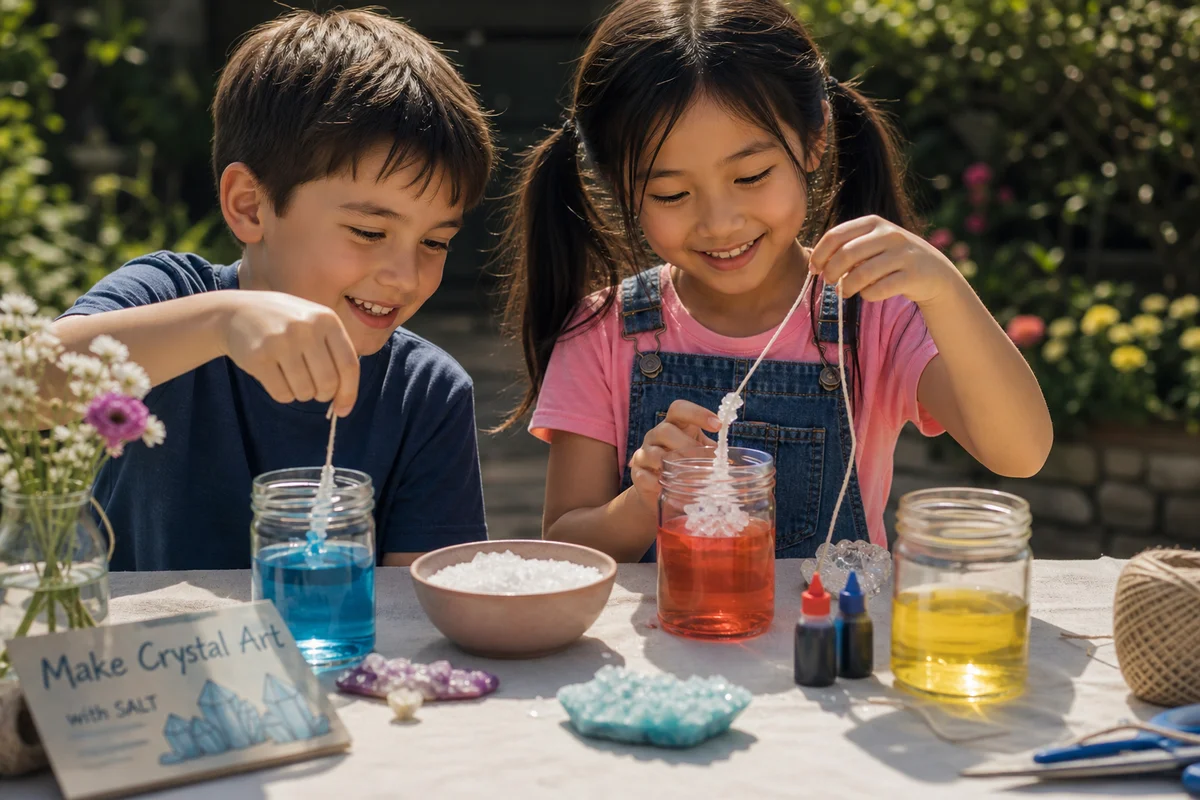
Crystal Activities Kids Can Do Without Buying Anything
Most "crystal activities for kids" articles suggest buying a rock tumbler ($80), a crystal growing kit ($25), or a mineral specimen set ($40). That's fine if you have the budget, but you don't actually need to spend money to get kids engaged with geology and mineralogy.
These activities use materials already in most households or can be done with free resources.
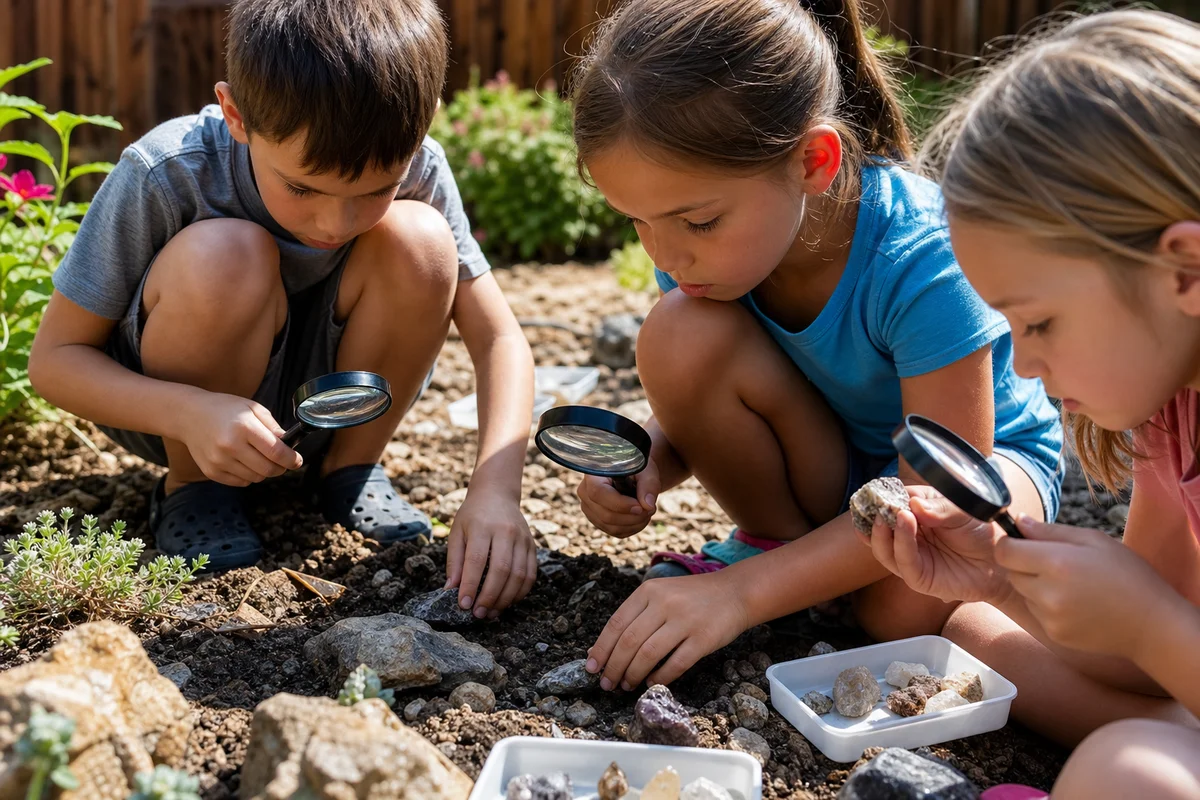
The Free Rock Hunt
This is the single best crystal activity for children, and it costs nothing. Go outside — backyard, park, schoolyard, creek bed, gravel driveway — and pick up interesting-looking rocks.
The activity isn't just "find rocks." It's about learning to observe:
- Color: Is it one color or multiple? Are the colors in layers, spots, or swirls?
- Luster: Does it shine like metal, look glassy, or appear dull and earthy?
- Texture: Smooth, rough, grainy, flaky?
- Hardness: Can you scratch it with your fingernail (Mohs 2.5)? With a penny (Mohs 3)? With a steel nail (Mohs 5.5)?
- Cleavage: Does it break in flat sheets, conchoidal (shell-like) curves, or irregular chunks?
Kids naturally sort and classify things. Give them an egg carton for sorting and they'll spend an hour organizing their finds by color, hardness, or whatever system makes sense to them. Crystal bingo cards add a game element — print them free from our resource page.
The Scratch Test Lab
You need: your fingernail, a penny, a steel nail or key, a piece of glass (old jar), and a piece of quartz (or another hard rock you found).
This is a simplified Mohs hardness test. The procedure:
- Try to scratch each rock with your fingernail. If it scratches, it's Mohs 1-2 (like talc or gypsum)
- Try the penny. Scratches? Mohs 2.5-3 (like calcite)
- Try the steel nail. Scratches? Mohs 4-5 (like fluorite or apatite)
- Try to scratch glass with the rock. If the rock scratches glass, it's Mohs 6+ (like quartz or feldspar)
Have kids record their results in a table. This teaches the scientific method: hypothesis ("I think this rock is hard"), test, observation, conclusion. No worksheets needed — a piece of paper and a pencil work fine.
Growing Salt Crystals on the Stove
You need: table salt, water, a saucepan, a jar, string, and a pencil or stick.
- Bring water to a near-boil in the saucepan
- Pour into the jar and stir in salt until no more dissolves (supersaturation)
- Tie the string to the pencil and hang it in the jar so the string dangles in the water but doesn't touch the bottom
- Wait 2-7 days
Salt (halite) crystals will grow on the string. They'll be cubic — halite has an isometric crystal system, so it naturally forms perfect little cubes. This is real crystallography, not just a craft project.
Extensions: try the same experiment with sugar (sucrose crystals are monoclinic — different shape), Epsom salts (epsomite crystals are orthorhombic), or borax (borax crystals form in a different structure). Comparing the crystal shapes teaches kids that different molecules produce different geometric patterns.
The Vinegar Test for Carbonates
You need: a small container of white vinegar and an eyedropper or spoon.
Drop vinegar onto different rocks. If the rock fizzes, it's a carbonate mineral (calcite, limestone, marble, dolomite). The acid in the vinegar reacts with the calcium carbonate, producing carbon dioxide gas — the bubbles you see.
This is the same test geologists use in the field. It's a genuine scientific identification method that kids can do with kitchen supplies. Try it on chalk (pure calcite — vigorous fizzing), seashells (made of calcium carbonate — definite fizz), and regular garden rocks (may or may not fizz).
Shadow Crystal Drawings
An art-meets-geology activity for younger kids. Place interesting rocks on paper in direct sunlight and trace the shadows at different times of day. The shadow changes shape and length as the sun moves.
With translucent stones (thin quartz slices, calcite rhombs, or even thick pieces of colored glass), you can explore how light passes through differently depending on thickness and angle. Crystal photography techniques like backlighting can be adapted for kids with a phone camera and a window.
Rock Storytelling
Each kid picks one rock and invents its life story: where did it come from? How old is it? What has it seen? This sounds like pure imagination, but it secretly teaches geological concepts.
A smooth, round rock was probably tumbled in a river. A flat, layered rock was likely sedimentary (compressed mud or sand). A rock with sparkly bits might contain quartz or mica. A heavy rock for its size might be iron-rich. A rock with fossils was once underwater.
After the storytelling, compare the stories with actual geological identification. Some of the "made up" origin stories will be surprisingly accurate, which reinforces that observation skills matter in science.
Free Digital Resources
If you have internet access but no budget:
- Google Earth: Explore famous geological sites virtually — the Giant's Causeway (basalt columns), Pamukkale (travertine terraces), Naica Mine (giant selenite crystals)
- YouTube: "crystal mining Arkansas," "volcanic crystals," and "how geodes form" have excellent free educational content
- Mindat.org: Free mineral database with photos of virtually every known mineral species
- Our backyard crystal mining guide covers what you can find in ordinary neighborhoods across the US
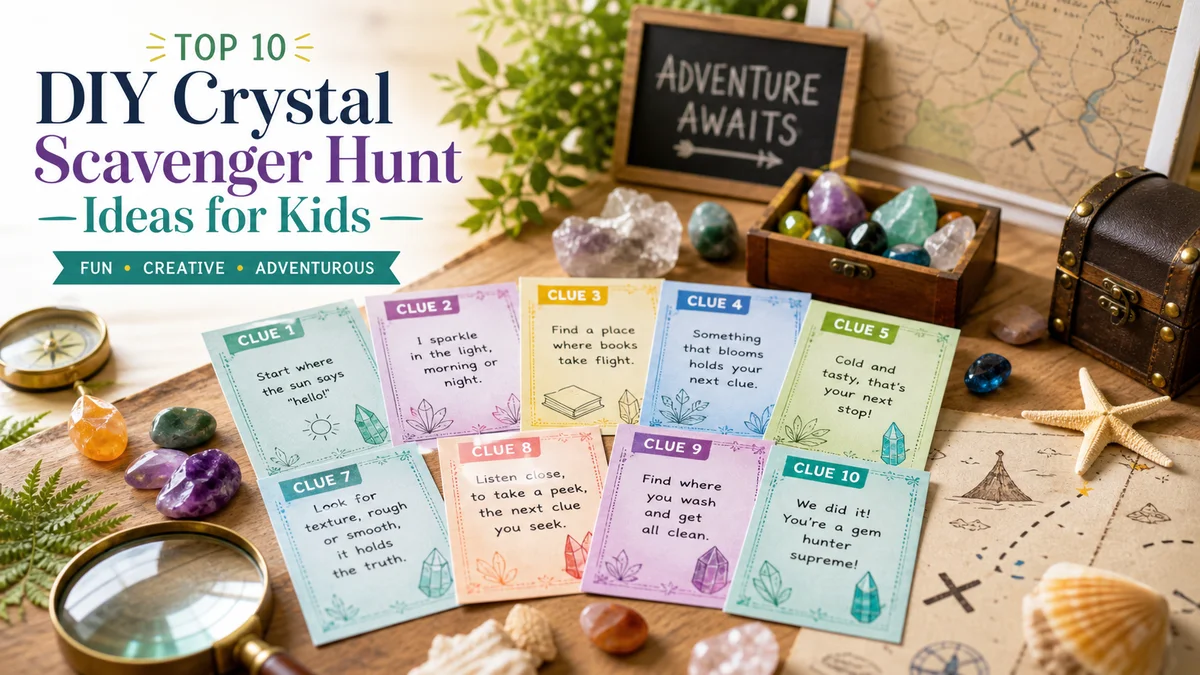
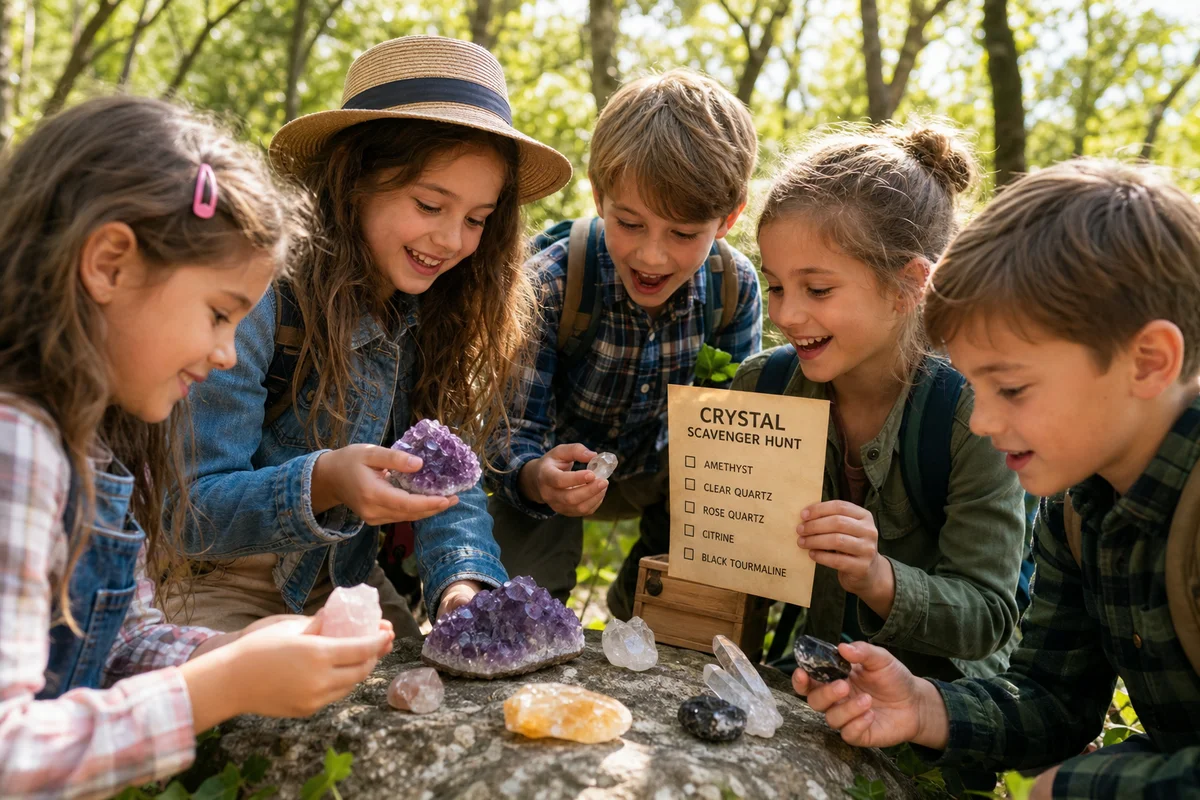
Crystal Scavenger Hunt
Our printable scavenger hunt can be adapted for free. Make a simple list of things to find outside:
- A rock that sparkles in sunlight (likely mica or quartz)
- A rock with stripes or layers (likely sedimentary)
- A rock smaller than your thumbnail
- A rock bigger than your fist
- A perfectly round rock
- A rock with two different colors
- A rock that feels unusually heavy for its size
- A rock that feels unusually light for its size (might be pumice)
The hunt gets kids outdoors, observing their environment, and thinking about physical properties — weight, color, texture, size. All core geological observation skills.
What Kids Actually Learn
These activities teach real science without feeling like school:
- Observation and classification — the foundation of all natural science
- The scientific method — hypothesis, test, observe, conclude
- Crystallography basics — crystals have geometric shapes determined by their molecular structure
- Mineral identification — hardness, reaction to acid, luster, cleavage
- Earth science — how rocks form, where minerals come from, why different places have different geology
The best part: none of this requires explaining these concepts upfront. Kids discover them through the activities. The adult's role is to ask "why do you think that happened?" and let them figure it out. That's actual scientific thinking, not memorization.
For more structured activities, our age-based crystal gift guide includes recommendations for educational materials at different developmental stages.
Creating Crystal Art with Household Items
Once you've gathered your rocks and crystals, it's time to get creative. Here's a simple way to make crystal art using items you probably already have at home.
- Materials: Rocks, clear nail polish, small paintbrushes, a flat surface like a table or countertop.
Paint your rocks with clear nail polish. Let them dry completely. You can paint them with a solid color, or use multiple layers to create a gradient. Once dry, your rocks will have a shiny, crystal-like finish. This is a great way to bring the beauty of crystals indoors and make your own unique pieces of art.
DIY Crystal Geode
Geodes are fascinating, and they can be made at home with a little patience and some household items. Here's how:
- Materials: A clear plastic bottle, baking soda, vinegar, a funnel, and sand.
1. Fill the bottle with sand, leaving about an inch of space at the top. 2. Using the funnel, fill the bottle with baking soda. 3. Add vinegar to the bottle until the baking soda starts to fizz. 4. Quickly place a rock or crystal inside the bottle. 5. Fill the bottle with more baking soda and vinegar until it's almost full. 6. Wait a few days to a week for the crystals to grow. 7. Once the crystals have grown, carefully remove the rock or crystal and rinse the geode with water.
This process is a bit like making a volcano, but instead of lava, you get crystals! It's a fun way to teach kids about crystal growth and the science behind it.
Crystal Painting with Watercolor
Another creative way to work with crystals is to paint them using watercolors. This activity is great for exploring the unique textures and shapes of different crystals.
- Materials: Watercolors, a brush, a flat surface, and a variety of crystals.
Choose a crystal and apply a thin layer of watercolor paint to its surface. Let it dry, then apply another layer. Continue this process until you achieve the desired effect. The watercolor will seep into the cracks and crevices of the crystal, creating a unique and beautiful piece of art.
Crystal Story Time
For a more cultural and historical approach, incorporate crystal stories into your activities. Many cultures have legends and myths surrounding crystals. Here are a few to get you started:
- Ancient Egyptians: Crystals were believed to have protective properties and were often used in jewelry and amulets.
- Ancient Greeks: The word "crystal" comes from the Greek word "krustallos," meaning "ice." They believed that crystals were formed from frozen lightning.
- Ancient Native Americans: Crystals were used in rituals and ceremonies, often believed to hold spiritual power.
Read stories to your kids about crystals, or create your own. This can help them connect with the historical significance of crystals and appreciate them beyond their physical beauty.
Crystal Bingo Game
For a fun, interactive way to learn about crystals, you can create a crystal bingo game. This is a great activity for a group of children or a family gathering.
- Materials: A bingo board, a die, and a variety of crystals or rock samples.
1. Create a bingo board with different types of crystals or rock samples listed in each square. 2. Each player should have a bingo board. 3. Roll the die and call out the type of crystal or rock. 4. Players check their boards and mark off any matching crystals or rocks. 5. The first player to get a line across wins!
FAQ Section
Can I use any rock for the scratch test lab?
Can I use any rock for the scratch test lab?
Yes, you can use any rock you find. Just be sure to compare it against the Mohs hardness scale to determine its hardness.
How long do salt crystals take to grow?
How long do salt crystals take to grow?
Salt crystals can take anywhere from 2 to 7 days to grow, depending on the conditions and the amount of salt used.
Are there any dangers in making a DIY geode?
Are there any dangers in making a DIY geode?
As long as you follow the instructions carefully, there are no major dangers. Be sure to supervise children and avoid inhaling the fumes from the vinegar and baking soda reaction.
Can I use any watercolor paint for the crystal painting?
Can I use any watercolor paint for the crystal painting?
Yes, any watercolor paint will work. However, some paints may be more vibrant or have different textures, so feel free to experiment.
How can I store my crystals and rocks after we're done with the activities?
How can I store my crystals and rocks after we're done with the activities?
Keep your crystals and rocks in a dry, cool place. You can use a shoebox, a plastic storage bin, or a display case to show them off.
Related Articles
For more activities and information on crystals, check out these related articles on SageStone.com:
Comments