Mohs Scale: Crystal Hardness Guide for
May 14, 2026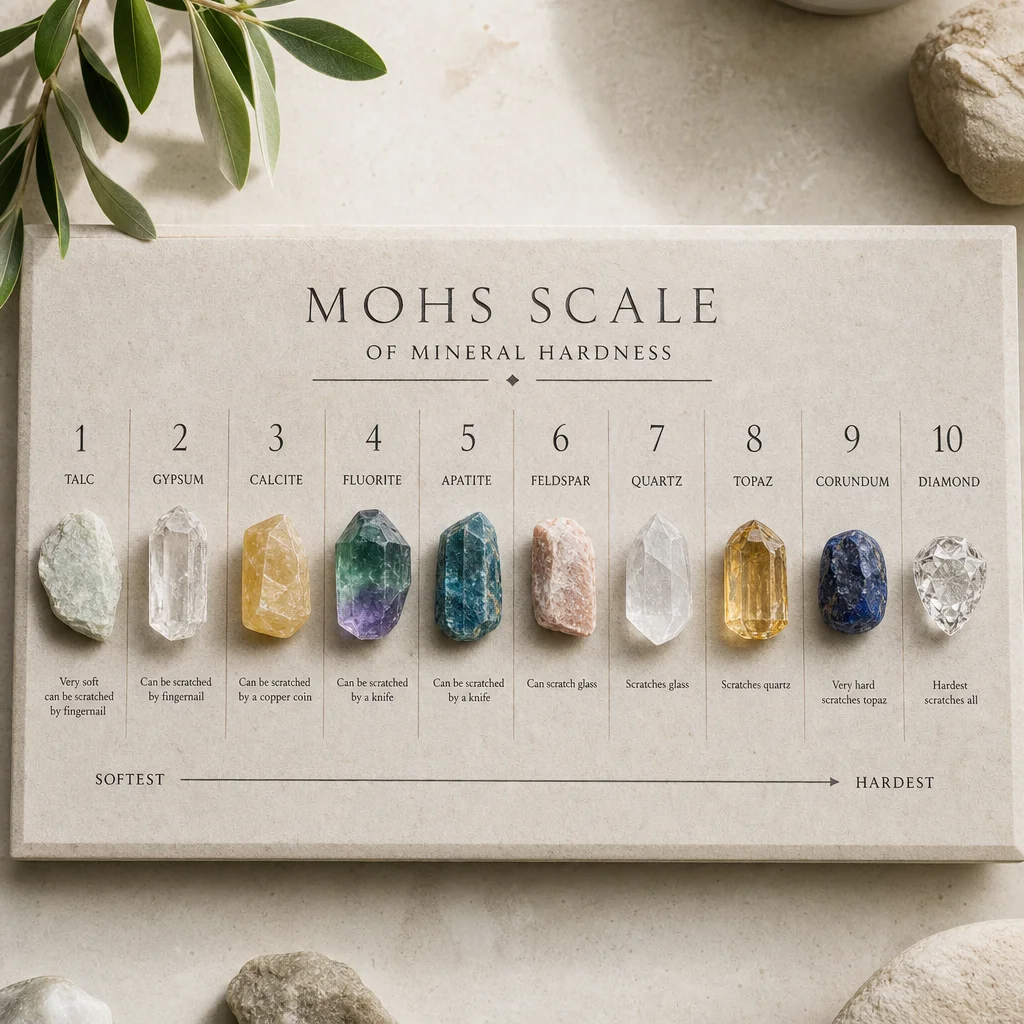
The Mohs Scale Explained: Why Your Crystal Scratches Glass (Or Doesn't)
Someone once told me they knew their crystal was real because it could scratch glass. I asked which crystal. They said fluorite. Fluorite has a Mohs hardness of 4. Glass is around 5.5. Their crystal couldn't scratch glass — it was being scratched by the glass. They'd been testing it wrong for months.
The Mohs scale is probably the single most useful thing you can learn as a casual crystal collector, and it's not complicated. Here's what it actually means, how to use it, and the common mistakes that lead people astray.
What the Mohs Scale Measures
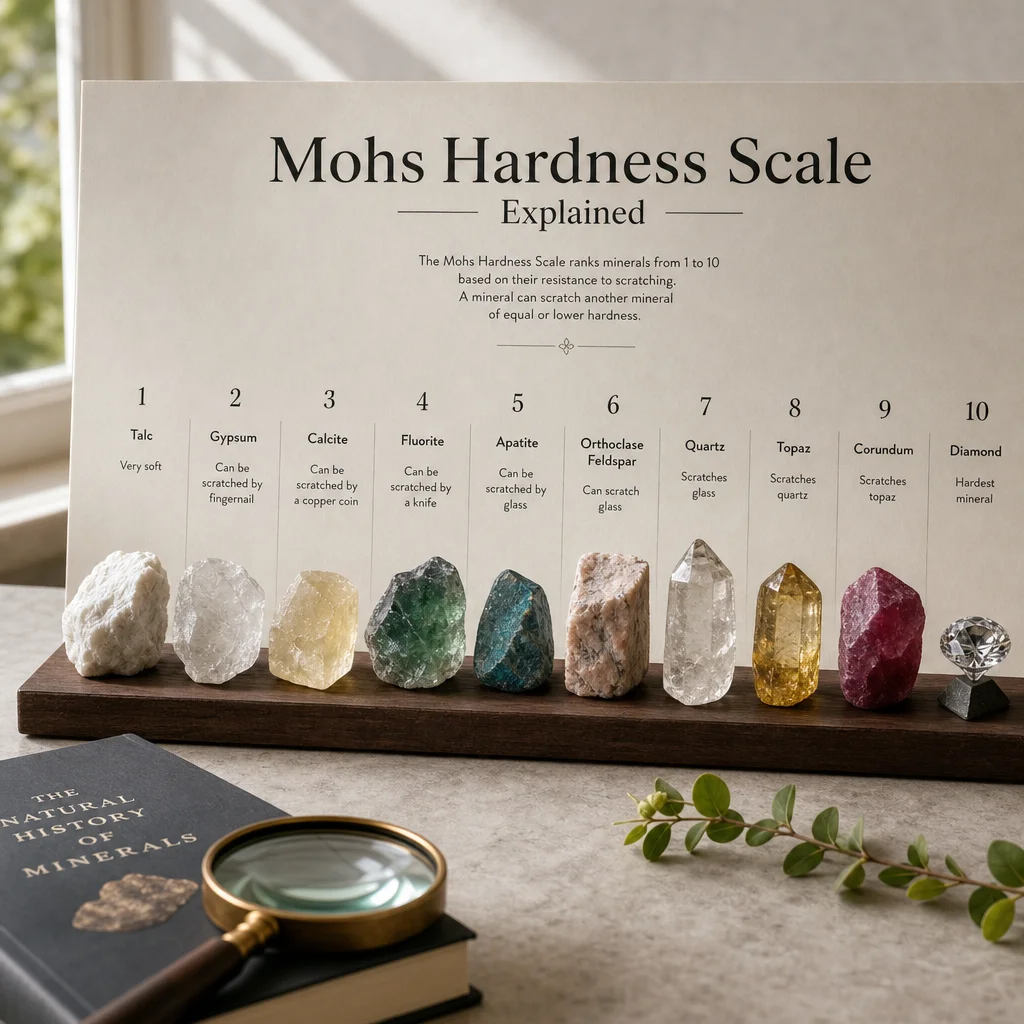
Developed by German mineralogist Friedrich Mohs in 1812, the Mohs hardness scale ranks minerals from 1 (softest) to 10 (hardest) based on their ability to scratch each other. A mineral with a higher number can scratch any mineral with a lower number. That's the entire system.
It's a relative scale, not a linear one. The jump from 9 (corundum) to 10 (diamond) is actually a bigger gap in absolute hardness than the entire range from 1 to 9 combined. But for practical identification purposes, the relative rankings are what matter.
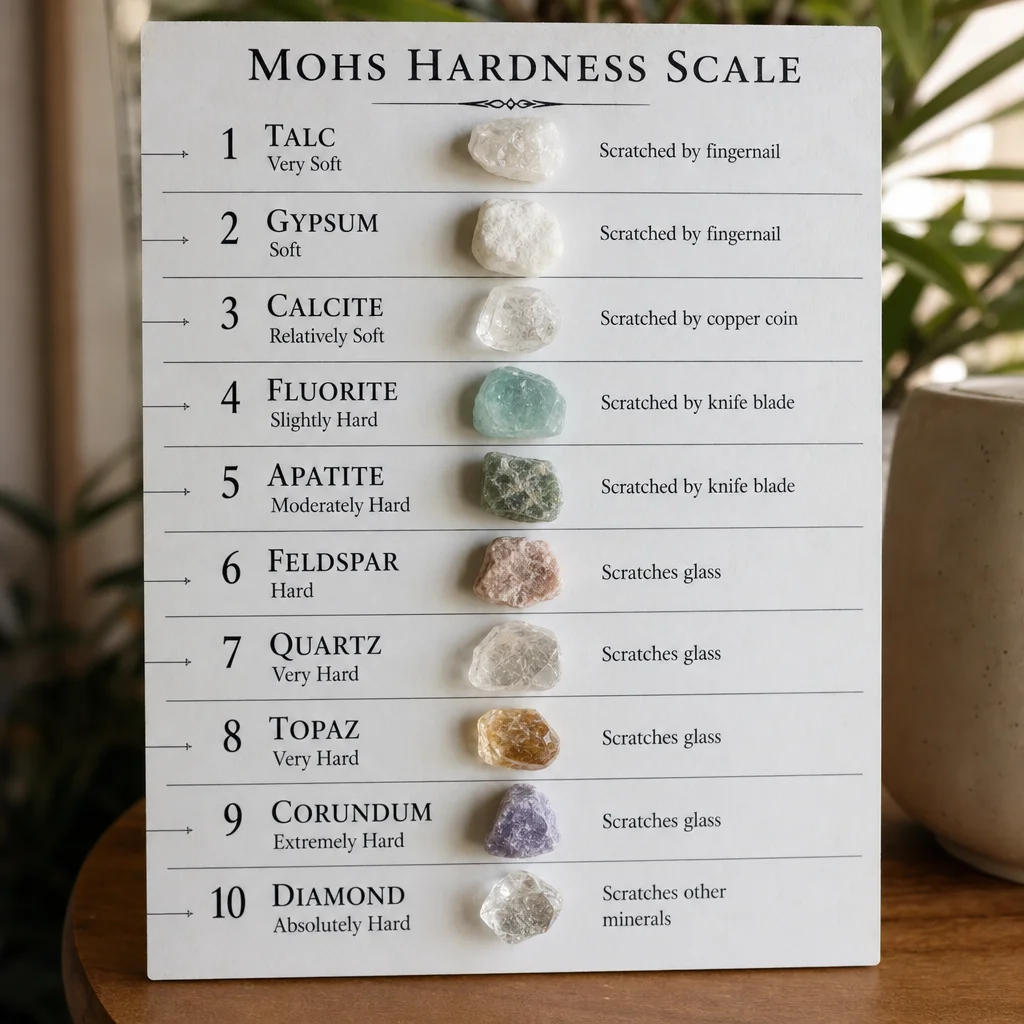
The ten reference minerals:
- 1 - Talc: Can be scratched with a fingernail
- 2 - Gypsum: Can be scratched with a fingernail (barely)
- 3 - Calcite: Can be scratched with a copper coin
- 4 - Fluorite: Can be scratched with a steel knife
- 5 - Apatite: Can be scratched with a steel knife with effort
- 6 - Orthoclase: Can scratch glass, can be scratched by a steel file
- 7 - Quartz: Easily scratches glass
- 8 - Topaz: Scratches quartz
- 9 - Corundum: Scratches topaz (ruby and sapphire are corundum)
- 10 - Diamond: Scratches everything, nothing scratches it
Common Crystals and Where They Fall
Most crystals you'll encounter in shops fall between 2 and 8 on the scale. Knowing where your pieces sit helps with everything from storage decisions to authenticity checks.
Soft (Mohs 1-3) — Handle With Care
- Selenite (2): Can be scratched with a fingernail. Also dissolves in water. The most fragile common crystal.
- Malachite (3.5-4): Softer than you'd expect from how solid it looks
- Calcite (3): Effervesces in weak acid (vinegar) — a fun identification test
- Pearl (2.5-3): Why perfume and hairspray damage pearl jewelry
Medium (Mohs 4-6) — Normal Handling
- Fluorite (4): Will get scratched if stored with quartz. Keep it separate.
- Lapis lazuli (5-5.5): Durable enough for daily-wear jewelry but don't store it rough-and-tumble with harder stones
- Apatite (5): The "what mineral?" of the crystal world — fairly common but nobody talks about it
- Labradorite (6-6.5): The reason it's safe for everyday pendants
Hard (Mohs 7+) — Tough Customers
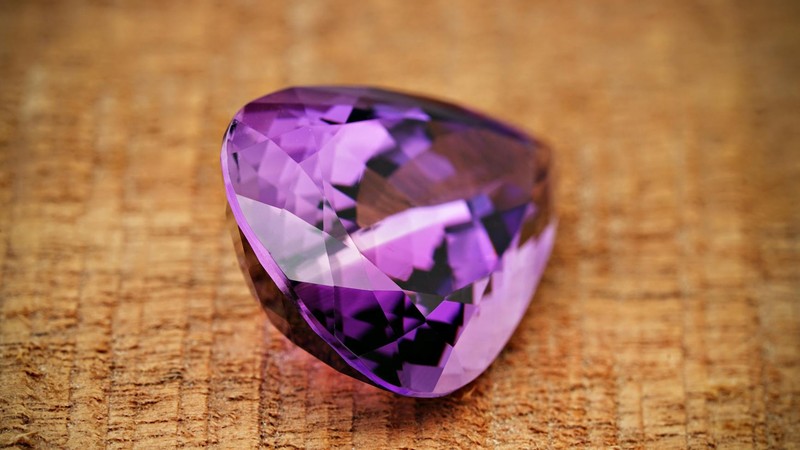
- Quartz (7): Amethyst, citrine, rose quartz, smoky quartz, clear quartz — all the same hardness. Will scratch glass easily.
- Topaz (8): The surprise hard one. Feels like it should be softer but isn't.
- Corundum (9): Ruby and sapphire. Second hardest natural material. Practically indestructible for daily wear.
Practical Scratch Tests You Can Do at Home
These tests won't tell you exactly what a mineral is, but they can narrow it down quickly. All you need are common household items.
The Fingernail Test (Mohs ~2.5)
Can you scratch the mineral with your fingernail? If yes, it's 1-2 on the Mohs scale. You're looking at something like talc, selenite, or gypsum. Very few "display crystals" fall this low, so if your specimen is scratchable by fingernail, it's either selenite or something unusual.
The Copper Coin Test (Mohs ~3)
A pre-1982 US penny (solid copper) or equivalent copper coin can scratch minerals at Mohs 3 and below. Calcite (3) is right on the edge — a coin will barely scratch it.
The Steel Knife Test (Mohs ~5.5)
A steel pocketknife or kitchen knife blade will scratch minerals up to about Mohs 5. If your knife can't scratch it, the mineral is 5.5 or harder. This is a useful dividing line — it separates the "needs careful storage" group from the "fairly durable" group.
The Glass Scratch Test (Mohs ~5.5)
This is the one most people know, but they often get it backwards. Glass is about 5.5 on the Mohs scale. If a mineral scratches glass, it's harder than 5.5 (quartz, topaz, etc.). If glass scratches the mineral, the mineral is softer than 5.5 (fluorite, calcite, etc.).
To test properly: find a piece of scrap glass (an old jar). Hold the mineral firmly and press its point or edge firmly across the glass surface. You should feel resistance and see a visible scratch line. Don't use gentle pressure — you need firm, deliberate contact.
Why Hardness Matters for Collectors
Storage
Harder minerals scratch softer ones. If you throw all your crystals in a box together, quartz (7) will scratch fluorite (4) and fluorite will scratch calcite (3). The dust in your storage container is often quartz particles (silica dust, Mohs 7), which means even leaving soft minerals exposed on a shelf leads to gradual surface damage.
Solution: wrap soft minerals individually, store hard and soft separately, and don't let specimens rattle against each other.
Wearability
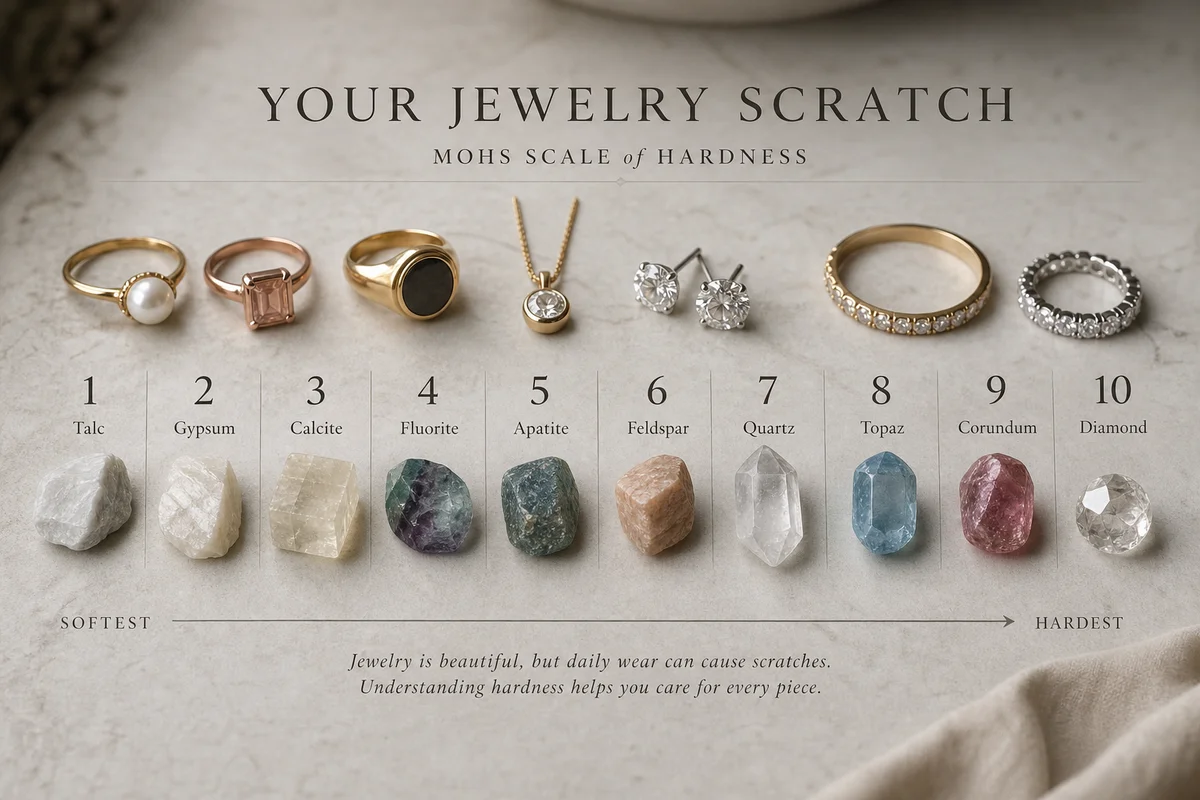
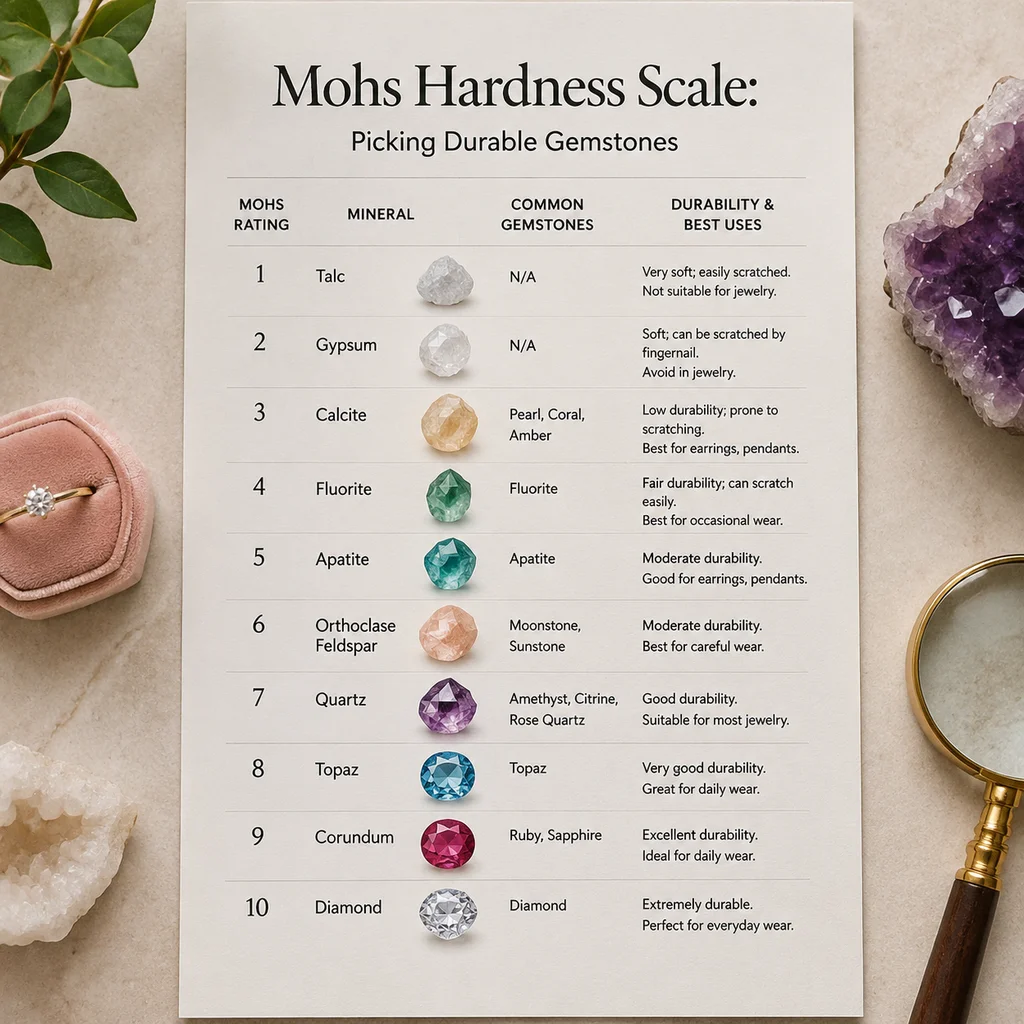
For jewelry that gets daily wear (rings especially), you want Mohs 7 or above. Ring surfaces get knocked against doorframes, countertops, and steering wheels constantly. A fluorite ring would be destroyed within a week of daily wear. A quartz or corundum ring will last decades.
For occasional-wear pendants and earrings, Mohs 5 and above is usually fine — they don't take the abuse that rings do.
Cleaning
Harder minerals can handle more vigorous cleaning. You can scrub quartz with a stiff brush without worry. Do that to selenite and you'll physically remove material. Ultrasonic cleaners are safe for hard stones (7+) but can crack or degrade softer ones.
Hardness vs. Toughness: They're Not the Same
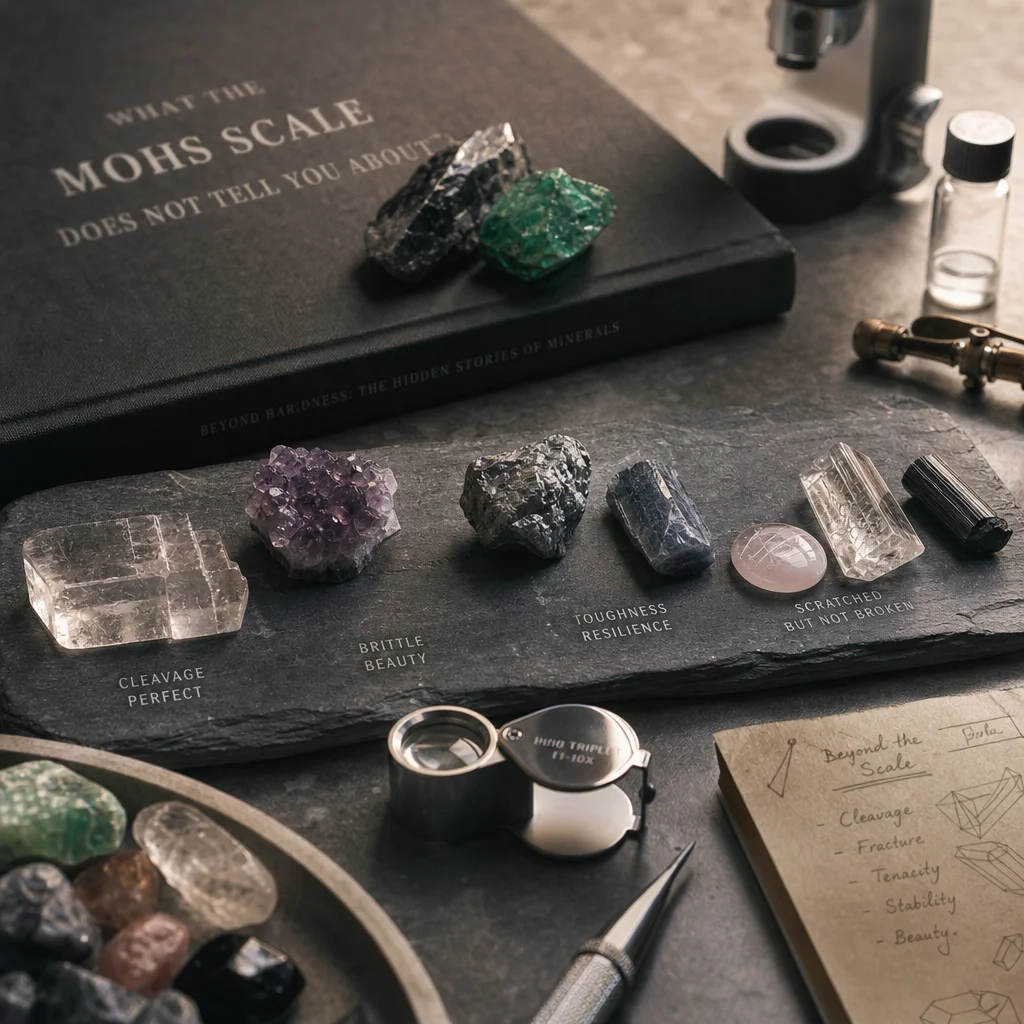
This distinction matters and confuses a lot of people. Hardness is scratch resistance. Toughness is break resistance. They don't correlate.
- Diamond (10 hardness, fair toughness): Can't be scratched but can be shattered with a hammer. The "hit it with a hammer" test in heist movies is actually accurate — diamonds are brittle despite being the hardest material.
- Jade (6-7 hardness, exceptional toughness): Not particularly hard, but incredibly resistant to breaking. This is why jade has been carved into intricate shapes for thousands of years — it doesn't shatter.
- Topaz (8 hardness, perfect cleavage): Very hard, but has a plane along which it splits cleanly with a single impact. Drop a topaz on a hard floor at the wrong angle and it can split in two.
For everyday practical purposes: hardness tells you what you can store it with and how to clean it. Toughness tells you whether you should worry about dropping it.
One Last Thing
The scratch test is one tool among many. It can narrow down possibilities but rarely identifies a mineral by itself. A stone that scratches glass could be quartz, topaz, corundum, tourmaline, or several other minerals. You need additional clues — color, crystal habit, streak, specific gravity, and sometimes refractive index — to make a confident identification.
But knowing the Mohs scale and where your common crystals fall on it will immediately level up your collecting. You'll stop storing incompatible stones together, you'll know which pieces are safe for daily-wear jewelry, and you'll be able to spot obvious fakes (if a "diamond" can be scratched by a steel knife, it's not diamond). Three practical wins from one simple scale.
For a comprehensive overview, see our Ultimate Crystal Guide for Beginners.
Choosing the Right Crystal for Your Needs
When you're selecting a crystal, it's not just about its Mohs hardness; it's about what you want to use it for. For example, if you're looking for a crystal for jewelry, you'll want something that's not only beautiful but also durable. Here's a guide to help you choose the right crystal based on its hardness and other properties.Hard (Mohs 7-10) — Ideal for Jewelry and Display
- Quartz (7): The most common crystal in the world, quartz is durable and versatile. It comes in many colors and is great for jewelry.
- Aquamarine (7.5-8): A beautiful blue variety of beryl, aquamarine is durable and perfect for jewelry.
- Topaz (8): Available in a range of colors, topaz is durable and can be used for both jewelry and decorative pieces.
- Corundum (9): The family that includes ruby and sapphire, corundum is extremely durable and a favorite for high-end jewelry.
- Diamond (10): The hardest natural material on Earth, diamonds are the ultimate choice for jewelry and are often used in engagement rings.
Soft Crystals: Perfect for Meditation and Chakra Balancing
Soft crystals, while not ideal for jewelry, are perfect for meditation and chakra balancing. Their gentle energy can help you relax and focus.- Selenite (2): Known for its ability to clear energy, selenite is great for meditation spaces and can be used to cleanse other crystals.
- Malachite (3.5-4): Malachite is associated with protection and is often used in meditation to promote emotional healing.
- Calcite (3): Calcite is a powerful cleanser and can be used to clear negative energy from a space.
- Pearl (2.5-3): Pearls are often used in meditation to promote peace and calmness.
How to Test Crystal Hardness at Home
If you're curious about the hardness of a crystal you have, you can perform a simple test at home. Here's how:- Find a piece of glass (like a window pane) that's at least 1/4 inch thick.
- Using the edge of a steel knife, gently scratch the glass. If the glass is scratched, the crystal is harder than glass (Mohs 7-10). If the knife scratches the glass, the crystal is softer (Mohs 1-6).
- For a more precise test, use the Mohs scale reference minerals. Try to scratch the glass with each mineral in order. The mineral that scratches the glass is the one you're testing against.
Storing Your Crystals Properly
Proper storage is crucial for maintaining the integrity and beauty of your crystals. Here are some tips:- Soft Crystals: Store in a soft cloth or a padded box to prevent scratches and damage.
- Hard Crystals: Store in a hard case or a box with dividers to prevent them from knocking against each other.
- Keep away from water: Some crystals, like selenite, dissolve in water. Keep them away from moisture.
- Avoid direct sunlight: Long-term exposure to sunlight can fade some crystals.
Common Mistakes to Avoid When Working with Crystals
When working with crystals, there are a few common mistakes that can lead to damage or disappointment:- Not Knowing Your Crystal's Hardness: This can lead to unnecessary damage, especially when using soft crystals for jewelry.
- Storing Crystals Improperly: Improper storage can lead to scratches, fading, and even damage.
- Using Harsh Chemicals: Some crystals are sensitive to chemicals. Always use gentle cleaners and avoid harsh chemicals.
- Overlooking Cultural Significance: Different cultures have different beliefs and uses for crystals. It's important to respect these traditions.
Expert Tips for Crystal Collectors
If you're serious about crystal collecting, here are some expert tips to help you get started:- Start Small: Begin with a few crystals that interest you. As you learn more, you can expand your collection.
- Learn About Metaphysical Properties: Understanding the metaphysical properties of crystals can enhance your experience and appreciation.
- Join a Community: Crystal collecting can be a very social activity. Joining a community can help you learn and share experiences.
- Keep Learning: The world of crystals is vast and ever-evolving. Stay curious and keep learning.
FAQ
Can I use a diamond to test the hardness of a sapphire?
Can I use a diamond to test the hardness of a sapphire?
Yes, you can. Since sapphire is a type of corundum, which is on the Mohs scale at 9, it can be scratched by a diamond, which is the hardest natural material on Earth (Mohs 10).
Are all crystals safe to use in jewelry?
Are all crystals safe to use in jewelry?
No, not all crystals are suitable for jewelry. Some are too soft and can easily scratch or break. It's important to know the hardness of a crystal before using it in jewelry.
How can I tell if a crystal is real?
How can I tell if a crystal is real?
While the Mohs scale can help you determine a crystal's hardness, it's not the only factor in determining authenticity. Look for other signs, such as color, clarity, and transparency. If you're unsure, consult with an expert or a reputable crystal dealer.
Can I clean my crystals with soap and water?
Can I clean my crystals with soap and water?
It depends on the type of crystal. Some crystals, like quartz and amethyst, can be cleaned with soap and water. However, some crystals, like selenite, are sensitive to water and should be cleaned with a soft cloth and a gentle cleaner.
How often should I cleanse my crystals?
How often should I cleanse my crystals?
It's a good practice to cleanse your crystals regularly, especially if you use them for meditation or healing purposes. You can cleanse them with water, salt, sage, or simply by holding them in sunlight or moonlight.
Comments