Seven of Cups Tarot Card: Complete Meaning Guide
May 17, 2026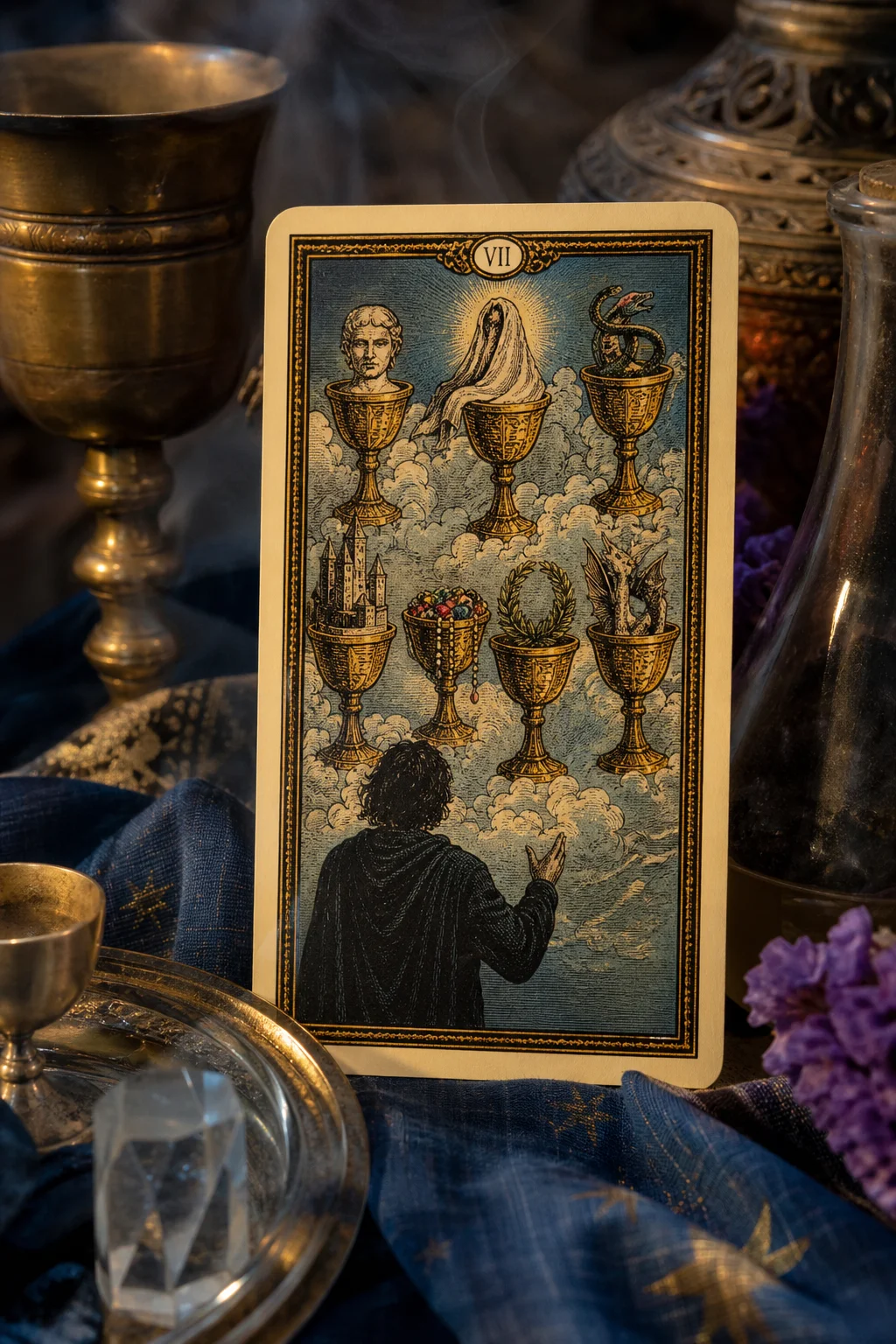
I Pulled the Seven of Cups Every Day for a Month, and It Changed How I Read Tarot
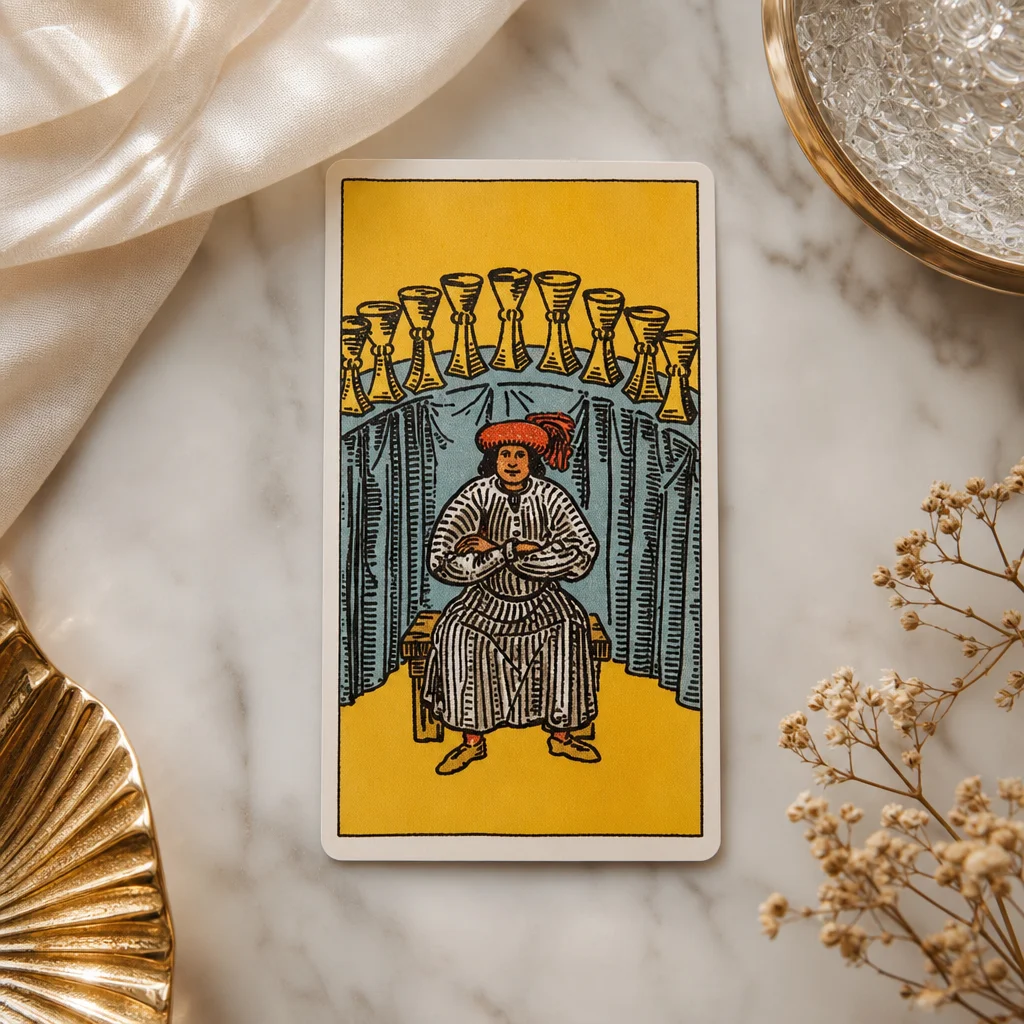
Let me tell you something embarrassing. For the first two years I read tarot, I treated the Seven of Cups like a greeting card that says "follow your dreams." You know the card — seven golden cups floating in a cloud, each one holding something different: a castle, a wreath, a snake, a dragon, a shrouded figure, jewels, and a laurel wreath. Pretty, right? Inspirational, even.
I was wrong. Completely, embarrassingly wrong.
The Seven of Cups is not about having choices. It is not about "many paths" or "exciting possibilities." It is, in my experience and in the experience of every serious reader I respect, the single most misunderstood card in the entire tarot deck. What it actually shows you is the moment before a bad decision — that warm, foggy space where you lie to yourself about what you want and why you want it.
I realized this during a month where I pulled the Seven of Cups daily, and every single day it called me out on something I was pretending not to see. So let me walk you through what this card really means, what it looks like, and how to actually work with it instead of sugarcoating it.
What Is the Seven of Cups? A Quick Primer
The Seven of Cups is a Minor Arcana card in the suit of Cups, which governs emotions, relationships, intuition, and the inner world of feelings. It sits at the number seven — a number traditionally associated with reflection, spiritual seeking, and that uncomfortable pause before a breakthrough. If you want to understand where it fits in the broader Cups journey, think of it as the card where emotional fantasy meets emotional reality, and neither one walks away happy.
In the Rider-Waite-Smith deck (the one most people learn on), the image shows a dark silhouette — usually interpreted as a person — standing before a cloud that holds seven cups. Each cup contains a different symbol, and none of them are clearly attainable. They hover. They tempt. They refuse to commit to being real.
That image is doing exactly what the card does in a reading: it presents illusions and waits to see which one you'll reach for.
The Visual Symbolism: What Each Cup Actually Represents
I think one of the reasons people misunderstand this card is that they look at the symbols individually instead of seeing the whole picture. So let's break it down honestly.
The Seven Symbols
- The Castle — Status, power, achievement. The fantasy of having "made it" without asking what it costs to get there.
- The Wreath (Laurel) — Victory, recognition, fame. The version of success that's more about being seen than being fulfilled.
- The Jewels and Treasure — Wealth, material comfort. The assumption that money solves emotional problems (spoiler: it doesn't).
- The Dragon or Winged Creature — Power, transformation, but also greed and possessiveness. The dark side of ambition dressed up as something magical.
- The Human Shrouded Figure — Mystery, the unknown, sometimes interpreted as sexual temptation or the desire to possess another person.
- The Snake — Wisdom in some traditions, but also deception, betrayal, and the thing that looks appealing right before it bites you.
- The Veiled Figure / Person — The self, hidden behind layers of projection. This is the cup most people ignore, and it's the one that matters most.
Notice something? Six of these seven symbols are external. They're things outside yourself — status, money, recognition, power over others. Only that veiled figure points inward, and it's the one obscured. The Seven of Cups is showing you that when you're in a fog of options, you're almost always looking outward for something that can only be found by looking inward.
If you work with crystals alongside tarot, this card pairs naturally with stones that encourage clarity over fantasy. Clear quartz is the obvious choice — it cuts through mental fog like nothing else. But I also like amethyst for this card, because it supports honest self-reflection without judgment.
Upright Meaning: The Illusion of Abundance
When the Seven of Cups appears upright, most guidebooks will tell you it means "choices" or "opportunities." I think that's only half the story, and honestly, it's the less useful half.
Here's what I've seen the Seven of Cups upright actually indicate in readings:
Self-deception in progress. You're telling yourself a story about what you want, but you haven't examined whether it's true. Maybe you think you want a promotion, but really you want to feel valued. Maybe you think you want a new relationship, but really you're avoiding being alone with yourself. The card shows up when your desires are performing for an audience — even if that audience is just you.
Analysis paralysis dressed up as open-mindedness. "I'm just keeping my options open" is something the Seven of Cups hears a lot. But keeping options open and refusing to commit are not the same thing. One is wise. The other is avoidance wearing a mask.
Daydreaming instead of doing. This is the card of the person who spends three hours researching crystal grids on Pinterest but never actually builds one. The fantasy of action feels safer than action itself.
Temptation that looks like opportunity. Not everything that glitters is meant for you. Some cups are traps. The snake cup is not subtle about this.
The upright Seven of Cups is your deck's way of saying: Stop fantasizing. Start examining. What do you actually want, and are you willing to be honest about it?
Reversed Meaning: When the Fog Starts to Lift
The reversed Seven of Cups is honestly one of my favorite cards to see in a reading, because it means something is shifting. The fog is clearing. But that clarity? It can be brutal.
Here's what the reversal typically signals:
Breaking through self-deception. You've been lying to yourself about something — a relationship, a career path, a version of yourself you've been performing — and the lie is no longer sustainable. The reversed Seven of Cups is the moment you stop pretending. It hurts. It's also the beginning of everything real.
Making a decision after a long period of avoidance. If you've been sitting on the fence for weeks or months, the reversed Seven of Cups says the fence is about to break. You'll choose. Maybe not gracefully, but you'll choose.
Sobering up from a fantasy. Maybe you were infatuated with someone who wasn't who you imagined. Maybe you pursued a goal that looked glamorous from the outside but felt hollow once you got close. The reversal strips away the projection and leaves you with the truth.
Grounded clarity. On the more positive end, the reversed Seven of Cups can indicate that you've already done the hard work of self-examination and you're finally seeing clearly. You know what you want. More importantly, you know what you don't want.
I always recommend pairing this card (especially reversed) with grounding practices. If you use crystals, labradorite is excellent here — it's a stone of transformation and intuition, which is exactly what this card is asking you to trust.
Seven of Cups in Love Readings
Oh, love readings. The place where the Seven of Cups causes the most damage and the most denial.
Let me be direct: when this card shows up in a love reading, someone is not seeing the relationship clearly. That someone might be you, might be your partner, might be both of you. But the card does not show up in love readings when things are grounded and honest.
Single and pulling this card? You might be in love with an idea of a person instead of a real person. The "type" you think you want might be a fantasy that keeps you from recognizing genuine connection. I've seen people walk away from wonderful partners because they didn't match a mental image that was never real to begin with.
In a relationship? One or both of you may be projecting onto the other. You're seeing what you want to see, not what's actually there. This is especially common in new relationships where everything is shiny and you haven't yet hit the phase where the real person shows up.
In a situationship or talking stage? The Seven of Cups here is a flashing red light. You're both holding onto the possibility of what it could be, but neither of you is dealing with what it actually is. The fog feels romantic. It's not. It's avoidance with better lighting.
For love-focused tarot work, I like to pair this card with crystals traditionally associated with love and relationships, especially moonstone, which encourages emotional honesty and helps you see through romantic projection.
Seven of Cups in Career Readings
In career readings, the Seven of Cups often points to a specific and very modern problem: option overload dressed up as ambition.
You know that feeling when you could do "so many things" that you end up doing none of them well? That's this card. The career version shows up when you're:
- Jumping between ideas without committing to a direction. You've got five business ideas, three potential career pivots, and a side hustle you never started. The excitement of possibility has replaced the satisfaction of execution.
- Chasing prestige instead of purpose. That castle cup? A lot of people reach for it in career readings. They want the title, the corner office, the impressive LinkedIn headline. But the Seven of Cups asks: do you want the reality of that role, or just the way it sounds when you describe it to other people?
- Avoiding a necessary but boring decision. Sometimes the right career move isn't glamorous. It's practical. It's incremental. The Seven of Cups appears when you're avoiding the sensible choice because the fantasy alternatives are more fun to think about.
If this resonates, consider this: the antidote to Seven of Cups career energy is not more brainstorming. It's commitment. Pick one thing. Give it three months. See what happens. You can always pivot later, but you can't evaluate a path you never walked.
For career-focused crystal work, citrine is a natural companion here — it's traditionally associated with manifestation and willpower, which is exactly what the Seven of Cups drains from you.
Daily Pull: What It Means When the Seven of Cups Shows Up
If you pull this card as your daily draw, it's usually a gentle (or not so gentle) nudge to check in with yourself about one question: Am I being honest about what I want today?
It might show up on a day when you're about to make an impulse purchase you'll regret. It might appear when you're about to say yes to something you actually want to say no to. It might come up when you're scrolling through social media, comparing your real life to everyone else's curated highlight reel.
The daily pull version of this card is small and personal. It's not about grand life choices — it's about the micro-moments where you choose comfort over honesty, distraction over presence, fantasy over reality.
When I pull it daily, I take it as a prompt to slow down. I'll usually spend five minutes with my meditation crystals and just sit with whatever feeling I've been avoiding. No journaling, no analysis. Just presence.
Crystal Combinations for the Seven of Cups
If you work with crystals alongside your tarot practice, the Seven of Cups benefits from stones that promote clarity, grounding, and honest self-reflection. Here are my favorite combinations:
- Clear Quartz + Amethyst — The classic clarity combo. Clear quartz amplifies your intention; amethyst supports honest introspection. I keep both on my reading table.
- Labradorite + Moonstone — For when the Seven of Cups appears reversed and you're navigating a period of transformation. Labradorite helps you trust what you're intuiting; moonstone keeps you emotionally honest.
- Black Tourmaline + Selenite — The grounding and clearing combo. Black tourmaline pulls you out of fantasy and into your body; selenite clears mental clutter.
- Carnelian + Citrine — For when you need to stop daydreaming and start doing. Carnelian fires up your willpower; citrine focuses it on something real.
None of these are magic bullets. Crystals don't make decisions for you. But they can create a physical anchor for the kind of honest, grounded energy the Seven of Cups is asking you to cultivate.
5 Journal Prompts for the Seven of Cups
If you pull this card and want to go deeper, here are five prompts I've used personally and with clients. They're designed to cut through the fog, not coddle it.
- 1. "What am I pretending to want that I actually don't?" This one is uncomfortable. That's the point. The Seven of Cups shows up when your surface desires don't match your deeper ones. Write without editing and see what comes up.
- 2. "If I could only choose one of the seven cups, which one would I grab — and what does that say about what I really value?" Look at the seven traditional symbols: castle, wreath, jewels, dragon, shrouded figure, snake, veiled person. Pick one. Sit with why.
- 3. "Where in my life am I keeping options open because I'm afraid of commitment, not because I'm genuinely exploring?" Be specific. Name the area. Name the fear.
- 4. "What would I choose if nobody else could see or judge my decision?" This strips away the performative layer. A lot of Seven of Cups energy comes from choosing what looks good to others instead of what feels right to you.
- 5. "What am I avoiding seeing clearly, and what would happen if I saw it?" The scariest prompt and the most valuable one. The Seven of Cups always points to something you're not looking at. This is your invitation to look.
I like to do these prompts with a crystal meditation practice — even just five minutes of sitting with a stone before I write. It helps me get out of my analytical brain and into whatever's underneath.
FAQ: Seven of Cups Common Questions
Is the Seven of Cups a yes or no card?
No. And I mean that in both senses — it's not a yes and it's not a simple no. The Seven of Cups refuses to give you a binary answer because the question itself is probably rooted in self-deception. If you're asking "should I do this?" and you pull the Seven of Cups, the card is saying: "You're not ready to ask that question honestly yet." Come back when you've done the inner work.
What does the Seven of Cups mean as a feelings card?
As a feelings indicator, it suggests the person is confused — but not in the neutral, harmless way people usually mean by "confused." They're confused because they're lying to themselves about what they feel. They may be emotionally scattered, drawn in multiple directions by different fantasies, or unwilling to face a feeling they've been suppressing. It's not "I don't know how I feel." It's "I know how I feel and I don't want to deal with it."
Is the Seven of Cups a positive or negative card?
Neither. It's a confrontational card. It shows up when you need to get honest with yourself, and that process is neither positive nor negative — it's just necessary. If you're willing to do the work of self-examination, it's one of the most valuable cards in the deck. If you're committed to your illusions, it's going to feel like a slap.
Can the Seven of Cups indicate addiction or escapism?
Yes, and I wish more tarot resources talked about this. The Seven of Cups is deeply connected to escapism — daydreaming as avoidance, substance use as self-medication, scrolling as dissociation, fantasy as a shield against reality. It doesn't always indicate something clinical, but it always points to some form of retreat from the real. If you're pulling this card frequently, it might be worth asking whether you're using imagination as a tool or as a hiding place.
Why I Keep Coming Back to This Card
Here's the thing about the Seven of Cups. It's not a comfortable card. It doesn't flatter you. It doesn't tell you you're on the verge of a breakthrough or that your dreams are about to come true. What it does is something more useful: it holds up a mirror and asks you to look at it without flinching.
Most of us walk around with a curated internal narrative about who we are and what we want. The Seven of Cups is the card that cracks that narrative open. It shows you the gap between the story you tell yourself and the truth you've been avoiding. And yeah, that's uncomfortable. But it's also the only way to make decisions that actually align with who you are, not who you're performing.
I've been reading tarot for years now, and the Seven of Cups still shows up in my personal spreads when I need it most — which is usually when I'm convinced I don't. That's the trick of this card. It catches you precisely in the moment you think you've got it all figured out.
So the next time you pull it, don't reach for the "choices and opportunities" interpretation. Sit with it. Ask yourself what you're not seeing. Trust that the fog will lift — but only if you stop pretending it isn't there.
Frequently Asked Questions
What crystals pair well with the Seven of Cups tarot card?
When working with the Seven of Cups, you need crystals that promote mental clarity. Amethyst is perfect for cutting through illusions and enhancing intuition. Wearing a handcrafted natural amethyst pendant while shuffling your deck helps dispel the card's scattered energy. Clear quartz is another excellent choice, grounding your wandering mind so you can evaluate your true options and make confident, aligned choices.
Comments