Mala Beads for Yoga Practice: Finding Your Med..
June 2, 2026
The Historical Connection Between Mala Beads and Yoga
Mala beads and yoga aren't separate traditions that happen to coexist — they're intertwined practices that evolved together over thousands of years. The practice of japa yoga (repetitive mantra meditation using prayer beads) is one of the classical paths of yoga described in ancient texts. Patanjali's Yoga Sutras, the foundational text of yoga philosophy, references the practice of reciting mantra as a form of meditation (dharana and dhyana).
In traditional yoga practice, mala beads serve as a tool for pranayama (breath control), mantra japa (mantra repetition), and dharana (focused concentration) — three of the eight limbs of classical yoga. The physical act of moving beads through your fingers mirrors the rhythmic cycle of breath, creating a body-mind-breath connection that deepens the practice.
Modern Western yoga classes rarely incorporate mala bead practice directly, which is a shame. Adding even a brief mala meditation at the beginning or end of a yoga session can significantly deepen the meditative aspects of the practice. And using a mala during savasana (final relaxation) is one of the simplest ways to transition from physical practice to seated meditation.
Choosing the Right Mala for Yoga
Not every mala works well during active yoga practice. The beads need to stay in place while you move, withstand body heat and sweat, and not snag on clothing or yoga mats.
Wrist Mala vs. Necklace for Yoga
Wrist mala (21 or 27 beads): The practical choice for most yoga practitioners. A wrist mala stays securely on during active practice — sun salutations, vinyasa flows, balance poses. You can feel the beads shift against your wrist during movement, which provides a subtle tactile awareness that many people find grounding. When it's time for seated meditation or savasana, simply slip the bracelet off and use it for bead counting.
Necklace mala (54 or 108 beads): Works well for restorative yoga, yin yoga, or meditation-focused classes where movement is minimal. A full 108-bead necklace can get in the way during active practice — beads swing, tangle, and can be distracting. A 54-bead half mala is a reasonable compromise, worn shorter and less prone to swinging.
For daily yoga practice, most people end up with both: a wrist mala for active sessions and a necklace for meditation and restorative practice.
Bead Material for Yoga Practice
Active yoga practice generates body heat and sweat. Choose bead materials that tolerate these conditions:
Good choices for active yoga: Rudraksha seeds handle sweat and heat well. Stone beads (amethyst, quartz, jade) are impervious to moisture and body heat. Glass or wooden beads with a protective coating also work.
Poor choices for active yoga: Unfinished wood beads (sandalwood without coating) can be damaged by sweat — salt from perspiration dries into the wood grain and can cause cracking. Tulsi beads are too fragile for active movement. Silk-threaded malas may weaken with repeated exposure to sweat.
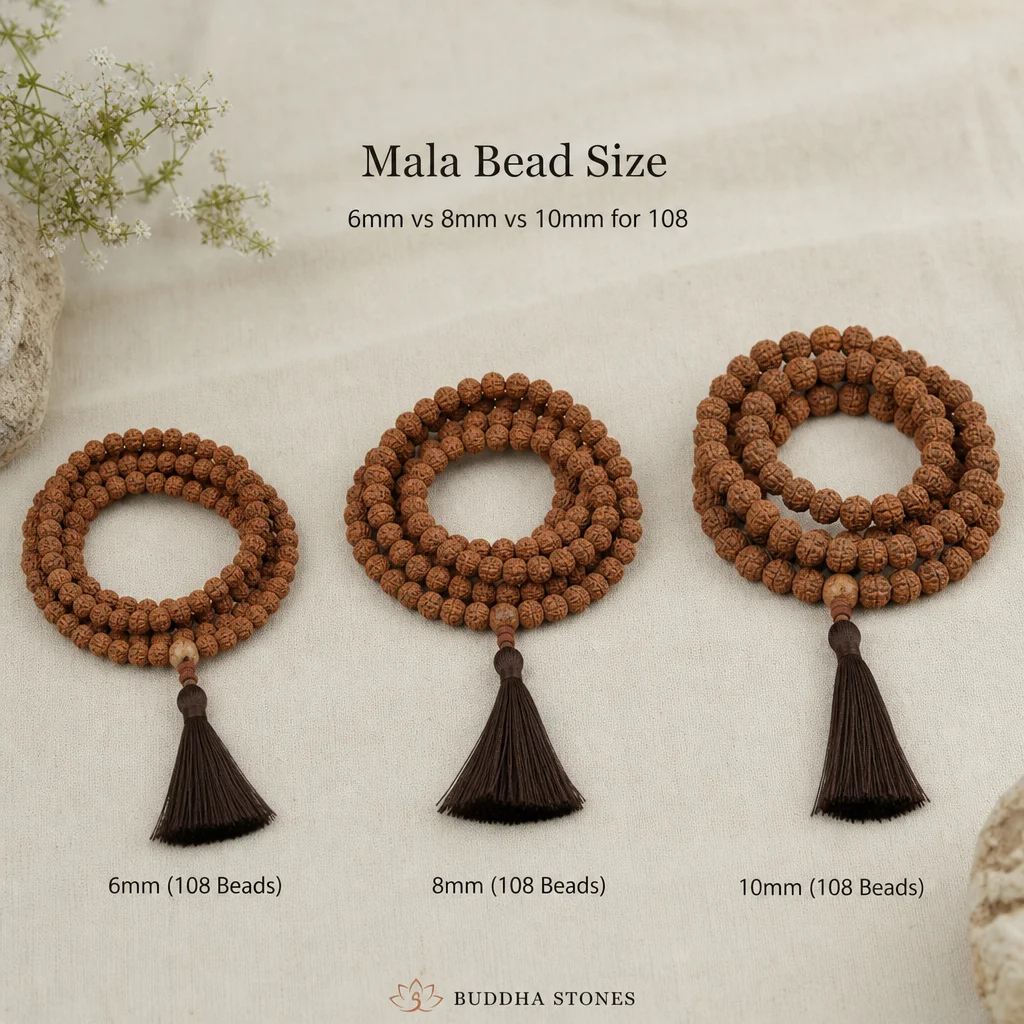
Bead size matters: For wrist malas worn during yoga, 6mm beads are ideal — they create a flexible bracelet that doesn't dig into the wrist during weight-bearing poses. 8mm beads work but create a stiffer bracelet. Avoid 10mm+ beads for active yoga wear.
Integrating Mala Practice with Different Yoga Styles
Each style of yoga has a natural entry point for mala bead practice:
Vinyasa and Ashtanga Yoga
In dynamic, flowing practices, mala beads serve as a wrist anchor rather than a counting tool during active movement. The tactile sensation of beads against your skin during sun salutations creates a subtle awareness that helps maintain focus as the physical challenge increases.
For integrating mala work into vinyasa practice, try using the beads for pranayama transitions. Between sequences, sit briefly and use a wrist mala to count 21 breaths (one full round of a 21-bead bracelet) before flowing into the next sequence. This creates rhythmic breathing pauses that maintain meditative quality throughout a vigorous practice.
Kundalini Yoga
Kundalini yoga has the deepest natural integration with mala bead practice. Many Kundalini kriyas (prescribed sets of exercises) already include mantra repetition alongside physical movements. Using a mala during the mantra portions adds a physical counting dimension that strengthens the practice.
Particularly in practices involving chakra activation, Kundalini practitioners sometimes use a mala where each bead represents a chakra in sequence — moving from root (bead 1) to crown (bead 7) and back, cycling through the energy centers. A 21-bead wrist mala allows for three complete chakra cycles, which works well with most Kundalini kriyas.
Yin Yoga and Restorative Yoga
Yin and restorative practices involve long-held poses (2–5 minutes each) in stillness. This is ideal mala bead territory. During each long hold, use a wrist mala to count breaths. A 27-bead bracelet means you count 27 slow breaths per pose — with 5–7 poses in a typical session, that's 135–189 counted breaths plus the meditative awareness of the bead transitions.
The combination of physical stillness, breath counting, and tactile bead awareness creates a deeply meditative state that goes beyond what either yin yoga or mala meditation achieves alone.
Hatha Yoga and Iyengar Yoga
Traditional alignment-focused practices benefit from mala use during the seated portions — opening meditation, pranayama exercises, and closing relaxation. Use the mala during the opening centering meditation (5 minutes of bead counting) and during savasana. During active poses, the mala can be set aside or worn as a wrist bracelet for tactile grounding.
Using Mala Beads for Pranayama Counting
One of the most practical applications of mala beads in yoga is breath counting during pranayama practice. Here's how to integrate them:
Ujjayi breath practice: Hold a wrist mala in your left hand (keeping the right hand in a mudra position if you practice that way). For each bead, complete one full ujjayi breath cycle — inhale (4 counts), exhale (6 counts). A 27-bead wrist mala gives you a complete 27-breath practice (roughly 4.5 minutes). This is long enough to establish a meditative breathing rhythm and short enough to fit before or after asana practice.
Nadi shodhana (alternate nostril breathing): Count one complete breath cycle (inhale left, exhale right, inhale right, exhale left) per bead. This is a slower practice — 27 beads take roughly 10–12 minutes. Best done as a standalone pranayama session rather than combined with active asana.
Box breathing (4-4-4-4): Inhale 4 counts, hold 4 counts, exhale 4 counts, hold 4 counts — that's one round per bead. A 27-bead bracelet gives you 27 rounds (about 7 minutes). This is excellent for pre-class centering.
Yoga Studio Etiquette with Mala Beads
Wearing mala beads in a yoga class is common and generally welcomed, but a few practical considerations apply:
Noise: Stone or glass bead bracelets can clink against the floor during floor-based poses. If your beads are noisy, consider removing them for active practice and using them during seated portions. Wood and seed beads are typically silent.
Distraction: A large, flashy mala necklace can be visually distracting to other students during meditation. Keep it simple for studio practice. Wrist malas are less conspicuous and serve the same function.
Scent: Sandalwood malas have a noticeable aroma that can spread in the enclosed space of a yoga studio. Some people love this; others find it overwhelming. If you're uncertain about the studio environment, a non-aromatic material like rudraksha or stone is a safer choice.
Storage: During practice, if you remove your mala, set it at the top of your mat rather than on the floor where it can roll away or get stepped on. Many practitioners place their mala at the front of the mat as a focal point during practice.
Building a Combined Yoga-Mala Practice
Here's a simple 45-minute session structure that integrates both practices naturally:
5 minutes — Centering with mala: Seated, 27 breaths counted on a wrist mala. Establish your breathing rhythm and set intention for practice.
5 minutes — Warm-up: Gentle movements (cat-cow, seated twists, shoulder rolls). Mala on wrist as a grounding anchor.
25 minutes — Asana practice: Your chosen style or sequence. Mala stays on wrist (if it's not distracting) or is set at the top of your mat.
5 minutes — Pranayama with mala: Seated, ujjayi breathing counted on the mala. 27 slow breaths to transition from physical to mental focus.
5 minutes — Savasana with mala: Lying down, mala placed on your chest or held loosely in one hand. Feel the beads as a physical grounding point during the final relaxation.
This structure works for any yoga style and any experience level. Adjust the proportions based on what you need more of — more asana, more meditation, more breathwork.
Frequently Asked Questions
Can I wear my mala while doing hot yoga?
It depends on the material. Stone beads and rudraksha handle heat and sweat fine. Wood beads (especially unfinished sandalwood) can be damaged by repeated exposure to high heat and moisture. If you practice hot yoga regularly, choose a stone or seed mala rather than a wooden one. Remove any mala with metal components (guru bead settings, spacers) as metal can become uncomfortably hot.
What mantra should I use with my mala during yoga?
The most common choice is "Om" — one bead, one Om. For yoga-specific practice, "Om Shanti" (peace) or "So Hum" (I am that) are also popular. In Kundalini yoga, Sat Nam (truth is my identity) is the standard mantra. If you don't use mantras, simply count your breaths per bead. The practice works with or without vocalized mantra.
Should I shower with my mala on?
Generally no. Soap, shampoo, and hot water can damage most mala materials — especially wood, seeds, and silk thread. Some stone bead malas on wire or nylon thread can tolerate occasional exposure, but it's not recommended for regular practice. Remove your mala before showering and put it back on afterward.
Can I use my yoga mala for other meditation outside of yoga?
Absolutely — that's one of the practical advantages of mala beads. The same wrist mala you wear during yoga serves equally well for seated meditation, walking meditation, breathwork sessions, or simply as a grounding tool during stressful moments. Your mala doesn't need to be yoga-specific.
Why do some yoga teachers discourage mala use during class?
Some teachers believe mala counting can become a mechanical activity that replaces genuine meditative awareness — the counting itself becomes the focus rather than the internal experience. Others find that students fidget with mala beads in ways that distract from practice. If your teacher asks you not to use beads during class, respect their preference and save the mala work for your home practice.
Comments