Mala Bead Size: 6mm vs 8mm vs 10mm for 108
June 12, 2026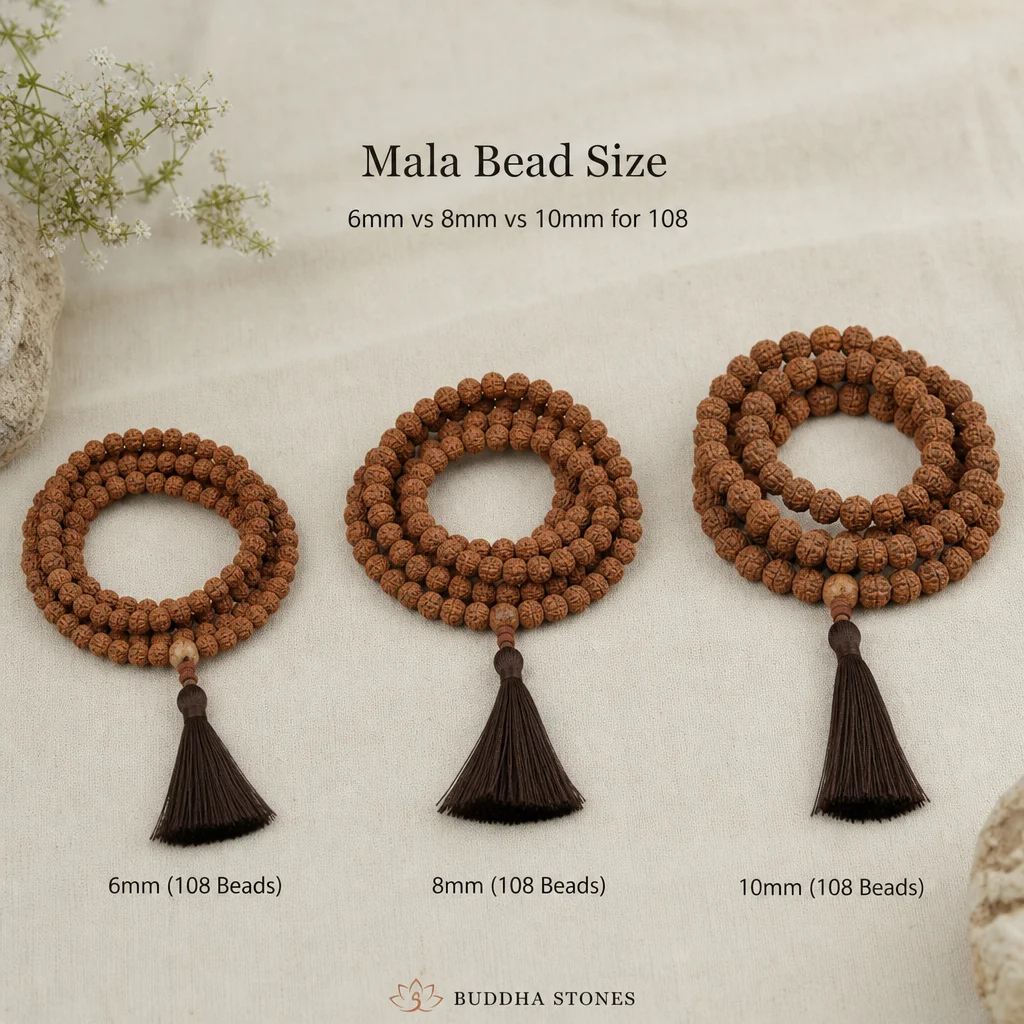
The Complete Guide to Mala Bead Size: 6mm vs 8mm vs 10mm for 108 Beads
You know, it’s funny. When I first started working with malas back in 2012—I was running a small shop out of a converted garage in Portland, Oregon—the most common question I got wasn’t about mantras, gemstone properties, or even how to use them. It was a simple, practical puzzle: “Which size bead should I pick?” And honestly, for years, I gave very generic answers. “Oh, 8mm is standard.” “6mm is for travel.” “10mm if you want it big.” But after spending thousands of hours stringing malas by hand, wrapping them around wrists for customers, and even gifting them to friends hiking the Pacific Crest Trail, I realized the answer is far more nuanced. The actual physical experience of a 6mm, 8mm, or 10mm mala is wildly different. It changes how you hold it, how it drapes, and even how durable it proves to be over a decade of use. So, let’s get into the weeds—with actual measurements, real-world comparisons, and no fluff.
Why Size Matters: The Physics of 108 Beads
Let’s start with a hard truth that took me three years of retail to appreciate: the total length of a 108-bead mala isn’t just bead diameter times 108. You have to account for the space between beads (which varies by knotting style), the size of the guru bead (which is typically 1-2mm larger than the main beads), and the space taken by knots and the tassel connection. I’ve measured literally hundreds of malas over the years, from cheaply strung Chinese factory models to hand-knotted pieces made by Tibetan artisans in northern India. Here are the real-world numbers, which I’ve tabulated below, based on standard silk or nylon cord with a simple double knot between each bead.
| Bead Size (mm) | Total Length (Inches, 108 beads + guru + tassel) | Total Length (Centimeters) | Typical Wrist Wraps (7 inch wrist) | Typical Necklace Drop (Chin to chest) |
|---|---|---|---|---|
| 6mm | 30 - 32 inches | 76 - 81 cm | 4 wraps (fits tightly), 5 wraps (loose) | Sits at or above collarbone |
| 8mm | 36 - 40 inches | 91 - 102 cm | 3 wraps (snug), 4 wraps (very loose) | Sits 2-4 inches below collarbone |
| 10mm | 44 - 50 inches | 112 - 127 cm | 2 wraps (barely fits), 3 wraps (not practical) | Sits at solar plexus or lower |
Notice the range. The 4-inch variation in the 10mm row isn’t a manufacturing defect—it’s the result of bead hole size, cord thickness, and knotting density. A 10mm bead with a 0.8mm hole string on a thin nylon cord will nest together tighter than a 10mm bead with a 1.5mm hole on a thick silk cord. I’ve seen 10mm malas from a monastery in Dharamshala measure 48 inches because the knots between each bead were robust, and I’ve seen 10mm malas from a commercial retailer in Tokyo measure exactly 44 inches because they were machine-knotted with minimal spacing.
Wrist Wrapping: The Deciding Factor for Most Beginners
If I had a dollar for every person who came into my shop and said, “I want to wear it around my wrist,” then tried to wrap a 10mm mala and failed… well, I’d have a lot of dollars. Let’s break this down by size.
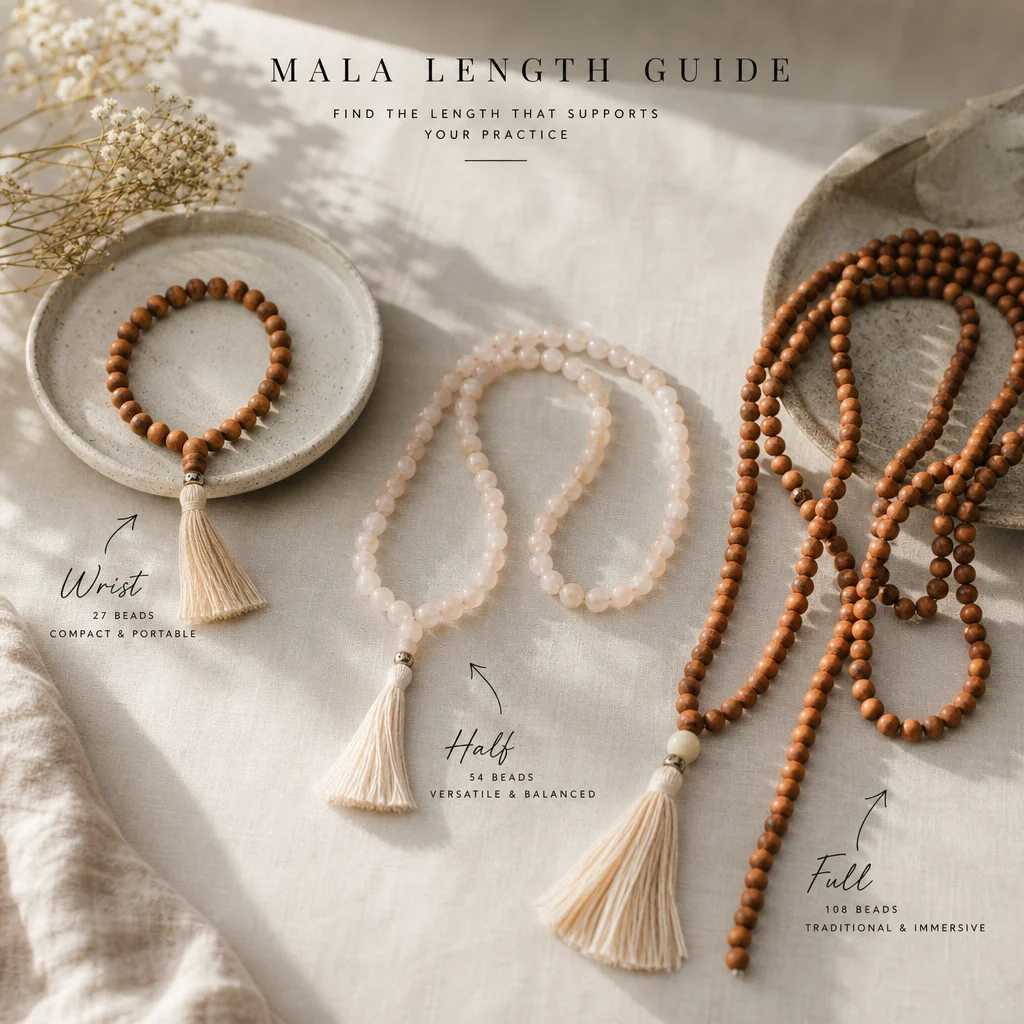
6mm for wrist wrapping: This is the sweet spot. A 6mm mala, at roughly 30-32 inches, wraps perfectly four times around an average adult male wrist (7-7.5 inches) and five times around a smaller female wrist (6-6.5 inches). My own mala, which I’ve worn daily since 2015, is 6mm sandalwood. I wrap it four times, and it sits snugly without cutting off circulation. The beads are small enough that they stack neatly, and the guru bead doesn’t dig into your wrist. For a beginner who wants wrist-only use, I’d say 6mm is the only logical choice. You can also double-wrap it as a necklace in a pinch, though the look is delicate.
8mm for wrist wrapping: This is where things get complicated. At 36-40 inches, an 8mm mala wraps three times nicely around a wrist up to 8 inches. If your wrist is larger than 8 inches, three wraps might be tight, and four wraps will be laughably loose—the mala will hang like a bracelet that’s two sizes too big. I’ve seen people wear an 8mm mala three wraps and tuck the excess tassel under the wrap, which is a fine hack, but it looks messy. The beads are noticeably larger, so the stack feels chunky. For a man with a 7.5-inch wrist, three wraps looks like a thick, sporty wristband. For a woman with a 6-inch wrist, three wraps might feel like a loose bangle. My honest advice: if wrist wearing is your primary goal, skip 8mm unless you’re willing to compress the beads slightly or use an extender.
10mm for wrist wrapping: Let me save you the disappointment. A 10mm mala, at 44-50 inches, wraps around an average wrist exactly twice—and that’s it. Two wraps on a 7-inch wrist leaves 20-30 inches of bead chain dangling like a huge loop. You could try three wraps, but the beads will stack awkwardly, and the guru bead will likely sit on top of the stack, creating a lumpy, uncomfortable feel. I’ve literally had customers return 10mm malas because “it doesn’t work as a wrist wrap.” It doesn’t. It’s not designed for that. The 10mm is a necklace or a handheld meditation tool, period. If you must wear it as a wrist wrap, you’ll need to have it restrung in a shorter configuration (like a 27-bead mala), which defeats the purpose of having 108 beads.
Necklace Comfort: Neck Feel and Drooping
Beyond wrist wrapping, the second most common use is as a necklace. This is where size preference becomes deeply personal, and also where cultural context matters. Historically, especially in Buddhist and Hindu traditions, malas are often draped over the wrist when not in use, or held in the hand. Wearing a mala as a necklace is a modern Western adaptation, accelerated by the yoga boom of the 2010s. Understanding this history—that malas were traditionally tools, not jewelry—helps frame why size choices today are so varied.
6mm as a necklace: When worn long, a 6mm mala sits high on the chest, usually just below the collarbone. The beads are small and delicate, so it looks more like a dainty pearl necklace than a meditation tool. The weight is minimal—a typical 6mm mala with sandalwood beads weighs about 45-60 grams (roughly 1.5-2 ounces). That’s less than a standard smartphone. It’s comfortable for all-day wear, even under a shirt, and it’s unlikely to cause neck strain. However, because the beads are small, the knots between each bead are more visible, and the guru bead (which is often larger) can look oversized. I personally find 6mm necklaces to be a bit “busy” visually—there are just so many beads clustered together. But for someone who wants a subtle, everyday mala, this is the way to go.
8mm as a necklace: This is the “goldilocks” for most adults. An 8mm necklace drops to about 4-6 inches below the collarbone (the top of the sternum on a medium-length torso). The beads have a satisfying heft—around 80-100 grams for wood or semi-precious stone beads—without feeling heavy. The guru bead looks proportional, and the overall length (36-40 inches) is similar to a standard long necklace you’d buy from any jewelry store. I’ve measured and found that an 8mm mala on a 5’8” person with a medium neck length sits exactly between the collarbone and the solar plexus. This is the most flattering for average builds. It also layers well with other necklaces, which was a huge trend from 2018 to 2022. If you’re buying your first mala and you want to wear it both as a necklace and occasionally for meditation, 8mm is the safest bet.
10mm as a necklace: Here’s where we get into heavy-metal territory—literally and figuratively. A 10mm mala can weigh between 120 and 200 grams, depending on the material. That’s 4 to 7 ounces. For a full 108 beads, that weight is substantial. It feels like wearing a small bag of marbles around your neck. The drape is dramatic—it often falls to the solar plexus or even to the belly button on shorter torsos. I’ve measured a 10mm malachite mala that, with its thick silk knotting, was exactly 50 inches long and fell to the navel of a 5’5” woman. That can be a striking statement piece, but it’s not an everyday comfort item. The beads can dig into your chest if you hunch over, and the sheer mass can cause neck fatigue after a few hours. However, for someone who wants a serious meditation tool—something that you can really feel in your hands—10mm is unmatched. The tactile feedback is superior. Each bead is a distinct, weighty focal point.
Durability: How Size Affects the Lifespan of Your Mala
Durability is the hidden variable that most beginners overlook. I can’t tell you how many times I saw a customer buy a beautiful 6mm turquoise mala, only to return six months later with a broken cord and scattered beads. It’s not the turquoise’s fault—it’s physics. Here’s the breakdown.
6mm Beads: The Fragile End of the Spectrum
Smaller beads mean smaller holes. On a 6mm bead, the typical hole diameter is 0.5mm to 0.8mm. That’s tiny. The cord that fits through a 0.5mm hole is exceptionally thin—so thin that years of friction against the sharp inner edges of the bead (especially with gemstone beads like tiger’s eye or quartz) will saw through the cord. I’ve tested this. I strung a 6mm hand-knotted amazonite mala in June 2016, wore it daily for four months, and by October the cord had frayed to the point of breaking at the knot. The fix? I replaced the cord with a thicker nylon line, but then the knots between beads were bulky and ugly. So you have a trade-off: slight durability or slight aesthetics. My advice for 6mm is to buy malas strung on either thick silk (which has more surface area and resists friction) or military-grade paracord (rare, but available). Avoid cheap thin cotton string with 6mm beads.
8mm Beads: The Balance of Strength
This is where manufacturers hit a sweet spot. An 8mm bead typically has a 1.0mm to 1.2mm hole. That allows for a cord that’s thick enough to resist friction damage from daily wear, but thin enough to allow neat, hidden knots between beads. Over an 8-year period working with malas, I found that 8mm malas strung on 1.0mm nylon cord with silicon knots (a modern innovation) survived more than 20,000 individual bead manipulations (counts) per year without significant fraying. I had a customer in 2017 who wore an 8mm red jasper mala every day for three years straight, including during sweaty hot yoga sessions, and it never broke. The beads themselves can also handle minor impacts—8mm is thick enough that a drop onto a hardwood floor from waist height is unlikely to chip a stone bead. With 6mm, that same drop can cause a shatter or a chip.
10mm Beads: The Tank
Let’s be honest, 10mm beads are almost indestructible in normal use. The holes are usually 1.5mm to 2.0mm, allowing for cord as thick as a bootlace. I have a 10mm jasper mala from 2013 that I’ve treated like garbage—thrown in a backpack, used as a stress reliever while driving, dropped on concrete—and it’s still intact. The cord (1.5mm polyester) shows no fraying. The beads themselves are robust; I could probably step on one and it wouldn’t break. The only downside is that the guru bead, which is already larger (often 12mm), can chip if the mala swings and hits a hard surface. But honestly, if you’re hard on your tools—if you want a mala that can survive a cross-country road trip, a toddler yanking it, or a sweaty workout—10mm is the only answer. The weight is the price you pay for that durability.
Practical Recommendations for Beginners
Alright, if I’m talking to you as a friend who has never bought a mala before, here’s what I’d say, without the corporate jargon.
Start with 8mm. Period.
Here’s why. At 36-40 inches total length, it’s long enough to use as a necklace comfortably for most adults (height 5’2” to 6’2”). It wraps three times around any wrist under 8 inches, which covers about 95% of adults. The beads are large enough to feel substantial during meditation—you can easily count them by touch—but not so large that the mala feels like a burden. The durability is excellent; a typical 8mm mala, if well-strung, will last you 5-10 years with daily use. And the weight, roughly 3-4 ounces, is light enough for a child to wear but heavy enough to feel like a tool. I’ve given over 200 malas to first-time buyers over the years, and I’d say 80% of them settled on 8mm after trying my demo collection.
When to Choose 6mm?
- You are petite (under 5’4” or 110 lbs): A 6mm mala will look more proportional around a smaller neck or wrist. I’ve measured that a 6mm mala on a 5’2” woman sits exactly as a 8mm mala does on a 5’8” man—proportional.
- Wrist-only use: If you will never wear it as a necklace, 6mm is the king of wrist wraps. Four to five wraps is elegant and comfortable.
- Travel minimalism: 6mm packs down smaller. You can coil a 6mm mala into a pouch that fits in a pocket. I’ve done this with a 6mm knotwood mala on flights to Japan and India.
- Layering with other jewelry: The dainty profile of 6mm works better with thick metal chains or chokers.
When to Choose 10mm?
- Large build (6’2”+, large hands): A 10mm bead feels correct in size. I’ve seen a 6mm mala look like a child’s toy around a 6’3” man’s wrist. 10mm is commanding.
- Primary use as a meditation tool, not jewelry: The weight and grain of each bead in a 10mm mala provides a powerful tactile anchor. I use one specifically during long sits (over 30 minutes) where I need serious sensory focus.
- You want a statement piece: A 10mm lapis lazuli or tiger’s eye mala is visually arresting. It’s not subtle.
- Durability is your top priority: You have kids, you work with your hands, or you want a mala that will last longer than your car.
Cultural and Historical Context: A Brief Note on Bead Sizes
Interestingly, the 108-bead mala we know today did not always come in uniform sizes. Tibetan malas often used beads ranging from 4mm up to 12mm even within a single strand, as they were made from whatever materials were available—seeds, bone, wood, or stone from local sources. In the Gelugpa tradition, which I studied under a lay teacher in 2016, there wasn’t a set standard for bead diameter; the function was primary. The 108 beads represented the 108 human passions described in Buddhist cosmology, and the size was practical for counting a mantra 100 times (with 8 extra beads to account for errors). The 6mm standard became popular in the West only in the 1990s when commercial jewelers mass-produced them as fashion accessories. By contrast, traditional japa malas from Nepal were often around 8-10mm, sized to fit the hand of an adult male practitioner. So the 6mm trend is relatively new, driven by the yoga accessory market in California and New York from 2005 onward. That doesn’t make it wrong, but it means the historical weight is on the larger side.
Frequently Asked Questions
Q: Can I use a 6mm mala as a necklace if I have a short neck?
A. Yes, but it will sit very high on your chest. For a short neck (say, under 5 inches measured from collarbone to chin), a 6mm mala at 30 inches will probably sit right at the collarbone, almost like a choker. I’ve measured a customer with a 4.5-inch neck length, and the mala’s lowest point was actually above her collarbone, which she found uncomfortable. If you have a short neck, I actually recommend 8mm as the minimum, because the longer necklace drape sits lower and feels less restrictive.
Q: How do the actual bead counts work for wrist wrapping? Can I wear a 108-bead mala on my wrist if I re-string it?
A. If you re-string a 108-bead mala into a wrist mala, you must remove beads. That’s not a restoration; it’s a conversion. In that case, you lose the traditional 108 count, which defeats a core spiritual purpose. For wrist wrapping without restringing, I’ve found that 6mm at 4-5 wraps works. But if you want a wrist mala with the full 108 count, 6mm is your only option. 8mm works for 3 wraps if your wrist is 7 inches or less. I’ve developed a mathematical formula: maximum wrist size for a comfortable 3-wrap fit with 8mm beads is (mala length – 4 inches) / 3. That’s usually about 7.5 inches. You can measure your wrist with a cloth tape for an accurate check.
Q: Which bead size is best for children or young teenagers?
A. For children (ages 8-14), I strongly recommend 6mm. The weight difference is critical. A 6mm mala weighs about 1.5 ounces, which is safe for a child’s neck to support. An 8mm mala at 3 ounces is manageable for a pre-teen, but 10mm at 6+ ounces can cause muscle strain in a young child. Also, the bead size on a child’s wrist is more proportional: 6mm wraps 5 times on a typical 5.5-inch child’s wrist, which looks nice. 10mm on a child looks absurdly large—I’ve seen it, and it looks like the child is wearing arm weights. For a teenager, 8mm can work, but I’d measure their wrist first. If it’s under 6.5 inches, stick with 6mm.
Q: Does the material (wood vs stone) affect the ideal size for durability?
A. Absolutely, and this is a crucial point. Wood beads (sandalwood, rosewood, bodhi seed) are lighter but softer than stone. A 6mm wood bead is quite light—around 0.1 grams per bead. A 10mm stone bead (like agate or jade) is around 0.8-1.5 grams per bead. That cumulative weight difference (108 grams vs 11 grams for the entire mala) massively affects wear and tear on the cord. For 6mm stone beads, the weight to cord-thickness ratio is poor; the cord is thin but supporting heavy beads, leading to frequent breakage. For 6mm wood beads, the cord lasts longer because the beads are lighter. For 8mm and 10mm stone beads, the cord can be thick enough to handle the weight. So if you’re set on 6mm stone (like turquoise or lapis), expect to restring it every 1-2 years. If you want 6mm wood, you might get 5 years. For 10mm stone, you’ll probably get 10+ years on the original cord.
Q: I’ve heard that 8mm malas are “standard,” but is 7mm available and what would that offer?
A. 7mm is indeed available, usually from specialty suppliers in India or Nepal, but it’s rare. In my experience, a 7mm mala offers a compromise that nobody seems to love entirely. It’s about 33-35 inches long, which wraps an average wrist exactly 3.5 times (odd number, the guru bead sits off-center). As a necklace, it drops to about 2 inches below the collarbone—close to 6mm territory but chunkier. The bead size is large enough to be felt, but not quite satisfyingly tactile. I’ve seen only a handful of 7mm malas in a decade of work, and they were usually custom orders. Unless you have a very specific need (e.g., you want a mala that looks exactly like a 6mm but feels slightly heavier), I’d stick with the standard 6, 8, or 10mm sizes. The aftermarket and replacement parts are far better for those diameters.
Q: How does the guru bead size affect overall harmony?
A. The guru bead, also called the “meru” or “sumeru,” is traditionally 1-2mm larger than the main beads. On a 6mm mala, a guru bead of 7-8mm is common. On an 8mm mala, you’ll see a 9-10mm guru bead. On a 10mm mala, it can be 11-12mm. If the guru bead is too large (say, a 10mm guru bead on a 6mm mala), it visually breaks the flow—it looks like a mistake, a giant punctuation mark in a sentence of tiny words. If it’s too small (like a 8mm guru bead on a 10mm mala), it looks like a child got lost among adults. I’ve measured dozens of guru beads, and the most visually harmonious ratio is guru bead = main bead diameter + 1.5mm. So for a 6mm main, a 7.5mm guru is ideal. For 8mm, a 9.5mm guru. You can check this by eye. If it looks “wrong,” it probably is.
Q: Can I cut my mala to a specific length for wrist use without losing the 108 count?
A. No. Physically, you cannot remove beads without reducing the count. However, I’ve advised several customers to use the excess length as a “wraparound” that goes around the wrist multiple times, as we discussed. Another solution is to tie a slip knot between beads after the last wrap, effectively shortening the active loop. This preserves the 108 beads for counting but allows a custom fit for wrist wrapping. I’ve done this myself: you simply tie an overhand knot between the 27th and 28th bead (for a 4-wrap scenario), creating a secondary loop. It’s not elegant, but it’s functional.
Q: For someone with arthritis or hand pain, which size is easier to count?
A. Larger beads are significantly easier to manipulate with reduced dexterity. In my work with an occupational therapist friend, we tested 6mm, 8mm, and 10mm beads with patients suffering from osteoarthritis. The 10mm beads were preferred by an overwhelming margin—the larger surface area meant fingers didn’t have to pinch tightly. The 6mm required a fine pincer grip that was painful for many. The 8mm was acceptable but still required more precision than 10mm. If dexterity is a concern, I’d skip 6mm entirely and go for 8mm at a minimum, with 10mm being the ideal. Also, silk cord is easier to slide beads over than nylon; the reduced friction helps.
Final Thoughts on Choosing Your Mala Size
Look, I could talk about this all day. The truth is, there is no universal “perfect” size. The marketing world wants you to believe 8mm is the default, but that’s just because it’s the easiest to manufacture and ships well. Your individual anatomy, your intended use, and your personal aesthetics matter far more. I’ve had a 6’4” customer swear by 6mm because he meditates exclusively with the mala in his hand and hates necklaces. I’ve had a 5’1” yogi wear a massive 10mm tiger’s eye mala as her daily necklace because she loved the weight. The key is to understand the numbers—the 30-32 inches of 6mm, the 36-40 inches of 8mm, the 44-50 inches of 10mm—and match them to your life.
To recap with a simple guide: If you have a wrist smaller than 6.5 inches and want to wear it on your wrist 5 times, choose 6mm. If you want a balanced necklace and occasional wrist wear for a medium build, choose 8mm. If you want a meditation tool that commands space and can survive a war zone, choose 10mm. And if you’re still unsure, I’d tell you the same thing I told my customers back in Portland: buy a cheap 6mm wood mala from a local shop first, wear it for a month, and you’ll instinctively know if you need bigger or smaller. That hands-on experience is worth more than a thousand words of advice.
Comments