Selenite's Water Solubility Explained
May 31, 2026
The Short Answer: Yes, and Faster Than You Think
Selenite dissolves in water. Not over months or years — over hours. Drop a selenite stick into a glass of water and within a few hours you'll notice the edges softening and the water becoming slightly cloudy. Leave it overnight and you'll find a visibly smaller, increasingly fuzzy specimen. Leave it for days and the stone will be significantly degraded, possibly dissolved past recognition depending on its original size.
This isn't a minor sensitivity like the kind rose quartz or amethyst has (where prolonged soaking is discouraged but brief contact is harmless). Selenite has a genuine, rapid solubility in water that ranks among the highest of any commonly collected mineral. Understanding why this happens, how fast it happens, and what to do about it is essential for anyone who owns selenite — whether you're a casual collector or someone who uses crystals in daily practice.
The Science: Why Selenite Dissolves
Selenite is a crystalline variety of gypsum, which is calcium sulfate dihydrate (CaSO₄·2H₂O). The "dihydrate" part is crucial — it means that every molecule of calcium sulfate in selenite is bound to two molecules of water within the crystal structure. This structural water is what gives selenite its characteristic transparency and satiny luster, and it's also what makes the mineral fundamentally water-soluble.
When selenite comes into contact with water, the water molecules interact with the crystal surface and begin breaking the ionic bonds between calcium and sulfate ions. The process is straightforward dissolution: the crystal literally disassembles at the molecular level, with calcium and sulfate ions entering solution. Because the crystal structure already contains water, there's minimal energetic barrier to adding more — the process is thermodynamically favorable and proceeds at a measurable rate even in cold, still water.
The rate of dissolution depends on several factors. Warm water dissolves selenite faster than cold water. Agitated water (moving water, running tap water) dissolves it faster than still water. A higher surface-area-to-volume ratio (thin pieces, rough textures, broken edges) dissolves faster than smooth, compact pieces. A small selenite wand (say, 10cm long and 1cm wide) left in a bowl of room-temperature water will show visible degradation within 4-6 hours and significant dissolution within 12-24 hours.
What Dissolution Looks Like: Stage by Stage
Stage 1: Surface Softening (0-2 hours)
The first visible sign of water damage is a loss of sharpness at edges and corners. Selenite that started with clean, defined edges will begin to look slightly rounded or soft. The surface may develop a very faint foggy or milky appearance where water has begun to etch the crystal surface. The water itself may become slightly cloudy if you look closely, though this is subtle in the early stages.
Stage 2: Edge Degradation (2-8 hours)
Edges and corners become noticeably rounded. Thin sections and points start to look melted or melted-looking. The surface develops a chalky, matte texture that contrasts sharply with selenite's normally satiny luster. You might see small flakes or particles detaching from the surface into the water. If you remove the stone from the water at this stage and let it dry, the surface damage is permanent — the soft, chalky texture won't revert to the original finish.
Stage 3: Structural Compromise (8-24 hours)
Significant material loss becomes visible. The stone is measurably smaller. Thin sections may have partially or fully dissolved. The water is noticeably cloudy with dissolved calcium sulfate. Any internal inclusions that were near the surface are now exposed. The stone may feel fragile to the touch — thin areas that were solid before may now flex slightly under pressure.
Stage 4: Extensive Dissolution (24+ hours)
For small pieces, complete dissolution is possible within a few days. Larger pieces will be severely compromised — deeply pitted, reduced in size, and structurally weakened. The water is opaque with dissolved mineral. Any remaining solid material is a fraction of the original.
Safe Cleaning Methods for Selenite
Dry Brushing (The Gold Standard)
The safest and most effective cleaning method for selenite is dry brushing with a soft, clean brush. A makeup brush, a soft paintbrush, or a dedicated crystal-cleaning brush (natural bristles, no metal) works well. Gently brush away dust, debris, and surface residue. This removes the vast majority of everyday contamination without exposing the stone to any moisture at all.
For stubborn dust in crevices or textured surfaces, a soft-bristled toothbrush (dry, unused for teeth) provides more precise cleaning. Work gently — the brush bristles shouldn't flex hard against the surface. Even dry selenite can be scratched by sufficiently abrasive materials, so use the softest brush that does the job.
Damp Cloth (Quick and Controlled)
If dry brushing isn't sufficient — say you've got a sticky spot or visible residue that won't brush off — a barely damp cloth is acceptable for brief, targeted contact. The key word is "barely." Wring the cloth out completely so it's barely more than moist to the touch. Wipe the affected area quickly, then immediately dry the selenite with a clean, dry cloth. The total water contact time should be under 10 seconds. This is safe for occasional use but shouldn't be your regular cleaning method.
Selenite Charging Plates: Self-Cleaning in Theory
Many people own flat selenite slabs marketed as "charging plates" for other crystals. The idea — that placing other stones on selenite cleanses their energy — is a traditional practice in crystal healing. But what about keeping the selenite plate itself clean? If you're placing relatively dry stones on the plate, the selenite is fine. However, some people place damp crystals (freshly rinsed amethyst, for instance) on their selenite plates, which introduces moisture that will slowly degrade the plate over time. Always dry other crystals completely before placing them on selenite.
What Not to Do With Selenite
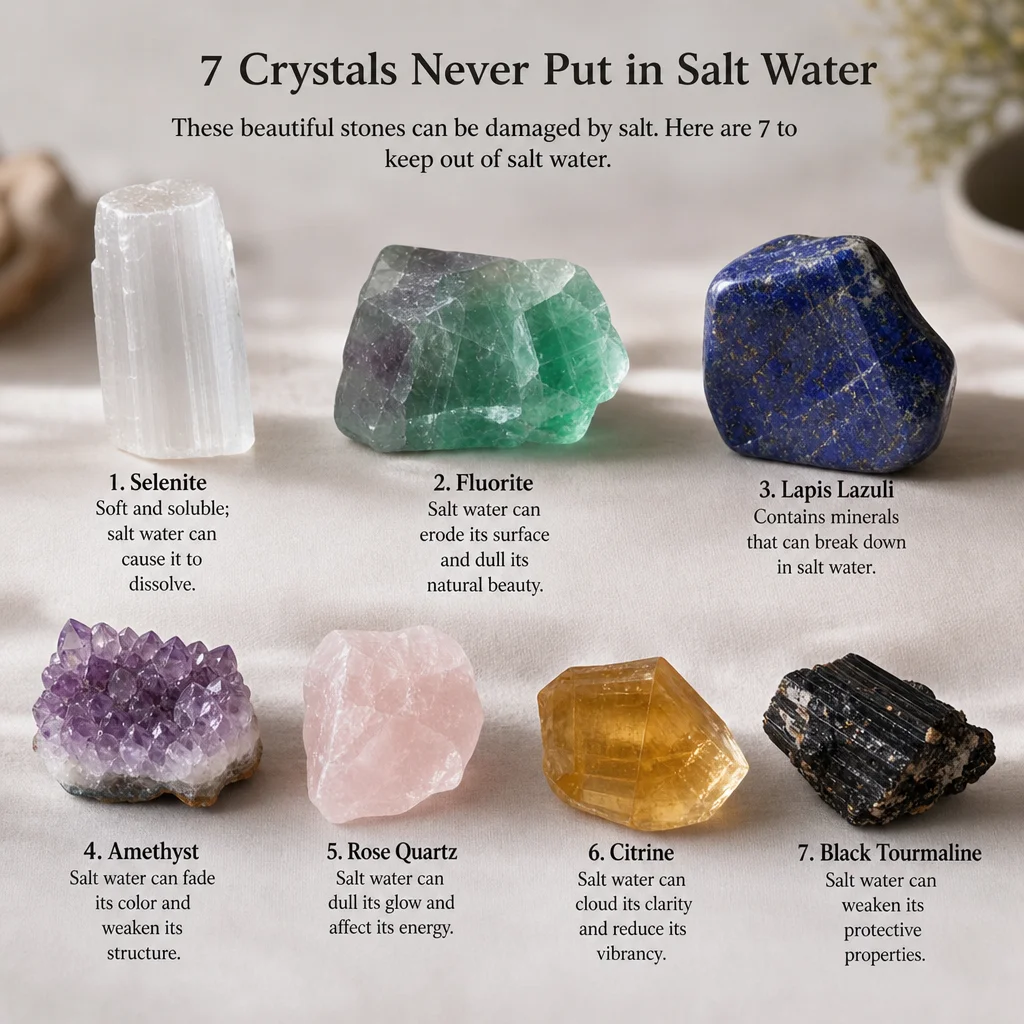
Never soak selenite in water. This should be obvious from everything above, but it's worth stating directly because many standard crystal care guides recommend "soaking your crystals in salt water for cleansing" without noting that this will destroy selenite (along with halite, calcite, malachite, and several other water-sensitive minerals).
Never leave selenite in humid environments long-term. A humid summer in a non-air-conditioned space, a steamy bathroom, or placement near a humidifier will cause slow, cumulative damage. The stone won't dissolve dramatically, but it will gradually develop a chalky, degraded surface. Store selenite in a dry location with stable humidity.
Never use any liquid cleaners on selenite. No soap, no alcohol, no vinegar, no commercial crystal cleaners. Any liquid that contacts the surface will begin the dissolution process. Stick to dry methods exclusively.
Never expose selenite to significant temperature changes. While temperature itself doesn't cause dissolution, rapid heating or cooling can create thermal stress fractures in the crystal structure. Selenite is relatively soft (Mohs 2) and somewhat flexible along its cleavage planes — it can bend slightly before breaking, unlike more rigid minerals — and thermal stress exploits this structural vulnerability.
How Selenite Compares to Other Water-Sensitive Crystals
Selenite isn't the only mineral that dissolves in water, but it's one of the most commonly owned among water-sensitive species. For context:
Halite (rock salt): Dissolves extremely rapidly — a halite crystal will disappear in a glass of water within minutes to hours, depending on size. Much faster than selenite.
Malachite: Doesn't dissolve structurally in water, but it's sensitive because it contains copper, which can leach into water in toxic amounts. The risk isn't dissolution but toxicity. Malachite jewelry should never be used to infuse drinking water.
Calcite: Dissolves slowly in water, especially acidic water. A calcite specimen in clean water will show very gradual surface etching over weeks or months — much slower than selenite, but not immune. Calcite effervesces visibly in weak acids (like vinegar) due to carbon dioxide release.
Azurite: Similar to malachite — the concern is copper leaching rather than structural dissolution. Azurite also weathers to malachite on the surface over time when exposed to humidity, which is why well-preserved azurite specimens are more valuable than those showing green weathering.
Fluorite: Somewhat soluble in water, but very slowly. Clean water won't visibly damage fluorite in short contact, but prolonged soaking isn't recommended. Fluorite is also sensitive to sudden temperature changes, which can cause cleaving along its four perfect cleavage directions.
Selenite sits in the moderate-to-fast range of mineral solubility — not as dramatic as halite, but fast enough that casual water exposure causes visible damage within hours rather than days or weeks.
What to Do If Your Selenite Has Already Gotten Wet
If you've accidentally gotten your selenite wet and caught it quickly (within a few minutes), the damage is likely minimal or nonexistent. Dry the stone immediately with a soft cloth and let it air-dry completely in a dry location. Inspect the surface once dry — if the satiny luster is intact and edges are still sharp, no meaningful damage occurred.
If the selenite has been wet for hours and shows surface damage, the degradation is permanent but not necessarily catastrophic. The stone is still structurally sound (gypsum that's been surface-etched retains its core strength) and can continue to be used. The aesthetic impact depends on how much surface material was lost. Minor edge rounding or a slightly matte patch is cosmetic; significant dissolution changes the shape and size of the piece permanently.
If you've completely dissolved a piece of selenite (it happens, especially with small tumbles left in water bowls for "cleansing"), the dissolved material is harmless calcium sulfate — essentially the same mineral as gypsum wallboard and plaster. It's non-toxic and safe to dispose of normally. Just drain the cloudy water and compost, dump, or rinse down the sink.
Emergency: Selenite in a Salt Water Bath
The worst-case scenario for selenite is the "salt water cleanse" — a commonly recommended crystal care practice that involves soaking crystals overnight in salt water. If you've done this to your selenite, the combination of extended water exposure and dissolved salt (which increases the ionic strength of the solution and can accelerate dissolution through common ion effects) will have caused significant damage.
Remove the selenite from the water immediately. Rinse very quickly with plain water (yes, this adds more water contact, but it removes the salt residue). Then dry immediately with a soft cloth. The stone will likely be visibly reduced in size with a rough, chalky surface. It may still be usable, especially if it was a large piece, but it won't look the same.
Frequently Asked Questions
Can selenite be near water?
Near water, yes — in a room with normal humidity or displayed near (but not touching) a water feature is fine. Direct contact with liquid water is the problem. A selenite tower in a bathroom where it gets occasionally splashed from hand-washing will show damage over time. Keep it out of the direct splash zone.
Does rain damage outdoor selenite?
Yes. Selenite should never be placed outdoors where it can be exposed to rain. Even brief rain exposure, repeated over time, will cause cumulative surface damage. This is true even in arid climates where rain is infrequent — each rain event does measurable damage.
Can I use selenite to make crystal elixirs or gem water?
Absolutely not. Because selenite dissolves in water, it would release calcium sulfate into your drinking water. While not toxic in small amounts, this defeats the purpose of a clean elixir and will eventually degrade your selenite completely. Use the indirect method instead — place the selenite near (not in) the water container.
How should I store selenite long-term?
Wrap individual pieces in soft cloth or tissue paper and store in a dry, temperature-stable location. A sealed container (like a plastic food storage box) with a silica gel packet provides excellent humidity control. Avoid storing in cardboard boxes in damp basements or garages.
Frequently Asked Questions
Can I wear my selenite jewelry in the shower?
You should always remove your selenite jewelry before showering or bathing. Because selenite is a very soft, water-soluble crystal, prolonged exposure to water and soap will cause it to slowly dissolve, scratch, or become permanently cloudy. To keep your handcrafted SagStone pieces looking their best, keep them dry and put them on only after applying lotions or perfumes.


Comments