What Is Celestite and Why It Is Called the An...
June 4, 2026
What Is Celestite and Why It Is Called the Angel Stone
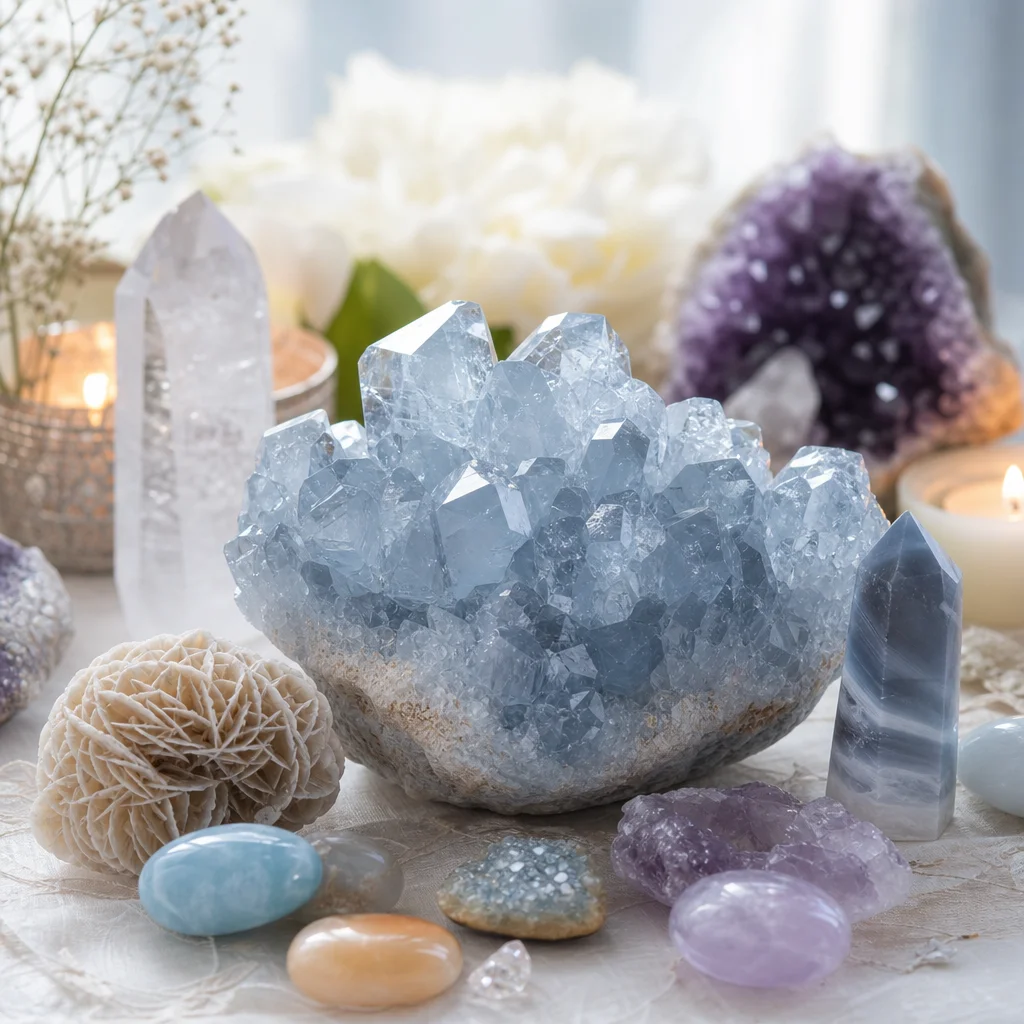
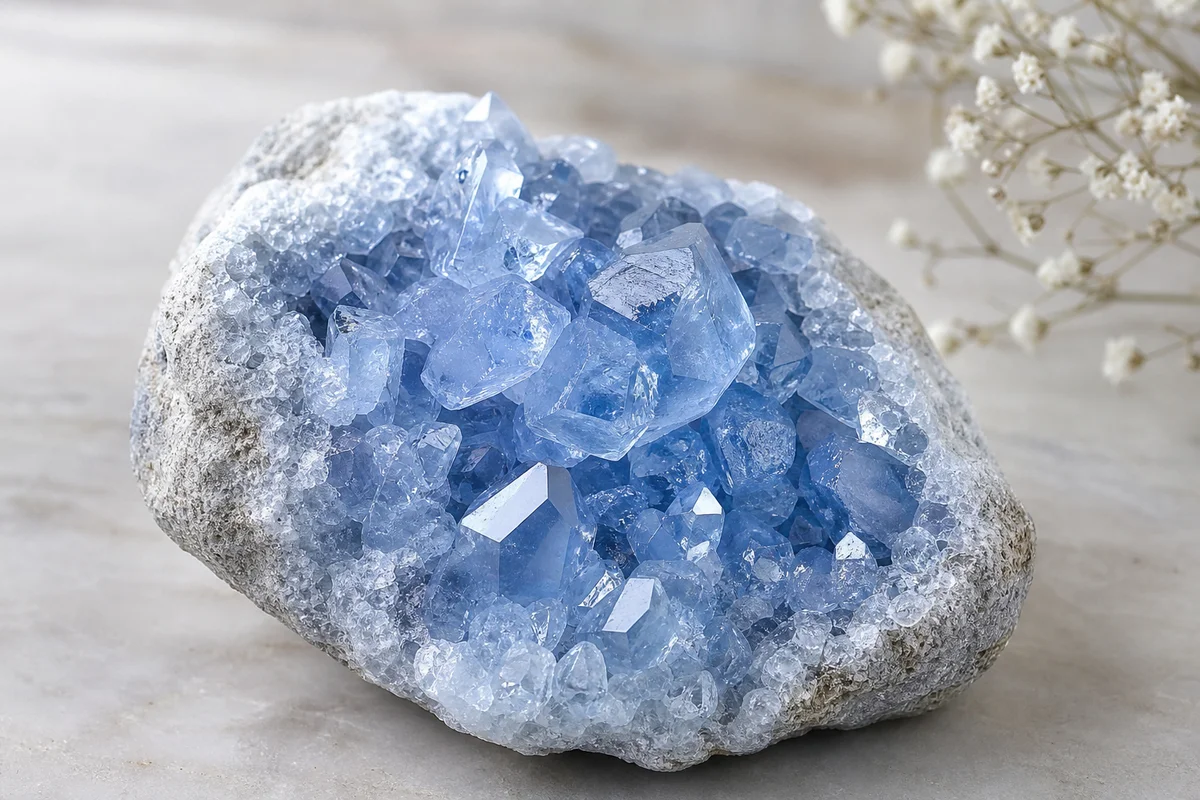
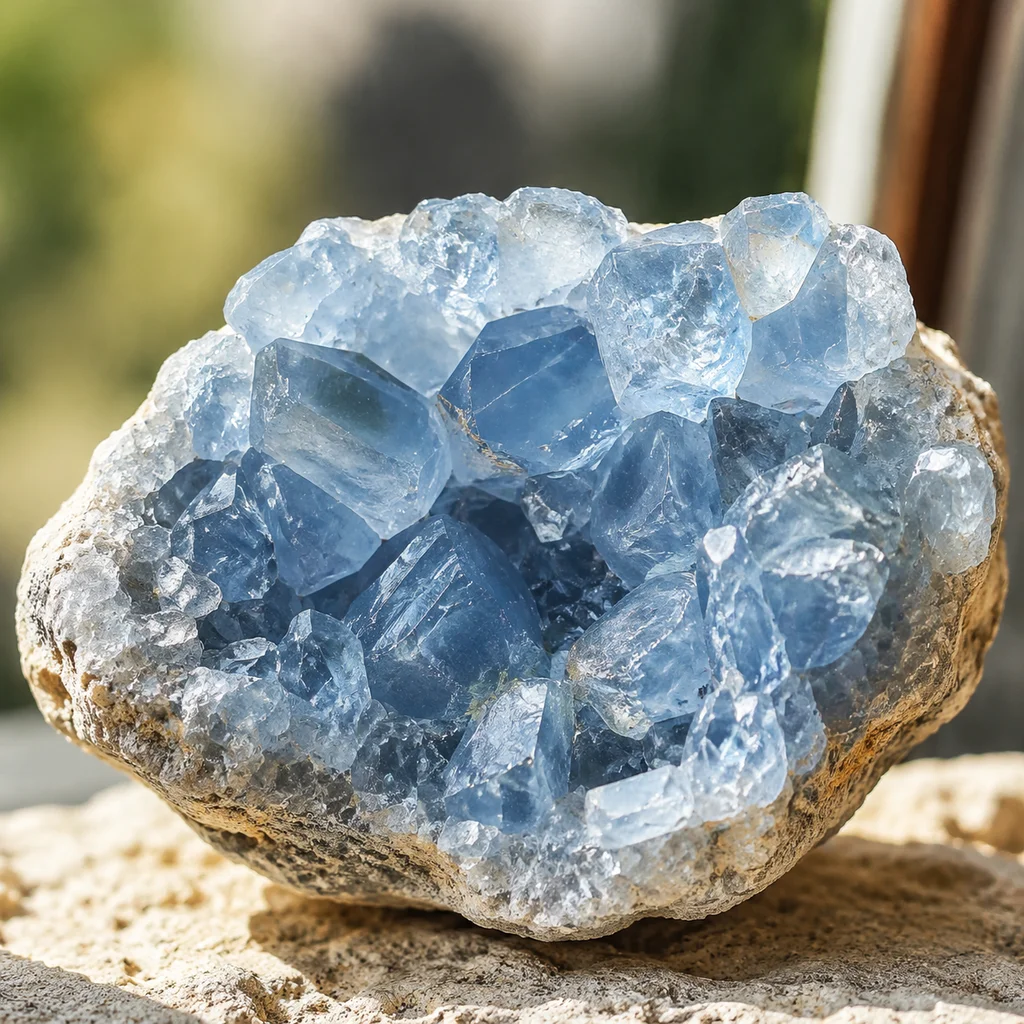
Celestite (also spelled celestine) is strontium sulfate (SrSO₄), a sulfate mineral that occurs in well-formed, often prismatic crystals with a distinctive pale blue to sky-blue color. The name comes from the Latin "caelestis," meaning "heavenly" or "celestial"—a reference to its ethereal sky-blue color that has earned it the nickname "Angel Stone" in metaphysical crystal communities. In geological terms, celestite forms in sedimentary rocks, particularly limestone, dolomite, and evaporite deposits, where strontium-rich fluids crystallize over geological time.
Before diving into the properties and uses of celestite, there is a critical practical fact that every potential buyer needs to know: celestite is extremely fragile. At only 3 to 3.5 on the Mohs hardness scale, it is softer than copper (3), easily scratched with a fingernail, and can be chipped or broken with moderate finger pressure. This single fact determines virtually everything about how you store, display, and—cautiously—use celestite.
The Science Behind Celestite's Blue Color
The blue color in celestite comes from trace amounts of strontium in the crystal lattice—though this statement requires a small clarification. Celestite IS strontium sulfate, so strontium is not a "trace" element in the chemical sense. Rather, the specific shade of blue is influenced by minute color centers and trace impurities within an otherwise pure SrSO₄ lattice. Pure strontium sulfate is actually colorless; the blue hue results from subtle defects and impurities that absorb certain wavelengths of visible light.
The intensity of the blue color varies significantly between specimens. Some celestite is a pale, almost white ice-blue that requires good lighting to see. Other specimens—particularly from Madagascar—are a vivid sky-blue that is immediately recognizable. The deepest blue specimens are the most commercially valuable and are typically found in large geode formations where the crystals had ideal conditions to grow slowly and evenly.
Celestite also occurs in colorless, white, yellow, orange, and reddish-brown varieties. The non-blue colors are less common in the commercial market but do exist and are collected by mineral enthusiasts who appreciate the crystallography regardless of color.
Madagascar: The Source of the World's Finest Celestite Geodes
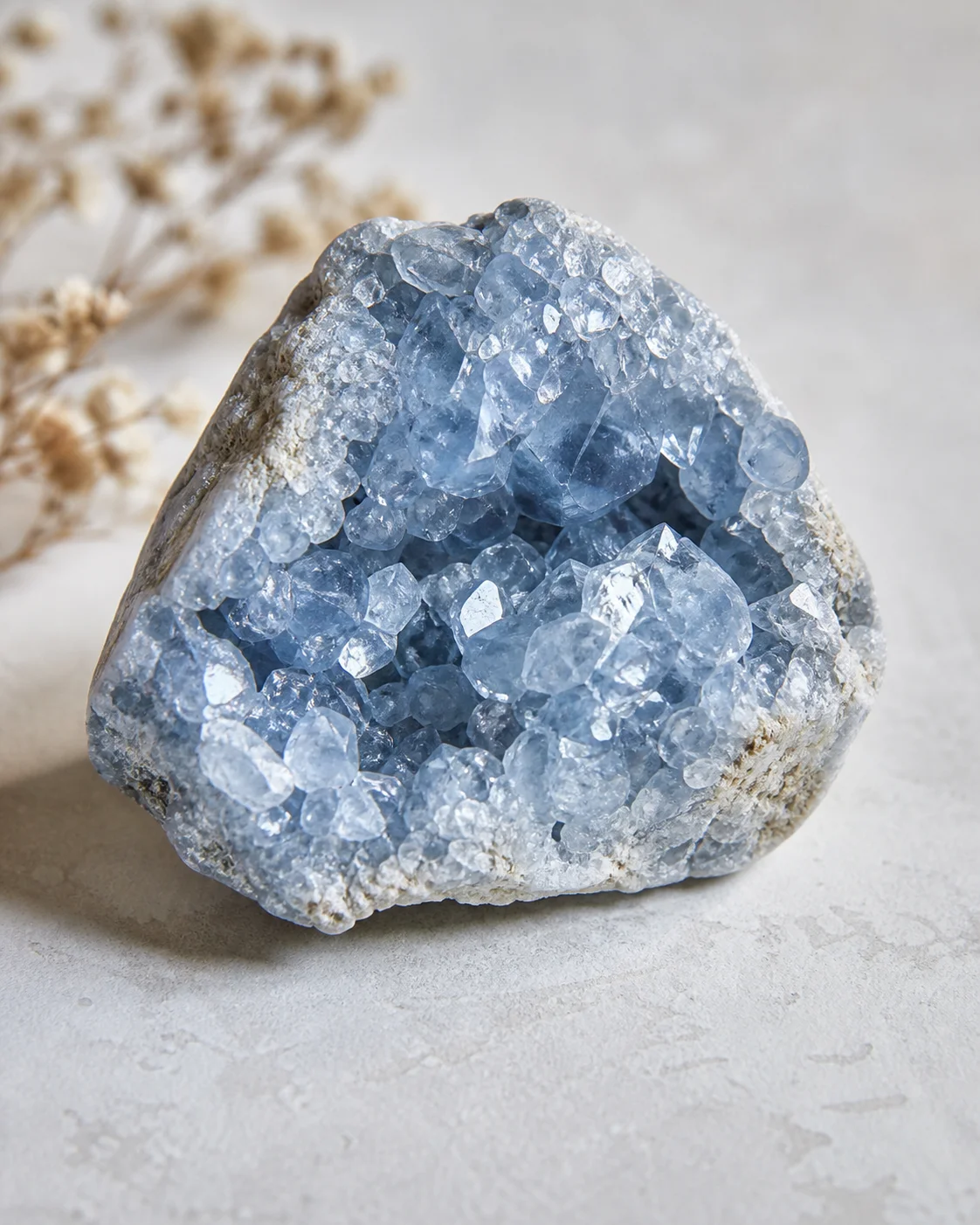
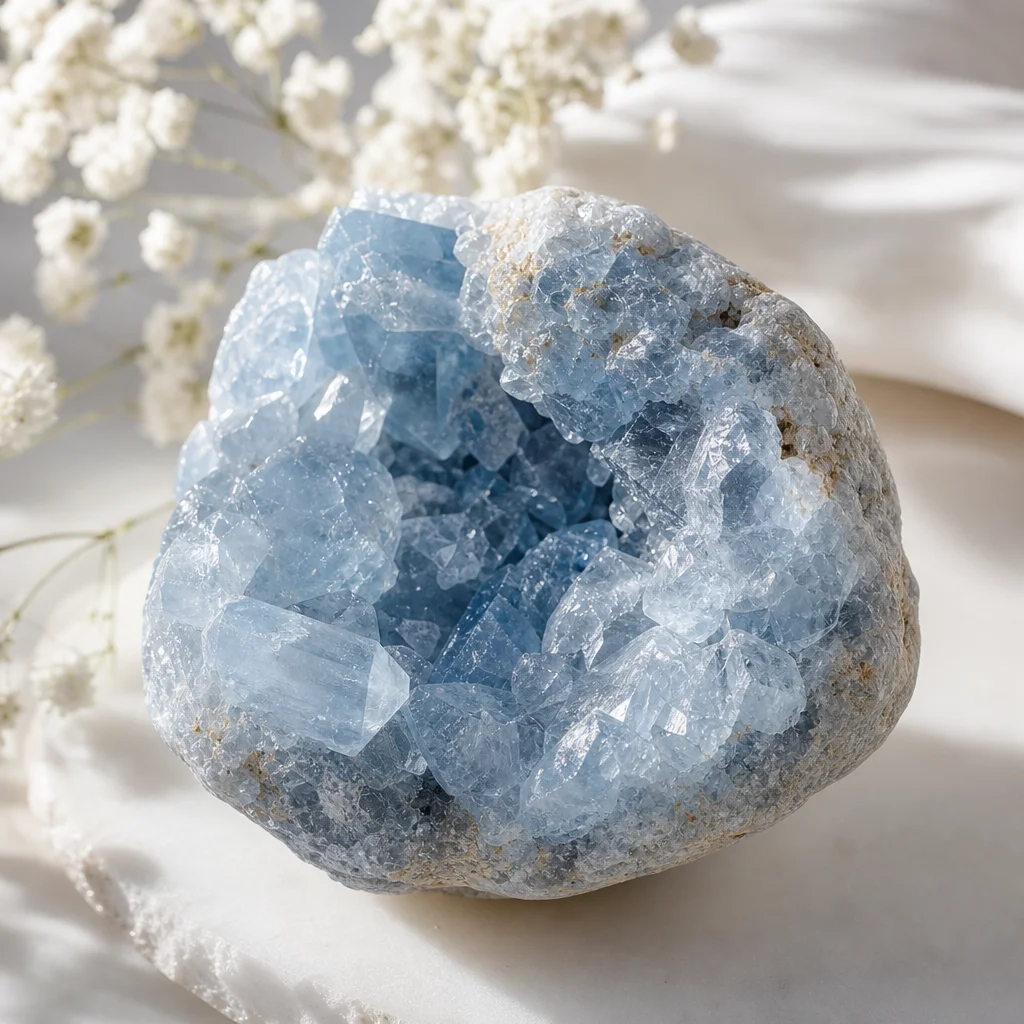
Madagascar is the world's premier source of specimen-grade celestite, and for good reason. The island's northwestern region contains massive celestite deposits where crystal-lined geodes—some measuring over a meter across—have been commercially mined for decades. These geodes contain hundreds or even thousands of blade-shaped celestite crystals radiating inward from the cavity walls, creating stunning natural formations that are displayed as decorative pieces in homes, offices, and crystal shops worldwide.
A typical Madagascar celestite geode specimen shows translucent to transparent pale blue crystals arranged in radiating clusters. The best specimens have large, well-terminated individual crystals with even color distribution. Size ranges from small palm-sized geodes to massive museum-quality pieces weighing over 100 kilograms.
Other significant celestite sources include the United States (Ohio, Michigan, and New York have produced notable specimens), Italy (Sicily), England (Bristol area), and Canada (Nova Scotia). However, the Madagascar material is so consistently high-quality that it dominates the commercial market almost entirely.
Why You Cannot Wear Celestite in Bracelets or Rings
This bears repeating because it is the most common mistake first-time buyers make: celestite is too soft and too fragile for jewelry that experiences any contact or impact. At Mohs 3-3.5, celestite ranks alongside materials like calcite, copper, and human fingernails. It can literally be scratched by a copper coin. In a bracelet, where the stones will regularly knock against tables, keyboards, and door frames, celestite crystals will chip, crack, and eventually shatter in a matter of weeks.
The only jewelry applications where celestite is remotely practical are in wire-wrapped pendants where the stone is fully enclosed and protected, or in resin-encapsulated pieces where the celestite fragment is suspended in a protective resin matrix. Even in these applications, the stone remains fragile and must be treated with care—this is a display piece, not a daily-wear item.
If you want a blue stone for a bracelet, consider alternatives like blue lace agate (Mohs 6.5-7), larimar (Mohs 4.5-5, but at least harder than celestite), blue chalcedony (Mohs 7), or aquamarine (Mohs 7.5-8). All of these provide blue tones in durable, wearable forms.
Why Sunlight Is Celestite's Enemy
Celestite's blue color is photosensitive—prolonged exposure to direct sunlight causes the color to fade, sometimes dramatically. A vivid sky-blue specimen left on a sunny windowsill for several weeks can become noticeably paler, and prolonged exposure over months can reduce the color to a near-colorless white. This is a well-documented phenomenon in mineralogy and is one of the key care considerations for any celestite collection.
The fading mechanism involves the breakdown of color centers (minute crystal defects that absorb specific light wavelengths) under ultraviolet radiation. Once these color centers are destroyed, the blue color cannot be restored through any treatment—unlike heat-treated amethyst or irradiated topaz, there is no known process to "re-blue" faded celestite.
Display your celestite geodes and specimens in areas with indirect or ambient lighting. LED lighting is ideal because it produces negligible UV radiation. If you want to photograph your celestite in sunlight for the best color representation, do it quickly—a few minutes of sun exposure for photography will not cause visible fading, but hours or days will.
Celestite vs. Angelite: Understanding the Difference
These two stones are frequently confused, largely because their names and their pale blue colors create an association in the crystal market. The confusion is understandable but the stones are fundamentally different:
- Chemical composition: Celestite is SrSO₄ (strontium sulfate). Angelite is CaSO₄·0.5H₂O (a hydrated calcium sulfate—essentially a form of gypsum).
- Hardness: Celestite is 3-3.5. Angelite is 3-3.5. They are similar in this regard—both are soft and fragile.
- Color: Celestite tends toward a clearer, more sky-blue tone. Angelite is typically a more muted, grayish-blue to white-blue. The distinction can be subtle and is not always reliable for identification.
- Crystal form: Celestite commonly forms large, distinct, prismatic crystals. Angelite typically occurs as massive, granular aggregates without well-formed crystals.
- Water sensitivity: This is the key practical difference. Angelite is a hydrated mineral—if you get it wet, the water of hydration can be disrupted, potentially altering the crystal structure. Celestite, while fragile, is not water-sensitive in the same way (though prolonged water exposure is still not recommended due to the risk of dissolution—SrSO₄ has low but non-zero solubility in water).
In practice, if you are looking at a piece of pale blue stone in a crystal shop, well-formed blade-like crystals with visible terminations are almost certainly celestite, while massive, irregularly shaped, grayish-blue material is more likely angelite.
How to Use Celestite in Meditation
Despite its fragility, celestite is one of the most popular stones for meditation and display in crystal collecting. The reasons are partly aesthetic (that sky-blue color is genuinely calming to look at) and partly tactile (the smooth, slightly cool surface of a polished celestite crystal feels pleasant to hold during seated meditation).
Common practices include placing a celestite geode on a meditation altar, holding a smaller single crystal in the palm during breathing exercises, or positioning a celestite cluster in a bedroom or study where its pale blue color is visible throughout the day. The idea behind all of these is simply creating a calming visual and tactile focal point—which is a well-established mindfulness technique, regardless of any beliefs about stone "energy."
Care Guidelines Summary
- Keep dry: No soaking, no water cleansing. Wipe with a dry or barely damp soft cloth.
- Keep out of sun: Display in indirect light only. UV causes permanent color fading.
- Handle carefully: Support from below when moving. The crystals can snap under their own weight if held at one end.
- Store separately: Do not stack or let harder stones contact celestite. Even quartz (Mohs 7) will scratch it.
- Dust gently: Use a very soft brush (makeup brush works) for dust removal. Compressed air can work for deep geode cavities.
Frequently Asked Questions
Can celestite be in a crystal grid on a desk near a window?
If the window receives direct sunlight, position the celestite where it is shaded. Even indirect bright light from a south-facing window may cause gradual fading over months. North-facing windows or rooms with no direct sun are ideal. If you are unsure, err on the side of caution—faded celestite cannot be restored.
Is celestite dangerous to handle?
No. Strontium sulfate is chemically inert and non-toxic. It is not radioactive, does not contain asbestos fibers, and will not harm your skin. The strontium in celestite is in a stable, non-soluble form and will not leach into your skin through normal handling. (Note: radioactive strontium-90 is a completely different substance with no chemical relationship to the stable strontium in celestite.)
Why are celestite geodes so expensive if the mineral is fragile?
You are paying for the natural formation, not just the mineral. The large, crystal-lined geodes from Madagascar take millions of years to form and require careful mining, extraction, and transport to arrive intact. Each geode is essentially a one-of-a-kind natural sculpture. The fragility that limits jewelry use actually increases the value of intact display specimens—fewer survive the mining process undamaged.
Frequently Asked Questions
Can celestite go in water?
No, you should never put celestite in water. As a delicate mineral, celestite is highly soluble and ranks quite low on the Mohs hardness scale. Prolonged exposure to moisture can cause the crystal's beautiful blue points to erode, become permanently brittle, or even dissolve completely. To safely cleanse your piece, simply use a dry, soft cloth.
How do you use celestite for sleep?
To use celestite for sleep, place a raw geode or tumbled stone on your nightstand or directly under your pillow. Known for its gentle, high-vibrational energy, this angel stone is perfect for soothing an overactive mind and promoting peaceful, lucid dreams. Ensure it rests in a secure spot to protect its fragile crystal points from chipping.

Comments