Celestite: The Sky Stone for Peaceful Sleep and
May 31, 2026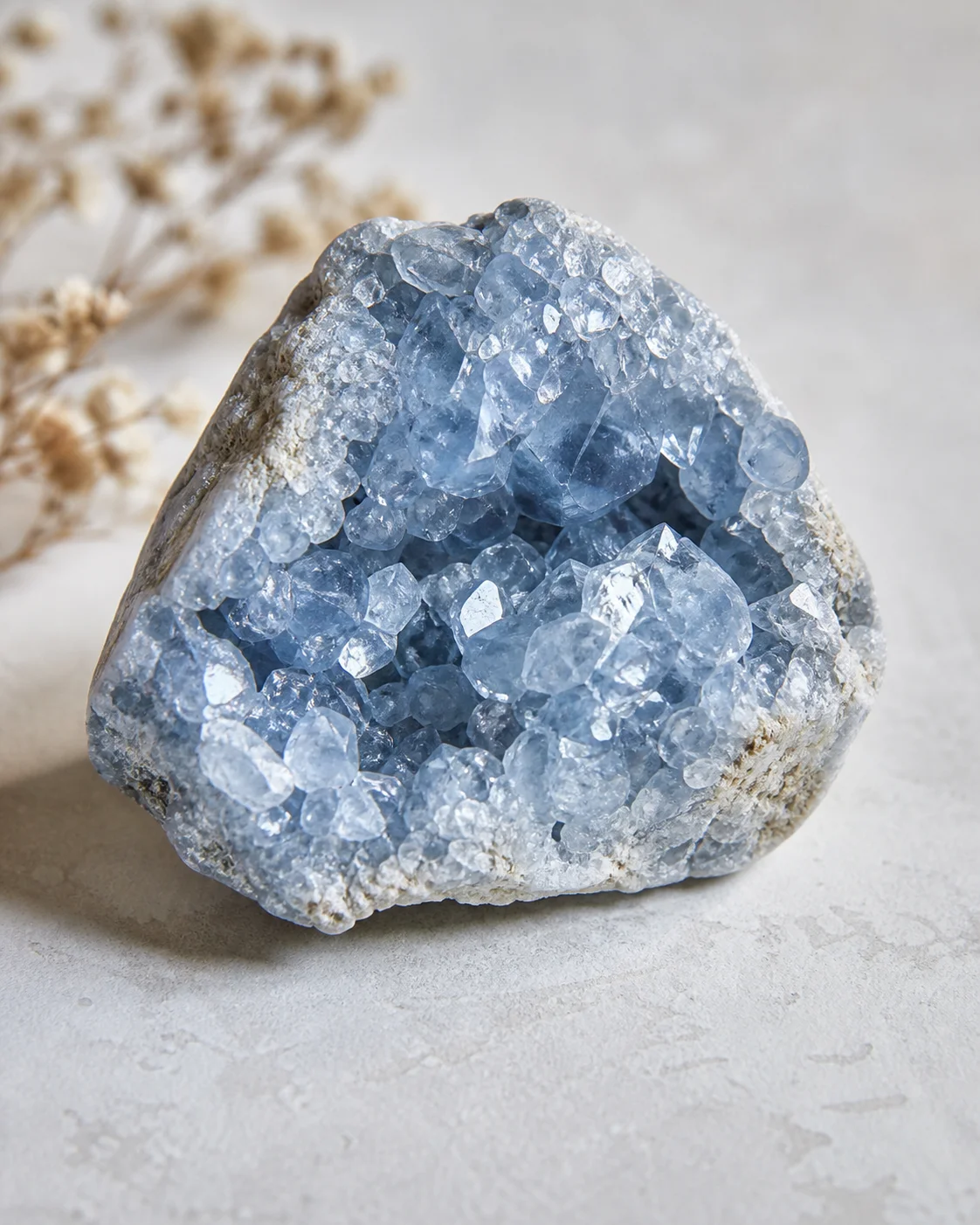
The Stone That Looks Like Captured Sky
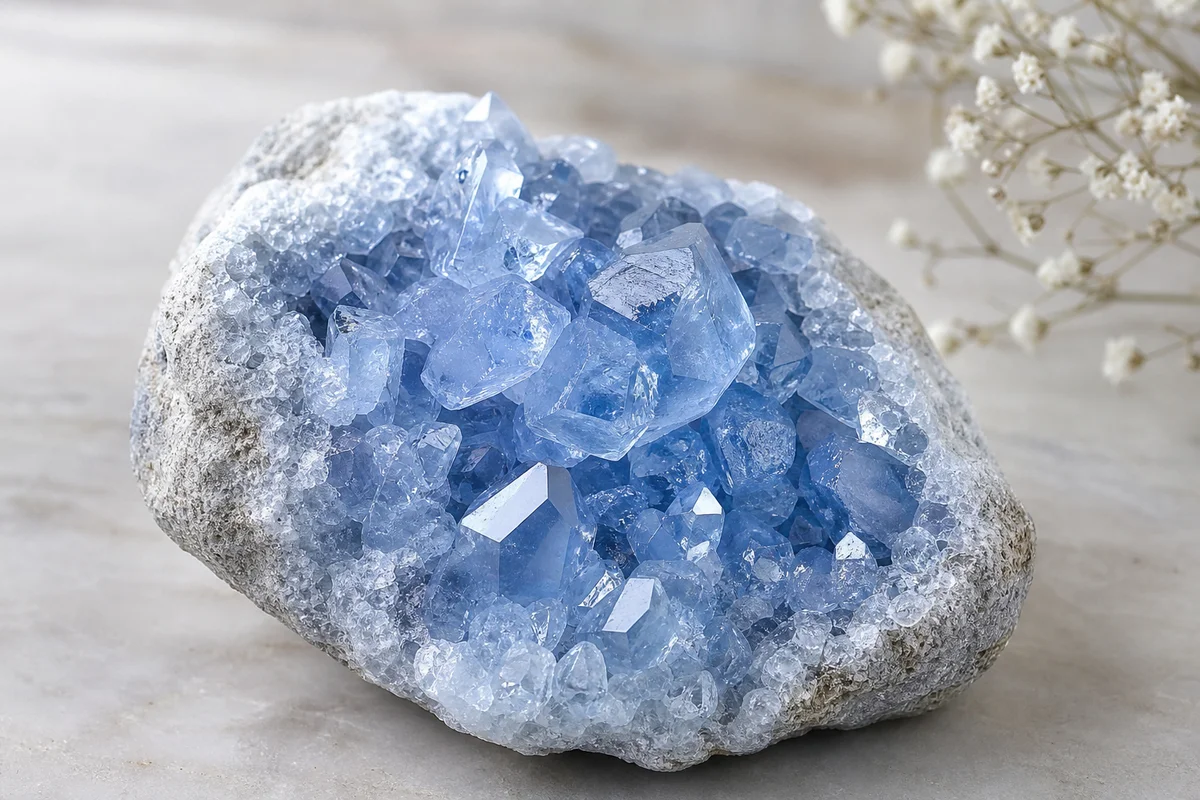
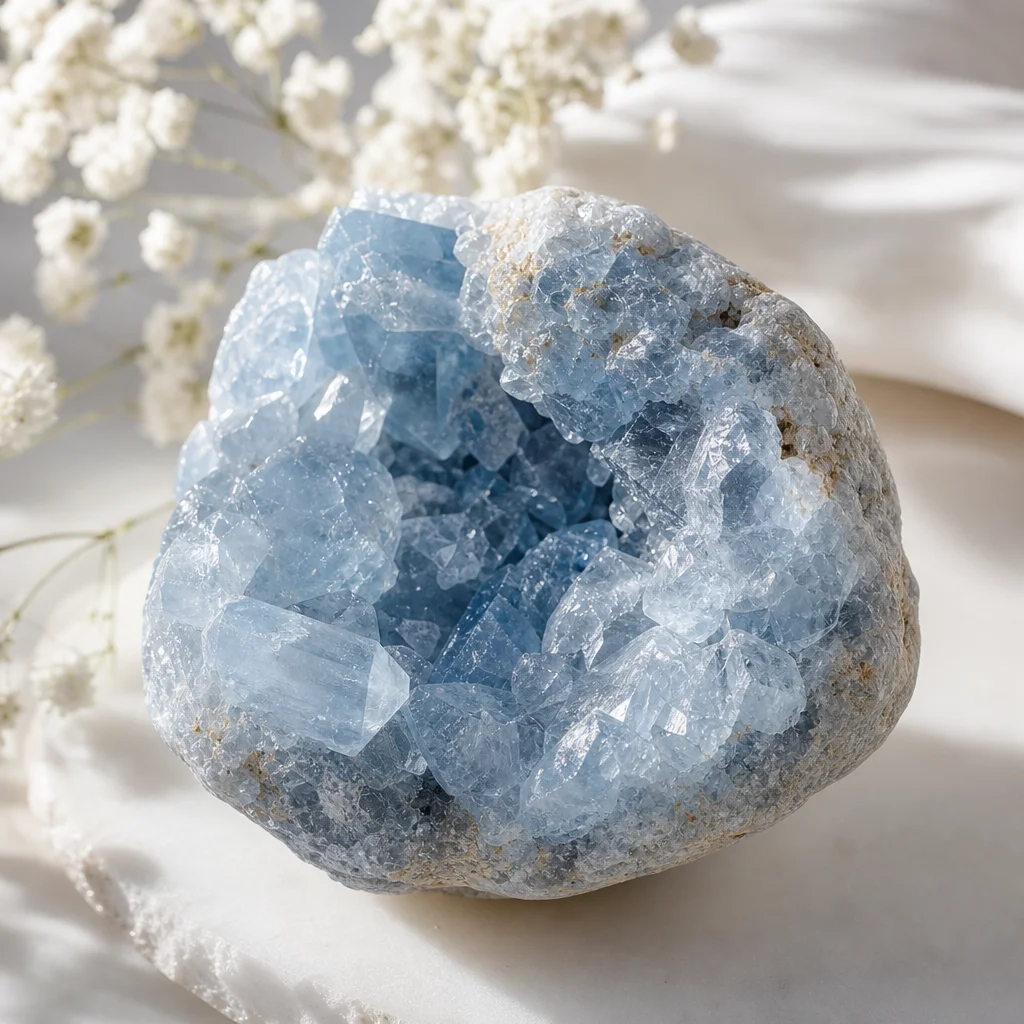
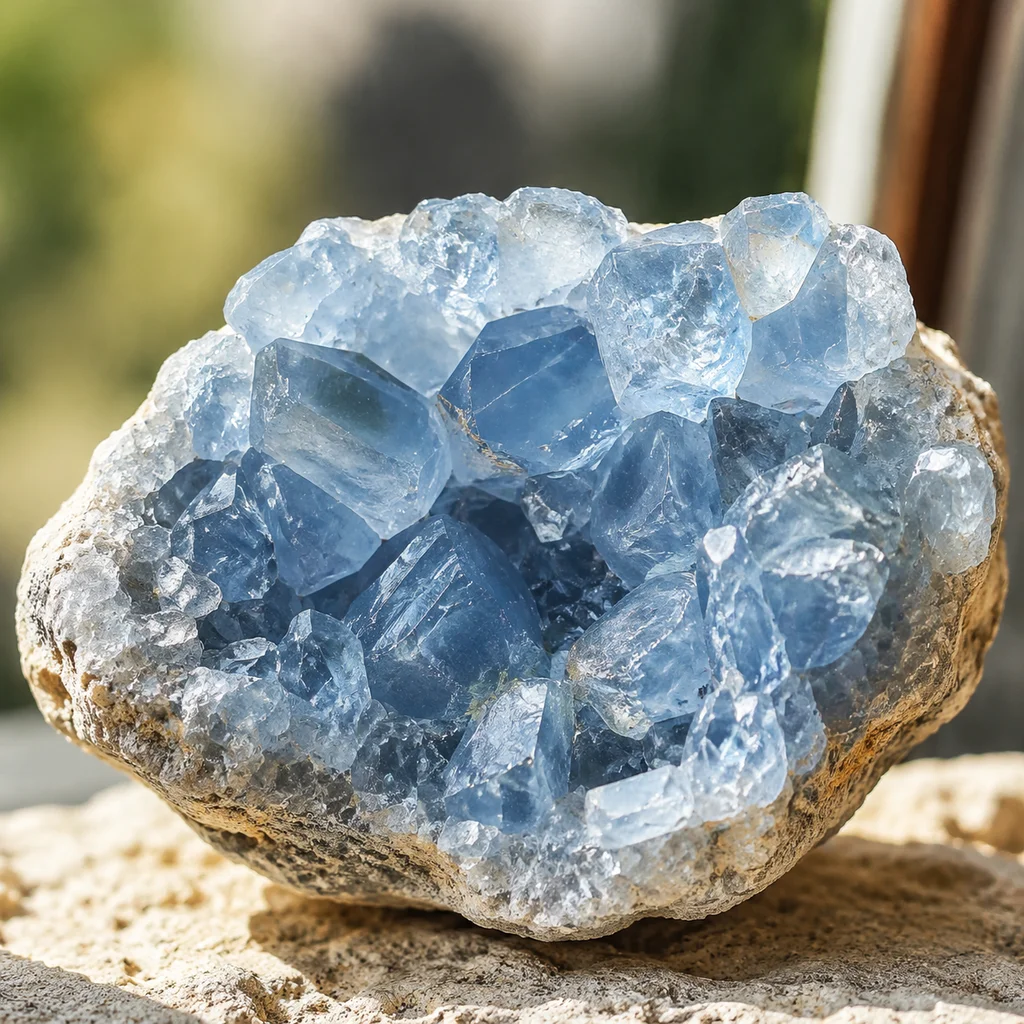
The name "celestite" comes from the Latin "caelestis," meaning heavenly or celestial — and the stone earns its name. Hold a well-formed celestite cluster up to a window and you'll see pale, icy blue crystal points that genuinely look like fragments of sky frozen into solid form. It's one of the few minerals whose color alone evokes an immediate, visceral reaction in most people. There's something about that specific shade of blue — not quite turquoise, not quite sapphire, existing in its own quiet register — that triggers a sense of calm before you know anything about the stone's supposed properties.
Celestite (also spelled celestine) is a strontium sulfate mineral with the chemical formula SrSO₄. The blue color comes from trace amounts of strontium itself interacting with light through electronic transitions, though the exact mechanism is complex and influenced by the presence of other trace elements and irradiation history. Not all celestite is blue — the mineral also occurs in colorless, white, yellow, orange, and occasionally reddish-brown varieties — but the blue material is by far the most commercially popular and what most people mean when they say "celestite."
Mineralogy: Beautiful but Fragile
Before diving into the metaphysical and practical applications of celestite, it's essential to understand its physical vulnerabilities. Celestite scores only 3 to 3.5 on the Mohs hardness scale. To put that in perspective, your fingernail is about 2.5, a copper penny is 3, and celestite sits just above the threshold of what a fingernail can scratch. This makes it one of the softer minerals commonly collected and sold.
The practical consequence: celestite is fragile in ways that surprise many buyers. The individual crystal points can snap off if bumped against harder objects. The geode formations that celestite often forms within can crack if dropped from even a modest height. And the flat, cleaved faces of individual crystals are delicate — the mineral has perfect rhombohedral cleavage, meaning it breaks along predictable planes that leave clean, flat surfaces but also create structural weaknesses.
Water sensitivity is another concern, though less severe than selenite's. Celestite is sparingly soluble in water — it won't dissolve dramatically in brief contact, but prolonged soaking will cause slow surface degradation. Avoid cleaning celestite with water; dry brushing is the standard recommendation. More importantly, avoid displaying celestite in humid environments where moisture in the air can slowly etch the crystal surfaces over months and years.
Angellite: The White Sister
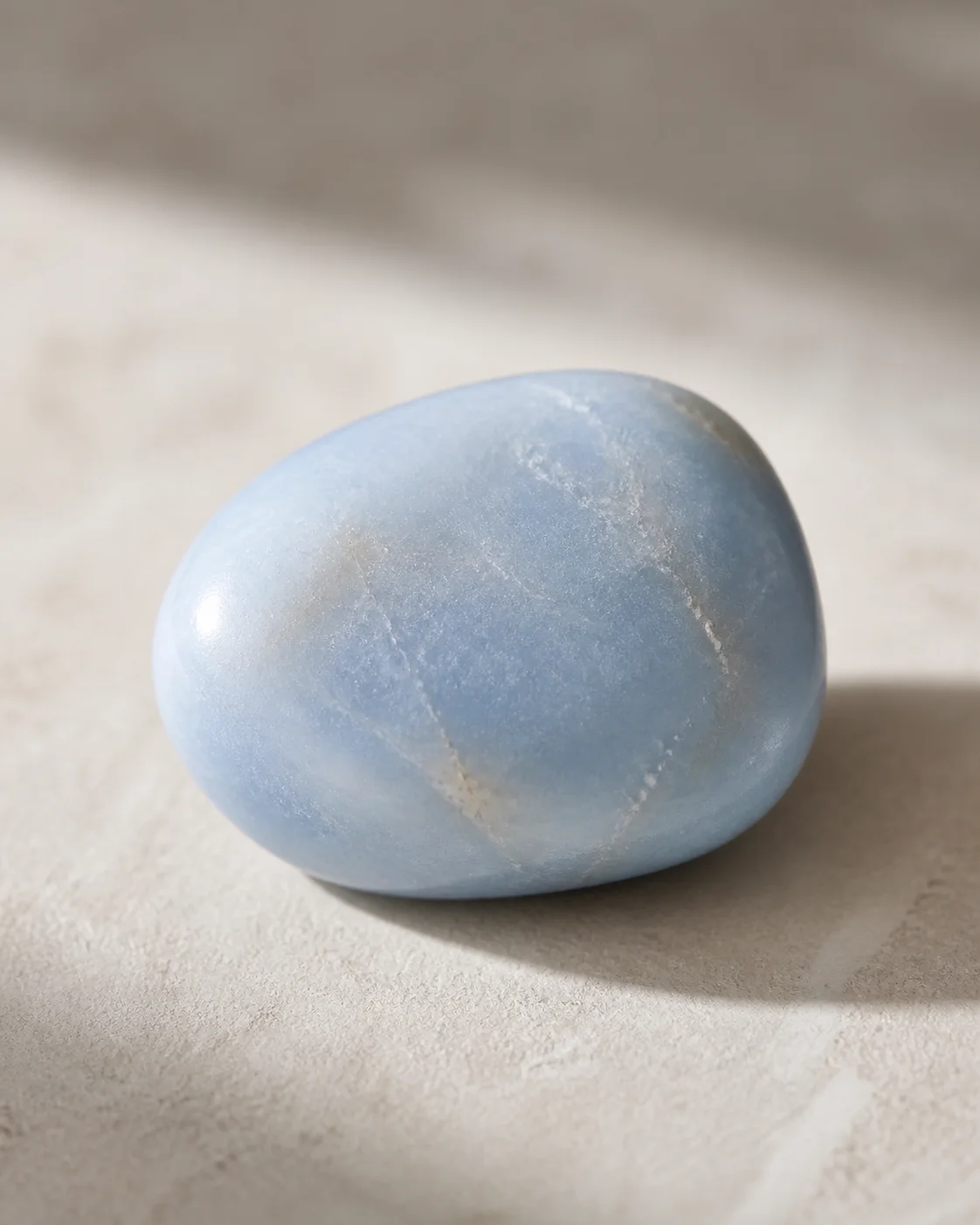
White or colorless celestite is sometimes marketed under the name "angelite" (not to be confused with anhydrite, which is also sometimes called angelite). The distinction is purely color-based — the mineral is the same strontium sulfate. Some practitioners in crystal healing assign different properties to blue celestite and white "angelite," but mineralogically, they're identical. If someone tries to sell you "angelite" at a premium because it's supposedly a different mineral, that's a marketing claim without geological basis.
Major Sources: Madagascar Leads the Market
The vast majority of commercial celestite on the market comes from Madagascar, specifically from the Mahajanga Province on the northwest coast. Madagascan celestite typically occurs as geode-like nodules — rough, spherical or irregular masses of gray-brown host rock that, when cracked open, reveal interiors filled with well-formed blue crystal points. The color ranges from pale, icy blue to moderately saturated medium blue. The finest Madagascan material shows good crystal form, sharp terminations, and even color distribution.
Other notable sources include Libya (which produced some of the finest deep blue celestite ever found, now largely depleted), Canada (Ontario and British Columbia), the United States (Ohio, Texas, Michigan), England, Italy, and Poland. Libyan celestite is particularly prized by collectors — its deep, vivid blue rivals fine blue lace agate in intensity. If you encounter "Libyan celestite" for sale, be prepared for premium pricing; the deposits have been essentially worked out.
Ohio celestite is historically significant — the Crystal Cave in Put-in-Bay, Ohio, contains what was once described as the world's largest known geode of celestite, measuring roughly 35 feet across. It's now a tourist attraction, and while the crystals aren't for sale, it gives a sense of the scale that celestite formations can achieve under the right geological conditions.
Sleep and Dreams: The Primary Association
Celestite's strongest and most consistent association in crystal healing traditions is with peaceful sleep and dream work. If you ask any crystal practitioner "what stone should I put by my bed for better sleep?" celestite will almost certainly be in the top three recommendations alongside amethyst and lepidolite.
The traditional use involves placing a celestite cluster or geode on a nightstand, within arm's reach of the bed, or under the pillow (though the latter is inadvisable given the stone's fragility — crushing a celestite cluster in your sleep would be a literal and figurative nightmare). The practice is typically combined with an intention-setting ritual: before sleep, hold the stone briefly, focus on peaceful rest or a specific question you'd like your subconscious to work on, then place it nearby.
For dream work specifically — the practice of becoming more aware of and intentional about your dream experiences — celestite is recommended as a "dream anchor." The idea is that having a consistent physical object associated with dream awareness trains the mind to recognize dream states more readily. This parallels techniques used in lucid dreaming research, where physical reality checks and consistent environmental cues help establish dream awareness habits.
Whether celestite's sleep benefits come from genuine energetic properties, placebo effect, the calming effect of its visual presence in the bedroom, or the focused attention of the intention-setting ritual itself (or all of the above), many users report improved sleep quality when using the stone consistently. The mechanism is less important than the outcome for most people.
Celestite in Meditation Practice
Beyond sleep, celestite is used in meditation for its calming presence and its association with the third eye and crown chakras. In chakra-based practice, the pale blue color links celestite to the throat and third eye energy centers, making it a stone for communication clarity, intuition development, and meditative states that emphasize connection and receptivity.
The stone's visual quality contributes significantly to its meditative effectiveness. Gazing at the crystal points of a celestite cluster — with their icy translucency and sky-blue color — produces a naturally calming visual experience that supports meditative focus. This isn't trivial: the visual aesthetics of meditation objects have documented effects on attention and relaxation, which is why meditation traditions worldwide emphasize specific colors, patterns, and materials in their practice objects.
Celestite is also recommended for connecting with what some traditions call "higher guidance" or "angelic realms" — hence the angelic name association. If this language doesn't resonate with you, the underlying practice still has value: using a calming, beautiful object as a focal point for contemplating big-picture questions, seeking clarity during confusing times, or simply establishing a regular meditation habit.
Displaying and Caring for Celestite
Choosing the Right Location
Bedrooms and meditation spaces are the natural homes for celestite. The stone's calming visual presence makes it a good choice for any room where you want to establish a peaceful atmosphere. Avoid placing celestite in high-traffic areas, near doors (where it might get bumped), or in areas with significant temperature or humidity fluctuations.
A geode slice — a flat, polished cross-section of a celestite geode — makes a stunning display piece that's somewhat more durable than a three-dimensional cluster because the crystals are embedded in a solid matrix. Clusters are more visually dramatic but also more vulnerable to damage from handling and accidental contact.
Light Exposure
Celestite's color is generally stable under normal indoor lighting, but prolonged direct sunlight can cause fading in paler specimens. Display your celestite in indirect light for best color preservation. The blue looks particularly beautiful against a white or light-colored background, which enhances the contrast and makes the crystal points stand out.
Cleaning
Dry brushing with a soft, natural-bristle brush is the safest cleaning method. For light dust, a gentle puff of compressed air (from a distance, never high-pressure directly on the crystals) can work. Avoid water, cleaning solutions, and ultrasonic cleaners. If you must use liquid for some reason (a sticky residue that won't brush off), use a barely damp cloth with contact time under five seconds, then dry immediately.
Handling
Handle celestite clusters by the base or matrix, not by individual crystal points. The points are the most vulnerable parts and snap off relatively easily. When moving a celestite specimen, cup your hand around the entire piece rather than grabbing a single point. For transport, wrap the specimen in tissue paper or soft cloth, then cushion in a sturdy box with packing material to prevent shifting.
Identifying Genuine Celestite
Celestite is not commonly faked because its unique physical properties — the specific blue color, the crystal habit, and the moderate price point — make imitation less profitable than outright alternatives. The main identification concern is confusion with blue calcite, which can look superficially similar.
The hardness test is the quickest discriminator. Calcite rates a 3 on the Mohs scale (just barely harder than a fingernail), while celestite rates 3 to 3.5. Both are soft, but if you can scratch the stone with a copper coin (penny), it's more likely calcite. Celestite is slightly harder and will resist a copper scratch more effectively. For a more definitive test, calcite will effervesce (bubble) when a drop of dilute hydrochloric acid is applied, while celestite will not.
Dyed specimens exist but are uncommon. If you suspect dye, check for color pooling in crevices and natural fissures — genuine celestite has relatively uniform color distribution within each crystal, while dyed material tends to show uneven, concentrated color in low-lying areas.
Frequently Asked Questions
Can celestite go in water?
Brief contact with water won't destroy celestite the way it would selenite, but prolonged soaking is not recommended. Celestite is sparingly soluble in water and will show slow surface degradation over time. Dry brushing is the preferred cleaning method.
Why is my celestite turning white?
White film or clouding on celestite surfaces is usually caused by moisture exposure — either from ambient humidity or from being wiped with a damp cloth. The surface becomes etched and takes on a chalky, white appearance. This damage is cosmetic rather than structural, but it's permanent. Prevention through dry storage is the best approach.
Is celestite radioactive?
Strontium has a radioactive isotope (Sr-90), but natural celestite contains the stable isotope Sr-88 and is not radioactive. The mineral is safe to handle, display, and keep in your home. No special precautions are needed.
Can I sleep with celestite under my pillow?
Physically possible but not recommended. Celestite is fragile and could break under the weight of your head, creating sharp crystal fragments. Place it on your nightstand instead — close enough to see, too far to crush.
Frequently Asked Questions
Can celestite go in sunlight?
Prolonged sun exposure can cause celestite's delicate blue color to fade over time, so it's best to display your piece away from direct sunlight. A cool, shaded spot preserves its ethereal color and protects the crystal from potential heat damage. Brief ambient light is generally fine, but avoid windowsills or outdoor placement.


Comments