Wood Mala Beads: Sandalwood, Rosewood & Sacre...
June 5, 2026
The Quiet Power of Wood Mala Beads
When most people think of mala beads, they picture polished gemstones — Amethyst, Rose Quartz, Black Tourmaline strung on silk cord. But wood mala beads have been used in meditation practice for far longer than crystal malas, and in many traditions, they remain the preferred choice.
There's something fundamentally different about holding wood during meditation. Gemstones carry distinct energetic signatures that can feel intense — Amethyst can feel buzzing, Black Tourmaline can feel grounding to the point of heaviness. Wood is subtler. It warms slowly to your body temperature, carries the faint scent of the tree it came from, and provides a gentle, consistent presence that supports meditation without demanding attention.
Monks in Thai forest temples have used wood malas for centuries. Tibetan Buddhist practitioners carry Bodhi seed malas passed down through generations. Hindu sadhus wear Rudraksha malas that darken with years of daily meditation practice. These aren't decorative accessories — they're functional meditation tools that improve with use, developing a patina of oil from repeated handling that smooths the beads and deepens their color.
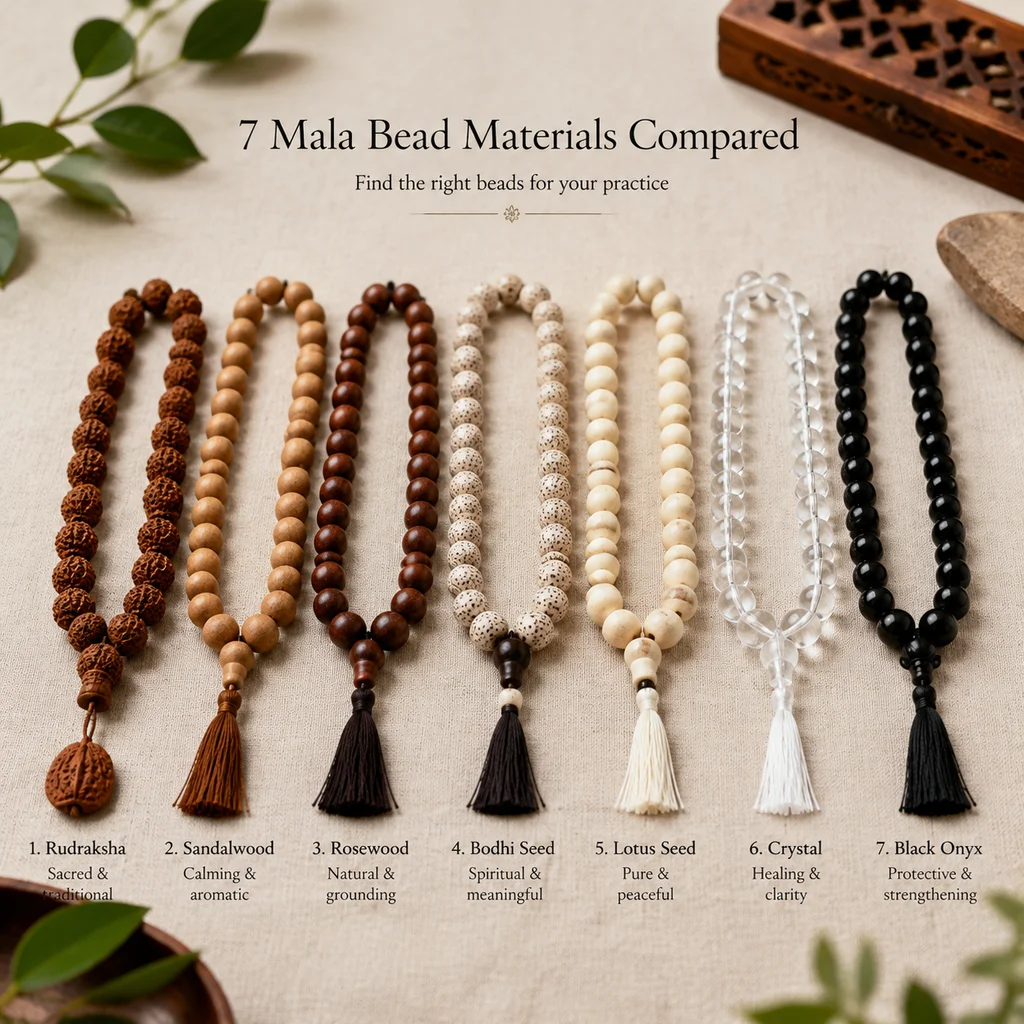
Sandalwood Mala Beads: The Meditation Classic
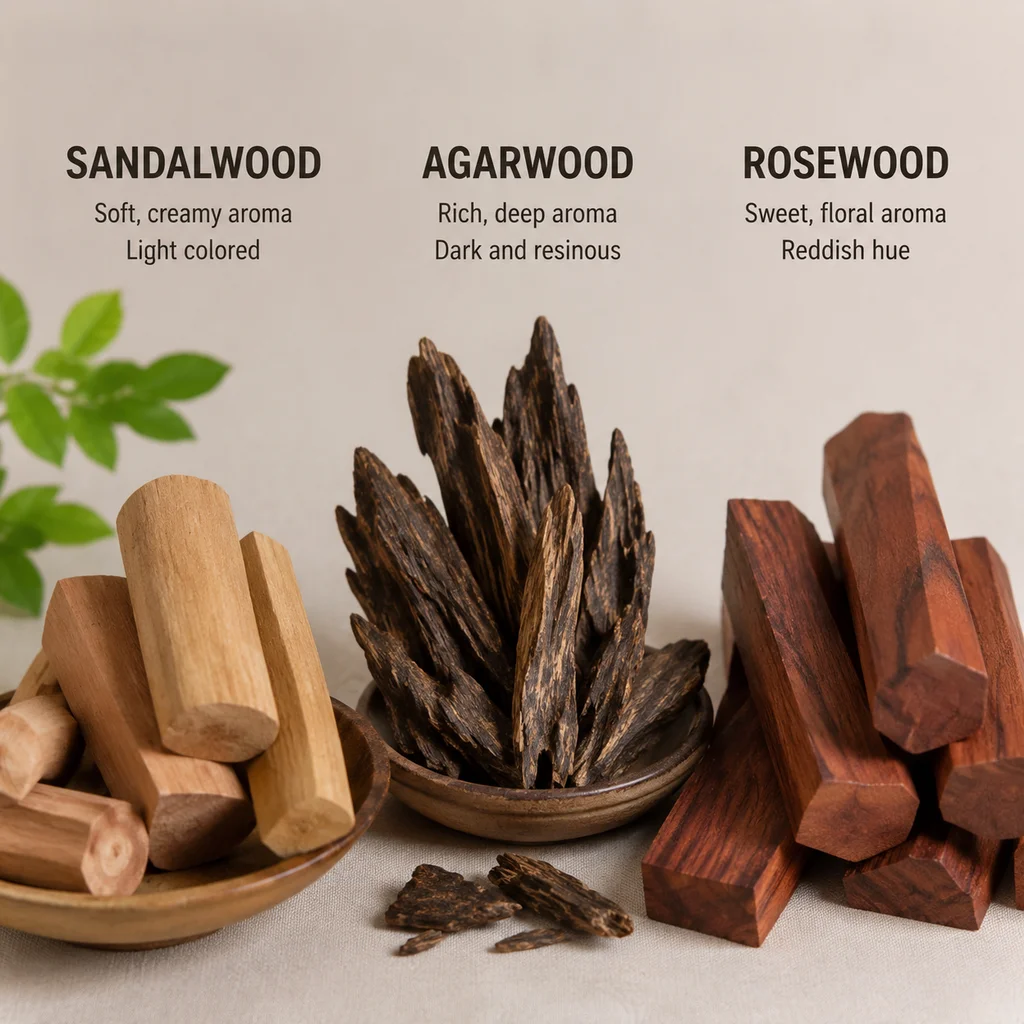
Sandalwood holds a unique position in the world of meditation beads. It's one of the few mala materials that engages multiple senses simultaneously — touch, smell, and sight all contribute to the meditative experience.
The Scent Factor
True Sandalwood (Santalum album) contains santalol — a sesquiterpene alcohol that gives the wood its distinctive, creamy fragrance. Unlike synthetic fragrances that hit you immediately and fade, natural sandalwood scent is activated by warmth. When you hold sandalwood mala beads during meditation, your body heat gradually releases the aromatic compounds, creating a subtle, evolving scent that deepens your meditative state over the course of a practice session.
This isn't mystical speculation — there's actual pharmacology at work. Santalol has documented sedative properties in aromatherapy research. A 2006 study published in Planta Medica found that sandalwood oil inhalation significantly reduced sympathetic nervous system activity (the fight-or-flight response) and increased parasympathetic activity (the rest-and-digest response). In practical terms, breathing near sandalwood during meditation genuinely helps lower your heart rate and reduce anxiety.
Indian vs. Australian Sandalwood
Two main species are used in mala production:
Indian Sandalwood (Santalum album): The gold standard for mala beads. Native to southern India (Karnataka, Tamil Nadu), this slow-growing tree takes 30-60 years to develop heartwood with sufficient santalol content for aromatic use. Indian government regulations have strictly controlled harvesting since the 1970s due to overexploitation, making genuine Indian sandalwood malas increasingly expensive. The scent is deep, creamy, and long-lasting — a well-cared-for Indian sandalwood mala can retain its fragrance for decades.
Australian Sandalwood (Santalum spicatum): Native to Western Australia, this species grows faster and produces heartwood with lower santalol content. The scent is lighter and more nasal — still pleasant but noticeably different from Indian sandalwood. Australian sandalwood malas are more affordable and more sustainably sourced, making them a popular choice for practitioners who prioritize environmental responsibility over maximum fragrance intensity.
Be cautious of extremely cheap "sandalwood" malas — many are actually made from a different wood with artificial sandalwood scent applied. The fragrance of genuine sandalwood develops gradually with heat and never smells cloying or chemical.
Caring for Sandalwood Malas
Sandalwood is naturally oily and doesn't require external conditioning. In fact, applying oils or waxes to sandalwood can clog the pores and reduce the natural scent release. The best care is simple: handle it regularly during meditation, which transfers a small amount of your skin's natural oils to the beads, creating a protective patina over time. Store in a cloth pouch (not plastic, which can trap moisture) when not in use.
Rosewood Mala Beads: The Buddhist Tradition
Rosewood malas are deeply connected to Buddhist meditation practice. Several species are used in mala production, most commonly species from the Dalbergia genus — the same genus that produces the famous (and highly regulated) Brazilian rosewood used in fine guitar making.
Cultural Significance
In Tibetan Buddhism, wood malas are often preferred over gemstone malas for daily practice. The reasoning is practical: wood is unassuming, doesn't draw attention, and focuses the practitioner's attention inward rather than outward on the appearance of the beads. A Tibetan monk explained to me that "the stones talk too much — they shout their color, their sparkle, their price. Wood whispers. Meditation should be a whisper."
Rosewood specifically carries associations with compassion — the rose, in Buddhist symbolism, represents the heart opening. Rosewood malas are often used in practices focused on loving-kindness (Metta) meditation and the cultivation of bodhicitta (the awakened mind of compassion).
Environmental Considerations
This is where rosewood malas become complicated. Many Dalbergia species are listed on CITES (Convention on International Trade in Endangered Species) Appendix II, which means international trade is regulated to prevent overexploitation. Brazilian rosewood (Dalbergia nigra) is on Appendix I — the highest level of protection, essentially banning international commercial trade.
If you're purchasing a rosewood mala, ask the seller about the wood source. Responsible mala makers use sustainably harvested rosewood or non-CITES-listed species like East Indian rosewood. Avoid malas priced suspiciously low — cheap rosewood may come from illegal logging operations that destroy old-growth forest habitat.
Rudraksha Mala Beads: Lord Shiva's Tears
Rudraksha beads deserve their own detailed treatment because they're unlike any other mala material. They're not wood, not stone, not metal — they're seeds from the Elaeocarpus ganitrus tree, a broad-leaved evergreen that grows at altitudes between 200-2,000 meters in Southeast Asia and the Himalayan foothills.
The Legend and the Botany
According to Hindu tradition, Shiva meditated for thousands of years with his eyes open. When he finally opened them, tears of compassion fell to the earth and grew into the first Rudraksha trees — hence the name, from "Rudra" (Shiva) and "Aksha" (tears/eyes). Each Rudraksha seed has a natural surface texture of grooves and ridges, counted as "faces" or "mukhis." The most common and most prized are 5-mukhi Rudraksha seeds, though they can range from 1 to 21 faces. Seeds with higher face counts (above 14) are extremely rare and command prices in the thousands of dollars.
Botanically, the grooves on Rudraksha seeds correspond to the locule chambers inside the fruit. Each seed develops within a blue drupe (the fruit is sometimes called a "blue marble" because of its striking color), and the internal structure creates the external ridges. The seeds are extremely hard and durable — they can last for generations with proper care, which is why family Rudraksha malas passed from teacher to student are common in Hindu practice.
108 Beads and the Face Count
Traditional Rudraksha malas use 108 seeds of the same face count, usually 5-mukhi. Mixed-face malas exist but are uncommon. The guru bead is traditionally a different type — either a larger Rudraksha of the same face count or, in some traditions, a crystal, coral, or gold bead. The tassel is typically red (representing energy and action in Hindu symbolism) or yellow (representing knowledge and learning).
Scientific Research on Rudraksha
While much of the Rudraksha tradition is spiritual, there are some intriguing physical properties. Rudraksha seeds contain approximately 32% moisture when fresh and dry to about 10-15%. They have a dielectric constant of about 4.5, meaning they can store small electrical charges — which has led some researchers to hypothesize about electromagnetic properties. A 2017 study from the Indian Institute of Technology found that Rudraksha seeds exhibit paramagnetic behavior (weakly attracted to magnetic fields), which the authors suggested could interact with the body's electromagnetic field during meditation practice.
Take this research with appropriate skepticism — the studies are preliminary and small-scale. But the tradition of Rudraksha as a meditation aid spans thousands of years across a culture that produced sophisticated mathematical and scientific knowledge. There may be more to the practice than pure symbolism.
Bodhi Seed Mala Beads: The Enlightenment Connection
Bodhi seed malas come from the seeds of the Ficus religiosa tree — the very species under which Siddhartha Gautama achieved enlightenment and became the Buddha. The connection is powerful and immediate for Buddhist practitioners: every bead on a Bodhi seed mala is literally a descendant of the enlightenment experience.
The seeds are small (typically 8-12mm diameter), roughly round with a slight irregularity in shape, and have a smooth, warm brown surface when polished. They're extremely lightweight — a full 108-bead Bodhi seed mala weighs about 40-50 grams, roughly one-third the weight of a crystal mala.
Bodhi seed malas are especially popular in Zen and Vipassana meditation traditions, where simplicity and unpretentiousness are valued. The seeds don't have a strong fragrance (unlike sandalwood) and don't carry the dramatic associations of Rudraksha. They're quiet, unassuming meditation partners that do exactly what they need to do and nothing more.
Olive Wood Mala Beads: The Middle Eastern Tradition
Olive wood malas have a unique heritage rooted in Middle Eastern and Mediterranean spiritual practices. The olive tree is one of the oldest cultivated plants in human history — evidence of olive cultivation dates back to 6000 BCE in the Eastern Mediterranean. In Christian, Jewish, and Islamic traditions, the olive tree symbolizes peace, wisdom, and divine blessing.
Olive wood has a distinctive grain pattern — swirling lines of cream, gold, and dark brown that make each bead uniquely beautiful. The wood is naturally oily, moderately hard (Mohs scale equivalent of about 3-4 for carving purposes), and develops a rich, warm luster with years of handling. Mediterranean monks and nuns have carved olive wood prayer beads for centuries, particularly on Mount Athos in Greece and in monasteries across the Levant.
A well-maintained olive wood mala can last a lifetime. The natural oils in the wood protect it from drying and cracking, and the grain pattern becomes more pronounced and beautiful as the patina develops from regular handling.
Wood vs. Crystal Mala: Understanding the Energetic Difference
The distinction matters more than many practitioners realize. Here's a practical comparison:
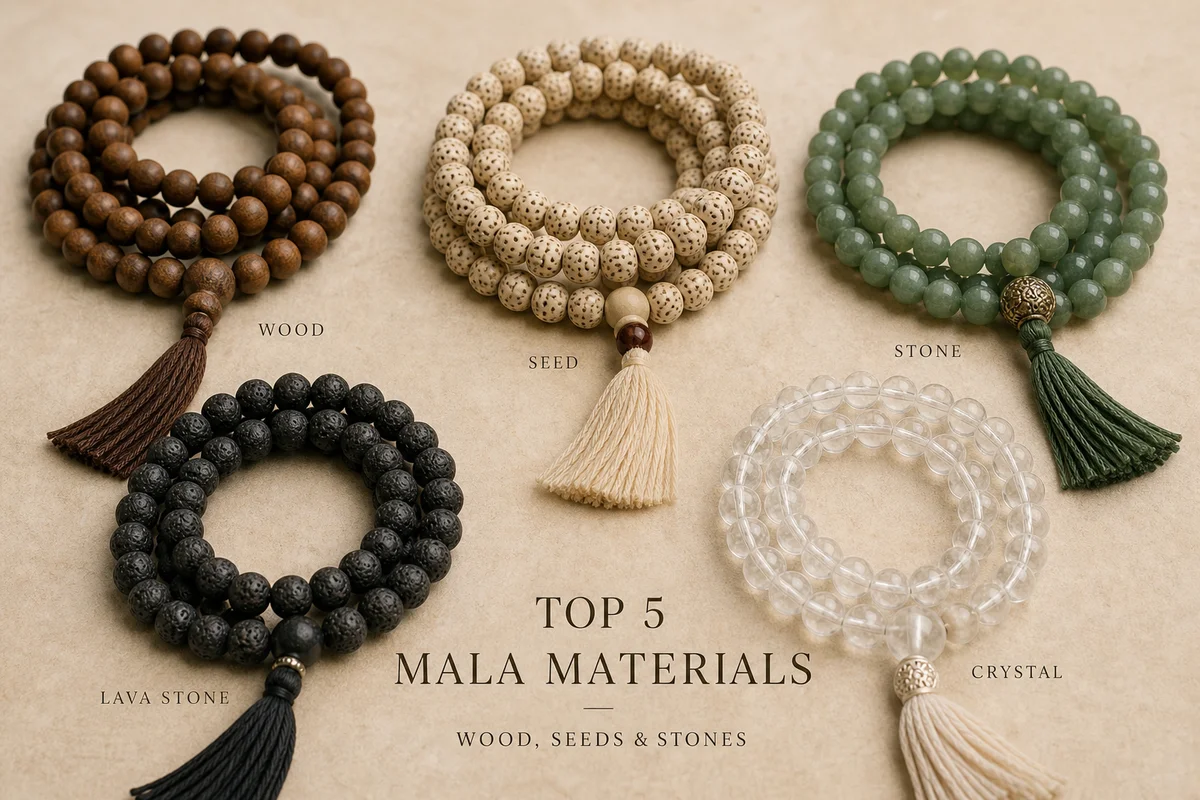
Energy quality: Wood malas provide a gentle, warming, persistent energy. Think of a slow-burning candle. Crystal malas provide a focused, intense, directional energy. Think of a laser pointer. Neither is inherently better — they serve different purposes.
Duration of effect: Wood malas tend to create a cumulative effect over long meditation sessions. The first few minutes may feel subtle, but by minute 20, there's a deep, sustained meditative state that crystal malas sometimes can't maintain because their energy is too stimulating. Crystal malas, by contrast, are often more effective for short, focused sessions where you need a quick shift in your energetic state.
Meditation style compatibility: Wood malas suit Vipassana (insight meditation), Metta (loving-kindness), and breath awareness practices. Crystal malas suit Japa (mantra repetition), chakra-focused meditation, and intention-setting practices.
Longevity: Wood malas improve with age. The beads develop patina, the scent deepens (for aromatic woods), and the energy becomes increasingly harmonized with your personal practice. Crystal malas don't age in the same way — they maintain their energetic signature but don't develop the personal connection that wood does through years of shared meditation.
How to Care for Wood Mala Beads
Wood requires different care than crystal. Here's what I've learned from years of working with wood malas:
Moisture Management
Wood is hygroscopic — it absorbs moisture from the air and releases it when the air is dry. In humid climates (tropical travel, rainy seasons), your wood mala may feel slightly sticky or swollen. In dry climates (desert travel, heated winter rooms), it may develop tiny cracks. Neither condition is permanent if addressed. For humidity, wipe the mala gently with a dry cloth and let it air-condition slowly. For dryness, briefly hold the mala in your hands — the natural moisture from your palms is usually enough to rehydrate the wood surface.
Oiling and Conditioning
Most wood malas don't need additional oiling — your skin provides enough during regular handling. However, if your mala feels excessively dry or the surface looks dull, a tiny drop of jojoba oil or beeswax rubbed into the beads with your fingers can restore the luster. Use organic, food-grade products — these will be absorbed into the wood and in contact with your skin for hours at a time during meditation.
Temperature Protection
Avoid leaving wood malas in direct sunlight, hot cars, or near heat sources. Sandalwood is particularly sensitive to heat — high temperatures can evaporate the aromatic oils, reducing the scent permanently. A general rule: if it's too hot for you to sit comfortably, it's too hot for your wood mala.
Sustainability: A Responsible Practitioner's Guide
The mala market has a significant environmental impact that most consumers don't see. Indian sandalwood is critically endangered in the wild due to centuries of overharvesting. Rosewood species across Southeast Asia and South America face similar pressures. Even Rudraksha seeds, though renewable, require the tree to mature for 10-15 years before producing viable seeds.
Choose suppliers who can verify the source of their wood. Look for certifications like FSC (Forest Stewardship Council) for wood products. Support artisan makers who source from plantation-grown timber rather than wild-harvested trees. The cost of a sustainably sourced mala is typically 30-50% higher, but the environmental savings are immeasurable. Your meditation practice should nourish the world, not deplete it.
FAQ
Does the scent of sandalwood mala beads fade over time?
Yes, but slowly. A quality Indian sandalwood mala should retain noticeable scent for 10-20 years with regular use. The scent deepens and matures rather than simply fading — fresh sandalwood has a bright, sharp note that mellows into a warm, complex fragrance over time. Storing the mala in a sealed cloth pouch (not plastic) when not in use helps preserve the aromatic oils. Avoid storing near strong-smelling substances like perfumes, incense, or essential oils, which can overwhelm the sandalwood's natural fragrance.
Can I wear my wood mala in the shower or while swimming?
Avoid prolonged water exposure. Brief contact (rain, hand washing) won't harm most wood malas, but soaking them can cause swelling, warping, or cracking as the wood expands unevenly. Rudraksha seeds are the most water-resistant wood-type mala material — they grow in tropical regions and are naturally adapted to humidity. Sandalwood is the most water-sensitive — prolonged moisture exposure can dilute the aromatic oils. Remove your mala before swimming, bathing, or heavy rain.
How can I tell if a sandalwood mala is genuine?
Three tests. First, the scent test — genuine sandalwood releases fragrance when rubbed gently with your thumb, and the scent lasts for years. Fake sandalwood has a sharp, chemical smell that fades within weeks. Second, the weight test — real sandalwood is moderately dense but not excessively heavy; a 108-bead mala should weigh about 60-80 grams. Extremely light malas may be made from other, cheaper woods. Third, the grain test — sandalwood has a fine, even grain with no large pores or knots. If the surface looks like it was stained or painted rather than naturally colored, it may not be genuine.
Frequently Asked Questions
How do I cleanse and energize my wood mala beads?
Unlike natural crystals, you should never use water or salt to cleanse your handcrafted wood mala, as moisture can warp or damage the bead surface. Instead, you can purify your mala by placing it under moonlight overnight, leaving it in direct sunlight for a brief period, or smudging it with purifying sage or palo santo to clear stuck energy and restore its peaceful vibrations.
Can I wear wood mala beads with my crystal jewelry?
Absolutely! Layering wood mala beads with natural crystal jewelry creates a beautiful balance of earthly and high-vibrational energies. Wood offers a deeply grounding, calming foundation, while stones like quartz or amethyst amplify specific intentions. Combining these artisan elements allows you to customize your daily mindfulness practice and personal style.
Comments