Why Amber Authentication Matters More Than Yo...
June 4, 2026
Why Amber Authentication Matters More Than You Think
Amber is fossilized tree resin that has undergone polymerization over millions of years. Genuine Baltic amber dates back 30-50 million years, while Dominican amber is roughly 20-40 million years old. The problem is that the market is flooded with imitations ranging from copal (young, incompletely fossilized resin that is only a few hundred to a few thousand years old) to outright fakes made from glass, plastic, and synthetic resins. Because amber prices can range from $20 per gram for high-quality Baltic specimens to thousands of dollars for pieces with rare inclusions (insects, plant matter), knowing how to authenticate what you are buying is not optional—it is essential.
The good news is that several reliable tests can be performed at home with basic household items. No gemological lab required. These tests will not give you a 100% definitive answer on their own (some advanced fakes can pass individual tests), but running multiple tests in combination gives you a high degree of confidence. Let me walk you through each one.
Test 1: The Saltwater Float Test
This is the most widely known and perhaps the most reliable single test for amber. The principle is simple: genuine amber has a specific gravity of 1.05 to 1.10, which means it is just barely denser than fresh water but less dense than saturated salt water. Copal, which is the most common "near-amber" substitute, has a similar density and can sometimes produce false positives, but most glass and plastic fakes will fail this test.
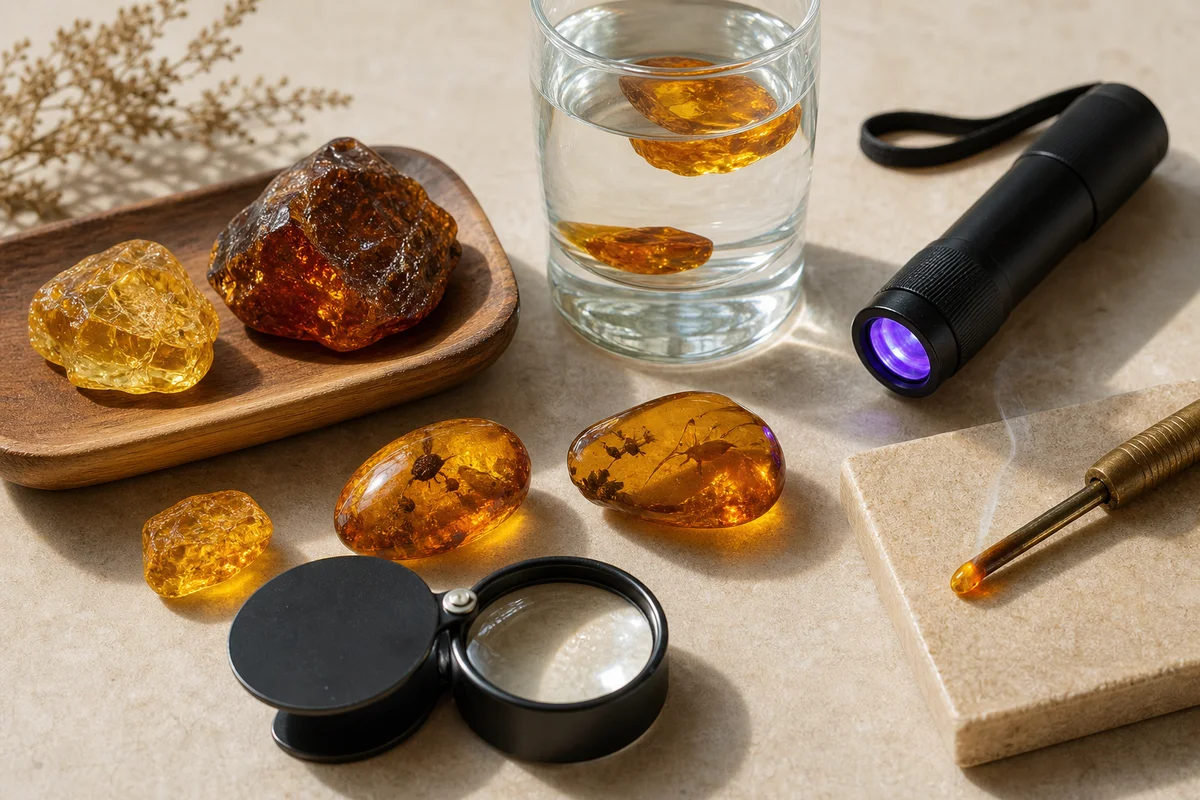
Here is how to do it: dissolve approximately 2 tablespoons of regular table salt in 1 cup (about 240 ml) of warm water. The water should be salty enough that a raw egg barely floats. Drop your amber piece into the solution. Genuine amber should float or be neutrally buoyant (hovering somewhere in the middle). Glass, most plastics, and many synthetic resins will sink. Copal will also float, which is why this test alone is not conclusive—but it is a strong first filter.
After testing, rinse the amber thoroughly with fresh water to remove salt residue. Salt can be corrosive to some metal settings over time if not cleaned off.
Test 2: The Static Electricity Test
Amber becomes electrostatically charged when rubbed, a property it has been known for since ancient times (the Greek word "electron," meaning amber, is the root of our word "electricity"). This test works because real amber is a natural resin with specific electrostatic properties, while most plastic imitations do not hold a charge the same way.
Take a clean, dry cloth (cotton or wool works best) and rub the amber piece briskly for 15-30 seconds. Then bring the amber close to small, lightweight items: torn pieces of tissue paper, small dust particles, strands of hair, or even a cigarette ash if you happen to have one. Genuine amber should attract these lightweight items noticeably. Plastic fakes may produce a very weak attraction, but it will be far less pronounced. Glass will not react at all.
This test is subjective in the sense that you are judging relative strength of attraction, but it is a useful supplementary test when combined with the saltwater float.
Test 3: The Hot Needle Test
This is the most conclusive of all home tests, but it is also the only one that carries a small risk of damage. The principle is that amber, being organic resin, produces a characteristic pine or resinous smell when heated and penetrated, while plastic produces an acrid chemical or burning plastic smell, and glass produces no smell at all and cannot be penetrated by a hot needle.
Heat a needle or thin wire (you can hold it with pliers over a candle flame or gas stove) until it is red-hot. Press the hot tip gently into an inconspicuous spot on the amber—ideally an area that will not be visible if worn as jewelry. Genuine amber will yield slightly to the needle (it is relatively soft, scoring about 2-2.5 on the Mohs scale) and release a pine-like, resinous, or sweet smell. The needle will leave a small mark but not penetrate deeply.
Plastic fakes will melt more readily, produce a distinctly chemical or acrid smell, and may leave a visible burn mark. Glass will not yield to the needle at all, and you risk the needle snapping off. Copal will yield more easily than genuine amber and produces a resinous smell, but the consistency is softer—you can often press a fingernail into copal with moderate pressure, while amber resists this.
Because this test is destructive, use it only as a last resort or on inexpensive pieces where a tiny mark does not matter.
Test 4: UV Fluorescence
Many types of amber fluoresce under ultraviolet light. Genuine Baltic amber typically shows a pale blue-white or greenish fluorescence under a standard 365nm UV (long-wave) flashlight. Dominican amber often fluoresces a brighter blue or blue-green. This is a useful test because many plastic and glass fakes either do not fluoresce at all or fluoresce in an obviously different color.
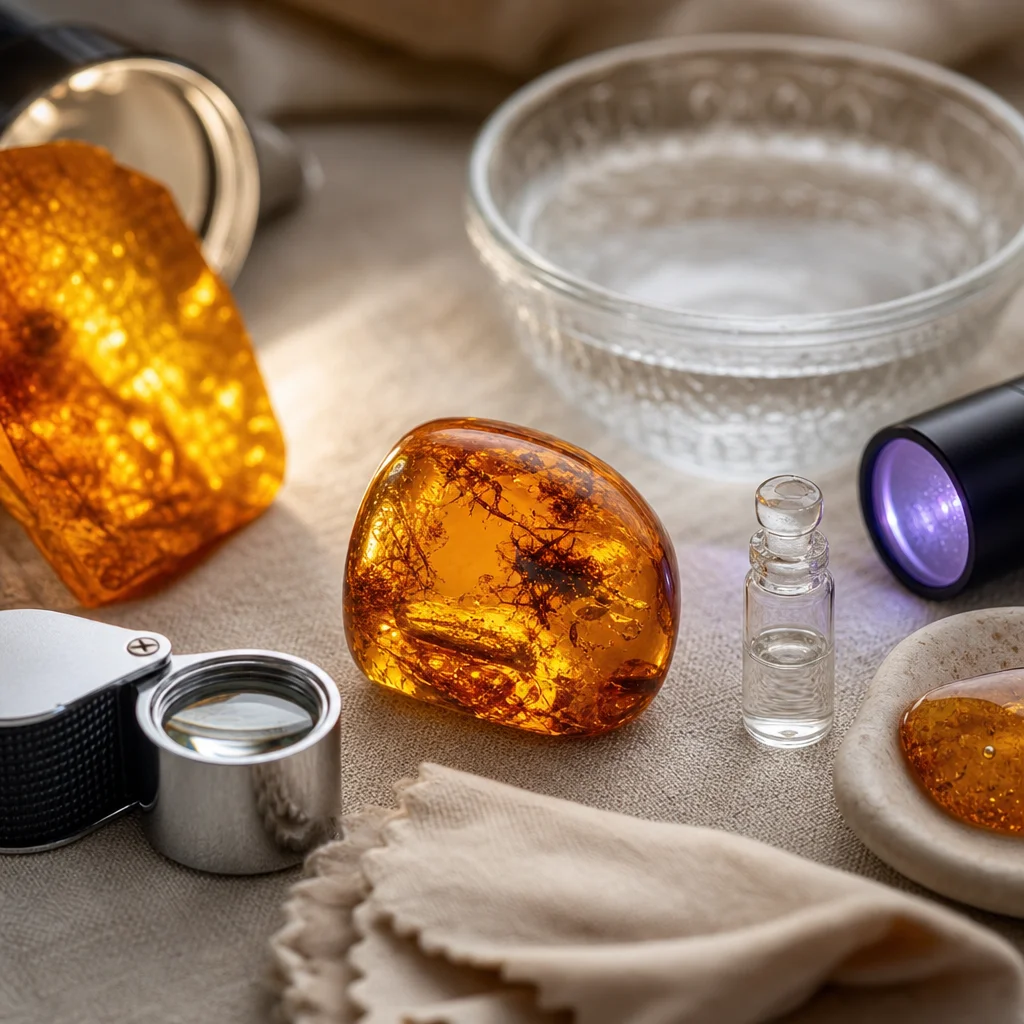
A small UV flashlight (available online for under $10) is all you need. Turn off ambient lights, shine the UV light on the amber in a dark room, and observe the color. If the piece fluoresces a consistent pale blue across its surface, that is a positive indicator. Patchy or uneven fluorescence, bright neon colors, or no fluorescence at all could indicate a fake.
The caveat is that some copal also fluoresces, and some genuine amber (particularly opaque or heavily weathered pieces) shows weak or no fluorescence. So, like all the other tests, read this one in combination with the others.
Test 5: The Alcohol/Solvent Test
This test is specifically useful for distinguishing genuine amber from copal, which is the most commonly encountered substitute. Copal is young resin that has not fully polymerized, so it is soluble or at least partially soluble in common solvents. Genuine amber, having undergone millions of years of polymerization, is essentially insoluble.
Dip a cotton swab in rubbing alcohol (isopropyl alcohol, 70% or higher) or acetone (nail polish remover). Gently rub the swab on a small, inconspicuous area of the piece. Genuine amber will show no reaction—the surface will not become tacky, sticky, or discolored. Copal, on the other hand, will become noticeably sticky or tacky within seconds, and you may see a slight dulling or residue on the swab. Plastics may also react to acetone (many dissolve or become tacky), so a positive reaction here means the piece is definitely not genuine amber.
Test 6: The Inclusions Test (Visual Inspection)
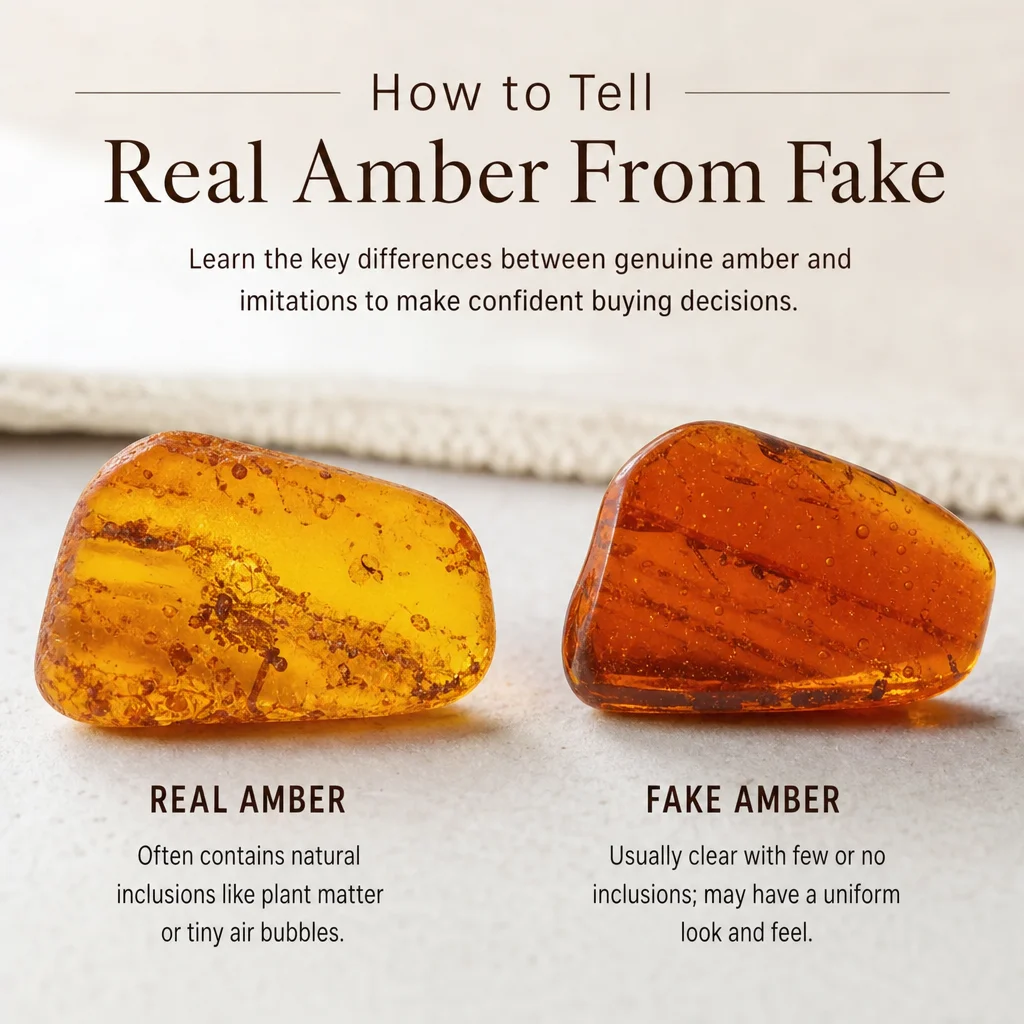
One of amber's greatest values lies in its inclusions—trapped insects, spiders, plant fragments, air bubbles, and other organic material from tens of millions of years ago. Genuine amber inclusions show certain characteristics that are extremely difficult to replicate in fakes:
In real amber, inclusions are typically preserved in a natural, often partially decomposed state because the creature was trapped in sticky resin and slowly engulfed over hours or days. You will often see the insect in a natural position—legs spread, wings partially open, sometimes with visible internal structure under magnification. Air bubbles in genuine amber are typically spherical or slightly elongated, and there may be flow lines or "veils" where different layers of resin solidified at different times.
Fake inclusions in plastic or resin are usually too perfect—symmetrical placement, perfectly preserved features, suspiciously centered in the stone. Modern fakes are getting better, but under 10x magnification, the differences are usually apparent. Look for the "stirring marks" that indicate a bug was placed into liquid resin and deliberately positioned.
Test 7: The Warmth and Weight Test
Genuine amber is warm to the touch—noticeably warmer than glass, plastic, or most gemstones when you hold it in your hand for 10-15 seconds. This is because amber is an organic material with low thermal conductivity, meaning it does not dissipate body heat quickly. Glass and many crystals feel cool or room-temperature even after prolonged handling.
Additionally, genuine amber is notably lightweight for its size. A 3cm bead of real amber weighs noticeably less than a 3cm bead of glass or plastic of the same apparent size. This is again due to its low specific gravity (1.05-1.10 compared to glass at 2.4-2.8 and most plastics at 1.1-1.5+). While this test is somewhat subjective on its own, when combined with the other tests, the warmth and lightness are consistent indicators of genuine amber.
Baltic vs Dominican Amber: Understanding the Two Major Types
Most genuine amber on the market falls into two categories, and knowing the differences helps you evaluate what you are buying.
Baltic amber comes from the Baltic region (primarily Russia, Poland, Lithuania, and the Kaliningrad area) and accounts for roughly 80-90% of the world's commercially available amber. It is typically 30-50 million years old, ranges in color from pale yellow to deep cognac, and often contains higher levels of succinic acid (which some attribute to its traditional use in teething necklaces, though medical evidence is limited). Baltic amber is denser than Dominican amber and more likely to have inclusions.
Dominican amber is younger (20-40 million years), comes primarily from the Dominican Republic, and is prized for its clarity and color range. It frequently occurs in transparent blue and green varieties that Baltic amber rarely matches. Dominican amber is also more likely to contain well-preserved insect inclusions. It is generally more expensive per gram than standard Baltic amber.
Copal vs Amber: The Most Common Confusion
Copal deserves special attention because it is the single most common "amber substitute" on the market and can be difficult for beginners to distinguish. Copal is young, incompletely fossilized tree resin. It may be anywhere from a few hundred to a few thousand years old (some definitions extend to a few million, but it has not undergone the full polymerization that characterizes true amber). Copal is softer, stickier, and can be scratched with a fingernail. It is soluble in alcohol and acetone. Under UV light, it may fluoresce but often differently than amber.
Unfortunately, copal is frequently sold as "young amber" or simply "amber" by unscrupulous dealers. The hot needle test and the alcohol test are your best tools for identifying copal versus genuine amber. If either test raises concerns, you are likely looking at copal.
Common Fakes to Watch For
- Glass: Heavy, cold to the touch, will not float in saltwater, cannot be penetrated by a hot needle. Easy to identify.
- Plastic (Bakelite, phenolic resin, modern polymers): Can look convincing at first glance but usually feels wrong—heavier or lighter than it should be, wrong warmth characteristics, and fails the hot needle test with an acrid chemical smell.
- Ambroid (pressed amber): Small pieces of genuine amber that have been heated and compressed under pressure to form a larger piece. This is technically real amber, but it is less valuable than a single natural piece and can be identified by flow lines or slight color variations under magnification.
- Reconstituted amber: Amber dust and shavings mixed with resin binder and formed into shapes. This is a manufactured product and should be priced and disclosed accordingly.
A Practical Testing Workflow
When you acquire a piece of amber and want to verify it, run the tests in this order: First, the saltwater float (non-destructive, quick). If it floats, move to the static electricity test (non-destructive, quick). Then the UV fluorescence (non-destructive). If all three are positive, try the alcohol test on an inconspicuous spot (minimal risk). For high-value pieces where you need certainty, use the hot needle test as a final check on a spot that will not affect the appearance of the piece. Check inclusions under magnification throughout the process. This combined approach will catch the vast majority of fakes on the market.
Frequently Asked Questions
Can I damage genuine amber by doing the saltwater test?
No, the saltwater test is completely safe for genuine amber. Just rinse the piece thoroughly with fresh water afterward and dry it with a soft cloth. Prolonged exposure to salt water is not ideal, but a brief immersion for testing purposes will not cause harm.
Does real amber ever sink in the saltwater test?
Rarely, very dense amber pieces with high mineral content or unusually large inclusions can sink. This is uncommon, but if a piece sinks despite passing other tests, it may still be genuine. The test is a first filter, not a verdict.
Is there a 100% foolproof home test for amber?
No single home test is 100% conclusive on its own. The combination of multiple tests (float, static, UV, alcohol, hot needle) gives high confidence, but for valuable pieces with important inclusions, professional gemological testing with infrared spectroscopy (FTIR) is the only definitive method.
How can I tell if my amber necklace is genuine Baltic amber?
Baltic amber beads should feel warm and lightweight, float in saltwater, and show the characteristic pale blue fluorescence under UV. Check the bead holes for signs of machining (genuine amber bead holes often show slight irregularities from hand-drilling, while plastic beads show perfectly uniform, machine-made holes). The alcohol test on a hidden part of the bead is also effective.
Frequently Asked Questions
How can I tell the difference between real amber and plastic at home?
While plastic fakes are common, our SagStone artisans rely on a few simple tests. When rubbed, real amber produces static electricity to pick up small bits of paper, whereas most plastics will not. Additionally, if you gently apply a tiny drop of acetone, genuine amber remains unaffected, but plastic fakes become sticky. Always buy natural stone jewelry from trusted artisan brands to guarantee authenticity.
Comments