How to Tell If Amber Is Real: 7 Tests
May 31, 2026
Why Fake Amber Is So Common
Amber is one of the most counterfeited materials in the gem and jewelry trade. Real amber is limited in supply (Baltic deposits are being depleted, Dominican sources are smaller, Burmese amber is increasingly restricted), and demand stays high for jewelry, carvings, and specimen collecting. This price-pressure mismatch creates a market for imitations: glass, various plastics, resins, and composites that look enough like amber to fool casual buyers.
The stakes aren't just financial—though being charged $50 for a piece of plastic pretending to be amber is frustrating enough. Some fake amber contains modern insects deliberately embedded in synthetic resin and sold as "million-year-old inclusions." Collectors have spent hundreds on these fabrications. Learning to identify real amber is a practical skill that saves both money and disappointment.
What Amber Actually Is
Amber is fossilized tree resin—the sticky, aromatic liquid that certain trees (primarily conifers in ancient forests) produced millions of years ago. Over geological time, this resin underwent polymerization: the organic molecules cross-linked into increasingly complex structures, eventually becoming a solid, stable material.
The minimum age for true amber is generally considered to be around 30-40 million years, though Baltic amber (the most common type) is typically 40-50 million years old. Younger fossilized resins exist but are called copal rather than amber—copal is an intermediate stage that hasn't fully polymerized and behaves differently in testing.
This age distinction matters because copal is sometimes sold as "young amber" or simply "amber" without qualification. It's not synthetic or fake in the traditional sense—it's real fossilized resin, just not old enough to be called amber. Copal is less durable, more reactive to solvents, and generally less valuable.
The Five Tests
Test 1: The Saltwater Float Test
This is the most accessible test and requires only a glass of water and table salt.
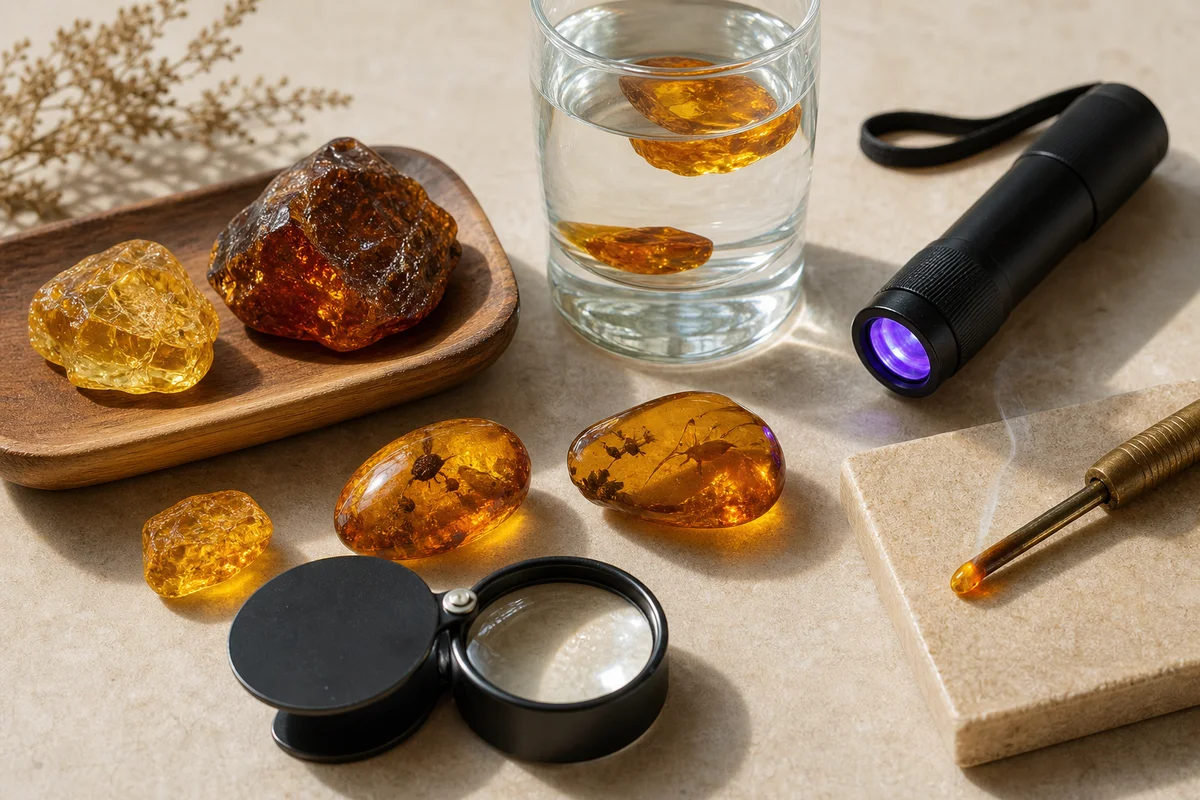
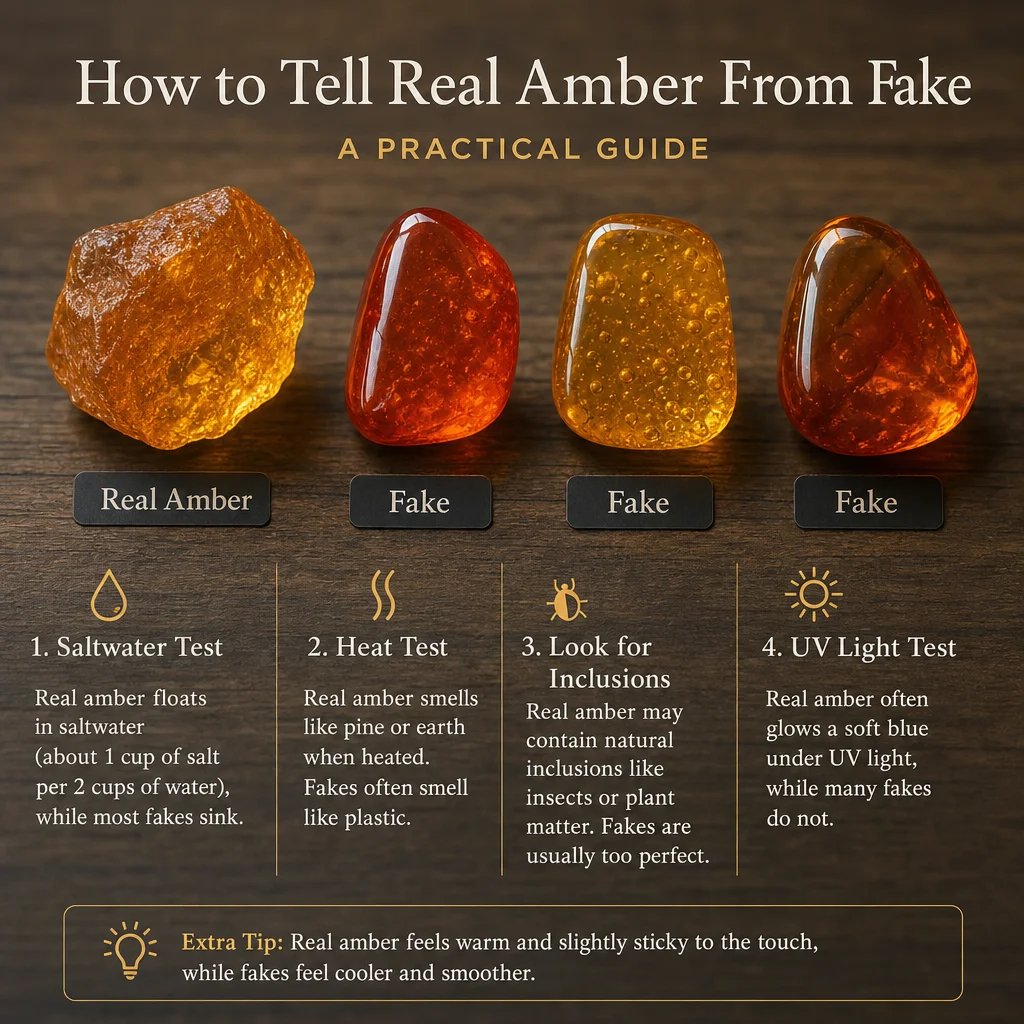
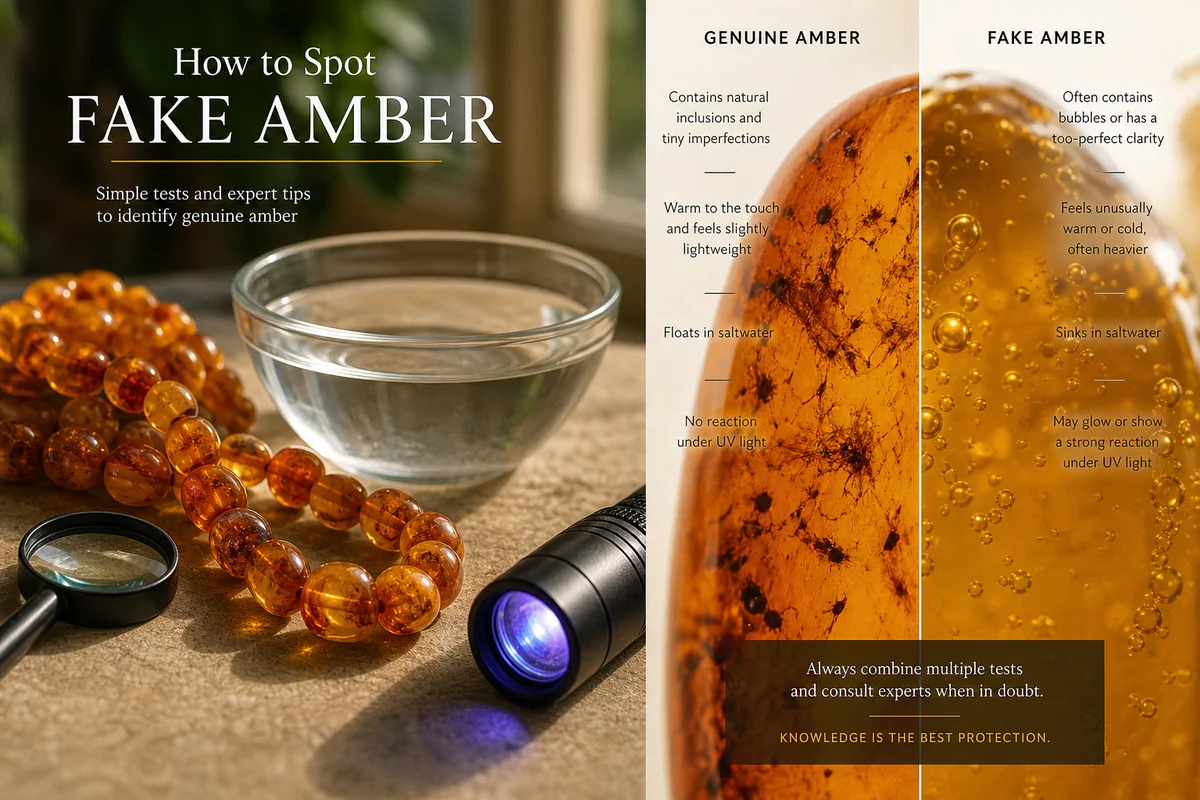
Procedure: Dissolve about 2-3 tablespoons of table salt in a glass of warm water (roughly 1 cup). Stir until fully dissolved. Drop your amber piece into the solution. Genuine amber will float in this saturated saltwater. Most fakes—glass, most plastics, and many synthetic resins—will sink.
Why it works: Real amber has a specific gravity of 1.05-1.10, which is just slightly denser than freshwater but lighter than the saltwater solution (specific gravity roughly 1.2). This narrow density range is a distinctive property of polymerized tree resin. Glass (specific gravity 2.4-4.5) and most plastics (specific gravity 1.1-1.5+) are denser and sink.
Limitations: Some plastics—particularly certain types of polystyrene, polyethylene, and some epoxy resins—have specific gravities close enough to amber that they also float in saturated saltwater. A positive float test doesn't guarantee authenticity; it just narrows the field. Use it as a first screening, not a final verdict.
Also note: Copal (young amber) floats in saltwater too, so this test can't distinguish between genuine amber and copal.
Test 2: The Static Electricity Test
This test uses amber's triboelectric properties—its ability to generate static electricity when rubbed.
Procedure: Rub the amber piece vigorously with a clean, dry cloth (cotton works well) for 15-20 seconds. Immediately hold the amber near small, lightweight items: torn bits of tissue paper, hair strands, small dust particles, or thread. Real amber will generate enough static charge to attract these items.
Why it works: Amber is an excellent insulator with strong triboelectric properties—so strong, in fact, that the word "electricity" comes from "elektron," the Greek word for amber. When rubbed, amber accumulates a surface charge that attracts lightweight materials. This property is unique enough among gem-like materials that a strong positive result is a good authenticity indicator.
Limitations: Many plastics also generate static when rubbed. If the piece passes the static test, it could be either amber or plastic. Combined with the float test, though, the two-positive result narrows possibilities considerably. A piece that both floats in saltwater and generates static electricity is more likely to be amber than glass, stone, or metal—though it could still be copal or certain plastics.
Important detail: The cloth must be dry. Moisture dissipates static charge instantly. If you're testing multiple pieces, make sure the cloth stays dry throughout.
Test 3: The Hot Needle Test
This is the most definitive of the practical tests, but it's destructive—you'll create a small mark on the piece. Only perform this test if you're willing to accept a minor flaw, or if the piece is large enough that a tiny mark on an inconspicuous area won't matter.
Procedure: Heat a sewing needle in a flame until the tip is red-hot. Quickly touch the hot needle to an inconspicuous spot on the piece (ideally a rough or already-damaged area). Then immediately smell the point of contact.
Results:
- Real amber: Produces a smell of burning pine resin or frankincense—woody, aromatic, and distinctive. You might see a tiny wisp of smoke. The needle will sink slightly into the surface rather than bouncing off.
- Plastic: Produces an acrid, chemical, or burning plastic smell. The needle may melt the surface, leaving a glossy depression. Some plastics produce black smoke.
- Glass: The needle bounces off. No smell. No mark. Glass has a much higher melting point than the needle tip can reach.
- Copal: Produces a resinous smell similar to amber, but less complex—more like fresh tree resin than the deeper, aged smell of true amber. The needle sinks in more easily because copal is softer.
Why it works: Amber is organic material—fossilized resin that still contains many of the volatile compounds present in the original tree resin. When heated, these compounds vaporize and produce the characteristic piney smell. Plastics are synthetic polymers with completely different chemical compositions, producing different odors when heated. Glass is inorganic and doesn't vaporize at needle temperatures.
Safety: Hold the needle with pliers, not fingers. Work in a well-ventilated area—burning plastic fumes are unpleasant. The test creates only a tiny mark (1-2mm), but it's permanent.
Test 4: The Alcohol/Solvent Test
This test distinguishes amber from copal and from some plastic resins.
Procedure: Apply a small drop of isopropyl alcohol (rubbing alcohol) or acetone to an inconspicuous area of the piece. Let it sit for 10-20 seconds, then wipe off with a clean cloth.
Results:
- Real amber: No reaction. The surface remains unchanged—no stickiness, no dissolution, no clouding. Wipe it off and the amber looks exactly the same.
- Copal: The surface becomes tacky or sticky. The alcohol begins to dissolve the partially-polymerized resin. This is the clearest differentiator between genuine amber and copal.
- Some plastics: Certain plastics (polystyrene, some acrylics) react to acetone with surface damage. Rubbing alcohol is milder and fewer plastics react to it, so test with rubbing alcohol first.
Why it works: Amber has undergone millions of years of polymerization, creating a highly stable, solvent-resistant material. Copal, being younger and less fully polymerized, still contains soluble compounds that react to common solvents. This chemical stability difference is one of the most reliable distinctions between the two.
Caveat: This test is most useful for distinguishing amber from copal. Many modern plastics also resist rubbing alcohol, so a negative result (no reaction) doesn't by itself confirm amber—it just eliminates copal and the plastics that do react.
Test 5: Visual and Structural Examination
Experienced amber dealers can often identify genuine amber by eye. While this takes practice, there are several visual cues that beginners can learn to recognize:
Inclusions
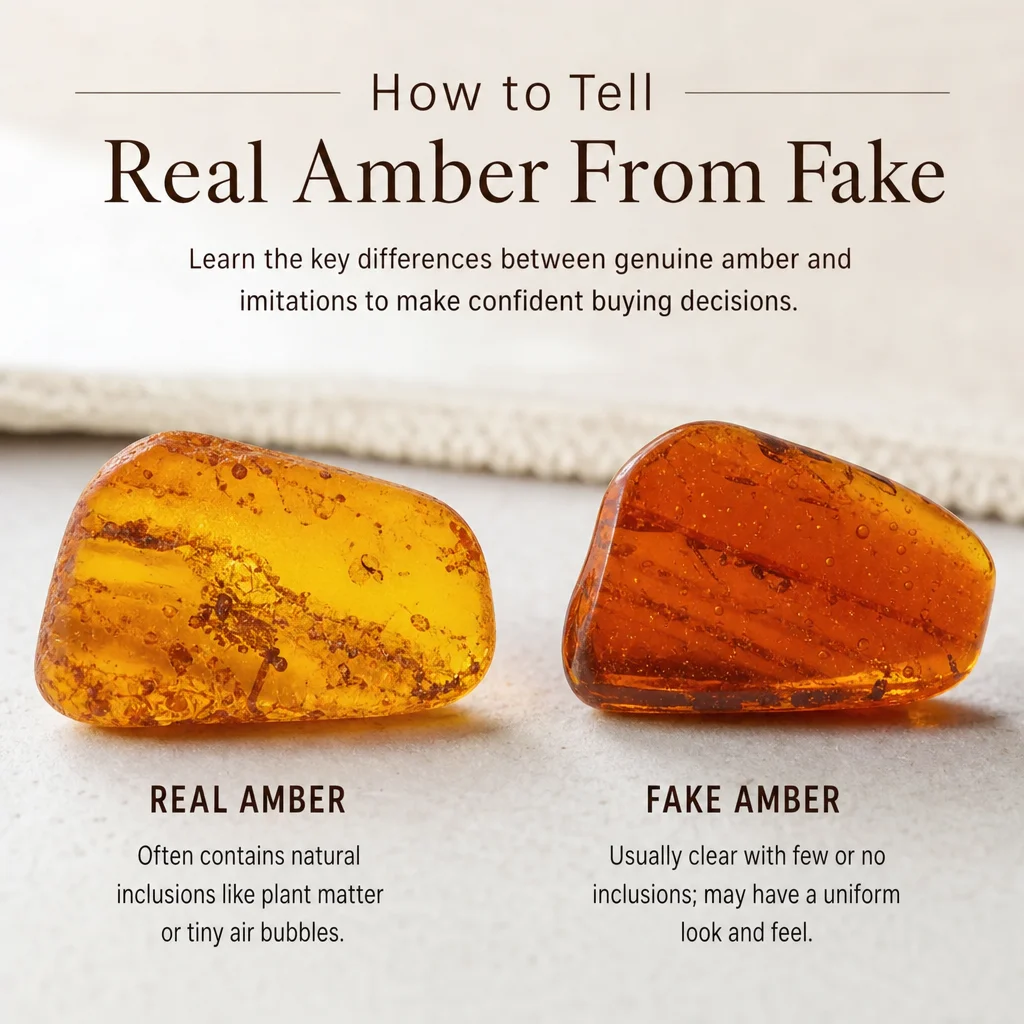
Genuine amber often contains inclusions—insects, plant material, air bubbles, and debris that were trapped when the original resin was still fluid. Real inclusions look natural: partially decomposed insects (legs and wings often visible but bodies may be collapsed), plant fragments at various angles, and randomly distributed air bubbles of different sizes.
Fake inclusions in plastic or synthetic resin often look "too perfect"—complete, intact insects centered in the middle of the piece, positioned at obviously deliberate angles, and suspended in uniformly clear material. Real inclusions are messy, random, and rarely photogenic.
Internal Structure
Hold the piece up to strong light. Genuine amber often shows internal flow patterns—curved, layered structures that reflect the original resin's movement as it dripped down the tree trunk. These "flow lines" or "schlieren" look like wavy, translucent bands within the amber, similar to the banding in agate but more subtle and organic.
Plastic imitations tend to have uniform internal structure or artificially created patterns that look too regular. Glass is completely uniform and may contain perfectly round air bubbles (mold marks from manufacturing).
Surface Temperature
Real amber feels warm to the touch, even in cold environments. Pick it up and hold it in your closed hand for 30 seconds—amber quickly reaches body temperature and feels distinctly warm. Glass and many plastics feel cooler for longer because they have different thermal conductivity properties.
This is subtle and takes some experience to recognize, but it's one of those things that, once you've handled genuine amber and compared it to glass and plastic, becomes immediately apparent.
Types of Real Amber
If your tests confirm the piece is genuine amber, it's useful to know which type you have:
Baltic Amber
Source: Baltic Sea region (Russia, Poland, Lithuania, Kaliningrad). Age: 40-50 million years. The most common and widely traded amber. Colors range from pale yellow to deep cognac brown, with occasional green and blue varieties. Contains succinic acid (a distinctive chemical marker), and some people report that Baltic amber feels warmer and generates stronger static than other types. Most amber jewelry on the market is Baltic.
Dominican Amber
Source: Dominican Republic. Age: 25-40 million years. Known for exceptional clarity and a wider color range including blue amber (which fluoresces blue under UV light, caused by pumiliotoxin from extinct Hymenaea trees). Dominican amber is more expensive than Baltic and prized by collectors. The insect inclusions in Dominican amber are particularly well-preserved due to the tropical conditions of the ancient forest.
Burmese Amber (Burmite)
Source: Myanmar (Burma). Age: 90-100 million years—Cretaceous period, making it the oldest commercially available amber. Contains inclusions from the age of dinosaurs, which is scientifically significant. Currently subject to export restrictions and ethical concerns related to mining conditions. Darker in color (deep red, reddish-brown, or black in some specimens) and harder than Baltic or Dominican amber.
Copal
Not true amber, but worth knowing about. Age: typically 1,000 to 10 million years. Found in Colombia, East Africa, New Zealand, and other tropical regions. Less durable, reactive to solvents, and less valuable. Sometimes sold deceptively as "young amber" or just "amber." The alcohol test (Test 4) is the most reliable way to identify copal.
Common Imitations to Watch For
Glass
Easiest to identify: it's cold to the touch, sinks in water (even saltwater), the needle bounces off, and it has a different internal refraction than amber. Some glass imitations are quite convincing visually, but the density and temperature tests catch them immediately.
Phenolic Resin (Bakelite and Modern Phenolics)
Harder and heavier than real amber. Often darker in color (deep reds, browns, blacks). The hot needle test produces a carbolic/formaldehyde smell rather than pine resin. Bakelite was used extensively in early 20th-century jewelry and is collectible in its own right—it's not "fake" if sold honestly, but it's sometimes passed off as amber.
Celluloid and Casein
Early plastics used in antique jewelry. Celluloid is flammable and produces a camphor smell when heated. Casein (made from milk protein) is lighter than many plastics but heavier than amber. Both are vintage materials with collector value when honestly identified.
Modern Polyester and Epoxy Resins
The most sophisticated imitations. Can match amber's color, translucency, and even contain deliberately embedded inclusions. These pass the float test and static test more often than other fakes. The hot needle test is your best defense—the smell will be chemical, not resinous.
Reconstructed Amber (Ambroid)
This is actually real amber, but it's been ground into powder, melted under heat and pressure, and reformed into blocks. It's sometimes sold as genuine amber without disclosing the processing. Ambroid is more uniform than natural amber, lacks natural flow lines, and may show micro-bubbles from the heating process. The hot needle test still produces an amber smell because the material is genuine—just processed. Ambroid has less collector value than natural amber but is sometimes used in commercial jewelry.
When to Get Professional Testing
If you've spent significant money on an amber piece ($200+) and the tests above give ambiguous results, consider professional verification:
- Spectroscopic analysis — Infrared spectroscopy can identify amber's unique chemical signature, distinguishing it from all known imitations. This is the gold standard for authentication.
- Refractive index testing — Amber has a refractive index of 1.54-1.55, which differs from most plastics and all glass. A gemologist can measure this with a refractometer.
- Succinic acid analysis — Baltic amber contains succinic acid; Dominican and Burmese amber contain different chemical markers. Testing for these specific compounds confirms origin.
These tests cost $30-100 depending on the lab. For high-value pieces (especially those with valuable inclusions), the investment is worthwhile.
Frequently Asked Questions
Does real amber glow under UV light?
Yes. Most genuine amber fluoresces under long-wave UV light (365nm)—Baltic amber typically glows blue-white, Dominican amber glows blue or greenish. Some plastics also fluoresce, so this alone isn't definitive, but it's a supporting indicator. A cheap UV flashlight ($5-10) is a useful tool for preliminary screening.
Can amber scratch glass?
No. Amber has a Mohs hardness of 2-2.5, which is softer than glass (5.5) and even softer than your fingernail (2.5). If a piece supposedly made of amber can scratch glass, it's not amber—it's glass pretending to be amber, or possibly a harder material like quartz.
Why is some amber so cheap and some so expensive?
Price depends on size, color, clarity, inclusions, and origin. A small, cloudy, pale yellow Baltic amber bead might cost $3-5. A large, clear piece with a well-preserved insect inclusion could be $500+. Blue Dominican amber commands premium prices ($50-200+ per gram for high-quality specimens). The same factors that determine gemstone value apply to amber—rarity, beauty, and desirability.
Frequently Asked Questions
Does real amber float in salt water?
Yes, genuine amber is buoyant in heavily salted water. If you dissolve about three tablespoons of salt into a glass of water, authentic amber pieces will float to the top. However, some plastic fakes will also float, so while this is a great initial test for our handcrafted jewelry, we always recommend pairing it with other methods like the smell or heat test to be absolutely certain.
Does real amber create static electricity?
Yes! When you rub real amber with a soft cloth, it builds up a static charge. This natural property allows the stone to attract small bits of paper or hair. This is actually where the word "electricity" comes from, derived from the ancient Greek word for amber. Testing your artisan jewelry for this static pull is a fantastic, non-destructive way to verify your piece is genuine fossilized resin.
Comments