Third Eye Chakra Crystals
May 28, 2026
The Third Eye Chakra: Your Inner Perceptual System
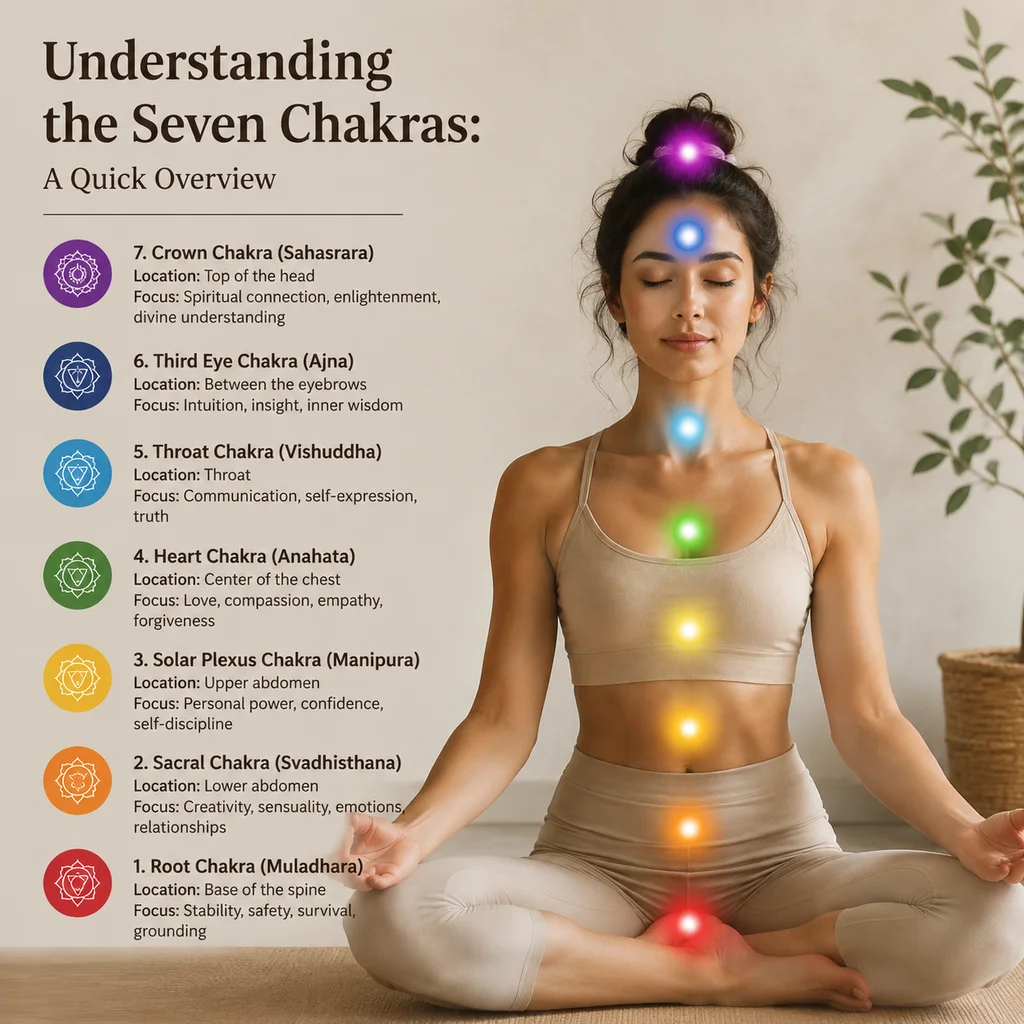
The third eye chakra, called Ajna in Sanskrit (meaning "command" or "perceive"), sits in the center of your forehead, just above and between your eyebrows. It's the sixth chakra and governs what we commonly call "intuition" — but that word doesn't fully capture what Ajna does.
A better way to understand the third eye is as your inner perceptual system. Your eyes see the physical world, but your third eye processes information that your other senses miss: patterns, subtext, the feeling that something is "off" before you can articulate why, the sense of knowing something without being able to explain how you know it.
When your third eye is balanced, you trust your instincts without being ruled by them. You notice patterns others miss. You can read between the lines in conversations and situations. You have vivid dreams that feel meaningful, and your creative ideas feel inspired rather than forced.
When it's blocked or overactive, you might experience: constant second-guessing of your gut feelings, vivid but disturbing dreams, frequent headaches or sinus pressure, difficulty concentrating, feeling disconnected from your inner voice, or — in the case of overactivity — becoming so absorbed in your inner world that you struggle to stay grounded in reality.
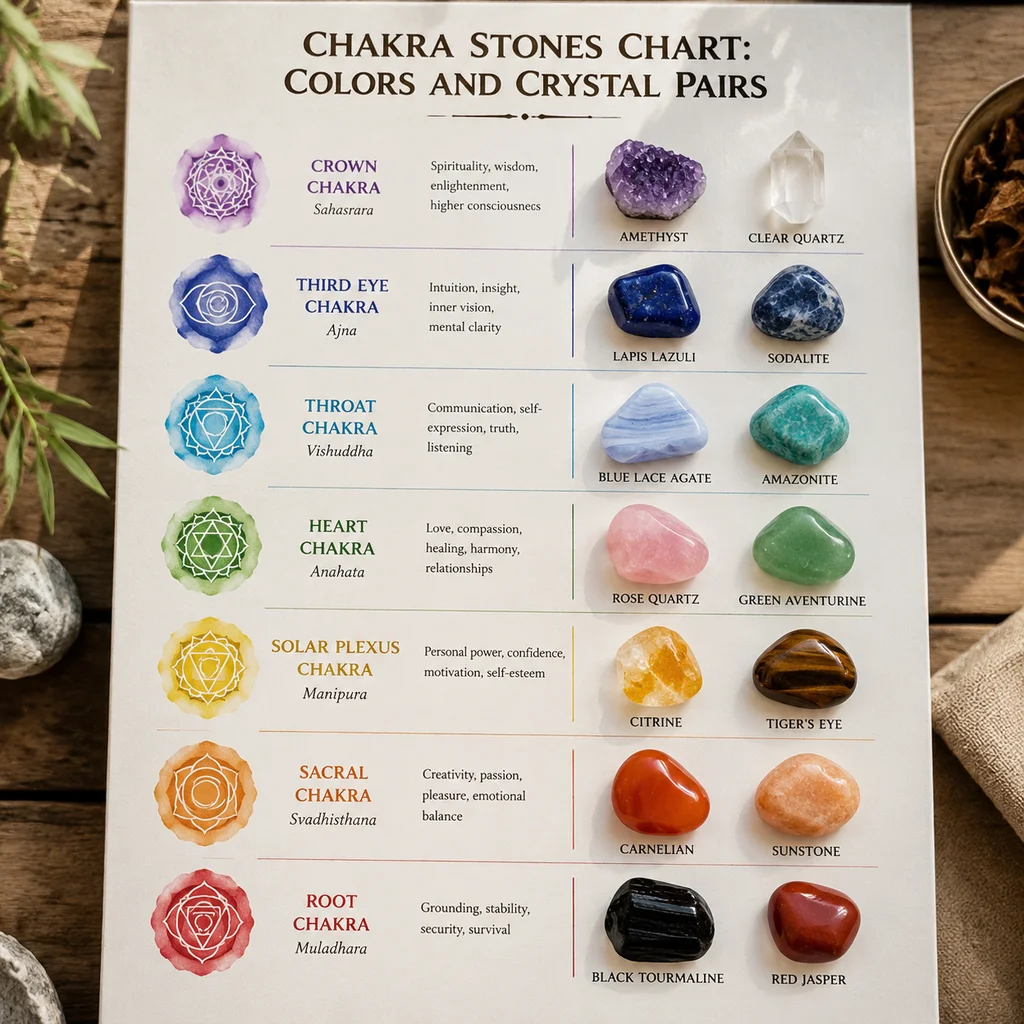
The third eye chakra is associated with deep indigo blue and purple. The crystals that work with this chakra tend to share these colors, though the connection goes deeper than visual matching.
8 Third Eye Crystals and What Each One Supports
1. Amethyst — The Master Third Eye Stone
Amethyst is the most commonly recommended crystal for third eye work, and its credentials are well-earned. This purple variety of quartz has been associated with clarity of mind and spiritual insight for thousands of years. The ancient Greeks believed amethyst prevented drunkenness — the word "amethystos" literally means "not intoxicated." While that's not how geology works, the underlying idea — that amethyst supports clear, sober thinking — is consistent with its traditional third eye applications.
For the third eye specifically, amethyst supports the most common challenge: distinguishing genuine intuition from anxiety, wishful thinking, or fear. Amethyst doesn't amplify intuition so much as it quiets the mental noise that drowns intuition out.
Best for: Meditation, dream work, calming mental chatter, developing discernment between genuine intuition and projection.
2. Labradorite — The Flash of Insight
Labradorite is famous for its labradorescence — flashes of blue, green, and gold that appear when you tilt the stone in the light. This optical phenomenon is caused by light reflecting off microscopic layers within the stone, and it's a perfect physical metaphor for what labradorite does for the third eye: revealing what's hidden in the ordinary.
Inuit legend says the Northern Lights were once trapped inside rocks along the coast of Labrador, Canada, until a wandering warrior struck them with his spear, freeing most of the light into the sky. The light that remained in the rocks became labradorite.
For third eye work, labradorite supports sudden insights and "aha" moments. If you've been stuck on a problem or situation and need a new perspective, labradorite helps shift your perception enough to see what was always there but hidden from view.
Best for: Breaking through mental blocks, creative problem-solving, accessing new perspectives, protecting your energy during intuitive work.
3. Sodalite — The Rational Intuitive
Sodalite bridges an interesting gap in third eye work: it supports intuitive knowing while also engaging your logical mind. This makes it especially useful for people who are skeptical of their own intuition and need help validating what they're sensing.
If you get a strong "gut feeling" about something but immediately dismiss it because you can't justify it logically, sodalite helps you hold both — the intuitive hit and the rational analysis — without one canceling out the other.
Best for: People who overthink their intuition, developing trust in inner guidance, balancing logic and instinct, analytical types who are developing their intuitive side.
4. Lepidolite — The Calm Observer
Lepidolite is a lilac to purple mica mineral that contains lithium — yes, the same element used in mood-stabilizing medications. While the amount of lithium in lepidolite is far too small to have pharmacological effects, the stone has a noticeably calming energy that makes it valuable for third eye work.
The third eye chakra can become overstimulated, especially during intense meditation or dream work. Lepidolite acts as a calming agent, helping you observe your intuitive impressions without getting overwhelmed by them. Think of it as the difference between watching a storm from a safe shelter versus standing in the middle of it.
Best for: Calming an overactive third eye, sleep issues related to vivid dreams, anxiety about intuitive experiences, creating a stable foundation for regular meditation practice.
5. Black Obsidian — The Truth Mirror
Black obsidian might seem like an odd choice for the third eye — it's not purple or blue, and it's more commonly associated with root chakra grounding. But obsidian has a unique property that makes it relevant here: it's a volcanic glass that was used by many ancient cultures to make mirrors.
The Aztecs and Maya used obsidian mirrors for divination — gazing into the reflective black surface to receive visions and insights. In the context of the third eye, obsidian serves a similar function: it reflects back what you need to see, including things you've been avoiding.
Obsidian is not a gentle stone. It's best used when you're ready to face uncomfortable truths about yourself or your situation. It strips away illusions and self-deception, which is painful but ultimately necessary for genuine intuitive development.
Best for: Shadow work, confronting self-deception, breaking through denial, receiving difficult but necessary insights.
6. Purple Fluorite — The Focus Stone
Purple fluorite is a calcium fluoride mineral that forms in geometric cubes and octahedrons. Its perfect crystalline structure is a physical expression of what it does energetically: creating order out of chaos.
For the third eye, purple fluorite supports concentration and mental focus during meditation. If your mind wanders constantly during third eye exercises, or if you start meditating and suddenly remember everything you forgot to do today, fluorite helps hold your attention steady.
Fluorite also has a practical property worth knowing: it glows under ultraviolet light (the word "fluorescence" comes from fluorite). This hidden luminosity mirrors the third eye's ability to illuminate what's normally invisible.
Best for: Concentration during meditation, organizing scattered thoughts, studying or learning new concepts, maintaining focus during extended intuitive work.
7. Iolite — The Navigator's Stone
Iolite is a blue-violet silicate mineral with strong pleochroism — it appears different colors (blue, violet, grayish) depending on the angle you view it from. Viking navigators reportedly used thin slices of iolite as a polarizing filter to determine the position of the sun on cloudy days, earning it the nickname "Viking compass."
For the third eye, iolite supports inner navigation — finding your way through confusing situations where the right path isn't obvious. If you're at a crossroads in life and feel genuinely uncertain about which direction to take, iolite helps you access your own internal compass.
Best for: Life transitions, navigating uncertainty, developing trust in your own direction, recovering from periods of feeling lost or directionless.
8. Azurite — The Deep Seer
Azure is deep blue with striking green malachite inclusions. Ancient civilizations across Egypt, Greece, and China considered azurite a stone of insight and spiritual vision. Chinese emperor Kwang's mirror was said to have been made from azurite, and it was used extensively in medieval Europe for illuminating manuscripts (as the pigment "azure").
For the third eye, azurite is for deep, sustained intuitive work. It's not a stone for casual meditation — it's for the practitioner who is committed to developing their intuitive abilities seriously and consistently. Azurite supports prolonged focus and depth of perception.
Best for: Advanced meditation practice, deep intuitive development, spiritual study, accessing insights that require sustained concentration.
Signs of Third Eye Chakra Imbalance
Underactive Third Eye
- Dismissing gut feelings as "just anxiety"
- Feeling disconnected from your dreams or rarely remembering them
- Difficulty making decisions because you can't sense the "right" choice
- Feeling like you're sleepwalking through life without purpose
- Struggling to read between the lines in social situations
- Frequent headaches, especially at the forehead or behind the eyes
Overactive Third Eye
- Intense, disturbing dreams or nightmares that feel prophetic
- Feeling overwhelmed by others' emotions in crowded spaces
- Difficulty distinguishing imagination from perception
- Anxiety about events that haven't happened (and may never happen)
- Obsessive overthinking and inability to be present
Third Eye Meditation with Crystals
This meditation is designed to be simple and grounding — many third eye meditations are overly elaborate and can actually overstimulate this chakra:
- Sit in a comfortable position with your spine straight. Close your eyes.
- Place your chosen crystal on your forehead, between and slightly above your eyebrows. You can hold it in place with a headband or lie down so it rests naturally.
- Focus on the physical sensation of the crystal against your skin. Notice its weight, temperature, and texture. This physical anchor prevents your mind from wandering.
- Breathe naturally — don't try to control your breath. Simply observe each inhale and exhale. After a few minutes, you may notice that your breathing has naturally slowed and deepened on its own.
- Ask a specific question — not a yes/no question, but something like "What do I need to understand about [situation]?" or "What am I not seeing about [relationship or decision]?"
- Don't try to answer it. Just sit with the question. Notice what images, words, feelings, or memories arise without analyzing them. Let them pass through like clouds.
- After 10-15 minutes, remove the crystal and place your palms over your eyes for 30 seconds. This "seals" the experience and brings you back to ordinary consciousness.
Keep a journal nearby and write down anything that came up immediately after the meditation — even if it seems random or unrelated to your question. Third eye insights often arrive indirectly.
Third Eye Crystal Combinations
| Combination | Purpose | Stones |
|---|---|---|
| Third Eye + Crown | Spiritual insight and connection | Amethyst + Selenite |
| Third Eye + Throat | Articulating intuitive insights | Sodalite + Aquamarine |
| Third Eye + Heart | Intuitive understanding of relationships | Labradorite + Rose Quartz |
| Third Eye + Root | Grounded intuition — practical application of insights | Black Obsidian + Red Jasper |
| Third Eye + Solar Plexus | Confidence to act on your instincts | Purple Fluorite + Citrine |
Daily Practices for Third Eye Health
Crystal work is most effective when combined with daily habits that support third eye function:
- Dream journaling: Keep a notebook by your bed and write down whatever you remember from your dreams immediately upon waking. Even fragments count. Over time, this trains your third eye to process and retain intuitive information received during sleep.
- Screen-free mornings: Avoid looking at your phone for the first 30 minutes after waking. The third eye is most receptive in the liminal state between sleep and full waking consciousness.
- Forehead massage: Gently massage the area between your eyebrows in small circles for 1-2 minutes. This relieves physical tension in the third eye area and increases blood flow.
- Stargazing or cloud-watching: Spending time looking at vast, open spaces (sky, ocean, mountains) activates the third eye's capacity for wonder and expanded perception.
FAQ
Q: Which third eye crystal should I start with?
A: Amethyst. It's widely available, affordable, and gentle enough for beginners while still being effective. It's also one of the safest crystals to work with — no toxicity concerns, durable enough for daily handling, and effective with or without elaborate rituals.
Q: I get headaches during third eye meditation. Is that normal?
A: Mild pressure or tension is common when you first start working with the third eye, similar to the discomfort of using an underused muscle. If the headache is severe, stop and ground yourself (eat something, walk barefoot, or do a root chakra meditation). Lepidolite can help reduce this discomfort.
Q: How do I know if what I'm sensing is intuition or imagination?
A: Intuition typically arrives as a calm, quiet certainty. It doesn't come with urgency, fear, or excitement. Imagination and anxiety tend to be louder, faster, and more emotionally charged. Sodalite is specifically helpful for developing this discernment.
Q: Can children work with third eye crystals?
A: Children's third eye chakras are naturally more open than adults', which is why kids often have vivid imaginations and "invisible friends." Rather than trying to develop their third eye further, it's more helpful to provide grounding stones (like red jasper or black tourmaline) to help them stay connected to the physical world. Amethyst under a pillow can help with nightmares.
Q: Is it dangerous to open the third eye?
A: "Opening" the third eye is a gradual process, not a sudden event. There's no danger in regular meditation with third eye crystals. However, if you start experiencing persistent anxiety, vivid disturbing dreams, or difficulty distinguishing inner experiences from outer reality, scale back your practice and focus on grounding (root chakra work) before returning to third eye work.
Frequently Asked Questions
Which crystal is best for opening the third eye chakra?
Amethyst is widely considered the most effective crystal for opening the third eye chakra due to its high spiritual vibration and calming energy. Other powerful options include lapis lazuli, sodalite, and clear quartz. Each crystal supports intuitive development differently, so choosing one that resonates with your personal energy and intentions will yield the best results for your spiritual practice.
Where do you place crystals for third eye chakra healing?
For third eye chakra healing, place crystals directly on the center of your forehead between your eyebrows during meditation or while lying down. You can also hold them in your hands, keep them on your nightstand while sleeping, or wear them as jewelry positioned near your head. Lapis lazuli pendants and amethyst earrings are especially effective for keeping this energy center activated throughout the day.
Can wearing crystal jewelry help open your third eye?
Yes, wearing handcrafted crystal jewelry is one of the most effective ways to keep your third eye chakra activated throughout the day. When you wear amethyst, lapis lazuli, or sodalite as earrings, necklaces, or bracelets, the stones maintain continuous contact with your energy field. This prolonged exposure gently stimulates intuitive awareness and supports gradual, balanced third eye opening over time.
How long does it take for third eye crystals to work?
The timeline varies for each person depending on their current energy state and consistency of practice. Some people notice subtle shifts in intuition within a few days, while deeper third eye activation typically unfolds over weeks or months of regular crystal work. Using your stones daily, setting clear intentions, and remaining patient with the process will support the most meaningful and lasting results.
What does it feel like when your third eye chakra opens?
When your third eye chakra begins opening, you may experience heightened intuition, vivid dreams, increased mental clarity, and a stronger sense of inner knowing. Physical sensations can include tingling or gentle pressure between the eyebrows, enhanced perception of colors, and deeper meditation experiences. Many people also notice improved decision-making and a greater ability to sense energy in people and environments.


Comments