Crystals That Survived Shipwrecks and Centuries
May 14, 2026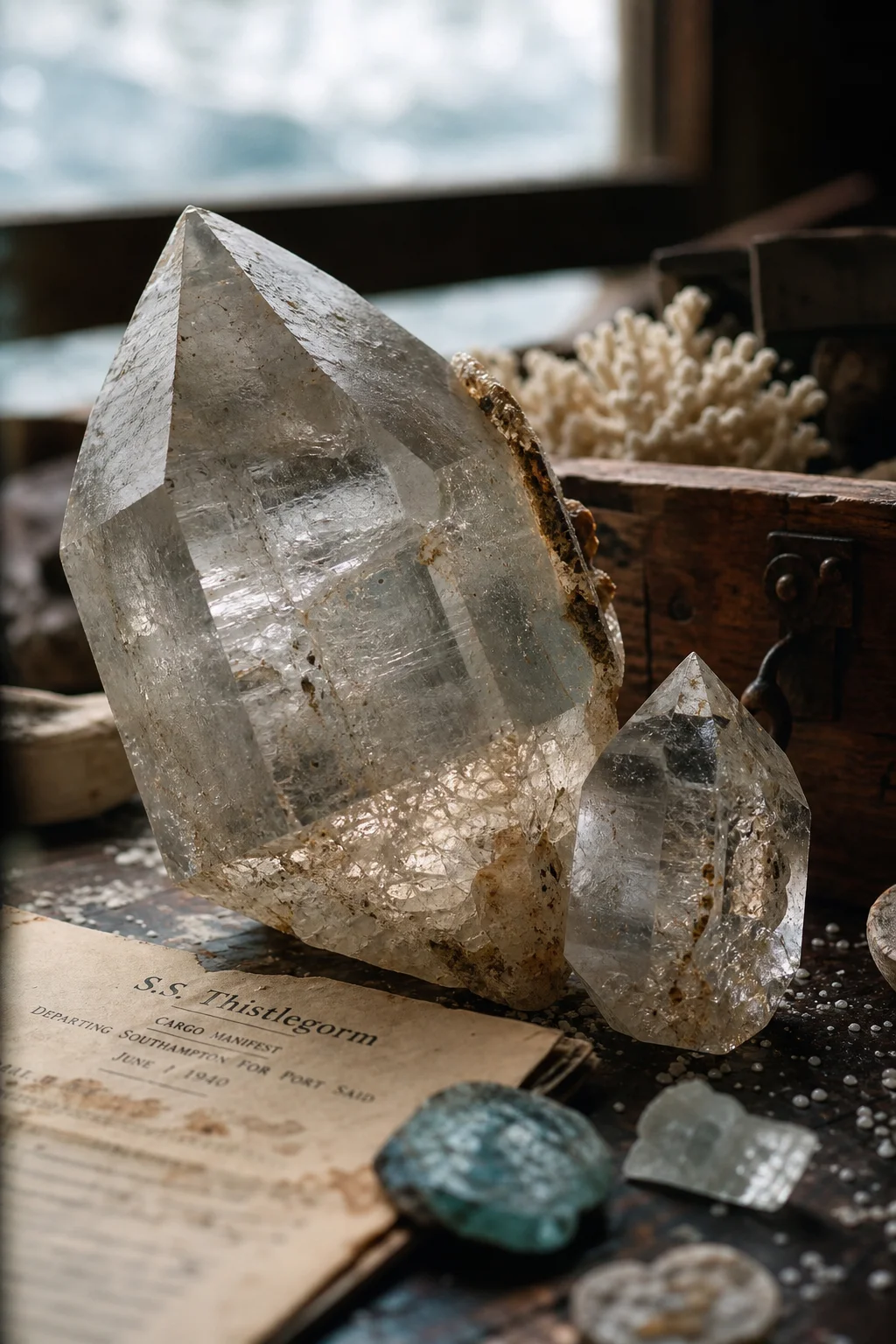
Crystals That Survived Shipwrecks and Centuries Underwater
In 1900, a Greek sponge diver named Elias Stadiatos descended near the island of Antikythera and surfaced pale and trembling. He told his captain he'd seen a heap of dead, naked women on the seabed. What he'd actually found was a Roman shipwreck from around 60 BC, loaded with bronze and marble statues — and a small collection of carved gemstones that had been sitting in saltwater for two thousand years.
When those gems were finally recovered and cleaned, many were in remarkable condition. The carnelian intaglios still held their intricate carvings. The amethyst cabochons hadn't lost their color. The rock crystal seals were as clear as the day they were made.
How is that possible? And what does it tell us about which crystals can actually survive rough conditions?
The Science of Underwater Survival
It comes down to chemistry and crystal structure. Minerals that are chemically stable in water — meaning they don't dissolve, react, or decompose — can survive indefinitely underwater. Saltwater actually slows down some forms of chemical weathering because it reduces oxygen availability.
The crystals that typically survive long-term water exposure include:
- Quartz family (amethyst, citrine, rose quartz, clear quartz, smoky quartz) — Mohs 7, chemically inert in water
- Corundum (ruby, sapphire) — Mohs 9, one of the most stable minerals on Earth
- Beryl (emerald, aquamarine, morganite) — generally stable but emeralds with fractures can absorb water
- Garnet — most varieties are stable in water
- Topaz — Mohs 8, chemically stable
- Tourmaline — stable, though some specimens have inclusions that can trap moisture
Famous Shipwreck Gemstone Recoveries
The Antikythera Wreck (c. 60 BC)
Besides the famous mechanical device, divers recovered carved gemstones including carnelian, agate, and rock crystal intaglios. After two millennia on the Mediterranean floor, the carvings were sharp enough that archaeologists could identify the mythological scenes depicted on them. Carnelian's Mohs rating of 6.5-7 and its resistance to chemical weathering made it an excellent survivor.
The Tudor Warship Mary Rose (1545)
When Henry VIII's flagship was raised from the Solent in 1982, archaeologists found personal belongings of the crew, including agate beads and a gold ring set with a garnet. The agate (a variety of chalcedony, Mohs 6.5-7) was intact after 437 years in the cold waters off Portsmouth. The garnet was unscratched and still held its deep red color.
The Spanish Galleon Nuestra Señora de Atocha (1622)
Mel Fisher's famous discovery off Key West yielded emeralds, amethysts, and pearls from the Colombian mines. While many pearls had degraded, the crystalline gemstones were largely intact. The emeralds, despite being heavily included (which makes them vulnerable), survived because the warm Caribbean water didn't contain the specific chemicals needed to break down beryl.
The RMS Titanic (1912)
Among the artifacts recovered from the Titanic were jewelry items containing diamonds, sapphires, and gold. The diamonds — pure crystallized carbon — were completely unaffected by 90 years on the Atlantic floor at near-freezing temperatures and crushing pressure. The sapphires were equally pristine.
Which Crystals Would NOT Survive
Not everything survives the deep. The same chemistry that makes some minerals indestructible in water makes others dissolve or degrade:
- Halite (salt crystals) — dissolves in water, sometimes in minutes
- Selenite/gypsum — slowly dissolves, especially in warm or acidic water
- Calcite — dissolves in acidic or even slightly acidic water over time
- Malachite and azurite — copper carbonates that can degrade in acidic conditions
- Pearl and amber — organic gems that degrade over centuries in water
- Opal — contains 3-21% water; prolonged immersion can cause cracking or "crazing"
What This Means for Your Collection
You don't need to worry about shipwrecks, but the same principles apply to everyday storage. If a crystal survived two thousand years on the Mediterranean floor, it'll survive your jewelry box. But if a crystal dissolves in a glass of water, you need to be careful with it.
The Mohs hardness scale is a good starting point for durability, but hardness and water resistance are different things. Topaz (Mohs 8) is both hard and water-resistant. Calcite (Mohs 3) is soft and dissolves in acid. Selenite (Mohs 2) is soft and dissolves in water.
For practical purposes, if you want crystals that are truly low-maintenance, stick with the quartz family. They're hard enough to resist scratching, chemically stable in virtually any household condition, and — as those ancient shipwrecks prove — capable of outlasting empires.
The Deepest Lesson
There's something oddly comforting about holding a piece of amethyst and knowing that the same mineral has been recovered from Roman shipwrecks, Egyptian tombs, and medieval cathedral foundations, looking essentially unchanged across thousands of years. Starting a crystal collection isn't just a hobby — it's a partnership with materials that measure time on a geological scale.
The crystals on your shelf will outlast you. The least you can do is keep them dry (well, most of them anyway).
Preservation Techniques and the Role of Museum Care
While some crystals are naturally resilient to underwater conditions, the way they are cared for post-recovery plays a crucial role in their preservation. Museums and collectors use a variety of techniques to maintain the integrity of these ancient gems.
One of the most common methods is the use of inert gas environments. These environments replace the oxygen in the air with a non-reactive gas like argon, which can prevent oxidation and further damage to the crystal surfaces. For example, the British Museum uses this technique to protect the Antikythera Mechanism and its accompanying gemstones.
Another technique is the use of controlled humidity and temperature. Many crystals are sensitive to changes in these conditions, which can lead to cracking or color fading. By carefully controlling the environment, museums can slow down the natural aging process and preserve the crystals for future generations.
The Importance of Documentation
Accurate documentation is essential for the preservation of shipwreck crystals. This includes detailed records of the crystal's history, the conditions under which it was found, and the methods used for cleaning and conservation. These records help researchers understand the crystal's journey and ensure that it is cared for appropriately.
For instance, the Mary Rose project includes extensive documentation of the agate beads and garnet ring, which provides valuable insights into the jewelry trends and craftsmanship of the Tudor period.
Modern Applications of Ancient Crystals
Despite their age, many of these ancient crystals are still used today. Their durability and beauty make them popular in jewelry and decorative art. Here are a few ways modern artisans are using these ancient crystals:
- Jewelry: Crystals from shipwrecks are often set in contemporary jewelry pieces, combining ancient history with modern design.
- Decorative Art: Some artists create sculptures and installations using shipwreck crystals, highlighting their unique history and aesthetic appeal.
- Collectibles: For many, owning a piece of history is a cherished experience. Shipwreck crystals are highly sought after by collectors and enthusiasts alike.
Comparing Crystal Durability
| Crystal Type | Mohs Hardness | Chemical Stability | Water Resistance |
|---|---|---|---|
| Quartz Family | 7 | Inert | High |
| Corundum | 9 | Inert | High |
| Beryl | 7.5-8 | Stable | Medium |
| Garnet | 6.5-7.5 | Stable | High |
| Topaz | 8 | Stable | High |
| Tourmaline | 7-8 | Stable | Medium |
FAQ
Can all crystals survive underwater conditions?
Can all crystals survive underwater conditions?
No, not all crystals are as resilient as those in the quartz family or corundum. Soft minerals like opal or calcite can dissolve or degrade in saltwater.
How long can crystals survive underwater?
How long can crystals survive underwater?
It depends on the mineral and the conditions. Some crystals can survive for thousands of years, while others may degrade much faster.
Are there any health benefits to wearing ancient crystals?
Are there any health benefits to wearing ancient crystals?
No, there are no scientific health benefits associated with wearing ancient crystals. Their significance is primarily cultural and historical.
How are shipwreck crystals cleaned and conserved?
How are shipwreck crystals cleaned and conserved?
Shipwreck crystals are cleaned using gentle methods, such as ultrasonic cleaning or hand-washing with distilled water. They are then conserved using techniques like inert gas environments and controlled humidity and temperature.
Are there any modern-day shipwrecks that have been discovered with gemstones?
Are there any modern-day shipwrecks that have been discovered with gemstones?
Yes, there have been several modern discoveries of shipwrecks containing gemstones. The SS Republic, for example, was found with a cargo of diamonds, sapphires, and rubies in 1985.
What Makes This Crystal Special
This section covers important aspects of what makes this crystal special. For detailed information, please refer to the FAQ section below.




Comments