What Filigree Actually Is
What Filigree Actually Is
Filigree is a jewelry-making technique where fine metal wire is twisted, curled, and soldered into intricate, lace-like patterns. The word comes from the Latin "filum" (thread) and "granum" (grain), referring to the thread-like wires and tiny granules that make up the designs. When you see a piece of filigree jewelry — a pendant with delicate scrollwork, a ring with an openwork floral pattern, earrings that look like frozen lace — you're looking at thousands of years of accumulated technique.
The basic process sounds almost too simple to produce something beautiful: take thin metal wire, bend it into shapes, solder the shapes together, and attach them to a frame. But the skill required to do this with precision and consistency at a microscopic scale is extraordinary. A single filigree pendant can contain hundreds of individual wire elements, each placed and soldered by hand.
Where Filigree Started
The earliest evidence
The oldest known filigree work dates back to around 2500 BCE in Mesopotamia, in what is now Iraq. Archaeologists have found gold beads and pendants with intricate wire patterns in royal tombs from the Sumerian period. These pieces are crude by modern standards — the wire is thicker, the patterns simpler — but the fundamental technique is unmistakable. Someone, nearly five thousand years ago, figured out that thin gold wire could be coiled and soldered into decorative shapes, and that idea spread from there.
From Mesopotamia, filigree spread to Egypt, where it was adopted into the elaborate goldwork of the pharaohs' courts. The Egyptians refined the technique, adding granulation — tiny spheres of gold fused to the surface — which became a hallmark of their jewelry style.
Greek and Etruscan mastery
The ancient Greeks took filigree to a level of sophistication that wouldn't be matched for centuries. Greek goldsmiths working between 600-300 BCE created pieces of astonishing complexity — necklaces, earrings, and diadems with wire patterns so fine they look like they were drawn with a pen. The famous "bee pendant" from Minoan Crete (though technically earlier than classical Greece) shows how far back the decorative potential of wirework was understood.
The Etruscans, who lived in what is now central Italy before the Roman Republic, were arguably the greatest filigree artists of the ancient world. Their granulation work — placing thousands of microscopic gold spheres in precise patterns — has never been fully replicated even with modern tools. How they achieved such consistency with only basic equipment remains something of a mystery, and modern metallurgists have published multiple theories attempting to explain it.
Asian traditions
While Mediterranean cultures developed their own filigree styles, independent traditions emerged across Asia. Indian filigree, particularly from the states of Odisha and Karimnagar, has been practiced for over 500 years and is recognized by UNESCO as an important craft tradition. The Indian style tends to be bolder and more geometric than Mediterranean filigree, with large, symmetrical patterns built from thicker wire.
Chinese filigree work, known as "huasi" or "flower wire," became prominent during the Ming Dynasty (1368-1644 CE). Chinese artisans combined filigree with enamel work to create the "cloisonné" style that remains one of China's most recognizable decorative arts. The wire in cloisonné serves a dual purpose: it creates the design pattern and acts as the barrier between different colored enamel sections.
The Medieval Period: Survival in Monasteries
After the fall of the Roman Empire, fine metalwork in Europe declined dramatically. The sophisticated techniques of Greek and Etruscan goldsmiths were largely lost, and the early medieval period produced comparatively crude jewelry. Filigree survived, but in simplified form, mostly in religious contexts — reliquaries, crosses, and altar decorations produced in monastery workshops.
The Byzantine Empire, which preserved Roman traditions in the eastern Mediterranean, kept filigree alive at a higher level of quality. Byzantine gold filigree work from the 6th to 12th centuries shows remarkable craftsmanship, often incorporating gemstones and pearls into the wire frameworks.
The Renaissance: Filigree's Golden Age
Filigree experienced a major revival during the European Renaissance (14th-17th centuries), driven by the rediscovery of classical art and the increasing wealth of merchant classes who could afford fine jewelry. Italian goldsmiths in particular elevated filigree to new heights — the city of Granata, Sicily became famous for its filigree work, and the tradition continues there today.
During this period, filigree techniques were formalized and documented in goldsmithing manuals for the first time. These manuals, written in Italian and German, described specific wire patterns, soldering methods, and design principles that had previously been passed down through apprenticeship alone. The documentation helped spread techniques across Europe and contributed to a general rise in quality and complexity.
The Renaissance also saw the development of "openwork" filigree — designs with large areas of empty space between the wire elements, creating a true lace-like effect. Earlier filigree tended to be denser, with wire patterns packed closely together. The openwork style allowed for more delicate, airy designs and required even greater precision in wire placement.
Why True Filigree Is Disappearing
The decline of filigree as a widely practiced technique has several causes, and they're all connected to modern manufacturing and economics.
First, casting and stamping can now produce designs that look like filigree at a fraction of the cost. If you go to a department store and buy a "filigree" necklace for $30, it's almost certainly cast or stamped from a mold, not made from individual wires. It looks similar at arm's length, but close up, the difference is obvious. Cast filigree has a uniform, mechanical quality — every scroll is identical, every curve is mathematically perfect. True handmade filigree has subtle variations that give it character.
Second, the skill barrier is enormous. Learning basic filigree takes months. Becoming proficient takes years. Becoming truly skilled takes decades. There's no shortcut — you have to develop the hand control, the eye for design, and the soldering instincts through thousands of hours of practice. In an era where most jewelry training focuses on CAD design and 3D printing, fewer and fewer jewelers are willing to invest that time.
Third, the economics are brutal. A hand-filigree pendant that takes 8-12 hours to make might sell for $200-400. That sounds reasonable until you subtract materials, overhead, marketing, and the fact that you can only make so many per week. Compare that to a similar-looking cast piece that can be produced by the hundreds for a few dollars each, and you can see why commercial manufacturers don't bother with real filigree.
Where Filigree Still Thrives
Despite the pressures, true filigree is not dead. It survives in pockets around the world, often supported by cultural preservation efforts and a small but dedicated market of collectors and enthusiasts.
In India, filigree artisans in Cuttack (Odisha) continue to produce traditional silver filigree jewelry using methods passed down through generations. The Indian government has recognized this as a Geographical Indication craft, which provides some protection and support.
In Portugal, particularly in the Minho region, gold filigree ("filigrana") remains a living tradition. Portuguese filigree is distinctive for its use of extremely fine gold wire and delicate, nature-inspired designs — hearts, flowers, and birds are common motifs. It's still a significant part of Portuguese cultural identity and is often given as a wedding or christening gift.
In the contemporary jewelry world, a small number of independent artisans practice filigree as their primary technique. These makers tend to sell through galleries, craft shows, and online platforms, and their work commands premium prices. The people who buy it are typically looking for something that can't be mass-produced — a piece with visible human imperfection, a connection to an ancient craft, and a story behind it.
Learning Filigree Today
If you're interested in trying filigree yourself, the basics are accessible to anyone with basic jewelry-making skills. You need fine wire (26-30 gauge for delicate work), a soldering setup, tweezers, round-nose pliers, and patience. Lots of patience.
Start with copper wire — it's cheap, solders easily, and forgives mistakes. Practice making basic shapes: coils, scrolls, S-curves, and circles. Learn to solder these shapes together without melting them (which will happen repeatedly at first). Once you can consistently produce clean, neat shapes, start combining them into simple patterns.
There are good instructional resources available. YouTube has several filigree artists who share their process, and books like Jeanne Rhodes-Moen's "Silver Threads" provide detailed tutorials. The Filigree Guild, an online community, connects learners with experienced makers who can offer guidance.
Filigree isn't the fastest or most efficient way to make jewelry. But it produces something that no other technique can replicate — a piece of metalwork that's simultaneously strong and delicate, ancient and contemporary, mechanical and deeply human. That tension between the precision of the technique and the organic quality of the handwork is what makes filigree special, and it's worth preserving.
Famous Filigree Pieces in History
A few specific historical pieces help illustrate what master-level filigree looks like. The Oxus Treasure, discovered in modern-day Tajikistan and dating to the 5th-4th century BCE, contains gold filigree jewelry of extraordinary delicacy — chains, earrings, and armlets made from wire thinner than human hair. These pieces survived two thousand years buried in the ground and are now in the British Museum.
The Staffordshire Hoard, found in England in 2009, contains Anglo-Saxon gold filigree from the 7th-8th centuries CE. The filigree work on the sword pommels and helmet fragments is incredibly detailed — tiny gold wires twisted into zoomorphic patterns that are barely visible to the naked eye. The craftsmanship suggests a tradition of filigree that rivaled anything being produced in the Mediterranean at the time.
More recently, the filigree work of Portuguese goldsmiths during the 18th and 19th centuries produced some of the most ornate examples of the craft. The "coração de Viana" — a heart-shaped filigree pendant from the Minho region — has become an iconic symbol of Portuguese culture and is still produced by traditional artisans today using methods that have changed little in 200 years.
The Tools of the Trade
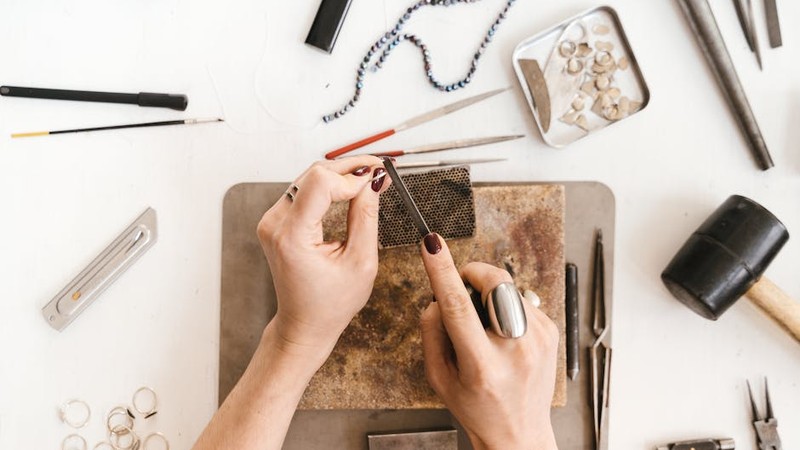
Traditional filigree requires a small but specialized set of tools beyond basic jewelry-making equipment. Fine-point round-nose pliers (for making tight coils and curves), flat-nose pliers (for holding and bending wire), flush cutters (for clean wire ends), a soldering station with a fine-tip torch (for precision soldering of tiny joints), tweezers (for positioning wire elements), and a charcoal block or honeycomb soldering board (for heat reflection during soldering).
The wire itself is typically fine silver or gold in gauges from 28 to 34 (very thin). The frame is made from heavier gauge wire — 18 to 22 gauge — that provides structural support for the delicate filigree work attached to it. Flux, solder paste, and a pickle solution for cleaning after soldering round out the basic toolkit.
None of this equipment is outrageously expensive — a basic filigree setup can be assembled for under $300 — but the skill required to use it effectively takes significant practice to develop. The difference between a beginner's filigree and a master's is immediately visible in the consistency of the wirework, the neatness of the solder joints, and the overall precision of the design.
Comments