Real Ruby Identification Tips
May 31, 2026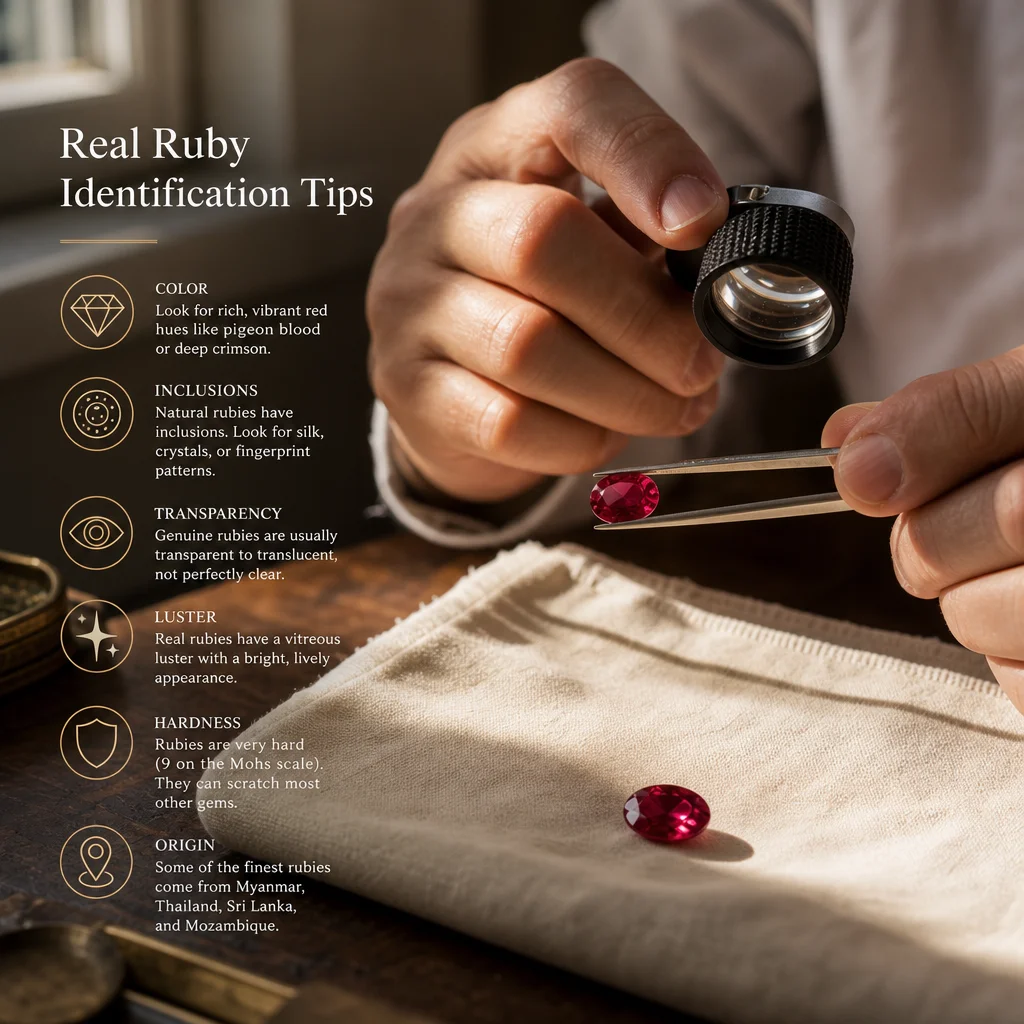
Why Ruby Verification Matters More Than You Think
Ruby is one of the most counterfeited gemstones in the world, and the fakes are getting better every year. Unlike cheaper stones where the financial incentive to counterfeit is low, ruby commands prices that make imitation profitable — especially at the commercial jewelry level where most people buy. A natural ruby of decent quality can cost hundreds or thousands of dollars per carat, while a convincing synthetic or simulant might cost a fraction of that. The gap is large enough that unscrupulous sellers have every reason to cut corners.
What complicates things further is the ruby industry's own practices. Heat treatment — the process of using high temperatures to improve a ruby's color and clarity — is so common in the trade that most rubies sold commercially have been treated. This isn't deception; it's standard industry practice. But it means that "natural" and "untreated" are not the same thing, and understanding the difference helps you evaluate what you're actually paying for.
The Foundation: Understanding What Ruby Actually Is
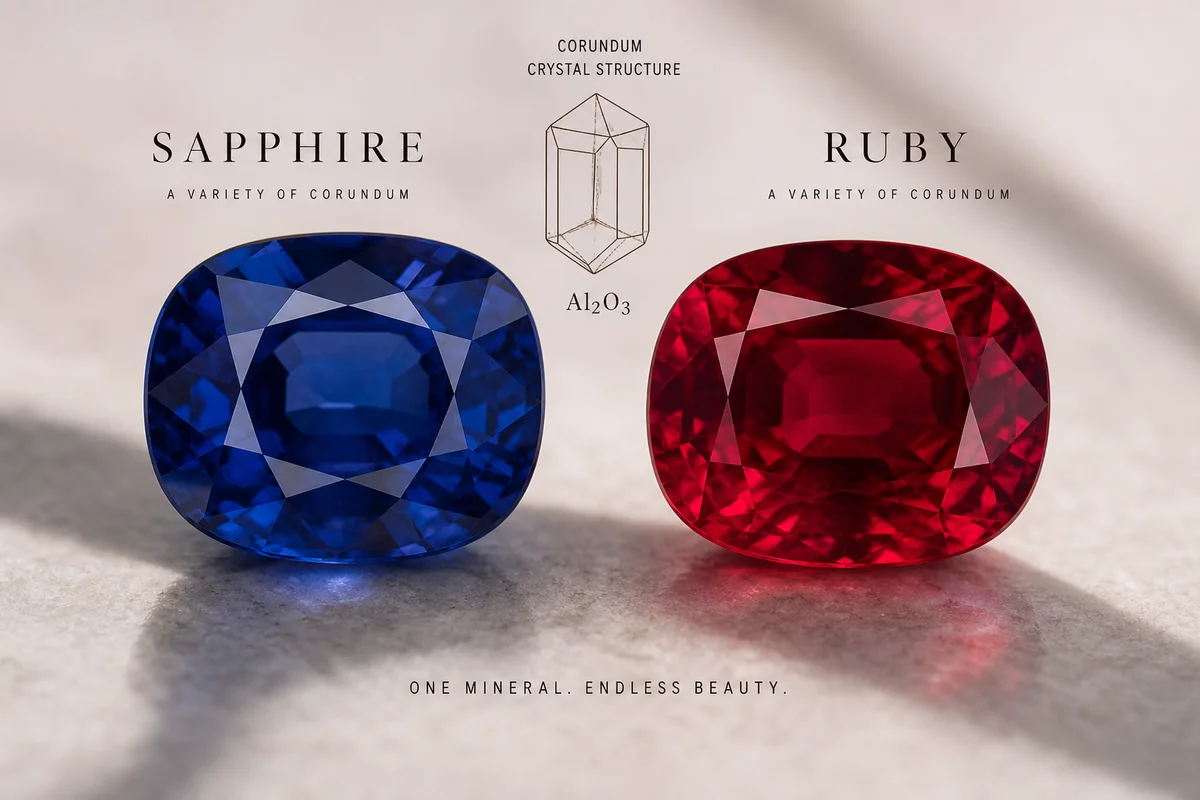
Ruby is the red variety of the mineral corundum (aluminum oxide, Al₂O₃). Corundum is one of the hardest natural materials on Earth, scoring 9 on the Mohs scale — second only to diamond. Every other color of corundum is called sapphire (blue, yellow, pink, green, etc.), but the name "ruby" is reserved specifically for the red variety. The red color comes from trace amounts of chromium substituting for aluminum atoms in the crystal lattice. Even tiny amounts of chromium produce vivid red, which is why corundum rarely needs to be pure to qualify as ruby.
This mineralogical foundation gives ruby several distinctive properties that are extremely difficult to fake simultaneously. A material that mimics ruby's color won't necessarily match its hardness, its refractive index, its specific gravity, or its fluorescence. Testing multiple properties at once is the key to reliable identification — no single test is definitive on its own.
Test 1: The Scratch Test (Mohs Hardness)
Ruby rates a 9 on the Mohs scale, which means it can scratch almost anything except diamond and another ruby or sapphire. This is one of the most practical field tests available, though it's also the one most likely to damage your stone if done carelessly.
Here's how to do it responsibly: find a piece of unglazed porcelain or a rough glass surface that you don't mind scratching. Hold your ruby firmly and draw a small line on the glass with a sharp point or edge of the stone. Then reverse the test — try to scratch the ruby with the glass. Genuine ruby will scratch the glass easily, and the glass will leave no mark on the ruby whatsoever.
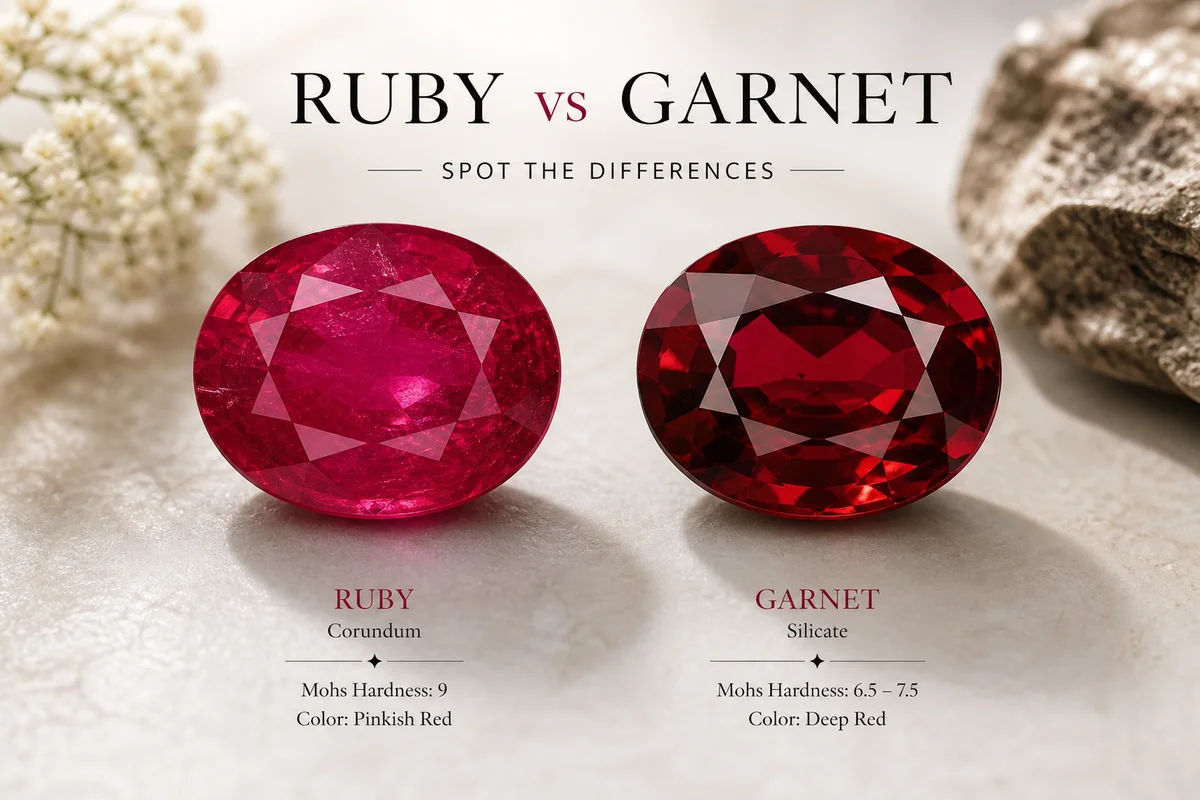
Caveat: This test only works with unset stones or stones where you can access a non-visible area. Do not try this on mounted jewelry where you might damage the setting. Also, spinel (Mohs 8) and some garnets (Mohs 7-7.5) can also scratch glass, so a positive result doesn't guarantee ruby — it just eliminates softer materials like glass, plastic, and quartz-based imitations.
Test 2: The Fluorescence Test (UV Light)
Many natural rubies fluoresce vivid red under long-wave ultraviolet (UV-A) light, which is the same wavelength used in most UV flashlights. This is one of the most distinctive identifying features of ruby and one of the hardest to fake convincingly.
Hold your stone under a UV flashlight (365nm wavelength is ideal) in a dark room. Genuine ruby from major sources like Myanmar (Burma), Thailand, and Madagascar will typically glow with a strong to moderate red fluorescence. The intensity varies — Burmese rubies tend to fluoresce more strongly than Thai stones, and some African rubies show weak or no fluorescence at all. But a strong, unmistakable red glow under UV light is a very good sign.
Most common ruby substitutes do not fluoresce red. Red glass, red spinel, and red garnet typically show no fluorescence or a different color response. Synthetic ruby (grown in a lab) does fluoresce, often more strongly and uniformly than natural ruby, which is one way experienced gemologists can distinguish lab-grown from natural material.
If you don't have a UV flashlight, you can try a less reliable version of this test: take your ruby into direct sunlight, then immediately move it into shadow. Some highly fluorescent rubies will appear to glow briefly as the red fluorescence interacts with the transition from UV-rich sunlight to UV-poor shadow. This is subtle and not always visible, but when it works, it's a strong indicator.
Test 3: The Doubling Test (Refractive Index)
Ruby has a refractive index of about 1.762-1.770, which is very high compared to most gemstones. One practical consequence of this high refractive index is that ruby has excellent "brilliance" — light bounces around inside the stone in a way that makes well-cut rubies flash with internal fire.
But there's a more specific test you can do with a jeweler's loupe (10x magnification is standard). Focus on the facet junctions inside the stone — the lines where two facets meet at the back of the stone. If you see a single, clean line, that's consistent with ruby (which has a relatively simple refractive index). If you see a "doubling" effect — where the line appears to split into two parallel lines — you're likely looking at a stone with a higher birefringence, which rules out ruby.
Red spinel is a common ruby substitute that shows no doubling, which is why it's been historically mistaken for ruby (including the famous Black Prince's Ruby in the British Crown Jewels, which is actually spinel). Spinel also fluoresces red under UV, making it one of the trickiest ruby lookalikes to identify without lab equipment.
Test 4: The Inclusion Test (Internal Imperfections)
Under 10x magnification, nearly all natural rubies show some type of internal imperfection — tiny needle-like crystals, fluid-filled cavities, growth zoning, or silk-like rutile inclusions. These inclusions are actually your friend when it comes to identification. A perfectly clean stone with no visible inclusions at 10x magnification is suspicious — it might be synthetic (lab-grown rubies are typically much cleaner than natural ones) or it might be glass.
Look specifically for "silk" — fine, needle-like inclusions of the mineral rutile (titanium dioxide) that run in specific directions through the crystal. These create a slightly hazy or silky appearance in some rubies and are among the most reliable indicators of natural origin. Heat treatment often dissolves or partially alters silk inclusions, but rarely eliminates them completely.
Synthetic rubies grown by the flame fusion method (also called Verneuil process) show characteristic curved growth lines and gas bubbles — perfectly round, tiny bubbles that never occur in nature. These are telltale signs of a lab-grown stone. More modern synthetic methods (Czochralski and flux growth) produce cleaner stones that are harder to distinguish, but the presence of certain types of flux inclusions or distinctive growth patterns can still give them away under magnification.
Test 5: The Color Test (Under Different Lighting)
Ruby has a property called pleochroism, meaning it shows different colors when viewed from different crystallographic directions. In most rubies, this manifests as a shift between purplish-red and orangey-red depending on the viewing angle. The effect is subtle but detectable if you know to look for it.
Rotate your stone slowly under good lighting and watch for color shifts. A red glass imitation won't show any directional color change — it'll look the same red from every angle. Red garnet does show slight pleochroism but typically between reddish-brown tones rather than the purple-to-orange range of ruby.
Also observe your ruby under different light sources. Natural ruby generally looks best under incandescent light (warm yellowish light like candlelight or traditional bulbs) and may appear darker or more purple under fluorescent lighting. This is a normal property of ruby's absorption spectrum and shouldn't be confused with color instability.
Test 6: The Density Test (Specific Gravity)
Ruby has a specific gravity of approximately 4.00, which is noticeably heavy for its size. Pick up your stone and heft it in your hand — a genuine ruby of a given size will feel heavier than most lookalikes of the same dimensions.
For a more precise test, you can use a simple water displacement method. Weigh the stone in air, then weigh it suspended in water (using a fine thread or wire). The formula for specific gravity is: weight in air divided by (weight in air minus weight in water). A result between 3.95 and 4.05 confirms corundum. Spinel comes in at 3.58-3.61, garnet varies by species (3.47-4.33), and glass is much lighter at around 2.5.
This test requires a jeweler's scale accurate to at least 0.01 carats, but it's one of the most reliable non-destructive field tests available.
Test 7: The Heat Conductivity Test
Ruby conducts heat differently from glass and many synthetic materials. Touch the stone to your lower lip (the most temperature-sensitive part of your body) or to your inner wrist. A genuine ruby will feel distinctly cool, even after sitting in a warm room. Glass and plastic imitations warm up much faster.
This is a quick, low-tech test that catches the cheapest fakes but won't distinguish ruby from spinel, garnet, or other hard natural stones. Think of it as a first-line screening rather than a definitive test. If the stone feels warm, it's almost certainly not ruby. If it feels cool, further testing is still needed.
Heat-Treated vs. Untreated: What You Need to Know
The majority of rubies on the market have been heat-treated to improve their appearance. This process involves heating the rough stone to temperatures of 1,300-1,800°C in a controlled atmosphere. Heat treatment can dissolve rutile silk (improving clarity), intensify color, and remove blue or purple undertones.
Heat treatment is generally accepted in the gem trade and doesn't significantly affect the stone's value, as long as it's disclosed. What does affect value is treatment with foreign substances — lead glass filling, for instance, where fractures in low-quality ruby are filled with a high-lead glass to improve apparent clarity. Lead glass-filled rubies should be priced significantly lower and clearly identified, because the filling material can be damaged by normal jewelry repair processes involving heat.
Beryllium diffusion treatment, where beryllium is diffused into the surface of a ruby to create a thin layer of improved color, is another treatment that requires disclosure. Diffusion-treated rubies may have surface-reaching color that could be worn away over time.
When These Tests Aren't Enough
The tests described here will identify most fakes and low-quality imitations. But modern synthetic rubies (especially those grown by flux or hydrothermal methods) can be extremely difficult to distinguish from natural stones without professional laboratory equipment. If you're dealing with a high-value stone — anything over a few hundred dollars — getting a certification from a reputable gemological laboratory (GIA, AGL, or Gubelin) is worth the investment.
Laboratory identification typically involves spectroscopic analysis, advanced microscopy, and trace element chemistry that goes far beyond what's possible with at-home tests. A good lab certificate doesn't just tell you whether the stone is natural; it tells you the geographic origin, any treatments applied, and provides a detailed description of the stone's characteristics.
Frequently Asked Questions
Does a real ruby always glow under UV light?
No. While many natural rubies do fluoresce red under long-wave UV, some — particularly those from certain African sources — show weak or no fluorescence. Iron content in the stone can suppress fluorescence. So a stone that doesn't fluoresce isn't automatically fake, but a stone that fluoresces strongly red is a very good sign.
Is heat-treated ruby considered "real"?
Yes. Heat treatment is an accepted industry practice and does not make a ruby synthetic or fake. The stone is still natural corundum with chromium — the heat just improves what nature created. The important distinction is between "heated" and "untreated," not between "heated" and "real."
How can I tell a ruby from a red spinel?
Without lab equipment, it's very difficult. Both are hard, both can fluoresce red, and visually they can be nearly identical. The most reliable field indicator is specific gravity — spinel (3.58-3.61) is noticeably lighter than ruby (4.00) for the same size. Historically, even expert gemologists confused the two, so don't feel bad if you can't tell them apart.
What should I do if I think my ruby is fake?
Take it to a certified gemologist or send it to a gemological laboratory for testing. If the stone was sold with a certification claiming it was natural and it turns out to be synthetic or fake, you may have grounds for a refund under consumer protection laws. Keep all purchase documentation.
Frequently Asked Questions
Can a real ruby scratch glass?
Yes, a genuine ruby can easily scratch glass because it ranks 9 on the Mohs hardness scale. At SagStone, we love handcrafting jewelry with such incredibly durable natural crystals. However, since other hard stones can also scratch glass, this test alone isn't foolproof. We recommend pairing this scratch test with an inclusion check to truly verify the authenticity of your artisan piece.
Comments