Ruby: The King of Gemstones — A Complete Guide to History, Value, and Buying
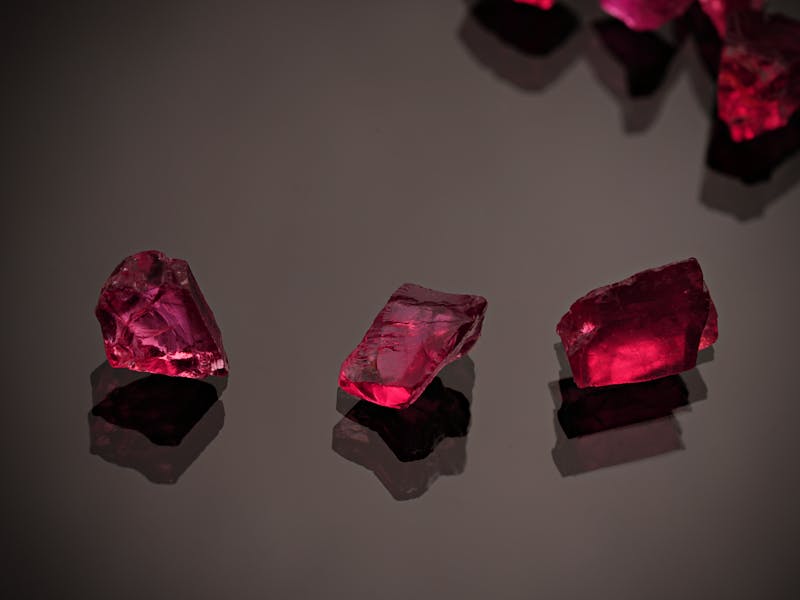
Rubies have inspired wars, launched empires, and adorned the crowns of kings for thousands of years. In the ancient Sanskrit language, ruby was called ratnaraj — the king of gems. And for most of human history, it was considered the most valuable stone on Earth, worth more than any diamond.
Today, fine rubies still command some of the highest prices in the gemstone world. A top-quality Burmese ruby can sell for over $1 million per carat at auction. But you don't need a royal budget to appreciate this extraordinary stone. Whether you're considering a ruby for a piece of jewelry or just want to understand why this gem has captivated humanity for millennia, this guide covers everything you need to know.
What Is a Ruby?
Ruby is the red variety of the mineral corundum. Corundum is aluminum oxide (Al2O3), and in its pure form it's actually colorless. The red color in rubies comes from trace amounts of chromium replacing some aluminum atoms in the crystal structure. The more chromium, the deeper the red.
Here's something most people don't realize: ruby and sapphire are the same mineral. Any corundum that's red is a ruby. Any other color — blue, yellow, pink, green, orange — is a sapphire. This makes ruby essentially the red sapphire, though the distinction matters enormously in the market.
Ruby ranks 9 on the Mohs hardness scale, making it one of the hardest natural substances. Only diamond and moissanite are harder. This exceptional hardness is why rubies have been used in jewelry for thousands of years — they resist scratching and maintain their polish virtually forever.
A Brief History of Ruby
The history of ruby stretches back at least 2,500 years. Ancient civilizations across Asia prized rubies above all other gems.
In ancient Burma (now Myanmar), rubies were believed to make warriors invincible in battle. Warriors would insert rubies under their skin before going to war. The Burmese also believed that rubies ripened like fruit — the redder the stone, the more ripe and powerful it was.
In ancient India, rubies were considered the most precious offering one could make to Krishna. Hindu texts described rubies as the "most precious of all stones" and believed they could bring peace, prosperity, and protection from evil.
In medieval Europe, rubies were associated with passion, courage, and vitality. Crusaders wore rubies for protection in battle. Medieval physicians ground rubies into powder and prescribed them for liver problems and to restore youth.
The most famous rubies in history include the Liberty Bell Ruby, which at 8,500 carats was the largest mined ruby in the world before it was stolen in 2011. The Sunrise Ruby, a 25.59-carat Burmese ruby, sold at Sotheby's in 2015 for $30.42 million — roughly $1.19 million per carat, a record for any colored gemstone. And the Black Prince's Ruby in the British Imperial State Crown, which is actually a spinel, not a ruby at all — a centuries-old case of mistaken identity.
Where Rubies Come From
The world's finest rubies have traditionally come from Myanmar (Burma), specifically the Mogok Valley, known as the "Valley of Rubies." Burmese rubies are famous for their "pigeon blood" color — a pure, vivid red with just a hint of blue that's considered the ideal ruby color. However, Myanmar's ruby production has declined significantly, and the country's political situation has made mining and export difficult.
Today, the most important ruby sources include Myanmar (still producing the finest quality but in smaller quantities), Mozambique (now the world's largest producer by volume, with some exceptional stones from the Montepuez mine), Thailand (historically important, known for darker, iron-rich rubies), Vietnam (produces fine rubies from the Luc Yen district), Madagascar (increasingly important source), Sri Lanka (produces lighter, pinkish rubies), and Tanzania (Winza and Longido mines produce some quality material).
Evaluating Ruby Quality: The 4Cs
Color is by far the most important factor in ruby value. The finest rubies display a pure, vibrant red to slightly purplish red. In the trade, the ideal is called "pigeon blood" — a vivid red with a subtle blue undertone. Brownish or orangey undertones reduce value. Rubies that are too dark (almost blackish red) or too light (pinkish red) are significantly less valuable.
Clarity in rubies is evaluated differently than in diamonds. Completely clean rubies are exceptionally rare and valuable. Most rubies contain inclusions — tiny crystals, needle-like rutile needles (called "silk"), or growth features. These inclusions are actually useful: they prove the ruby is natural, not synthetic. The key is that inclusions should not affect durability or overly detract from beauty. Rubies with too many visible inclusions or those that threaten structural integrity are worth less.
The famous "silk" inclusions in some rubies create a soft, velvety appearance that's actually prized. In rare cases, rutile needles are oriented in just the right way to create a six-rayed star effect called asterism — these star rubies are among the most collectible gemstones.
Cut quality affects both beauty and value. Rubies are often cut as oval or cushion shapes, which preserve the most weight from the rough crystal. Round cuts are rarer because they waste more rough material. A well-cut ruby should display even color across the stone, with good brilliance and minimal windowing (areas where you can see straight through the stone). Unlike diamonds, rubies are not typically cut to idealized mathematical proportions — the cutter's priority is maximizing color and retaining weight.
Carat weight has an exponential effect on ruby price. Fine rubies over 3 carats are rare. Over 5 carats, they're genuinely scarce. Over 10 carats, they're museum-quality. A 1-carat fine Burmese ruby might sell for $15,000-$25,000 per carat, while a comparable 5-carat stone could be $50,000-$100,000 per carat. This price jump is because large, clean, well-colored rubies are exponentially rarer.
Treatments: What You Need to Know
The vast majority of rubies on the market have been treated in some way. Understanding treatments is essential for any ruby buyer.
Heat treatment is the most common and widely accepted treatment. About 90-95% of rubies are heated to improve their color and dissolve some inclusions. Heat treatment is permanent and stable — it doesn't degrade over time. The gemological community considers heated rubies to be "natural" because heat simply accelerates what would happen naturally deep in the Earth over millions of years.
Unheated rubies are rare and command significant premiums — sometimes 50-100% more than comparable heated stones. An unheated Burmese ruby with a laboratory certificate is one of the most valuable objects per gram on Earth.
Glass filling (also called fracture filling) is a more controversial treatment. Rubies with surface-reaching fractures are filled with a lead glass to improve their apparent clarity. This treatment is not permanent — the glass can be damaged by heat, chemicals, or even household cleaning. Glass-filled rubies should cost significantly less than untreated or heated rubies. They must be disclosed as treated, and reputable sellers will clearly identify them.
Beryllium diffusion is a treatment where beryllium is diffused into the ruby at high temperature to improve or change its color. This is permanent but only affects the surface layer. If the stone is chipped or recut, the untreated core may be exposed. This treatment must be disclosed.
Flux healing involves using borax-based flux at high temperature to dissolve and heal fractures. It's generally accepted as a minor treatment, similar to heat treatment.
Synthetic Rubies
Synthetic rubies have been produced since the late 1800s and are chemically, physically, and optically identical to natural rubies. They're real rubies — they just grew in a lab instead of the Earth.
The main methods for creating synthetic rubies include the Verneuil flame fusion process (the oldest method, produces curved growth lines visible under magnification), the Czochralski pulling method (produces higher quality crystals), the flux growth method (produces the finest synthetics, but is slow and expensive), and the hydrothermal method (mimics natural growth conditions most closely).
Synthetic rubies are perfectly legitimate for fashion jewelry and cost a fraction of natural stones. A beautiful synthetic ruby might cost $20-$100 per carat versus $1,000-$10,000+ for natural. The problem is when synthetics are sold as natural — this is fraud, and it happens more often than you'd think.
How to Spot Fake or Misrepresented Rubies
Buyer beware is especially important with rubies. Here are the red flags:
Glass imitations are the most common fake. Red glass can look convincingly ruby-like to the untrained eye, but it lacks hardness (glass scratches easily), feels lighter, and shows no birefringence under magnification. If a "ruby" is perfectly clean, perfectly cut, and suspiciously cheap, it's probably glass.
Dyed quartz or dyed other stones are sometimes sold as ruby. The color distribution is usually uneven — you can see color concentrated in cracks and surface areas. Genuine ruby's color is distributed evenly throughout the crystal structure.
Composite stones (also called "rubies in quartz") consist of a thin slice of genuine ruby sandwiched between glass or quartz. They look like large, clean rubies but are essentially mostly glass. These should be clearly disclosed and priced accordingly.
Doublets are similar — a thin ruby top fused to a colored glass or synthetic base. The giveaway is usually visible at the girdle (the edge of the stone) where you can see the join line.
The single most important protection: always buy from reputable dealers and insist on a laboratory certificate from a recognized lab (GIA, AGL, Gübelin, or SSEF for high-value stones, GRS or Lotus for mid-range). A lab certificate is your proof of identity, treatment status, and origin.
Ruby in Jewelry
Ruby is the birthstone for July and the traditional gift for the 15th and 40th wedding anniversaries. Its hardness (9 Mohs) makes it suitable for all types of jewelry, including daily-wear pieces like engagement rings.
For engagement rings, ruby is an increasingly popular alternative to diamond. A ruby engagement ring is bold, colorful, and meaningful. Look for stones at least 1 carat with good color and minimal treatment. Setting in platinum or white gold provides excellent protection and creates a beautiful contrast with the red stone.
Ruby pairs well with diamonds — the classic combination of red and white has been popular for centuries. Ruby and diamond three-stone rings, halo settings, and tennis bracelets are all timeless designs.
For everyday wear, consider heated rubies with minor inclusions. They're more affordable and more durable than inclusion-free stones (paradoxically, some very clean rubies can be slightly more brittle). Avoid glass-filled rubies for rings or bracelets that will see daily wear.
Caring for Ruby Jewelry
Despite being extremely hard (9 Mohs), rubies do need some care:
Clean with warm soapy water and a soft brush. Ultrasonic cleaners are generally safe for untreated or heat-treated rubies, but avoid them for fracture-filled or glass-filled stones. Never use steam cleaning on filled rubies.
Store separately from other jewelry. While ruby is hard, it can scratch softer stones (like pearls, opals, and turquoise) and can be scratched by diamonds.
Avoid harsh chemicals. Acids, bleach, and strong household cleaners can damage treated rubies, especially glass-filled ones. Remove ruby jewelry before swimming in chlorinated pools.
Protect from extreme heat. While rubies are heat-resistant, glass-filled rubies can be damaged by prolonged heat exposure. Don't leave them on a sunny windowsill or in a hot car.
Ruby vs Similar Red Stones
Several red gemstones are commonly confused with ruby:
Ruby vs garnet: Garnet is softer (6.5-7.5 Mohs), typically darker and more brownish red, and much less expensive. Garnets also have different crystal structure and optical properties.
Ruby vs red spinel: Spinel is the classic ruby impostor — the Black Prince's Ruby in the British Crown is actually spinel. Spinel is slightly softer (8 Mohs) and has different refractive properties. Fine red spinels are increasingly valued in their own right and are actually rarer than rubies in comparable quality.
Ruby vs red tourmaline: Tourmaline is softer (7-7.5 Mohs) and has different pleochroic properties — you can see color change when viewing from different angles. Red tourmaline (rubellite) is a beautiful stone in its own right.
Ruby vs rhodolite garnet: Rhodolite is a purple-red garnet with a distinctive raspberry tone. It's softer and less valuable but can be equally beautiful.
Investment Potential
nFine rubies, especially unheated Burmese stones, have been one of the best-performing gemstone investments over the past decade. Auction prices have risen dramatically as supplies from traditional sources decline and demand from Asian collectors increases.
However, ruby investment requires significant knowledge and capital. The gap between investment-grade stones ($10,000+ per carat) and commercial-grade stones ($100-$1,000 per carat) is enormous. If you're considering ruby as an investment, focus on unheated stones with laboratory certificates from top-tier labs, ideally with Burmese or Mozambique origin and exceptional color.
For most people, the best approach is to buy rubies you genuinely love at fair prices. If they appreciate in value, that's a bonus. If not, you still own something beautiful that can be passed down through generations.
Final Thoughts
Ruby is more than just a pretty red stone. It's a piece of Earth's geological history, colored by chromium atoms that were forged in the hearts of ancient volcanoes. It's a stone that has commanded the respect of emperors, inspired legends across every culture, and continues to be one of the most sought-after gems in the world.
Whether you're drawn to ruby for its history, its symbolism of passion and courage, its investment potential, or simply its breathtaking color, understanding what makes a ruby valuable will help you make smarter buying decisions and appreciate this king of gems more deeply.
Comments