The Emperor Tarot Card: Complete Meaning Guide
May 17, 2026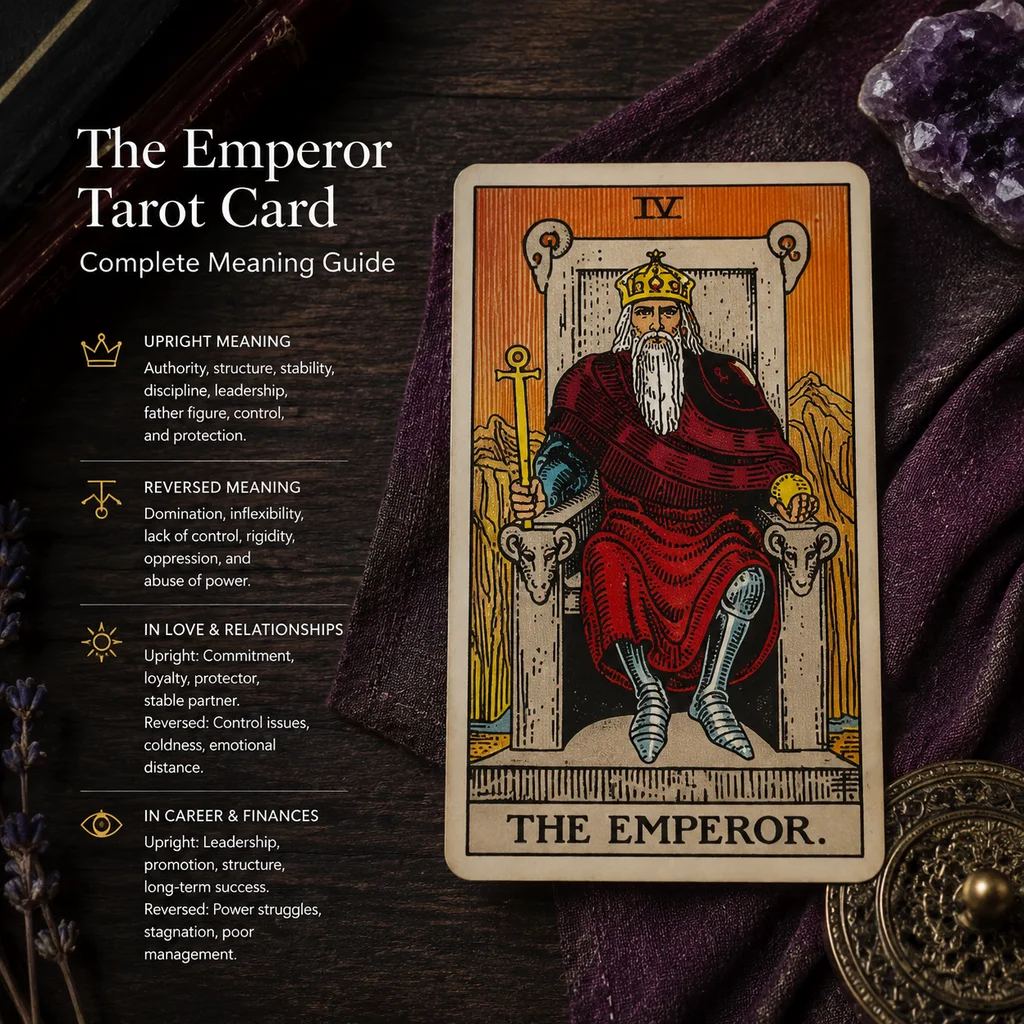
The Card My Father Would Have Drawn
My father never touched a tarot deck. He wouldn't have known what to do with one if you handed it to him. But if some cosmic dealer had laid out the Major Arcana and said "pick your card," I know exactly which one he'd gravitate toward. Not because he was mystical or spiritually inclined — he was a mechanic who fixed things with his hands and ran his household with quiet, unyielding certainty.
The Emperor would have been his card, and honestly, it took me years of reading tarot to understand why that matters.
When I first learned the Major Arcana, I treated the Emperor like a speed bump between the Empress — all warm and nurturing and easy to love — and the more "interesting" cards later in the sequence. The Hierophant, the Lovers, the Tower. The Emperor felt... stiff. A stern man on a throne, ram horns on his stone chair, armor under his robes. He looked like someone who'd tell you to sit up straight and stop asking so many questions.
I wasn't wrong about the imagery. But I was wrong about what it meant.
My father built things. Not in a metaphorical sense — literally built a workshop in our garage, built a fence that survived three hurricanes, built a morning routine so precise you could set your watch by when he started the coffee maker. He didn't talk about "structure" or "systems" or "authority." He just lived them. And when he died, I pulled the Emperor from my deck the next morning without even thinking about it. That's when I started paying attention.
This guide is my attempt to give the Emperor the depth it deserves. Not as a card you memorize for readings, but as an archetype that shows up in your life whether you carry a deck or not. If you're new to tarot, I'd recommend starting with our beginner's guide to reading tarot cards before diving deep into individual card meanings. But if you're here for the Emperor specifically — you're in the right place.
Visual Symbolism: What's Actually on This Card
Let's talk about what you're looking at, because the Rider-Waite-Smith Emperor is packed with details that most people gloss over.
First: the throne. Unlike the High Priestess, who sits between two pillars in balanced repose, the Emperor's throne is angular, solid, almost severe. It's not designed for comfort — it's designed to last. The ram heads carved into the armrests connect him to Aries, the first sign of the zodiac, and to the idea of initiation, raw life force, the courage to begin something. Rams don't ask permission to charge.
Then there's the armor underneath his robes. This is the detail that changed how I read this card. The Emperor isn't a king lounging in silk — he's dressed for battle under the ceremony. He's prepared. He's been in fights. The orange-red sky behind him isn't a sunset; it's the color of Aries, of Mars, of controlled fire. It's dawn energy, not twilight.
He holds an ankh in his right hand — the Egyptian symbol of life — and his legs form the number four, which is the Emperor's numerological association. Four is stability, foundation, the four walls of a house, the four directions. Everything about this card screams "built to endure."
Notice also that he's facing forward, directly at the reader. The Fool looks up and to the right, lost in possibility. The Magician gestures downward, channeling energy. But the Emperor looks at you. He's not performing. He's evaluating. And depending on where you are in your life, that gaze either makes you feel safe or makes you want to look away.
The mountains behind him are barren and sharp. No lush gardens, no flowing water — just stone and sky. This isn't a landscape that welcomes you with open arms. It's a landscape that demands you come prepared. And that distinction tells you everything about what the Emperor represents: not hostility, but high standards. Not coldness, but the understanding that real security requires real work.
Upright Meaning: More Than Just "Dad Energy"
Every tarot book will tell you the upright Emperor represents authority, structure, and father figures. And sure, that's accurate. But it's also incomplete in a way that does the card a disservice.
The upright Emperor is about building something that outlasts you. It's the energy of the person who doesn't just have a vision — they have a blueprint, a timeline, and the discipline to execute. My father didn't set out to be "authoritative." He set out to make sure his family had a working house, a running car, and enough predictability that we could focus on being kids instead of worrying about whether the lights would stay on.
In a reading, the upright Emperor often shows up when you need to stop brainstorming and start executing. When you've been in the Empress's world of creativity and nurturing for too long and need someone to say "okay, beautiful, now let's put a deadline on it." It's the card of budgets, schedules, boundaries, and the uncomfortable truth that freedom without structure is just chaos wearing a nice outfit.
This card also represents legitimate authority — the kind earned through competence, not claimed through force. There's a difference. The Emperor's power comes from what he's built and maintained, not from what he's taken. When this card appears, ask yourself: am I building something, or am I just controlling things?
Keywords people use: leadership, stability, discipline, protection, structure, systems thinking. All valid. But I'd add one they usually miss: reliability. The Emperor shows up. Every time. On time. Whether he feels like it or not. That's not glamorous, but it's the foundation everything else is built on.
Reversed Meaning: When Structure Becomes a Cage
The reversed Emperor is uncomfortable, and I think it's supposed to be.
When this card shows up inverted, we're usually looking at one of two scenarios. Either someone is abusing authority — micromanaging, controlling, refusing to delegate, treating every interaction like a power struggle — or they've internalized toxic discipline to the point where they can't relax, can't be vulnerable, can't admit when they're wrong.
I've pulled the reversed Emperor for myself during periods when I was running my life like a project management spreadsheet. Color-coded calendars, optimized routines, zero tolerance for "unproductive" time. Sounds efficient. Felt like drowning. The reversed Emperor often appears when you've confused control with competence.
It can also represent the absence of healthy structure. If you grew up without reliable authority figures — or worse, with authoritarian ones who used "discipline" as a cover for cruelty — the reversed Emperor might be showing up to say: you never learned what good structure looks like, and now you're either rejecting all of it or recreating the toxic version.
In readings about other people, the reversed Emperor is a red flag. Someone who demands loyalty but doesn't earn it. Someone who equates questioning with betrayal. Someone whose "protection" feels more like imprisonment. If you're seeing this card reversed alongside cards like the Three of Swords or the Tower, pay attention — it's not warning you about bad luck, it's warning you about a bad dynamic.
For more on reading reversed cards and what they can signal, check out our guide to reversed tarot cards for beginners.
Love Readings: Commitment, Boundaries, and the Control Trap
The Emperor in love readings is one of those cards where context is everything.
In its best expression, this card shows up when a relationship is ready for the next level of commitment. Not the sparkly, heart-eyed kind — the practical, "let's build a life together" kind. Moving in, getting married, combining finances, having kids. The Emperor energy in love says: I'm not just here for the good times. I'm here for the mortgage payments and the 3 AM hospital runs and the boring Tuesday evenings. And there's something deeply romantic about that, even if it doesn't photograph well.
But — and this is a big but — the Emperor can also signal that one partner is falling into a controlling role. Not necessarily maliciously. Sometimes it's the person who "just wants to help" by managing everything, making all the decisions, solving problems their partner never asked them to solve. It feels like care. It functions like control.
If you pull the Emperor in a relationship reading, ask yourself: does my partner respect my autonomy, or do they manage my life for me? Do we make decisions together, or does one of us always "know best"? Healthy Emperor energy in a relationship looks like shared structure — agreements, boundaries, mutual accountability. Unhealthy Emperor energy looks like one person carrying all the authority and the other person carrying all the resentment.
For single people, the Emperor often suggests that what you need right now isn't a partner — it's a standard. Not a rigid checklist of must-haves, but a clear sense of what you will and won't tolerate. The Emperor builds walls not to keep people out, but to define what's inside. Know what you're protecting.
Career Readings: Leadership and Toxic Boss Recognition
Career is where the Emperor shines and where it gets dangerous, often in the same reading.
The upright Emperor in a career context is excellent news if you're stepping into a leadership role, starting a business, or trying to bring order to a chaotic workplace. This card says: you have what it takes to build systems, manage people fairly, and create something sustainable. It's the energy of the founder who's still in the trenches, the manager who actually knows how to do their team's jobs, the leader whose authority comes from competence.
I've seen this card show up for people right before they get promoted, launch companies, or finally implement the organizational system they've been thinking about for months. It's a "green light with a responsibility attached" card. Not a lucky break — an earned one.
But the reversed Emperor in career readings? That's your "toxic boss" card. The person who takes credit for your work. The manager who thinks fear is a motivator. The company culture that confuses "professionalism" with "emotional suppression." If you're seeing this reversed, it might be time to update your resume.
There's also a subtler reading: sometimes the reversed Emperor in career shows up when you're the one who's become rigid. When you've been doing things one way for so long that you can't see alternatives. When "that's how we've always done it" is your default answer to every suggestion. The Emperor built his empire — but he didn't build it to be a museum. Structures need to evolve, or they collapse.
Daily Pull Meaning: What the Emperor Wants From You Today
When the Emperor shows up as your daily card, it's usually not subtle. Something that day will require you to show up with discipline, take charge of a situation, or hold a boundary you've been avoiding.
Maybe it's as simple as following through on something you promised yourself you'd do. Maybe it's having a conversation you've been putting off because it requires being direct. The Emperor doesn't do passive-aggressive. He doesn't do "maybe later." His energy is clear, present, and accountable.
On the flip side, this daily pull might be asking you to examine whether you're being too rigid today. Are you insisting on doing things your way when someone else's approach would work just as well? Are you treating a minor inconvenience like a crisis of authority? The Emperor at his best is flexible within his structure — the walls hold, but the doors open.
If you pulled this today, pick one thing you've been avoiding because it requires decisive action, and do it. That's the Emperor's homework for you. And don't overthink it — the Emperor trusts action more than deliberation once the path is clear.
Crystal Combinations for the Emperor
I'm not going to tell you that crystals magically activate your Emperor energy. But I will say that certain stones have been traditionally associated with grounding, protection, and personal power — all themes that align with this card. For a deeper dive, our crystal combinations for tarot guide covers pairings across all the Major Arcana.
Garnet is my top pick for the Emperor. It's a stone of commitment and endurance — not flashy, not trendy, just reliable. It's associated with the root chakra and with the kind of steady, low-burn energy that sustains long-term effort. If the Emperor had a pocket stone, garnet would be it.
Hematite brings grounding and mental clarity. The Emperor doesn't have the luxury of being scattered. Hematite helps cut through noise and focus on what's actually important.
Onyx is about inner strength and the kind of quiet confidence that doesn't need external validation. It's also traditionally used for protection, which fits the Emperor's armor symbolism.
Tiger's eye combines earth energy with solar energy — practical and ambitious at the same time. It's associated with decision-making and courage, both essential Emperor qualities.
Journal Prompts for Working With the Emperor
If you want to go deeper with this card, grab a journal. (And if you're new to tarot journaling, our beginner's guide to tarot journaling will get you started.) Here are five prompts designed specifically for the Emperor:
- Where in my life am I building something that will outlast me — and where am I just maintaining control for the sake of control?
- What did "authority" look like in my family growing up? Was it earned or demanded? How does that shape my relationship with structure now?
- If I treated my commitments the way the Emperor treats his throne — with seriousness, investment, and long-term thinking — what would change?
- Where am I refusing to ask for help because I've confused self-reliance with strength?
- What's one boundary I know I need to set but keep avoiding? What would happen if I set it today?
Frequently Asked Questions
Is the Emperor always a positive card?
No card in tarot is "always" anything. The upright Emperor generally signals structure, authority, and stability — which is great if you need those things and suffocating if you don't. Context matters. In a reading about creative exploration, the Emperor might be telling you to stop planning and start making. In a reading about financial instability, it's exactly the energy you need.
What's the difference between the Emperor and the Hierophant?
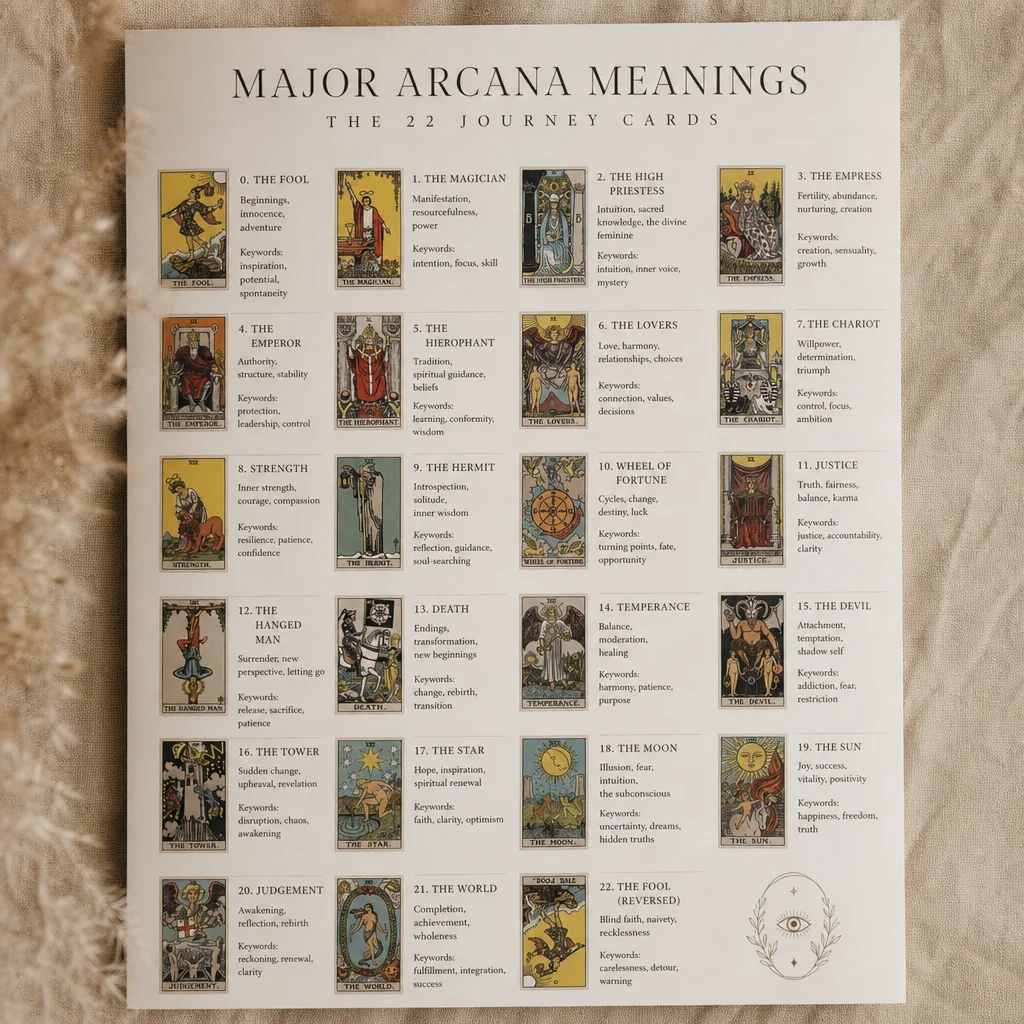
The Emperor represents secular authority — laws, systems, institutional power. The Hierophant represents spiritual authority — traditions, belief systems, moral frameworks. They're both about structure, but the Emperor builds the walls and the Hierophant decides what goes inside them.
Can the Emperor represent a woman?
Absolutely. The Emperor is an archetype, not a gender. Any woman who builds systems, holds boundaries, leads with competence, and creates stability is embodying Emperor energy. The card's imagery is historically male, but its meaning is universal.
What does the Emperor mean as a significator?
If the Emperor represents you in a reading, you're in a phase of building, protecting, and structuring. You might be the person others rely on for stability. That's powerful — but check whether you're also allowing yourself to be supported, not just supporting everyone else. The strongest foundations are the ones where the builder knows when to ask for help carrying the weight.
Related Guides
- Crystal Shapes Explained: Tumbled, Raw, Points, Spheres
- Garnet Varieties Guide
- Complete Crystal Guide: Identification and Meanings
- How to Tell if a Crystal Bracelet Is Real or Fake
- Crystal Energy Guide: Healing Properties
- How to Read Tarot Cards: Beginner Complete Guide
- The Complete Guide to Crystal and Jewelry Care
Frequently Asked Questions
What crystals work best with the Emperor tarot card?
Tiger's Eye, Garnet, and Black Onyx resonate strongly with the Emperor's structured, authoritative energy. Tiger's Eye builds confident leadership, Garnet grounds ambition into purposeful action, and Black Onyx reinforces healthy boundaries. Wearing handcrafted crystal jewelry featuring these stones during tarot pulls can help you channel the Emperor's discipline without falling into control-mode. Try pairing a Tiger's Eye bracelet with your daily Emperor draws.

Comments