Crystals for Focus and Concentration: What the Evidence Actually Shows
May 14, 2026
Crystals for Focus and Concentration: What the Evidence Actually Shows
Open any crystal blog and you'll find lists of stones that supposedly improve focus — fluorite for mental clarity, citrine for concentration, clear quartz for amplifying intention. These lists are everywhere. What you won't find is any explanation of why a particular mineral would affect your brain function, or any evidence that it does.
I'm not going to tell you that holding a piece of fluorite will make you smarter. But I am going to tell you that the relationship between crystals and focus is more interesting than either true believers or total skeptics make it out to be.
The Psychological Mechanism That Actually Works
There's a well-documented psychological phenomenon called an anchor — a physical object or sensation that your brain associates with a particular mental state. Athletes use this (a specific warm-up routine before competition). Musicians use this (sitting at the piano signals "practice time" to the brain). And yes, crystal users can use this too.
The mechanism is straightforward: if you consistently hold or look at a specific stone while doing focused work, your brain begins to associate that stone with the state of concentration. Over time, simply picking up the stone can trigger a mild shift toward focus — not because the crystal has magical properties, but because you've trained yourself to associate it with that mental state.
This is behavioral conditioning, not mineralogy. But it works regardless of whether you believe in crystal energy or not.
What Each Popular "Focus Stone" Actually Offers
Here's an honest look at the most commonly recommended crystals for focus, with what's real and what's not:
Fluorite
The most commonly recommended "focus stone." Fluorite (calcium fluoride, Mohs 4) has no known neurological effects. However, it does have a distinctive visual quality — it's often banded in purple, green, and blue, which makes it visually engaging to look at during long work sessions. Some people find that having something interesting but non-distracting to glance at helps them refocus.
Practical note: Fluorite is Mohs 4, which means it scratches easily. Don't carry it loose in your pocket with keys.
Clear Quartz
Called the "master healer" in crystal circles. In reality, clear quartz is silicon dioxide — chemically inert and the most abundant mineral in the Earth's crust. It's cheap, widely available, and visually clean. Some people like its clarity as a visual metaphor for mental clarity. That's a personal aesthetic preference, not a physical effect.
One genuine advantage: clear quartz is Mohs 7, so it's safe for water contact and can be used as a desk object without worrying about damage.
Hematite
Often recommended for "grounding" and focus. Hematite is iron oxide — it's heavy, metallic, and cool to the touch. The weight is the interesting part. Holding something heavy creates proprioceptive feedback (awareness of body position), which can help people with attention difficulties feel more physically present. This is the same principle behind weighted blankets.
Note: magnetic hematite (widely sold) is not natural hematite — it's a manufactured ceramic. Natural hematite is only weakly magnetic.
Black Tourmaline
Black tourmaline is recommended for protection and clearing "negative energy." What it actually offers is visual simplicity — it's black, opaque, and doesn't demand visual attention. For some people, having a visually quiet stone on their desk is less distracting than a colorful one.
Citrine
Associated with "success" and "abundance." Most commercial citrine is heat-treated amethyst (baked at 400-500°C to turn it yellow). Natural citrine is rare. The warm color can be pleasant on a desk, but there's no evidence it affects cognitive function.
The Environmental Factor Nobody Talks About
Here's something most crystal blogs miss entirely: the benefit of having crystals on your desk may have nothing to do with the crystals themselves. It's about what they replace.
If you put a small crystal display on your desk instead of your phone, you've removed a major source of distraction. If you reach for a stone instead of checking social media during a thinking break, the stone is serving as a behavioral redirect. The "focus benefit" comes from what you're not doing, not from the mineral itself.
How to Use This Information Practically
If you want to use crystals as focus aids, here's an approach grounded in actual psychology:
- Pick one stone and use it consistently. The anchor effect requires repetition. Don't rotate between ten different stones.
- Use it as a work trigger. Pick up the stone when you start a focused work session. Put it down when you're done. Let your brain build the association.
- Choose based on tactile preferences. Smooth and heavy (hematite) for grounding. Cool and clear (quartz) for a "clean slate" feeling. The texture matters more than the mineralogy.
- Keep it on your desk, not in your pocket. Visual proximity is part of the anchor. You need to see it for it to work as a trigger.
- Don't overspend. A $3 tumbled clear quartz works exactly as well as a $30 "high-vibration" specimen for this purpose.
What Won't Work
Sleeping with crystals under your pillow, wearing crystal bracelets during exams, or putting crystals in your drinking water will not improve your focus. The anchor mechanism requires active association, not passive proximity. And some crystals are genuinely dangerous in water — selenite dissolves, malachite leaches copper, and pyrite can produce sulfuric acid.
Beyond Crystals: Focus Strategies That Are Proven
If genuine cognitive improvement is your goal, the evidence-based toolkit looks different:
- Pomodoro Technique: 25 minutes of focused work, 5-minute break. Extensively studied and effective.
- Environmental design: Remove phone from workspace, use noise-canceling headphones, control lighting.
- Physical anchors: A crystal can serve this role, but so can a specific pen, a desk arrangement, or a breathing exercise.
- Sleep and hydration: Boring but true. These affect focus more than any external object.
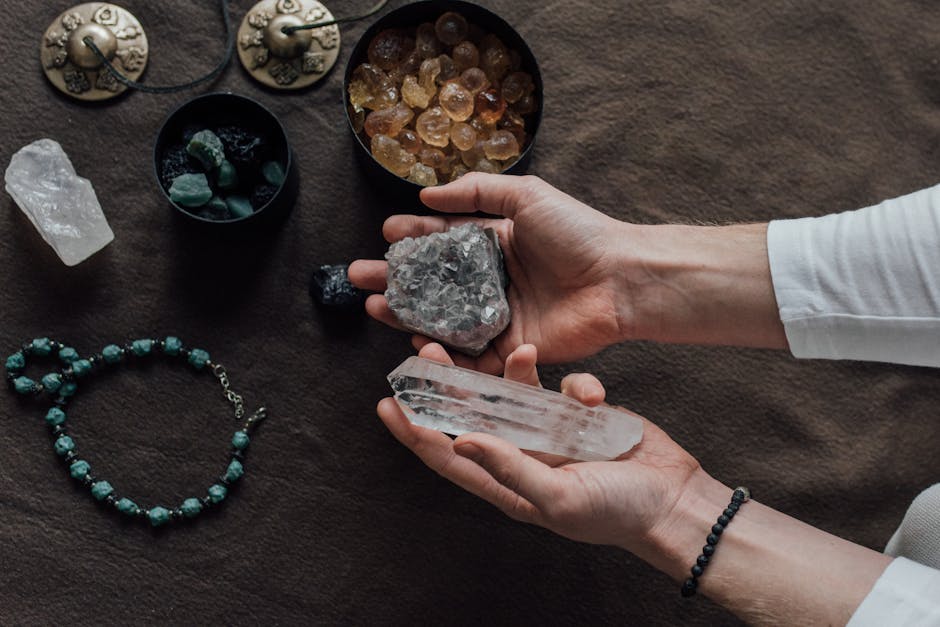
Crystal grids and arrangements can serve as a form of environmental design — creating a visual space that signals "work mode" to your brain. The key is consistency and intentionality, not the specific stones used.
The bottom line: crystals won't fix your attention problems. But as part of a broader focus strategy, they can serve as useful psychological anchors. The stone isn't doing the work — you are. The stone just reminds you to start.

Comments