How to Build a Crystal Toolkit for Beginners
June 3, 2026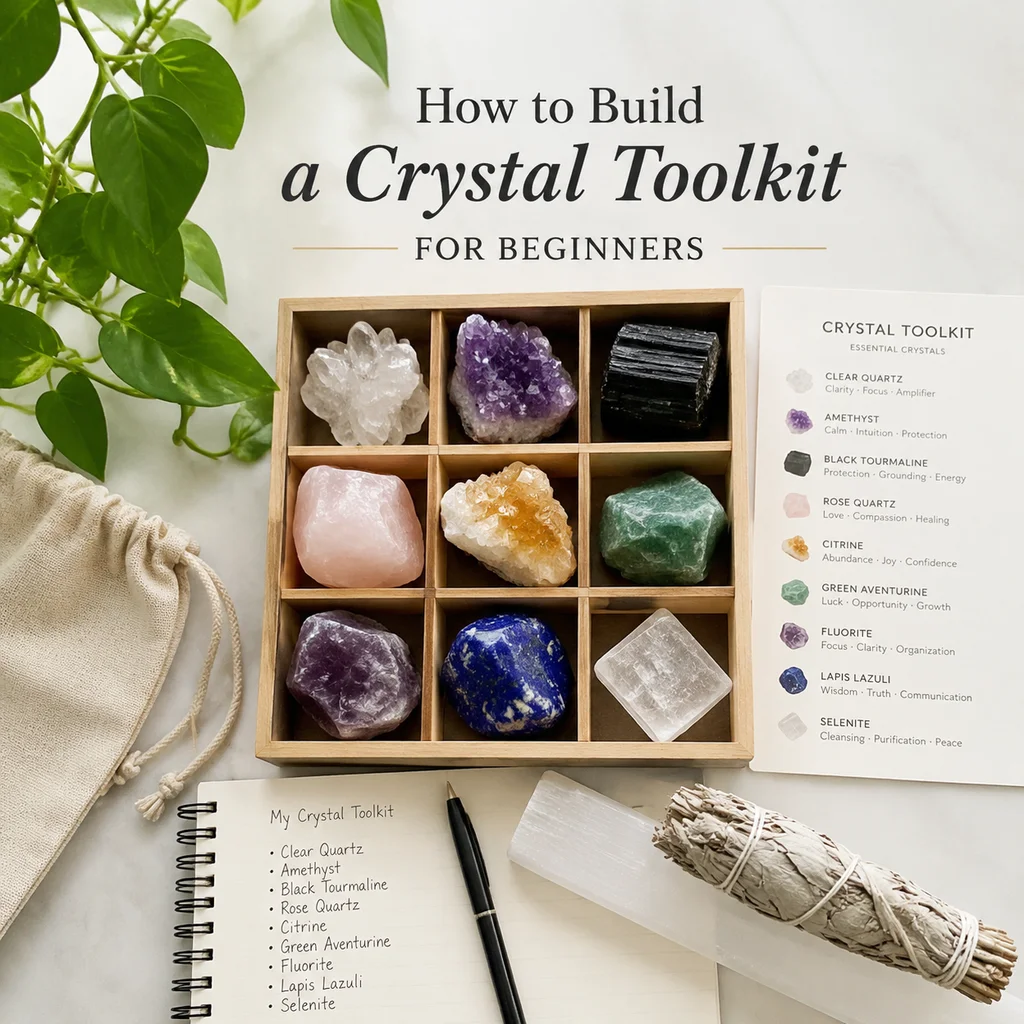
Why a Structured Approach Beats Random Buying
Walking into a crystal shop for the first time—or scrolling through an online store—can be overwhelming. There are hundreds of varieties, price ranges from $2 to $200 per stone, and conflicting advice everywhere about what you "must" have. The result is that most beginners either buy nothing (analysis paralysis) or buy a random assortment of pretty stones that collect dust because they do not have a clear sense of how to use them.
A better approach is to start with a curated toolkit: a small, purposeful collection of 8-10 versatile stones that cover the most common use cases. You can always expand later, but having a functional starting set means every stone in your collection serves a purpose from day one. This guide covers what those essential stones are, how to care for them, how to store them, and how to build your collection progressively without spending a fortune.
The 10 Essential Stones for Every Beginner
1. Clear Quartz (The Versatile Foundation)
Clear quartz (silicon dioxide, SiO₂) is the single most recommended starter crystal, and for practical reasons beyond metaphysical traditions. It is widely available, affordable ($3-8 for a tumbled stone), durable (Mohs 7, resistant to scratching), and visually clean—making it easy to see inclusions, rainbows, and formations that make studying mineralogy interesting. Clear quartz is also the standard stone used in most crystal grid layouts, meditation practices, and jewelry-making tutorials you will encounter online. Having a clear quartz point or cluster means you can follow along with virtually any tutorial without needing to buy additional specialized stones.
2. Amethyst (The Most Popular Crystal Worldwide)
Amethyst is the purple variety of quartz, colored by trace amounts of iron and gamma irradiation. It is the world's most popular crystal for good reason: it is affordable, widely available in every form (tumbled, raw, carved, jewelry), and its purple color makes it visually distinctive in a collection. Amethyst is one of the few crystals that works equally well in jewelry (hard enough for daily wear at Mohs 7) and as a decorative specimen. A good starting piece would be a small tumbled stone ($4-10) for carrying and a small cluster or geode ($15-30) for your desk or nightstand.
3. Rose Quartz (The Soft Pink Essential)
Rose quartz gets its distinctive pink color from microscopic inclusions of dumortierite, not from trace elements in the crystal lattice itself. This makes its color stable—it will not fade in sunlight the way some colored stones do. At Mohs 7, it is durable enough for daily wear in rings, bracelets, and pendants. Rose quartz tumbled stones are among the cheapest crystals available ($2-5 each), making it easy to accumulate several for different uses: one for your pocket, one for your desk, one for under your pillow.
4. Citrine (The Warm Yellow Companion)
Natural citrine is relatively rare—most commercial citrine is actually heat-treated amethyst or smoky quartz. For a beginner, this distinction is less critical than you might think. Heat-treated citrine has the same chemical composition (SiO₂) and hardness (Mohs 7) as natural citrine, and it costs a fraction of the price ($5-12 for a tumbled stone vs. $30-100+ for genuine natural citrine). Either way, citrine's warm yellow-to-amber color makes it a visually appealing addition to any collection, and its durability means it holds up well in jewelry.
5. Black Tourmaline (The Protective Dark Stone)
Black tourmaline (schorl) is the most commonly recommended dark-colored stone for beginners, and the reasoning is partly practical: it is one of the most durable stones you can own (Mohs 7-7.5), it is widely available ($5-15 for tumbled pieces), and its opaque black color provides visual contrast that balances lighter stones in a collection. Black tourmaline is also one of the few stones that can be worn daily in a bracelet without significant worry about damage from bumps, scratches, or exposure to water.
6. Selenite (The Fragile White Cleanser)
Selenite (gypsum, CaSO₄·2H₂O) is the one stone on this list that requires special handling. At only Mohs 2 on the hardness scale, it is so soft it can be scratched with a fingernail and will dissolve slowly in water. Why include it? Because selenite is the go-to stone for cleansing other crystals—a role it plays in almost every crystal care guide. A selenite wand or charging plate ($8-20) is one of the most useful tools a beginner can own, even if you treat it carefully.
7. Hematite (The Heavy Grounding Stone)
Hematite (iron oxide, Fe₂O₃) is noticeably heavier than most stones of similar size, which makes it immediately distinguishable by feel. This weight comes from its high iron content—hematite is literally iron ore. At Mohs 5.5-6.5, it is moderately durable but can be scratched by harder stones and should not be stored in direct contact with them. Hematite's metallic silver-gray luster adds visual variety to a collection that might otherwise lean heavily toward translucent and crystalline stones. Tumbled hematite is inexpensive ($3-8).
8. Carnelian (The Warm Orange Stone)
Carnelian, the red-orange to brown-orange variety of chalcedony, rounds out the color spectrum of your starter kit. While most of the stones above are purple, pink, yellow, black, white, or gray, carnelian provides a warm orange that creates visual balance. At Mohs 6.5-7, it is durable and suitable for jewelry. Tumbled carnelian is widely available and affordable ($3-8).
9. Smoky Quartz (The Translucent Brown)
Smoky quartz, colored by natural irradiation of aluminum-containing quartz, adds a muted brown-to-gray tone to your collection. It is a good complement to the brighter colors of amethyst and citrine. Like other quartz varieties, it rates Mohs 7 and is affordable ($4-10 for tumbled pieces). Smoky quartz is also one of the most commonly used stones in wire-wrapping jewelry projects, making it a practical choice if you plan to explore jewelry making.
10. Blue Lace Agate (The Calming Patterned Stone)
Blue lace agate (a banded variety of chalcedony) brings a soft blue-white banding pattern that none of the other stones on this list offer. Its gentle appearance and calming color make it a popular choice for worry stones and palm stones. At Mohs 6.5-7, it is durable for daily handling. Tumbled or polished pieces range from $5-15. If budget is tight, this is the one stone you could defer to a later purchase, but having it in your initial set means you have a color variety that will be useful in different contexts.
Budget Breakdown: $50-$100 Starter Kit
You can build a functional starter toolkit for remarkably little money if you buy wisely. Here is a realistic budget breakdown based on current online crystal shop prices:
- Bare minimum ($30-40): Clear quartz point ($5), amethyst tumbled ($5), rose quartz tumbled ($4), citrine tumbled ($6), black tourmaline tumbled ($6), selenite wand ($8)
- Solid starter kit ($50-70): Add hematite ($5), carnelian ($5), smoky quartz ($5)
- Complete beginner set ($80-100): Add blue lace agate ($8), a small amethyst cluster ($15), plus a few extra tumbled stones of your favorites ($10)
Buy tumbled stones rather than raw specimens for your first set. Tumbled stones are polished, comfortable to handle, and consistent in size (roughly 2-3 cm), which makes them ideal for carrying in pockets, placing on body during meditation, or arranging in crystal grids. Raw and rough specimens are better for decorative display and can be added later as your collection grows.
Storage Solutions That Actually Work
How you store your crystals matters more than most beginners realize. The main concerns are physical damage (softer stones scratched by harder ones), dust accumulation, and organization (being able to find what you want without digging through a pile).
The simplest solution: a wooden or fabric-lined box divided into compartments. Many crystal shops sell these specifically designed for stone storage, but any small organizer box with soft lining will work. The key principle is to separate stones by hardness—do not let your selenite (Mohs 2) rattle against your quartz (Mohs 7) in the same compartment.
For daily carry: small organza bags or silk pouches are inexpensive ($1-3 each) and protect individual stones from scratching each other and from picking up pocket lint. A small pouch with 2-3 stones fits easily in a bag or pocket.
For display: clear acrylic stands, wooden shelves, or even a dedicated windowsill work well. Just avoid direct, intense sunlight for extended periods with color-sensitive stones (amethyst, rose quartz, celestite, and smoky quartz can fade with prolonged sun exposure).
Basic Cleansing and Charging Routine
Crystal cleansing is a topic with many approaches, but the practical minimum that every beginner should know comes down to a few simple methods:
- Running water: Hold your stone under cool running tap water for 30-60 seconds. This physically removes dust and surface residue. Works for most quartz, jasper, agate, and feldspar varieties (Mohs 6+). Do not use for selenite, halite, or other water-soluble stones.
- Selenite charging: Place stones on or near a selenite wand or plate overnight. This is the most common non-water method and requires no special setup.
- Moonlight: Place stones on a windowsill during a full moon. This is more of a periodic ritual than daily maintenance—once a month is sufficient.
- Sound: A singing bowl or tuning fork near your collection is a non-contact method that works for fragile stones.
The truth is that for a beginner's toolkit, the most important "cleansing" is simply keeping your stones physically clean. Dust them regularly, rinse them occasionally, and store them properly. The other methods are complementary practices you can incorporate as you develop your personal routine.
How to Expand Your Collection Over Time
Once your starter kit is in place, the question becomes: what do you add next? The best approach is needs-based rather than random shopping. When you find yourself reaching for a specific tool in your practice (meditation, jewelry making, grid work) and your current stones do not cover that need, that is your cue to research and purchase the stone that fills the gap.
Common second-wave additions include: jade or aventurine for green tones, lapis lazuli for deep blue, obsidian for a glass-like black, labradorite for its distinctive flash, and moonstone for its adularescence. Each of these opens up new possibilities for both collection display and practical use.
What to Avoid as a Beginner
- Overspending on single pieces: A $50 museum-quality specimen is not more useful to a beginner than ten $5 tumbled stones that you will actually handle and learn from.
- Buying stones with no plan: Every stone in your starter kit should serve a purpose (daily wear, meditation, cleansing other stones, display). Random pretty stones can come later.
- Storing all stones together: Hard stones will scratch soft ones. Separate by hardness, or at minimum use individual pouches.
- Ignoring water safety: Check the Mohs hardness and water solubility of every stone before rinsing it. Selenite, halite, and some other stones will literally dissolve in water.
Frequently Asked Questions
How many crystals should a beginner start with?
Six to ten stones is the sweet spot. That is enough variety to cover different colors, hardness levels, and uses without overwhelming your budget or storage. You can always add more, but starting with too many makes it hard to learn about each one individually.
Where is the best place to buy crystals for a beginner?
Local crystal shops are ideal because you can see and feel the stones before buying. If shopping online, look for shops with clear photos, honest descriptions (noting treatments like heat-treated citrine), and reasonable return policies. Avoid listings that seem dramatically underpriced for the claimed stone.
Do I really need all 10 stones on this list?
No—this is a recommendation, not a requirement. The core four that I would consider genuinely essential are clear quartz, amethyst, rose quartz, and black tourmaline. Everything else is a valuable addition that enhances your toolkit but is not strictly necessary.
Frequently Asked Questions
How do I know if a crystal is real or fake?
To spot fake crystals, look for signs of synthetic manufacturing like perfectly uniform colors, microscopic bubbles inside, or an unnaturally low weight. At SagStone, we ensure every piece is genuine natural stone, celebrating the unique imperfections, inclusions, and raw beauty that only Mother Earth can create over thousands of years.
What is the fastest way to cleanse new crystals?
The fastest and most accessible way to cleanse your new crystals is by using sound, smoke from sage or palo santo, or placing them in a bowl of dry brown rice. Running them under cool tap water for a minute is also quick, but be careful, as softer stones like selenite or calcite can dissolve or get damaged by moisture.

Comments