Crystal Meanings for Weddings: Which Stone Fits
May 29, 2026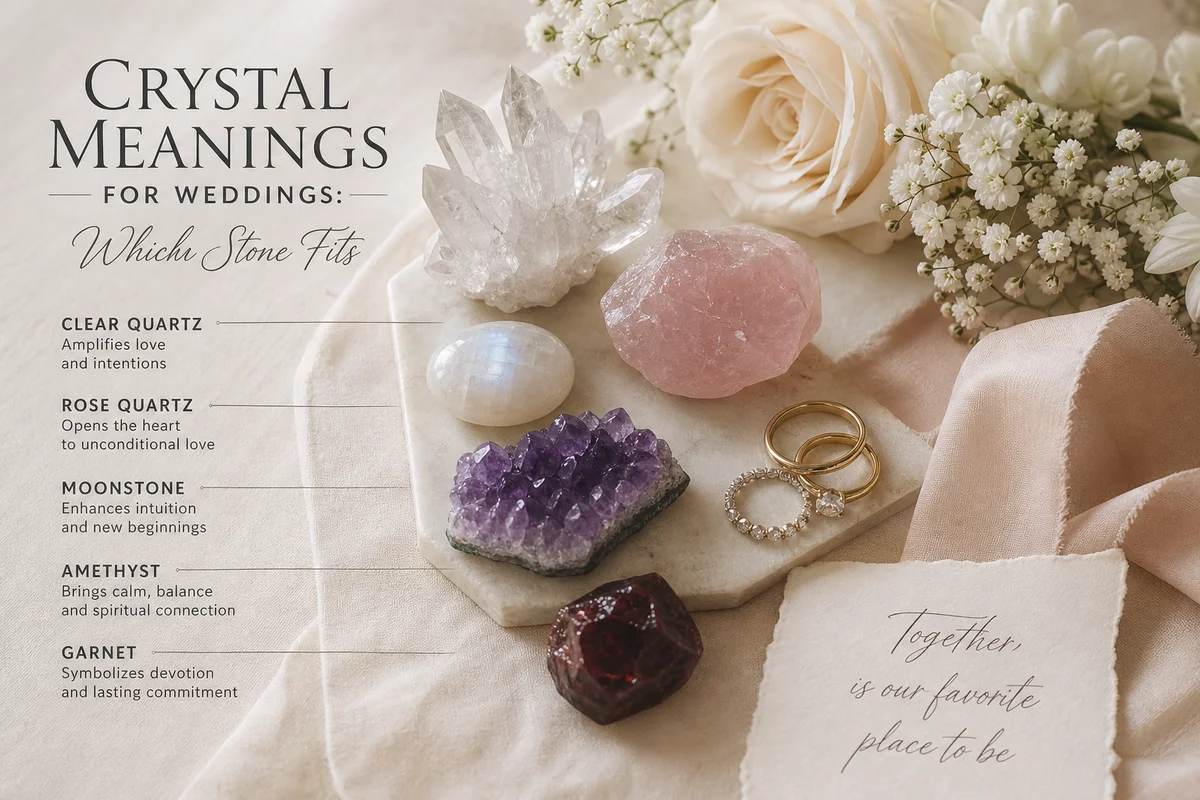
Why Crystal Meanings Matter at Weddings
Weddings are built on symbolism. The rings represent eternity. The white dress represents new beginnings. The flowers each carry their own language — roses for love, lilies for purity, myrtle for luck. Adding crystals to your wedding is not a new idea, but understanding what each crystal traditionally represents lets you choose stones that match the story you want to tell.
A rose quartz favor is not just a pink stone — it is a symbol of the love you are celebrating. An amethyst is not just purple — it represents the peace and clarity you wish for your guests. When you know the meaning behind each crystal, your favors, decor, and jewelry become intentional instead of random.
This guide covers the traditional symbolism of every crystal commonly used in weddings, organized by what they represent so you can choose based on the message that matters most to you. For practical advice on incorporating crystals into your wedding — from favor presentations to table decor — see our crystal wedding favors guide.
Crystals for Love and Romance
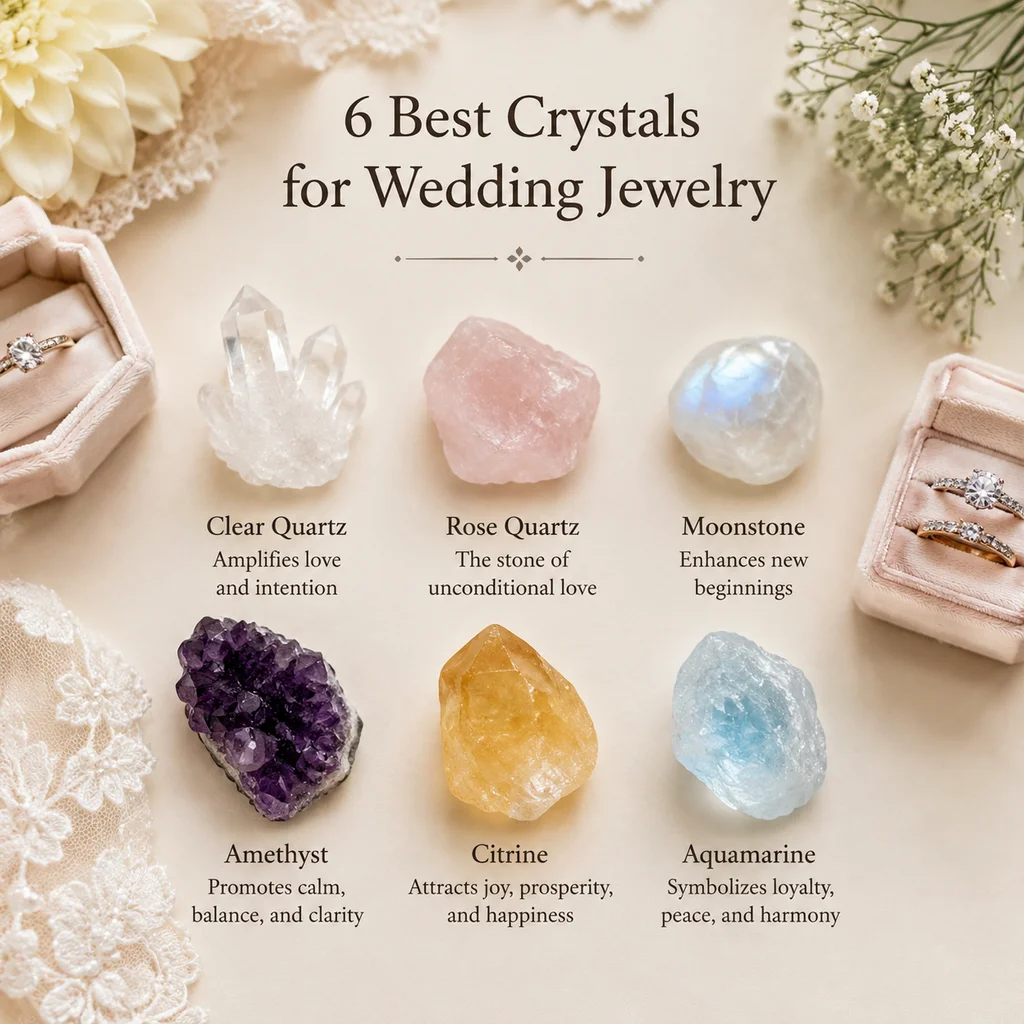
Rose Quartz — Unconditional Love
Rose quartz is the most popular crystal for weddings, and the symbolism is straightforward: it has been associated with love for thousands of years. Ancient Greeks connected it to Aphrodite, the goddess of love. The stone's soft pink color and gentle energy made it a natural symbol for tenderness, compassion, and emotional openness.
At a wedding, rose quartz represents the love between the couple, the love shared with family and friends, and the wish that love continues to grow. It is the safest choice for a crystal favor because its meaning is universally understood and its symbolism is positive for guests of any background.
Best uses: Wedding favors (tumbled stones, hearts, or spheres), bouquet accents, table scatter, ceremony backdrop elements.
Rhodochrosite — Passionate Love and Emotional Healing
Rhodochrosite is sometimes called the "Stone of the Compassionate Heart." Its pink-to-red banding is associated with emotional healing and the courage to love deeply. While less common than rose quartz, it is a meaningful choice for couples who have been through challenges together and want to honor that journey.
Best uses: A single statement piece for the couple (perhaps on the ceremony altar), or as a special favor for close family members.
Kunzite — Divine Love and Emotional Connection
Kunzite is a pale pink-to-lilac stone associated with opening the heart to all forms of love — romantic, familial, and self-love. It was discovered relatively recently (the early 1900s) and named after George Kunz, a gemologist at Tiffany and Co. Its symbolism is less ancient than rose quartz but equally meaningful for modern couples.
Best uses: Bridal jewelry (pendant necklace or earrings), or as part of a multi-stone favor set for close friends.
Ruby and Garnet — Passion, Commitment, and Vitality
Red stones have represented passion and life force across nearly every culture. Rubies symbolize passionate love and the fire of commitment. Garnets represent loyalty, devotion, and the enduring nature of love — they were exchanged between friends in ancient times as a symbol of affection and the promise to reunite.
Best uses: Wedding band accents, statement jewelry for the bride or groom, or a small garnet stone included in a favor set.
Crystals for Peace, Calm, and Harmony
Amethyst — Peace, Clarity, and Spiritual Calm
Amethyst has one of the richest histories of any crystal. Ancient Greeks believed it prevented intoxication (the word comes from "amethystos," meaning "not drunk"). Over centuries, its meaning expanded to include clarity of mind, spiritual awareness, and inner peace.
At a wedding, amethyst represents the calm and clarity at the center of the celebration — the quiet certainty beneath the noise of planning and partying. It is also simply one of the most beautiful stones to display, with its range of purple hues catching light in a way that photographs beautifully.
Best uses: Geode slices as coasters or display pieces, tumbled stones as favors, crystal points as ceremony decor, or amethyst jewelry for the wedding party.
Blue Lace Agate — Communication and Gentle Calm
Blue lace agate is associated with clear, compassionate communication — making it a fitting symbol for a day built on spoken vows. Its soft blue banding represents calm water and peaceful energy. This is a thoughtful choice for couples who value communication as a foundation of their relationship.
Best uses: Small tumbled stones as favors, or included in a multi-stone blessing set alongside rose quartz and amethyst.
Selenite — Purification and Peaceful Energy
Selenite is named after Selene, the Greek goddess of the moon. Its translucent, almost glowing appearance is associated with purity, peace, and clearing negative energy. Some traditions hold that selenite never needs to be cleansed because it naturally purifies itself and its surroundings.
At a wedding, selenite represents a fresh, clean start — the beginning of a new chapter unburdened by the past. Its luminous quality makes it stunning in candlelit reception settings.
Best uses: Tower or wand as a ceremony centerpiece, small selenite sticks as favors, or selenite charging plates as part of a display.
Crystals for Joy, Abundance, and New Beginnings
Citrine — Joy, Abundance, and Positive Energy
Citrine is often called the "merchant's stone" or the "stone of abundance" because of its long association with prosperity and success. Its warm golden color represents sunshine, warmth, and optimism. For weddings, citrine symbolizes the joy of the celebration and the hope for a prosperous life together.
Citrine is also one of the few crystals traditionally associated with positive energy that does not need to be cleansed — it is said to naturally transmute negative energy. This makes it a popular "feel-good" stone for favors.
Best uses: Tumbled stones as favors, crystal points as table decor, or citrine jewelry as bridesmaid gifts.
Green Aventurine — Luck and New Opportunities
Aventurine is known as the "Stone of Opportunity" and is associated with luck, new beginnings, and growth. Its green color connects it to nature, spring, and renewal. For weddings, aventurine represents the luck of finding the right person and the excitement of new beginnings.
Best uses: Tumbled stones in favor bags, aventurine hearts as favors, or small polished pieces in a crystal blessing jar.
Moonstone — New Beginnings and Intuition
Moonstone has been associated with new beginnings and feminine energy across many cultures. Roman historians believed it was formed from frozen moonlight. In Indian tradition, it is a stone of intuition and spiritual insight. Its shimmering adularescence — the way light seems to float across its surface — gives it an otherworldly quality that fits the transformative nature of a wedding day.
Moonstone is especially popular for bohemian, outdoor, or evening weddings where its iridescent quality catches candlelight and sunset.
Best uses: Bridal jewelry (moonstone engagement rings are a growing trend), tumbled stones as favors, or moonstone beads in bouquet wraps.
Crystals for Protection and Strength
Black Tourmaline — Protection and Grounding
Black tourmaline is one of the most widely used protection stones. It is associated with shielding against negative energy, grounding scattered thoughts, and creating a sense of safety. At a wedding, it symbolizes the protective strength of the couple's commitment and the wish that their home together remains a safe haven.
While not the most visually striking stone, black tourmaline has a quiet elegance when polished. It works well as a "hidden" element — tucked into a bouquet, placed under the ceremony tablecloth, or given to the wedding party rather than as a general favor.
Best uses: Small raw pieces tucked into bouquets, tumbled stones as favors for the wedding party, or placed at the four corners of the ceremony space.
Hematite — Grounding and Stability
Hematite's metallic sheen and heavy weight make it feel substantial in the hand. It is associated with grounding, stability, and practical thinking — qualities that balance the emotional intensity of a wedding day. Hematite represents the solid foundation the couple is building.
Best uses: Small tumbled stones in favor sets, or hematite beads incorporated into wedding jewelry.
Tiger's Eye — Courage and Confidence
Tiger's eye is associated with courage, confidence, and personal power. Its chatoyancy — the way light moves across its surface like a cat's eye — makes it visually distinctive. At a wedding, tiger's eye represents the courage it takes to commit fully and the confidence to build a life together on your own terms.
Best uses: Groom or groomsmen gifts (its golden-brown color and bold energy are traditionally considered masculine), or as part of a multi-stone favor set.
Crystals for Clarity and Focus
Clear Quartz — Clarity, Amplification, and Universal Energy
Clear quartz is called the "master healer" and "universal crystal" because it is associated with clarity, focus, and the amplification of other energies. In a wedding context, clear quartz represents the clarity of the couple's commitment and the pure intention behind their vows.
Clear quartz is also the most affordable crystal on this list, making it practical for large weddings. Its transparency means it works with any color scheme.
Best uses: Crystal points as ceremony decor, tumbled stones as affordable favors, or quartz clusters as table centerpieces.
Labradorite — Transformation and Inner Strength
Labradorite is associated with transformation, intuition, and discovering hidden strengths. Its labradorescence — flashes of blue, green, and gold that appear when the stone catches light — makes it one of the most visually stunning crystals for wedding decor. The symbolism fits: a wedding is a transformation, and marriage reveals strengths you did not know you had.
Best uses: Polished labradorite slabs as table numbers or place cards, labradorite jewelry for the bride, or tumbled stones as favors for an evening wedding where the flash effect is visible.
Less Common Crystals With Wedding Symbolism
Peridot — Harmony and Positive Relationships
Peridot's bright green color is associated with harmony, good cheer, and positive relationships. It is the traditional August birthstone and was historically worn as a protective amulet. For weddings, peridot symbolizes the harmony the couple wishes to maintain throughout their marriage.
Lapis Lazuli — Truth and Honest Communication
Lapis lazuli has been treasured for over 6,000 years, from ancient Egyptian burial masks to Renaissance paintings (it was ground into ultramarine pigment). It is associated with truth, wisdom, and honest communication — the foundation of any lasting partnership.
Aquamarine — Courage and Clear Communication
Aquamarine's name means "water of the sea," and its pale blue color is associated with the courage to speak truth and the calm clarity of open water. Ancient sailors carried it as a talisman for safe voyages. For weddings, it represents the couple's journey together and the courage to navigate whatever comes.
Prehnite — Unconditional Love and Inner Peace
Prehnite is a lesser-known green stone associated with unconditional love, inner peace, and letting go of what no longer serves you. It is a thoughtful choice for couples who want their wedding to feel like a genuine new chapter, not just a celebration.
How to Choose Crystals Based on What Matters Most to You
Instead of picking crystals by color or availability, try choosing based on the quality you want to emphasize at your wedding:
If love is your theme: Rose quartz (unconditional love), rhodochrosite (passionate love), kunzite (divine love), ruby (commitment).
If peace and calm matter most: Amethyst (clarity), selenite (purity), blue lace agate (gentle calm), lepidolite (emotional balance).
If you want to celebrate joy and new beginnings: Citrine (joy), aventurine (luck), moonstone (new beginnings), clear quartz (amplifying all positive energy).
If strength and protection resonate: Black tourmaline (protection), hematite (stability), tiger's eye (courage), labradorite (transformation).
If communication and truth are your foundation: Lapis lazuli (truth), aquamarine (clear communication), blue lace agate (compassionate expression).
You can also combine multiple crystals to create a layered message. A favor set containing rose quartz (love), amethyst (peace), and citrine (joy) tells a more complete story than any single stone. For budget-friendly ways to create these multi-stone favor sets, check our crystal wedding favors budget guide — it includes cost breakdowns for favor combinations at every price point.
Crystal Symbolism in Different Wedding Traditions
Western Traditions
In modern Western weddings, crystals are most often used as decorative elements and favors rather than formal ceremonial components. The symbolism is personal rather than religious — couples choose stones that represent qualities they value in their relationship.
Chinese Wedding Traditions
Jade holds deep significance in Chinese wedding traditions, symbolizing purity, moral integrity, and lasting love. Jade bangles are traditional wedding gifts in many Chinese families, passed from mother to daughter. The stone's durability represents the permanence of the marriage bond.
Indian Wedding Traditions
Crystals and gemstones play important roles in Indian wedding jewelry, with specific stones associated with different astrological signs and planetary influences. Navaratna (nine-gem) jewelry combines nine specific stones that together represent cosmic balance and protection for the couple.
Contemporary Spiritual Weddings
Couples who incorporate spiritual or New Age elements into their ceremonies sometimes include crystal grids on the altar, crystal blessings during the ceremony, or crystal-charged water for toasts. The symbolism here is energetic — crystals are chosen for their perceived vibrational qualities rather than purely aesthetic appeal.
A Quick Reference Chart: Crystal Meanings at a Glance
Print this chart or save it to your phone while you plan:
Rose Quartz — Unconditional love, tenderness, emotional healing. Color: Soft pink.
Amethyst — Peace, clarity, spiritual calm. Color: Purple (pale to deep).
Citrine — Joy, abundance, optimism. Color: Golden yellow to amber.
Clear Quartz — Clarity, amplification, pure intention. Color: Transparent.
Moonstone — New beginnings, intuition, feminine energy. Color: White/cream with blue flash.
Labradorite — Transformation, hidden strength, magic. Color: Gray with blue/green flash.
Aventurine — Luck, opportunity, growth. Color: Green.
Selenite — Purity, peace, energetic clearing. Color: White, translucent.
Black Tourmaline — Protection, grounding, safety. Color: Black.
Tiger's Eye — Courage, confidence, personal power. Color: Golden brown with chatoyancy.
Garnet — Devotion, loyalty, passion. Color: Deep red.
Kunzite — Divine love, emotional openness. Color: Pale pink to lilac.
Lapis Lazuli — Truth, wisdom, honest communication. Color: Deep blue with gold flecks.
Aquamarine — Courage, clear communication, safe passage. Color: Pale blue.
Blue Lace Agate — Calm communication, gentle peace. Color: Light blue with white banding.
Hematite — Grounding, stability, practical strength. Color: Metallic silver-gray.
Rhodochrosite — Compassionate love, emotional healing. Color: Pink with white banding.
Peridot — Harmony, positive relationships. Color: Bright green.
The right crystal for your wedding is the one whose meaning resonates with you — not the one that matches your table linens. Choose stones that tell the story you want to tell, and the rest of the wedding details will follow. For more on incorporating crystals into every part of your wedding day, from favors to decor to jewelry, explore our complete guide to crystal wedding favor ideas and our DIY crystal favor tutorial for hands-on assembly instructions.
Frequently Asked Questions
Which crystal is the best choice for wedding favors?
Rose quartz is the most popular and universally understood choice — its association with love is recognized across cultures, its pink color is wedding-appropriate, and it is affordable in bulk. Amethyst is the second most popular choice for its associations with peace and clarity. For budget-conscious couples, clear quartz is the most affordable option and still carries meaningful symbolism of clarity and pure intention.
Can I combine multiple crystals with different meanings in one favor?
Yes, and this is actually one of the most meaningful approaches. A favor set containing rose quartz (love), amethyst (peace), and citrine (joy) gives each guest a trio of blessings rather than a single wish. The key is to include a card explaining what each stone represents so guests understand the intentionality behind the combination.
Do crystal meanings have any historical or cultural basis?
Many crystal associations have roots in ancient Greek, Roman, Egyptian, Chinese, and Indian traditions spanning thousands of years. Rose quartz's connection to love, for example, dates back to Greek mythology. Jade's association with purity and longevity in Chinese culture predates written history. While crystal symbolism is not scientifically proven, the cultural and historical significance is real and meaningful — which is what matters at a wedding, where symbolism and intention are everything.
Frequently Asked Questions
What are the best crystals for brides to wear on their wedding day?
Brides often seek crystals that promote emotional balance, unconditional love, and radiant confidence. Rose quartz is a beautiful choice for attracting deep love, while moonstone enhances intuition and inner harmony. At SagStone, our handcrafted pendants and bracelets are designed to hold these loving intentions close to your heart, making them meaningful, artisan additions to your bridal jewelry.
How should I cleanse my wedding crystals before the ceremony?
Cleansing your crystals ensures they hold only the highest, most positive intentions for your big day. You can gently cleanse your natural stones by placing them under moonlight overnight, using sound vibrations, or smudging them with sage or palo santo. Doing this a few days before your wedding ensures your handcrafted jewelry or decor pieces are fully energized and ready to bless your new journey.
Comments