Best Crystals for Mala Beads: Selection Guide
May 29, 2026
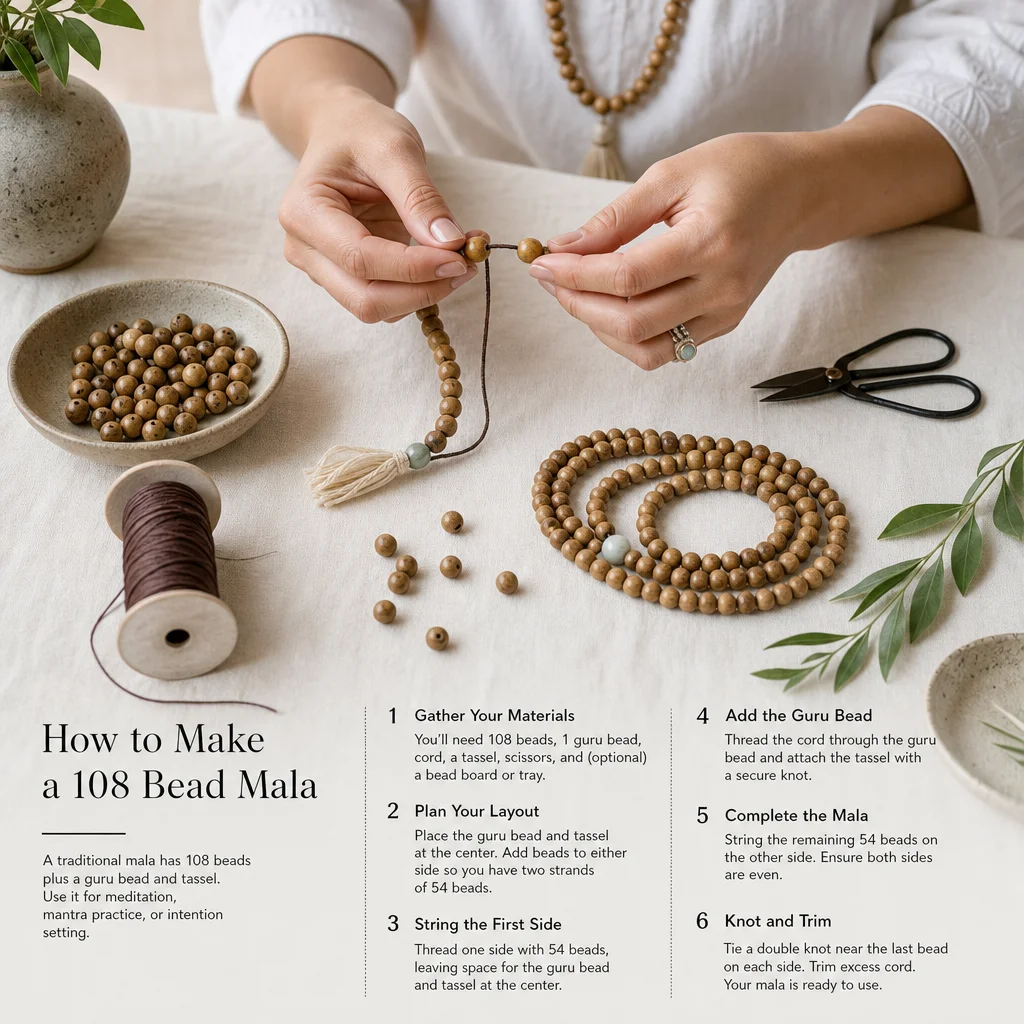
Making a mala is different from making a bracelet. A bracelet has 15-20 beads that take moderate wear. A mala has 108 beads plus a guru bead and tassel — significantly more surface area exposed to friction from handling, rolling, and the repeated motion of your thumb across each bead during meditation. That means hardness matters more than most people realize, and choosing the wrong crystal can result in a beautiful mala that looks terrible after three months of daily use.
This guide covers the best crystals for mala making by intention category, with the mineralogical details that determine durability.
Why Hardness Matters (The Mohs Scale Refresher)
The Mohs scale ranks mineral hardness from 1 (talc, crumbles) to 10 (diamond, scratches everything). For daily-wear malas, you want stones at hardness 6 or above. Stones below 5 will scratch, chip, and wear down from the constant friction of your thumb during japa meditation.
Acceptable for daily-wear mala (hardness 6-7): Quartz family (amethyst, citrine, rose quartz, clear quartz, smoky quartz), feldspar family (moonstone, labradorite), beryl (aquamarine, emerald — but emerald is brittle), jade (nephrite/jadeite 6-7), garnet (6.5-7.5).
Acceptable for gentle use (hardness 5-6): Apatite, sodalite, lapis lazuli (5-6, but the calcite matrix is softer — watch for flaking), turquoise (5-6, porous, needs treatment), opal (5.5-6.5, but fragile).
Not recommended for mala (hardness below 5): Fluorite (4), calcite (3), selenite (2), malachite (3.5-4), azurite (3.5-4), gypsum (2). Save these for loose stones or the guru bead position only.
Protection Malas
Black Tourmaline (Hardness 7-7.5)
The top choice for protection malas. Tourmaline is a complex borosilicate mineral, and the black variety (schorl) is the most common and affordable form. It is dense, durable, and handles daily wear without issue.
Role in mala: Can be the sole stone for a focused protection mala, or used as the primary stone (72-81 beads) with accents of hematite (grounding) and obsidian (clarity).
Price: Tumbled beads 8mm: $0.50-1.50 each. Full mala: $15-35.
Note: Natural black tourmaline often has visible inclusions and slight variations. Uniformly black, perfectly round beads at very low prices may be dyed onyx or glass.
Obsidian (Hardness 5-5.5)
Obsidian is volcanic glass — technically not a mineral but a rock formed by rapid cooling of lava. Its hardness of 5-5.5 puts it at the lower end of mala durability, but its density and smooth, glassy texture resist scratching better than softer minerals.
Role in mala: Use as accent beads (every 4th or 9th bead) rather than the full 108, to reduce wear on individual obsidian beads. Pairs well with black tourmaline.
Price: Tumbled beads 8mm: $0.50-1.00 each.
Caution: Obsidian can contain micro-crystalline structures that look like inclusions but are actually trapped gas bubbles. This is normal and not a defect.
Calm and Peace Malas
Amethyst (Hardness 7)
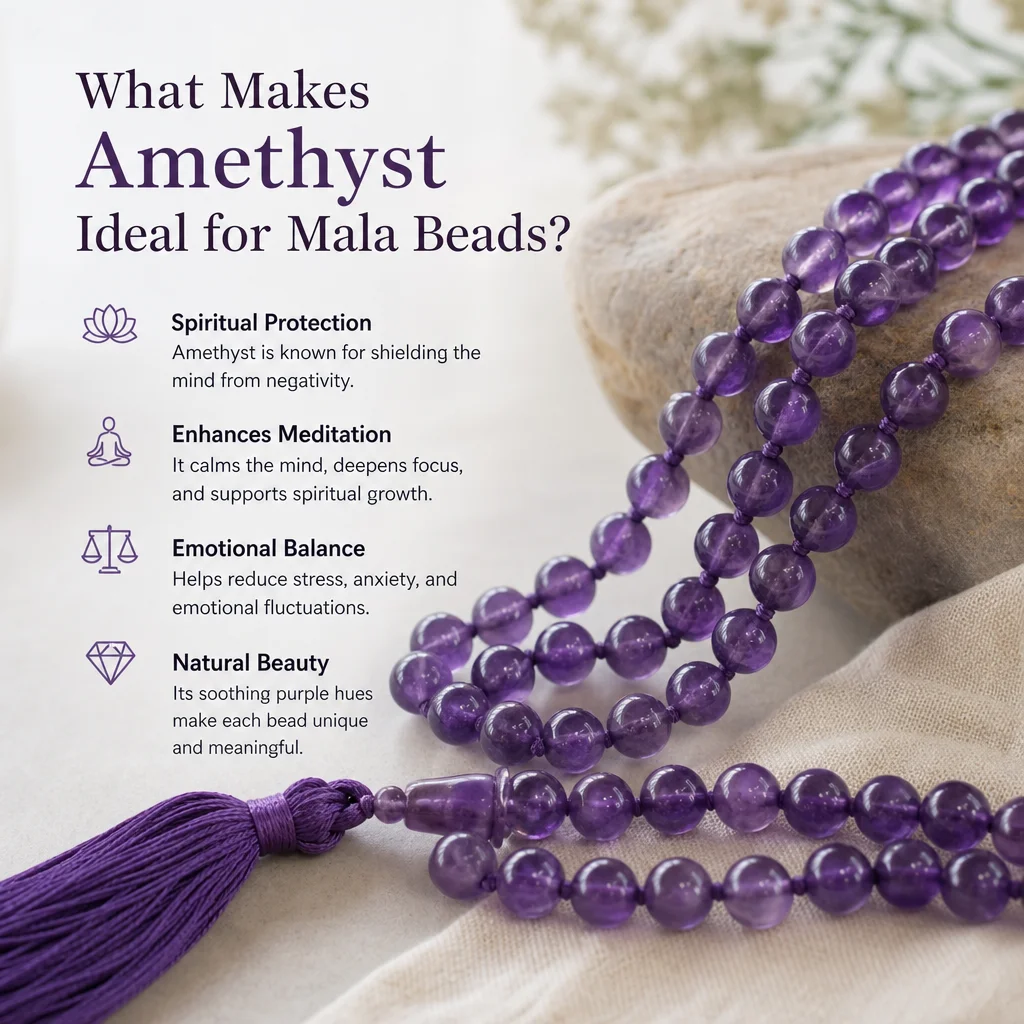
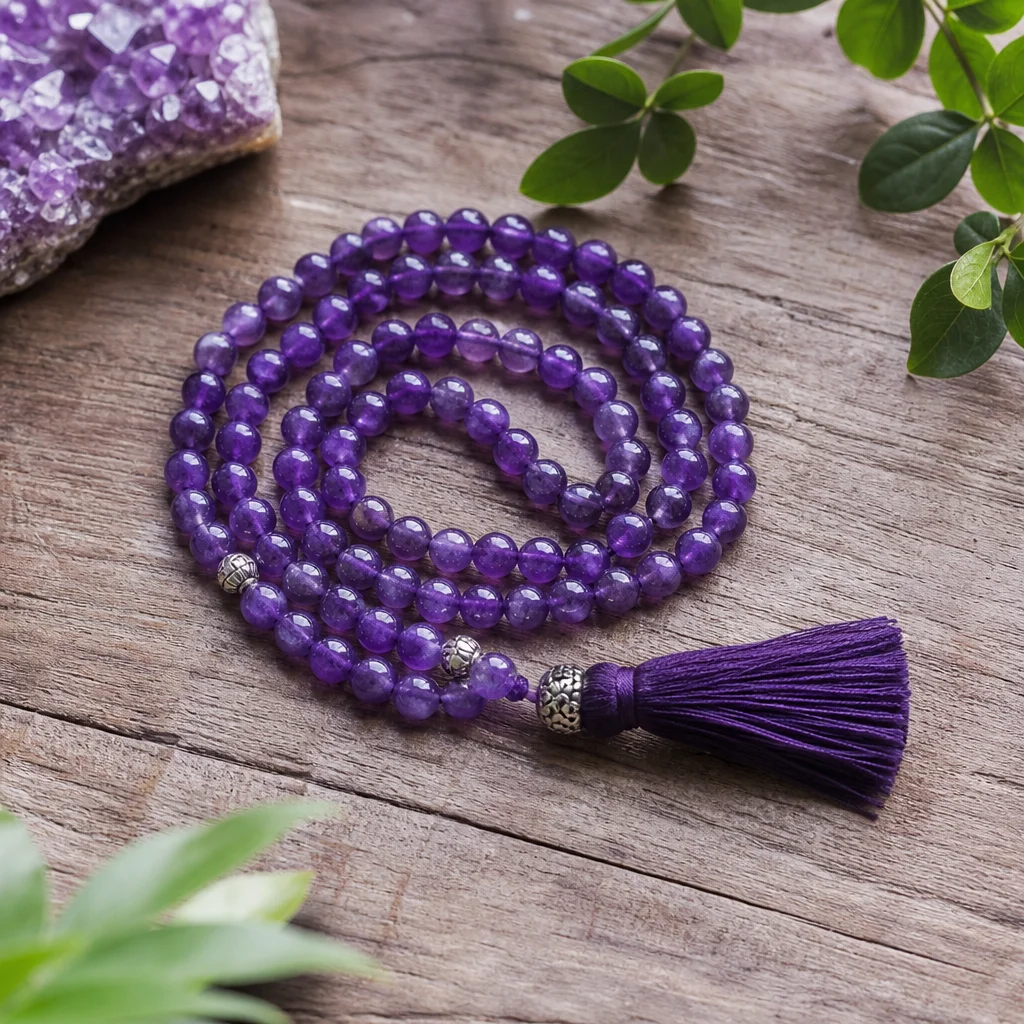
Amethyst is purple quartz colored by iron impurities and natural irradiation. It is the most popular crystal for meditation malas, and for good reason — it is durable, affordable, and visually striking.
Role in mala: The dominant stone in any calm/meditation mala. Can serve as the full 108 beads, or as the primary stone with accents of lepidolite or clear quartz.
Price: Tumbled beads 8mm: $0.75-2.00 each. Full mala: $20-50.
Quality tiers: Light lavender (cheapest), medium purple (standard), deep purple with red flashes (premium, called "Siberian" or "Uruguayan" amethyst). For malas, medium purple offers the best balance of beauty and cost.
Lepidolite (Hardness 2.5-3)
Important: Lepidolite is too soft for a full mala. At hardness 2.5-3, beads will wear down to nothing within months of daily use.
Role in mala: Guru bead only. Use lepidolite as the center stone with harder quartz beads as the 108 counting beads. This gives you the calming, lithium-bearing energy without the durability problem.
Howlite (Hardness 3.5)
Like lepidolite, howlite is too soft for a full mala but makes an excellent guru bead for calm-focused malas.
Love and Heart Malas
Rose Quartz (Hardness 7)
Rose quartz is the most accessible heart stone. As a member of the quartz family, it has the durability to handle daily mala use without issue.
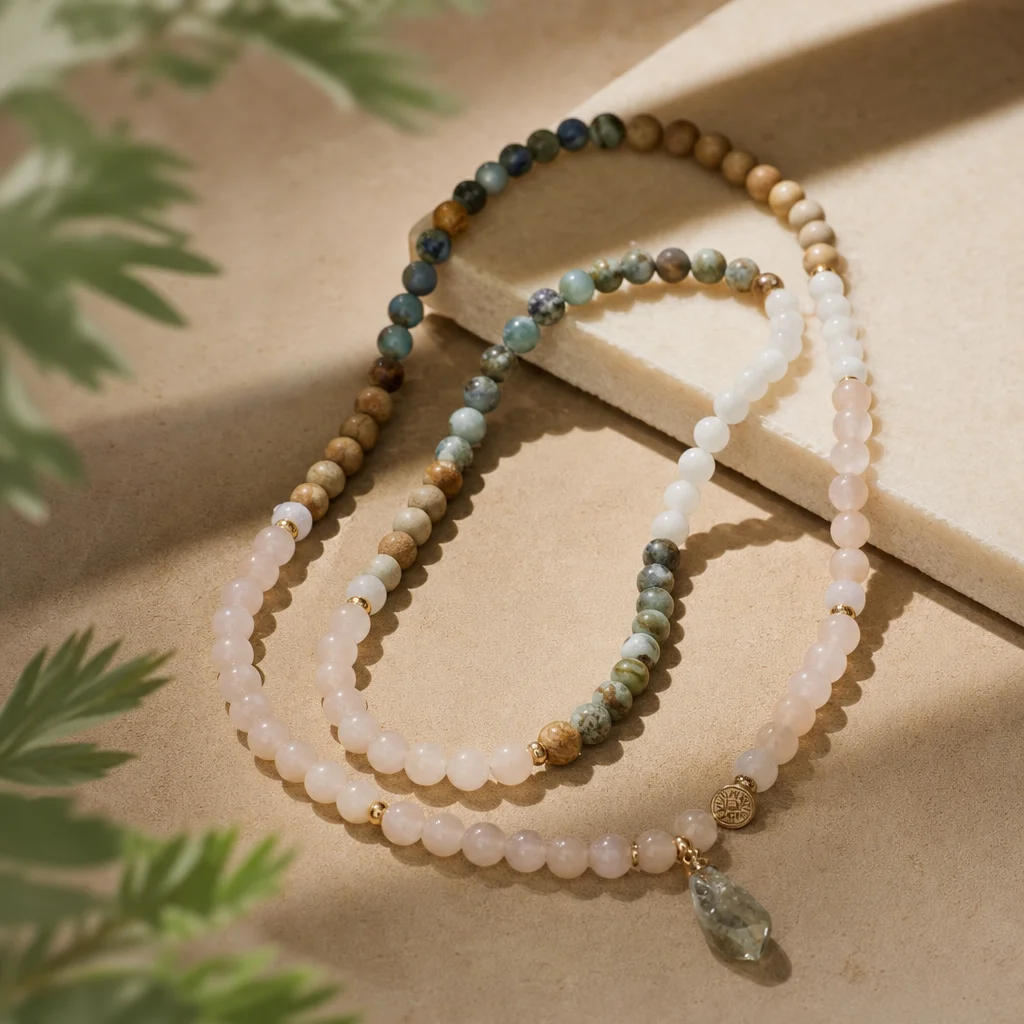
Role in mala: The primary stone for love and emotional healing malas. Beautiful as a full 108-bead mala — the soft pink is calming and elegant.
Price: Tumbled beads 8mm: $0.50-1.50 each. Full mala: $15-35.
Color caveat: Deep, saturated pink rose quartz is increasingly rare and expensive. Most commercially available rose quartz is pale to medium pink. If you find intensely pink, uniformly colored beads at a suspiciously low price, they may be dyed. Genuine rose quartz has subtle variations and occasional internal fracture lines visible under light.
Rhodonite (Hardness 5.5-6.5)
Rhodonite sits right at the durability boundary. It works for malas if you are not extremely rough with your beads.
Role in mala: Alternate bead in rose quartz malas (every 9th bead), or as a primary stone in self-love malas.
Price: Tumbled beads 8mm: $0.75-2.00 each.
Focus and Study Malas
Fluorite (Hardness 4)
Not recommended for daily-wear malas. Despite being the classic "study stone," fluorite is too soft. The constant thumb pressure during japa meditation will wear down fluorite beads within weeks.
Alternative approach: Use a fluorite specimen as your meditation focus stone (placed in front of you during practice), and wear a clear quartz or sodalite mala for the actual bead counting.
Sodalite (Hardness 5.5-6)
Sodalite is one of the best alternatives for focus malas. It is harder than fluorite and has the blue coloring associated with mental clarity.
Role in mala: Primary stone for focus malas, either alone or paired with clear quartz.
Price: Tumbled beads 8mm: $0.50-1.50 each.
Clear Quartz (Hardness 7)
The universal stone. Clear quartz works in any mala as a primary stone or an accent. Its hardness 7 makes it nearly indestructible for daily use.
Role in mala: Amplifier — pair it with any other stone to strengthen the dominant stone's quality. Also works as a standalone mala for general meditation.
Price: Tumbled beads 8mm: $0.30-1.00 each. Full mala: $10-25.
Wealth and Abundance Malas
Citrine (Hardness 7)
Citrine is the go-to stone for abundance and prosperity malas. Its golden color is energizing, and its quartz-based hardness makes it ideal for daily wear.
Role in mala: Primary stone for abundance malas. Pair with tiger eye and carnelian for a warm, energizing combination.
Price: Tumbled beads 8mm: $1.00-2.50 each. Full mala: $25-60.
Important: 90%+ of citrine on the market is heat-treated amethyst. Natural citrine (mined from the earth in its golden color) is rare and expensive. Both types have the same hardness and durability. If natural origin matters to you, ask the seller directly and expect to pay 3-5x more.
Tiger Eye (Hardness 6-7)
Tiger eye is a chatoyant variety of quartz — the same mineral family as citrine and amethyst. Its golden-brown shimmer (chatoyancy, from the Greek "cat's eye") is caused by parallel asbestos fibers that were replaced by quartz during formation.
Role in mala: Companion stone in abundance and focus malas. Works well as alternating beads with citrine.
Price: Tumbled beads 8mm: $0.50-1.50 each.
Guru Stone Selection
The guru bead is the 109th bead — the larger, central bead that signifies the end of a 108-count cycle. It can be any stone, regardless of hardness, because it does not experience the same friction as the counting beads.
Traditional guru stones:
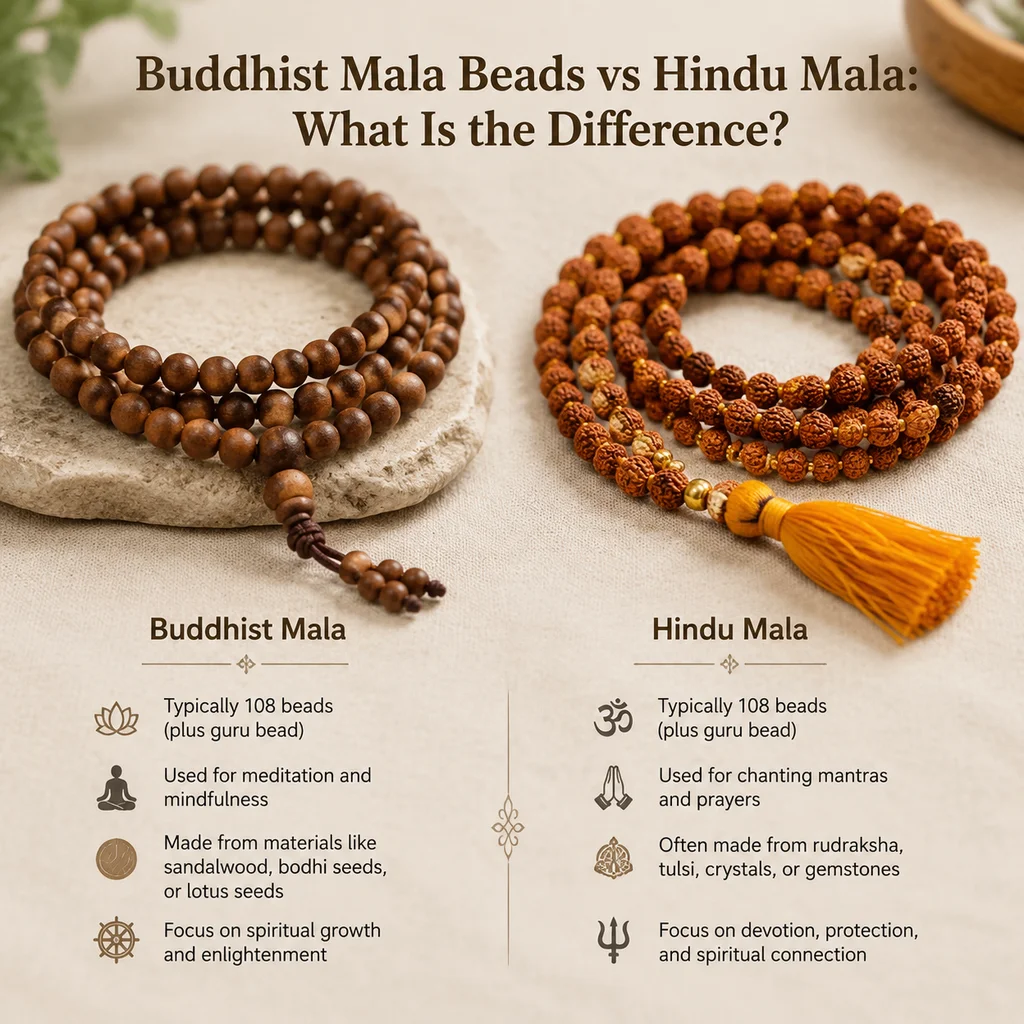
- Rudraksha seed (Hindu tradition)
- Bodhi seed (Buddhist tradition)
- A larger bead of the same crystal as the main mala
- A contrasting stone (clear quartz guru on an amethyst mala, for example)
Cost Analysis by Stone Type
| Crystal | Per Bead (8mm) | Full Mala (108+guru+tassel) ||---------|:---:|:---:|| Clear Quartz | $0.30-1.00 | $10-25 || Black Tourmaline | $0.50-1.50 | $15-35 || Rose Quartz | $0.50-1.50 | $15-35 || Amethyst | $0.75-2.00 | $20-50 || Citrine | $1.00-2.50 | $25-60 || Lapis Lazuli | $1.50-3.00 | $35-80 || Labradorite | $2.00-4.00 | $50-120 || Moonstone | $2.00-5.00 | $60-150 |
Summary: Choose by Intention
| Intention | Primary Stone | Accent Stones | Avoid ||-----------|:---:|:---:|:---:|| Protection | Black Tourmaline | Hematite, Obsidian | Soft stones || Calm | Amethyst | Clear Quartz, Howlite (guru) | Fluorite, Lepidolite (beads) || Love | Rose Quartz | Rhodonite, Rhodochrosite | Green fuchsite (too soft) || Focus | Sodalite, Clear Quartz | Amethyst, Tiger Eye | Fluorite (beads) || Abundance | Citrine | Tiger Eye, Carnelian | Pyrite (oxidizes) || Spiritual | Clear Quartz, Amethyst | Selenite (guru only), Moonstone | Selenite (beads) |
The best mala is the one you make with stones you love looking at and handling 108 times, every single day. Start with the stone that matches your biggest current intention and build from there.
Frequently Asked Questions
Can I wear my crystal mala bracelet every day?
Yes, you can wear your crystal mala daily, but it is important to consider the Mohs hardness of the stones. Softer crystals like turquoise or calcite can scratch easily with rigorous daily wear. For everyday use, we recommend handcrafted malas made from harder stones like quartz or amethyst, which resist daily wear and tear while keeping your intentions close.
How do I clean and care for my natural crystal mala?
To clean your crystal mala, gently wipe the beads with a soft, damp cloth. Avoid harsh chemicals or ultrasonic cleaners. To energetically cleanse your handcrafted jewelry, you can place your mala in moonlight overnight. Because natural crystals vary in hardness and porosity, keeping them away from prolonged water exposure and direct sunlight helps preserve their vibrant color.
Which hand should I wear my crystal mala bracelet on?
Traditionally, a mala is worn on the right wrist, wrapped several
Frequently Asked Questions
How do I activate my crystal mala?
To activate your handcrafted crystal mala, find a quiet space and hold it in your hands. Close your eyes, take deep breaths, and focus on your specific intention—whether it is peace, love, or abundance. You can also leave it under moonlight overnight to cleanse its energy before your first meditation or yoga practice. This connects your personal energy to the natural stones.
What is a guru stone on a mala necklace?
The guru stone is the centerpiece bead of a traditional mala, usually the 109th bead. It represents the teacher, your highest intention, or spiritual connection. At SagStone, we carefully handcraft our malas with unique guru stones like clear quartz or amethyst to anchor your energy, serving as a grounding focal point during your daily meditation practice.
Comments