Wire Wrapping Tools & Materials
May 28, 2026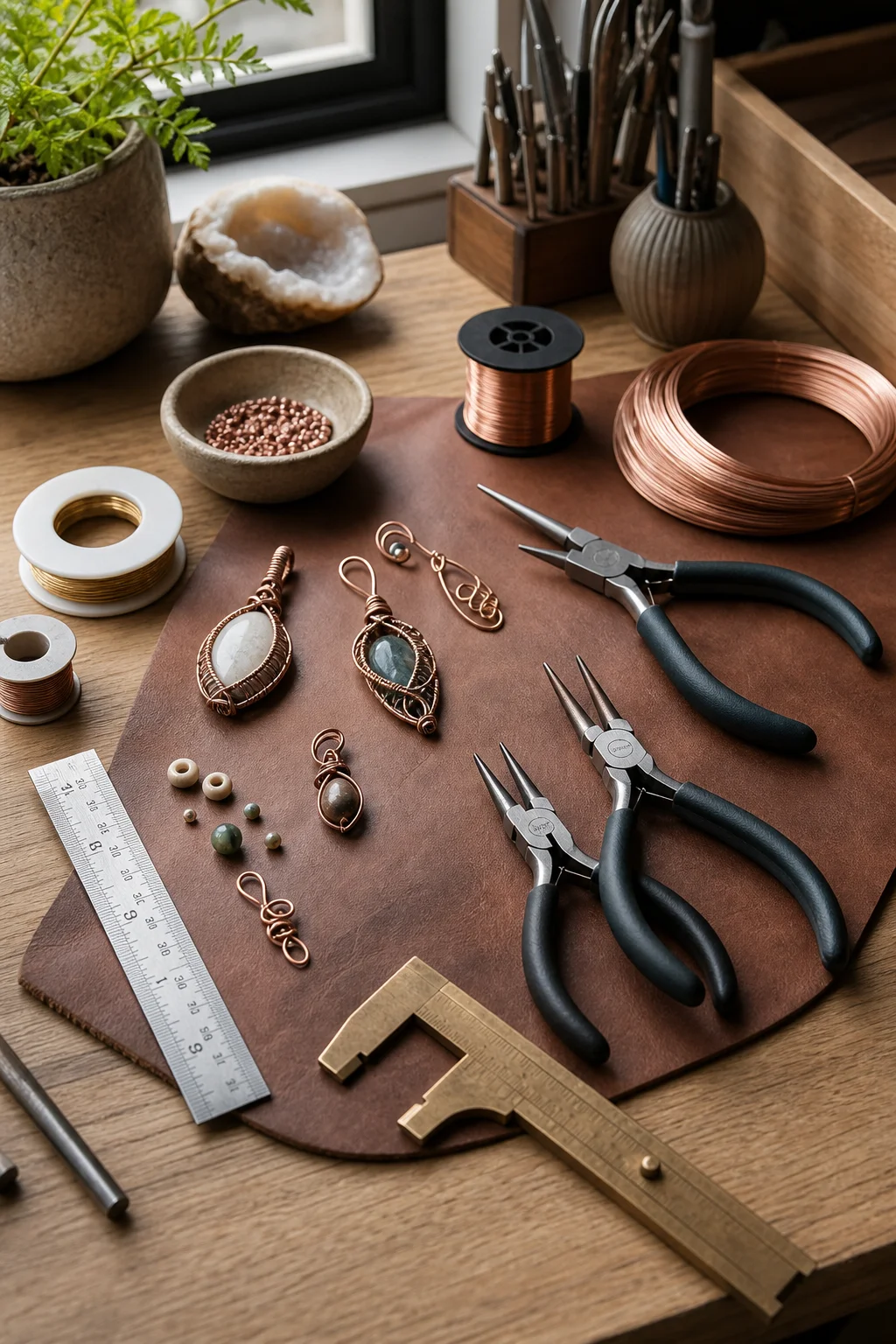
Wire Wrapping Tools & Materials: The Complete Starter Kit
You Need Less Than You Think
Walk into a jewelry supply store or browse an online retailer and you'll see walls of tools, racks of wire in dozens of gauges, and accessories you've never heard of. It's overwhelming — and most of it is unnecessary for beginners.
Wire wrapping at its core requires three things: wire, pliers, and something to wrap. That's it. The rest is technique, patience, and practice. This guide focuses on what you actually need to get started, what's worth upgrading later, and what you can skip entirely.
Wire: The Foundation of Everything
Metal Types
The wire you choose affects the look, workability, and durability of your finished piece. Here are the most common metals for wire wrapping, ranked by beginner-friendliness:
Copper Wire
- Price: $3-8 per spool (depending on gauge and length)
- Workability: Excellent — soft and malleable, easy to bend and shape
- Patina: Develops a natural verdigris (green-blue) patina over time
- Pros: Cheap, forgiving, easy to practice with, widely available
- Cons: Can leave green marks on skin initially, not "precious" metal
- Best for: Learning, practicing, and everyday wear pieces
Artistic / Craft Wire (Copper Core with Colored Coating)
- Price: $4-12 per spool
- Workability: Good — similar to copper but the coating can scratch
- Colors: Silver, gold, rose gold, antique bronze, black, and many more
- Pros: Affordable, variety of colors, good for matching design aesthetics
- Cons: Coating can chip at bend points, not suitable for heavy manipulation
- Best for: Adding color variety without investing in precious metals
Sterling Silver Wire (925)
- Price: $15-50+ per spool (fluctuates with silver market)
- Workability: Good — work-hardens quickly, so plan your bends
- Pros: Valuable metal, professional appearance, hypoallergenic
- Cons: Expensive for practice, can be stiff in thicker gauges
- Best for: Finished pieces you plan to sell or gift
Brass Wire
- Price: $4-10 per spool
- Workability: Good — slightly stiffer than copper
- Pros: Warm gold color at a fraction of the cost of gold
- Cons: Can tarnish, may cause skin reactions in sensitive individuals
- Best for: Practicing gold-colored designs before buying gold-filled wire
Gold-Filled Wire
- Price: $25-80+ per spool
- Workability: Similar to sterling — work-hardens with manipulation
- Pros: Much more durable gold layer than gold-plated, good value
- Cons: Expensive, not for practice
- Best for: High-end finished pieces
Wire Gauge (Thickness)
Wire gauge is measured on the AWG (American Wire Gauge) scale. Counter-intuitively, higher gauge numbers mean thinner wire. A 28-gauge wire is hair-thin; a 14-gauge wire is thick and stiff.
| Gauge | Diameter (mm) | Use in Wire Wrapping | Beginner Priority |
|-------|---------------|---------------------|-------------------|
| 14-16 | 1.6-1.3 mm | Frame wires, bangles, structural elements | Nice to have |
| 18 | 1.0 mm | Core/frame wires for pendants | ⭐ Must have |
| 20 | 0.8 mm | Frames, heavier wraps, bails | ⭐ Must have |
| 22 | 0.6 mm | Weaving, wrapping, smaller elements | ⭐ Must have |
| 24 | 0.5 mm | Fine wrapping, weaving, decorative coils | Nice to have |
| 26 | 0.4 mm | Very fine weaving, securing small stones | Nice to have |
| 28-30 | 0.3-0.25 mm | Hair-fine weaving, crochet-style wrapping | Later |
Beginner starter recommendation: Get copper wire in gauges 18, 20, and 22. These three gauges cover 90% of beginner projects. Add 24-gauge once you're comfortable with basic wraps.
Wire Hardness
Wire comes in three hardness levels:
- Dead soft — Very malleable, easy to bend by hand. Best for most wire wrapping techniques, especially weaving and wrapping. Start here.
- Half hard — Moderately stiff, holds its shape better after bending. Good for structural elements like frames and ear wires.
- Full hard — Very stiff, springy. Rarely used in wire wrapping; more common in wire sculpture and chain making.
For learning, buy dead soft wire exclusively. You can work-harden it by running it through nylon pliers or gently hammering it after shaping.
Pliers: The Three You Actually Need
You need exactly three pairs of pliers to start wire wrapping. Every additional pair is a luxury, not a necessity.
1. Round-Nose Pliers
The tapered, conical jaws make loops, curves, and spirals. The taper allows you to create different-sized loops depending on where along the jaw you grip the wire.
What to look for:
- Smooth jaws (no teeth or grooves that would mark the wire)
- Tapered jaws with a consistent conical shape
- Spring-loaded handles (reduces hand fatigue)
- Comfortable grip length (4-5 inches)
Budget: $8-15 (entry level) / $25-40 (professional)
2. Chain-Nose Pliers
Flat on the inside, tapered to a point. Used for gripping wire, tucking in ends, making sharp bends, and flattening wraps. Think of them as precision fingers.
What to look for:
- Smooth, flat inner jaws (no serration)
- Fine tips for detailed work
- Spring-loaded handles
Budget: $8-15 (entry level) / $25-40 (professional)
3. Flush Cutters
Cut wire with a flat cut on one side and a pinched cut on the other. The flat side is what you want facing your finished work — it leaves a nearly flush edge that won't snag. The "pinch" side leaves a sharp point.
What to look for:
- Rated for the wire gauges you're using (check the manufacturer's specs)
- Sharp, aligned cutting edges
- Spring-loaded
Budget: $10-20 (entry level) / $25-50 (professional)
Optional But Useful Tools
| Tool | Use | Price | Priority |
|------|-----|-------|----------|
| Nylon-jaw pliers | Straightening kinked wire without marring | $10-20 | ⭐ Highly useful |
| Bent chain-nose pliers | Getting into tight spaces | $10-20 | Nice to have |
| Stepped pliers | Making consistent loops in various sizes | $12-25 | Nice to have |
| Bench block + hammer | Work-hardening and texturing wire | $15-30 | Later |
| Mandrel (ring or bracelet) | Shaping rings and cuffs | $10-20 | Later |
| Steel ruler | Measuring wire lengths | $3-5 | ⭐ Useful |
| Fine-tip marker | Marking wire for bending points | $1 | ⭐ Useful |
Stones and Objects to Wrap
You can wrap virtually anything with a reasonably flat surface. For beginners, start with:
Recommended Beginner Stones
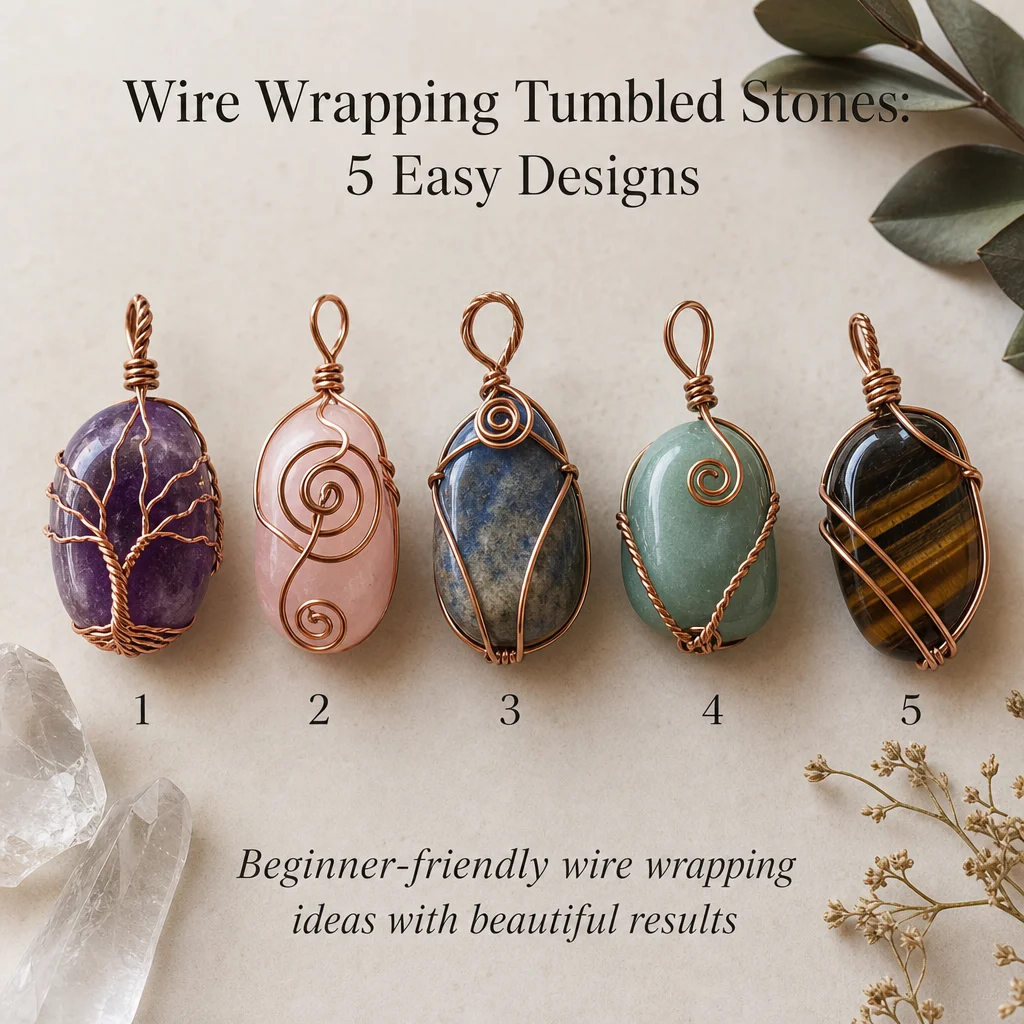
- Tumbled stones (1-3 cm) — Smooth, rounded, easy to grip while wrapping
- Flat cabochons — The flat back provides a natural "setting" surface
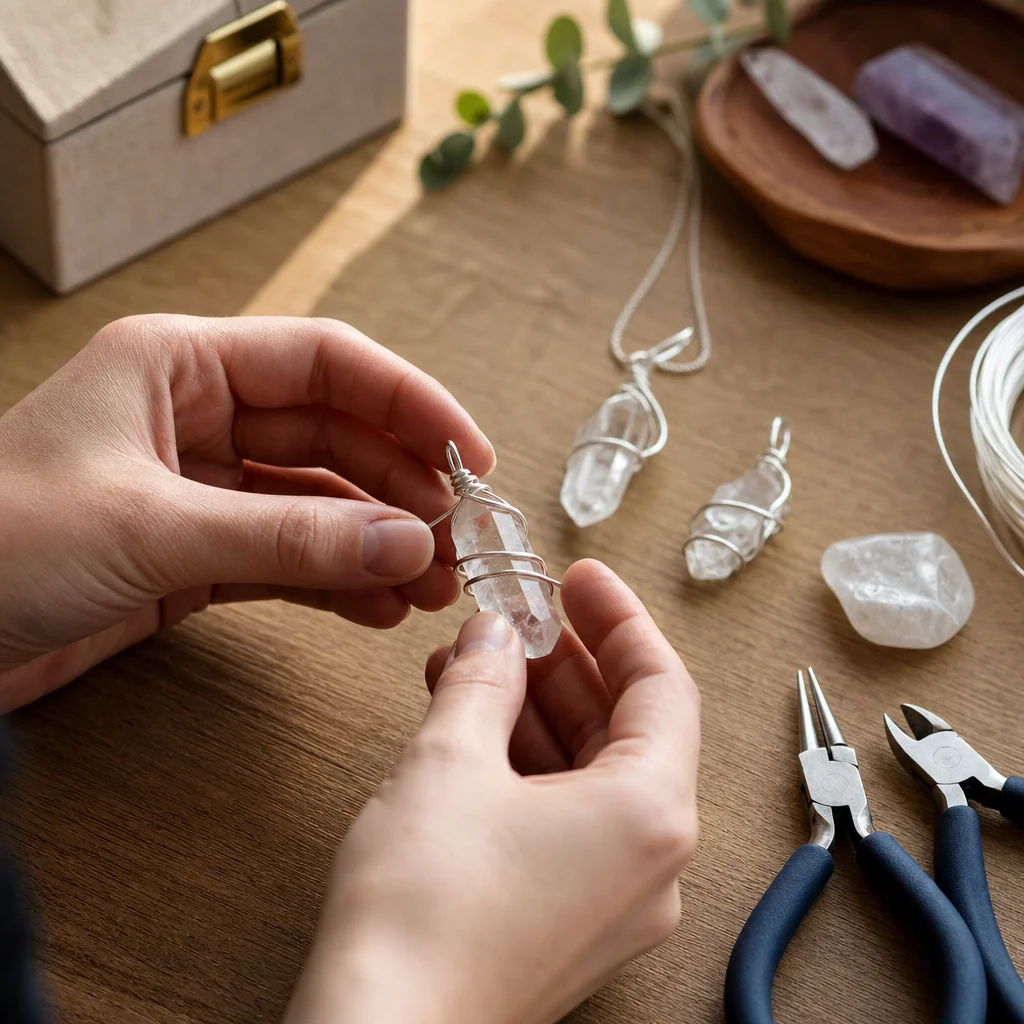
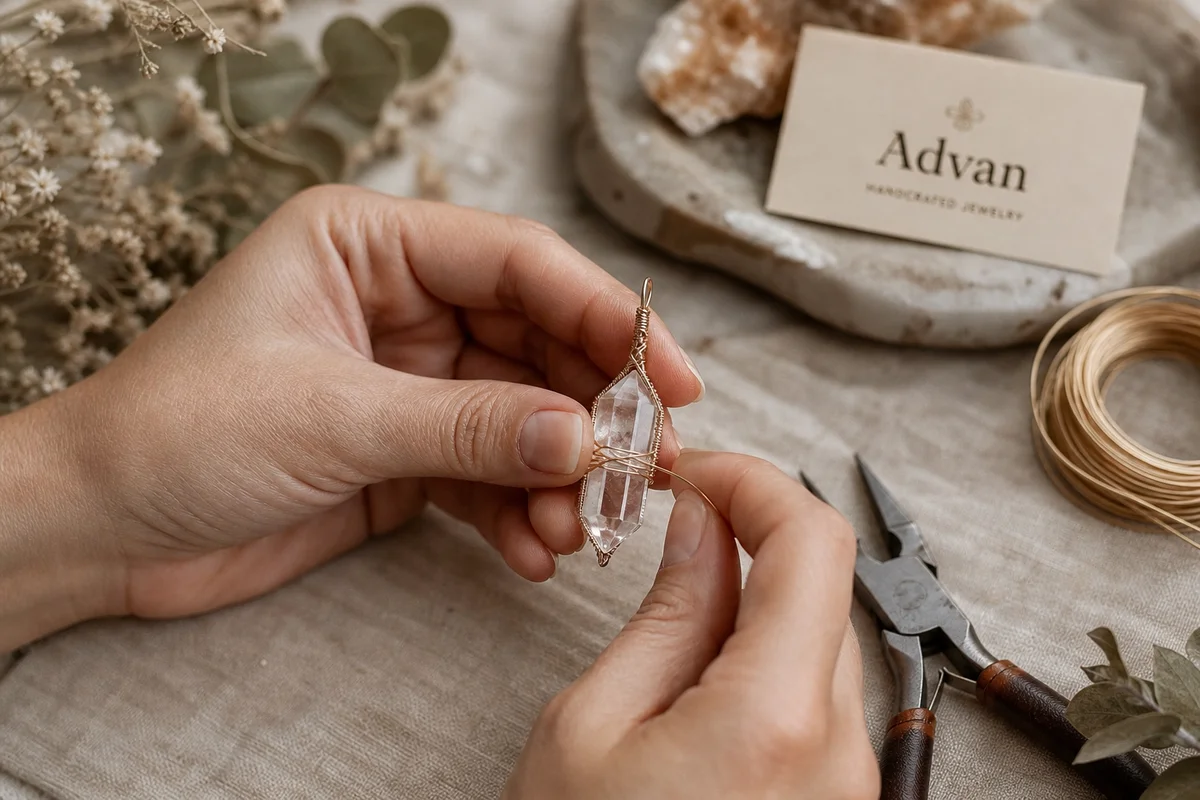
- Crystal points (2-4 cm) — Classic wire-wrapping subject, elongated shape is easy to work with
What to Avoid at First
- Very small stones (<1 cm) — Hard to hold and wrap simultaneously
- Very round spheres — Slippery and require advanced techniques
- Fragile stones (selenite, calcite) — Can crack under wire pressure
- Stones with sharp edges — Wire can slip off during wrapping
Stone Shape and Wrapping Difficulty
| Shape | Difficulty | Technique |
|-------|-----------|-----------|
| Flat oval cabochon | Easy | Simple cage wrap |
| Tumbled oval | Easy | Basket weave or cage |
| Crystal point (terminated) | Medium | Pendant wrap with bail |
| Rough crystal cluster | Medium-Hard | Freeform wrapping |
| Perfect sphere | Hard | Requires precise tension |
| Very thin/flat slice | Hard | Wire wants to slip off edges |
Workspace Setup
You don't need a dedicated studio. A corner of a desk or table works fine. The essentials:
- Good lighting — You need to see fine wire detail. A desk lamp with a daylight-spectrum bulb (5000-6000K) makes a huge difference.
- Non-slip surface — A piece of felt, a cutting mat, or even a folded towel prevents stones from rolling away.
- Organization — Small containers or a tackle box for wire scraps, beads, and findings. Wire tangles easily; keeping spools separated saves frustration.
- Comfortable seating — Wire wrapping involves detailed hand work. An uncomfortable chair will cut your practice sessions short.
Your First Project Shopping List
Here's everything you need for your first 10 wire-wrapped pendants, with approximate costs:
| Item | Spec | Quantity | Price |
|------|------|----------|-------|
| Copper wire, 18-gauge | Dead soft, 10 yards | 1 spool | $5 |
| Copper wire, 20-gauge | Dead soft, 10 yards | 1 spool | $5 |
| Copper wire, 22-gauge | Dead soft, 15 yards | 1 spool | $5 |
| Round-nose pliers | Entry level | 1 pair | $10 |
| Chain-nose pliers | Entry level | 1 pair | $10 |
| Flush cutters | Entry level | 1 pair | $12 |
| Tumbled stones | Mixed, 2-3 cm | 10 pack | $8 |
| Total | | | ~$55 |
That's $55 for enough materials to make 10+ pendants and learn the fundamental techniques. Every additional spool of wire costs $3-5, so ongoing costs are minimal.
Where to Buy Wire Wrapping Supplies
- Amazon / Etsy — Convenient, wide selection, read reviews carefully
- Rio Grande — Professional-grade jewelry supplies, excellent quality
- Fire Mountain Gems — Large selection of wire, tools, and stones
- Local craft stores (Michaels, Hobby Lobby) — Good for emergency copper wire runs
- Local rock shops — Best source for interesting stones to wrap
FAQ
Q: What's the best wire gauge for beginners?
A: Start with 20-gauge copper wire. It's thick enough to hold its shape but thin enough to bend easily by hand. Once you're comfortable, add 18-gauge for frames and 22-gauge for weaving and wrapping.
Q: Do I need to buy expensive tools?
A: No. Entry-level pliers ($8-15 each) are perfectly fine for learning. Upgrade to professional tools only when you feel the limitations of your beginner tools — usually after 3-6 months of regular practice.
Q: Why does my wire keep kinking?
A: Wire kinks when it's bent past its elastic limit and then straightened. To prevent kinks, use nylon-jaw pliers to straighten wire (they won't mar the surface), and try to plan your bends rather than bending and unbending repeatedly. Once copper wire is kinked, the kink is permanent — cut that section off and start fresh.
Q: Can I use craft wire from the dollar store?
A: You can, but it's often inconsistent in gauge, hardness, and coating quality. For a few dollars more per spool, jewelry-grade copper wire from a reputable supplier will give you much more consistent results and a more enjoyable learning experience.
Q: How do I know if my wire is dead soft or half hard?
A: If you're buying from a jewelry supply retailer, the hardness will be clearly labeled. If you're buying unlabeled wire from a craft store, it's usually dead soft. You can test by making a sharp 90-degree bend — dead soft wire bends easily and stays bent; half hard wire resists slightly and may spring back a few degrees.
Frequently Asked Questions
What are the best crystals for wire wrapping jewelry?
For wire wrapping, choose crystals with a hardness rating of 6.0 or higher on the Mohs scale, such as amethyst, citrine, and rose quartz. These crystals are durable enough to withstand the wrapping process without scratching or breaking.
Can I use any type of wire for wire wrapping with crystals?
Yes, you can use various types of wire, including 20-gauge dead soft wire for fine jewelry, or 18-gauge for a more durable piece. Ensure the wire is suitable for the size and weight of the crystal you are using.
How do I clean my wire wrapped jewelry to maintain its sparkle?
Clean your wire wrapped jewelry with a soft cloth and mild soap and water. For a deeper clean, use a jewelry cleaning solution designed for crystal jewelry. Avoid using harsh chemicals or abrasive materials to prevent damaging the crystal.
What's the best way to prevent the wire from tarnishing on my wire wrapped jewelry?
Prevent tarnishing by storing your wire wrapped jewelry in airtight containers or ziplock bags with anti-tarnish strips. Applying a clear, protective coating to the wire before wrapping can also help maintain its shine over time.
Can I make wire wrapped jewelry for sensitive skin?
Yes, you can make wire wrapped jewelry suitable for sensitive skin by using hypoallergenic materials, such as sterling silver or stainless steel wire. Ensure the crystals used are also free from harmful chemicals or irritants.
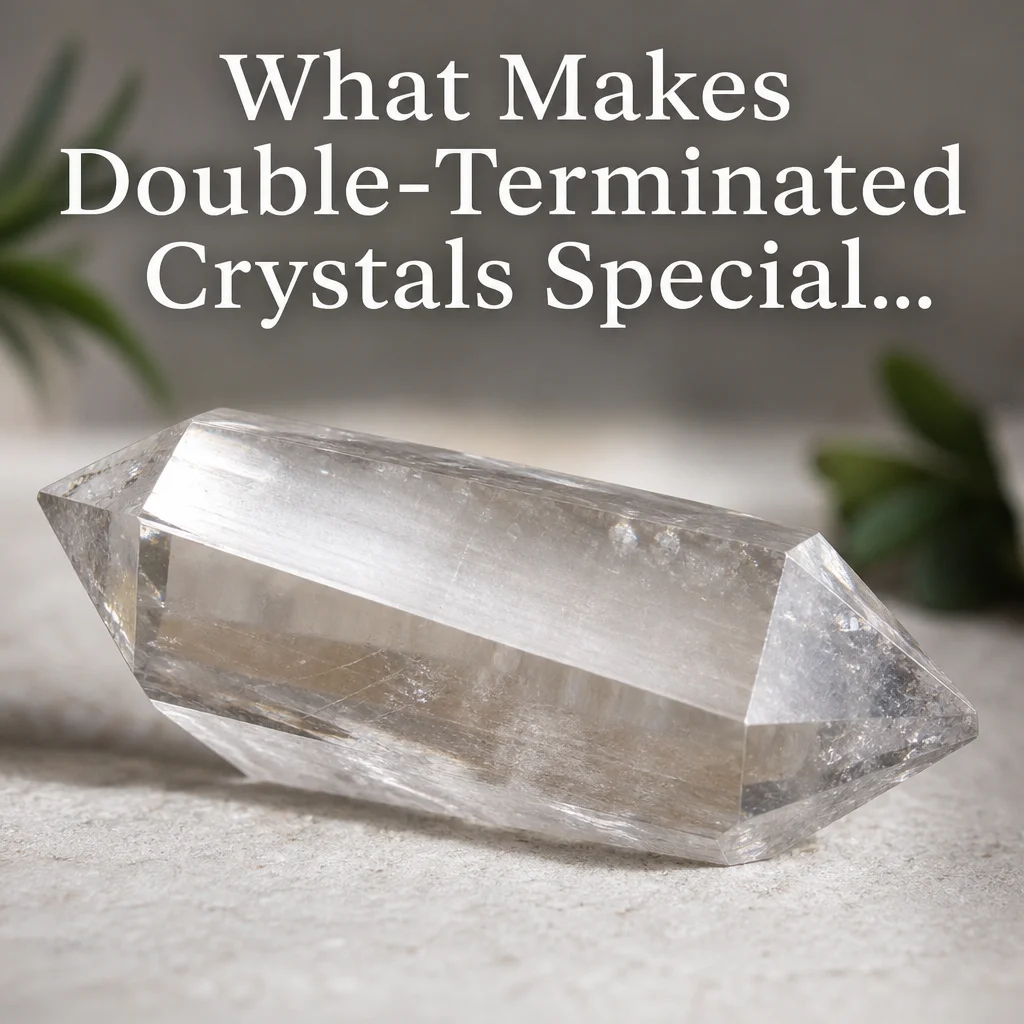
What Makes This Crystal Special
This section covers important aspects of what makes this crystal special. For detailed information, please refer to the FAQ section below.
Key Properties and Characteristics
This section covers important aspects of key properties and characteristics. For detailed information, please refer to the FAQ section below.
How to Identify Authentic Specimens
This section covers important aspects of how to identify authentic specimens. For detailed information, please refer to the FAQ section below.
Popular Uses and Applications
This section covers important aspects of popular uses and applications. For detailed information, please refer to the FAQ section below.
Comments