5 Key Differences: Smoky Quartz vs Black
May 31, 2026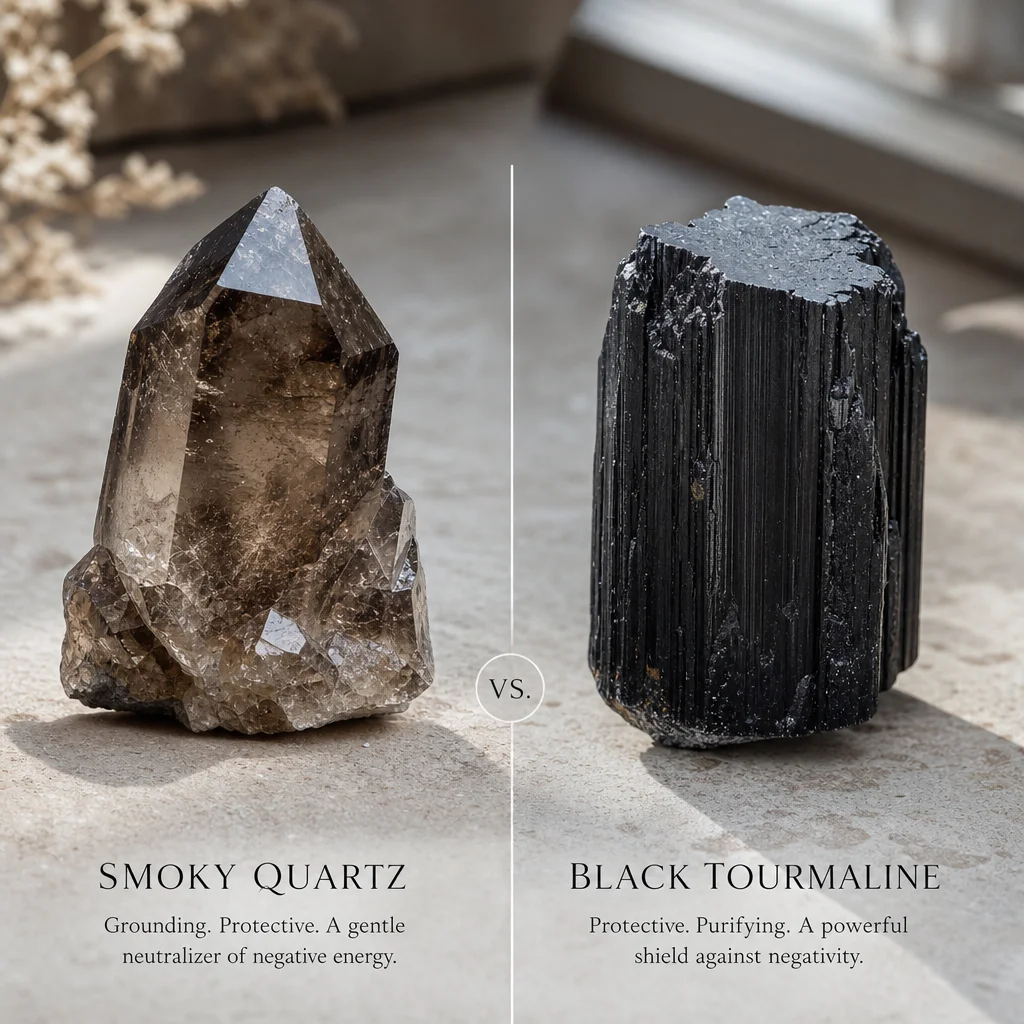
Why People Confuse These Two Stones
If you walk into any crystal shop and ask for "a protection stone," the owner will almost always reach for either smoky quartz or black tourmaline. Both are dark, both are associated with grounding and energetic shielding, and both show up in just about every beginner's starter kit. But treating them as interchangeable misses the point entirely.
Smoky quartz and black tourmaline come from completely different mineral families. They form under different geological conditions, they interact with light differently, and in crystal healing traditions, they approach the idea of "protection" from opposite angles. Understanding these differences isn't just geological trivia — it helps you pick the right tool for what you're actually dealing with, whether that's a stressful work environment, disrupted sleep, or a meditation practice that needs more grounding.
The Science: Two Completely Different Minerals
Smoky Quartz: The Dark Side of the Quartz Family
Smoky quartz is a variety of macrocrystalline quartz, which means it belongs to the same mineral family as clear quartz, rose quartz, amethyst, and citrine. Its chemical formula is silicon dioxide (SiO₂), and it scores a solid 7 on the Mohs hardness scale. The characteristic brown-to-black coloration comes from natural irradiation interacting with trace amounts of aluminum within the crystal lattice. This is a slow geological process that happens deep underground over thousands or millions of years.
What makes smoky quartz distinctive is its translucency. Hold a good-quality piece up to strong light and you'll see warm brown, amber, or root-beer tones filtering through. The darkest specimens, sometimes called "morion," are nearly opaque, but even they tend to have a slight translucency at thin edges. This optical quality is part of why people find smoky quartz visually grounding — there's a warmth to it that pure black stones don't offer.
Black Tourmaline: The Complex Boron Silicate
Black tourmaline, or schorl, belongs to the tourmaline supergroup — an enormously complex family of cyclosilicate minerals with the general formula XY₃Z₆(BO₃)₃Si₆O₁₈(OH,F,OH)₃. Where smoky quartz is chemically simple (just silicon and oxygen with a dash of aluminum), tourmaline contains boron, aluminum, iron, magnesium, lithium, and a host of other elements depending on the specific variety. Black tourmaline specifically gets its color from high iron content.
Tourmaline has a Mohs hardness of 7 to 7.5, making it slightly tougher than smoky quartz for everyday wear. Its most telling physical property is something most people never notice: tourmaline crystals are piezoelectric and pyroelectric. Apply pressure or heat to a tourmaline crystal and it generates a small electrical charge. This isn't mystical — it's well-documented crystal physics. Dutch traders in the 1700s called tourmaline "aschentrekker" (ash drawer) because they noticed the stone attracted ashes when heated near a pipe.
Visually, black tourmaline is opaque and typically more intensely black than smoky quartz. It forms in elongated, vertically striated prismatic crystals that are easy to distinguish from quartz's hexagonal habit once you know what to look for.
How Each Stone "Protects": Different Philosophies
Smoky Quartz: Absorbs and Transmutes
In crystal healing traditions, smoky quartz is considered an absorptive protector. The metaphor goes like this: smoky quartz takes in negative energy, heavy emotions, and stagnant vibes the way a sponge absorbs water. Because it's fundamentally a quartz crystal, it's associated with amplification and transmutation — the idea being that absorbed negativity gets broken down and released rather than simply bouncing back.
This makes smoky quartz particularly popular for people dealing with grief, anxiety, or emotional processing work. If you're going through a rough period and want a stone that "sits with you" through it, smoky quartz is the traditional recommendation. Many practitioners say smoky quartz feels companion-like — supportive rather than defensive.
The grounding aspect of smoky quartz ties to its earth tones. Unlike clear quartz, which is associated with the crown chakra and spiritual connection, smoky quartz is linked to the root chakra and the sense of being physically present. People who feel scattered, dissociated, or mentally overstimulated often report that holding smoky quartz brings a subtle but noticeable settling effect.
Black Tourmaline: Shields and Repels
Black tourmaline takes a fundamentally different approach. Instead of absorbing negativity, the tradition around black tourmaline treats it as a reflective shield. The working metaphor is a mirror or a force field — problematic energy encounters the stone and bounces back or gets deflected away entirely. Tourmaline doesn't "process" what it encounters; it keeps it at arm's length.
This distinction matters when you're choosing a stone for a specific situation. If you work in a toxic environment with difficult people, black tourmaline is the go-to recommendation because it's designed to keep external negativity from reaching you in the first place. If you're processing your own internal difficulties, smoky quartz is generally preferred because it supports rather than blocks.
Black tourmaline also has a stronger association with electromagnetic field (EMF) protection. You'll find it marketed heavily for placement near computers, Wi-Fi routers, and other electronics. While the scientific evidence for this is thin at best, the piezoelectric property of tourmaline (its ability to generate an electric charge under pressure) gives this claim a bit more traction than similar claims made for other stones — though it's still a significant leap from "generates a small charge when squeezed" to "blocks EMF radiation from your phone."
Physical Properties: A Side-by-Side Comparison
Hardness and Durability
Both stones rate between 7 and 7.5 on the Mohs scale, which means they're both suitable for daily-wear jewelry. Neither will scratch easily under normal conditions, and both can survive accidental drops onto hard surfaces most of the time. For bracelets and pendants that see everyday use, durability is a wash between these two.
The main durability difference shows up in crystal specimens rather than cut stones. Smoky quartz has perfect conchoidal fracture (like glass), so when it breaks, it breaks in smooth, curved patterns. Tourmaline has imperfect cleavage, meaning it has natural planes of weakness. A tourmaline crystal is more likely to split along its length than a quartz crystal is to cleave along any specific plane.
Color Range and Transparency
Smoky quartz ranges from pale yellowish-brown to deep morion black, with the most common commercial color being a medium café-au-lait brown. Natural citrine is sometimes misidentified as very light smoky quartz, and heat-treated amethyst can produce smoky-looking stones as well. The best way to confirm you have genuine smoky quartz rather than dyed material is to check for consistent color distribution — natural smoky quartz is usually lighter at the base and darker at the termination, or shows zoning patterns.
Black tourmaline is almost always fully opaque and uniformly black. Some specimens show a slight blue-gray or greenish tint under very bright light, but this is subtle. Unlike smoky quartz, tourmaline is almost never faked or dyed — the market price is low enough that counterfeiting isn't profitable, and the striated crystal habit is distinctive enough that experienced buyers can spot imitations immediately.
Formation and Origin
Smoky quartz forms in hydrothermal veins and pegmatites, often alongside other quartz varieties. Major sources include Brazil, Madagascar, Scotland (the famous Cairngorm Mountains), the United States (Pikes Peak, Colorado), and the Swiss Alps. The irradiation that produces the color can also come from nearby uranium or thorium deposits in the host rock.
Black tourmaline forms in metamorphic rocks and granite pegmatites. The world's best specimens come from Brazil (Minas Gerais), Pakistan, Madagascar, and the United States (San Diego County, California and Maine). Tourmaline crystals in pegmatites can grow impressively large — some black tourmaline prisms reach over a meter in length, though these are museum specimens rather than jewelry material.
Choosing by Use Case
For Your Home or Workspace
Black tourmaline is the standard recommendation for environmental shielding. Place a piece near your front door, on your desk at work, or next to your bed if you live in an apartment with lots of external noise and activity. The idea is that it creates a boundary between your personal space and whatever's happening outside it. Four pieces placed at the cardinal points of a room is a common arrangement in feng shui-influenced crystal practices.
Smoky quartz works well in spaces where you want emotional warmth alongside protection. A living room, a therapy office, or a creative workspace benefit from its more companionable energy. People who find black tourmaline's "blocking" quality too intense often prefer smoky quartz for home use.
For Meditation and Grounding
Both stones support grounding practices, but the experience differs. Smoky quartz tends to produce a sinking, settling sensation — people describe it as feeling "rooted" or "anchored." Black tourmaline creates more of a boundary — practitioners often describe feeling contained or shielded, as if wrapped in a protective layer.
If your meditation practice is about emotional processing, shadow work, or facing difficult feelings, smoky quartz is the better companion. If it's about maintaining energetic boundaries, shielding yourself from overwhelming environments, or developing a sense of personal sovereignty, black tourmaline aligns better with those intentions.
For Daily Wear
For bracelets, the choice often comes down to aesthetics and comfort. Smoky quartz beads tend to be warmer and more versatile with everyday clothing. Black tourmaline beads make a bolder statement and pair well with black, silver, and dark earth tones. Both are durable enough for everyday wear.
One practical consideration: smoky quartz can fade if exposed to prolonged direct sunlight. If you spend a lot of time outdoors, black tourmaline won't have this issue. Store smoky quartz away from windowsills and direct sun to maintain its color long-term.
For Sleep
Smoky quartz is generally preferred for sleep support. Its grounding quality without the intense shielding effect of tourmaline makes it gentler for nighttime use. People who place crystals under their pillows or on nightstands almost always choose smoky quartz over black tourmaline for this purpose — the tourmaline can feel overstimulating when you're trying to wind down.
Combining Both Stones
One of the most effective approaches is to use both stones together rather than choosing one. The traditional combination places black tourmaline at the feet or root area and smoky quartz at the heart or solar plexus during body layouts. This creates a layered effect — tourmaline handles the external shielding while smoky quartz processes whatever internal work needs to happen.
For a simple daily carry, try a smoky quartz pendant with a black tourmaline bracelet, or vice versa. The proximity still allows the two stones to work in tandem without needing a formal crystal layout.
If you're building a crystal grid for protection, combining both is more effective than using either alone. A common arrangement places black tourmaline at the outer boundary of the grid (acting as the shield) and smoky quartz in the center (acting as the transmutation core).
How to Tell Real Stones From Fakes
With smoky quartz, the main concern is irradiated material. Some clear quartz is artificially irradiated to produce smoky color, which isn't inherently problematic (it's the same process, just sped up) but is worth knowing about. Truly natural smoky quartz from established sources like Brazil or Madagascar is easy to find at reasonable prices. Dyed quartz, which might use brown dye to simulate smoky color, can be identified by scratching an inconspicuous area — the dye will come off, revealing clear quartz underneath.
Black tourmaline is rarely faked, but "tourmalinated quartz" is sometimes simulated by embedding dark mineral fragments in clear resin. Genuine tourmalinated quartz contains actual black tourmaline needles suspended within clear or milky quartz — the inclusions should be visible from multiple angles and follow the characteristic striated shape of tourmaline crystals.
The Bottom Line
There's no wrong answer between these two stones, but there is a more effective answer for your specific situation. Choose black tourmaline when you need a barrier between yourself and a hostile or overwhelming environment. Choose smoky quartz when you need support processing heavy emotions, grounding scattered energy, or creating warmth in your space. Choose both when you want comprehensive protection that addresses both external and internal challenges simultaneously.
Either stone makes an excellent addition to a beginner's crystal kit, and most experienced collectors keep both on hand for different purposes. The minerals cost roughly the same per carat for tumbled stones, so the decision comes down to personal resonance and practical need rather than budget.
Frequently Asked Questions
Can I wear smoky quartz and black tourmaline together?
Absolutely. In fact, many practitioners consider this combination more effective than either stone alone. Black tourmaline handles the external shielding while smoky quartz supports internal emotional processing. Try wearing them as a bracelet stack or keeping both on your desk.
Which stone is better for EMF protection?
Black tourmaline is the traditional choice for EMF protection, largely because of its natural piezoelectric properties. However, scientific evidence supporting crystal-based EMF shielding is limited. If this is a concern for you, tourmaline is the stone to go with based on the available (albeit inconclusive) information.
Does smoky quartz fade in sunlight?
Yes, prolonged exposure to direct sunlight can cause smoky quartz to fade. Store your pieces away from windows and strong light. Black tourmaline is not affected by sunlight and can be displayed in bright locations without concern.
Which is more affordable?
For tumbled stones and basic beads, both are similarly priced and very affordable. Large, high-quality smoky quartz crystals (especially from the Scottish Cairngorms) can command premium prices, but for everyday use, you'll spend roughly the same on either stone. Black tourmaline rough specimens from Brazil are among the most affordable crystal materials available.
Frequently Asked Questions
Can you put smoky quartz and black tourmaline in water?
Yes, both smoky quartz and black tourmaline are safe to briefly rinse in water. Because they are relatively hard stones, occasional contact won't damage your handcrafted jewelry. However, we advise against soaking them for extended periods. Prolonged submersion can eventually dull the surface of natural crystals. To safely cleanse your pieces, a quick rinse and gentle pat dry is all you need.
Comments