Why do crystals have different colors? The chemistry behind it
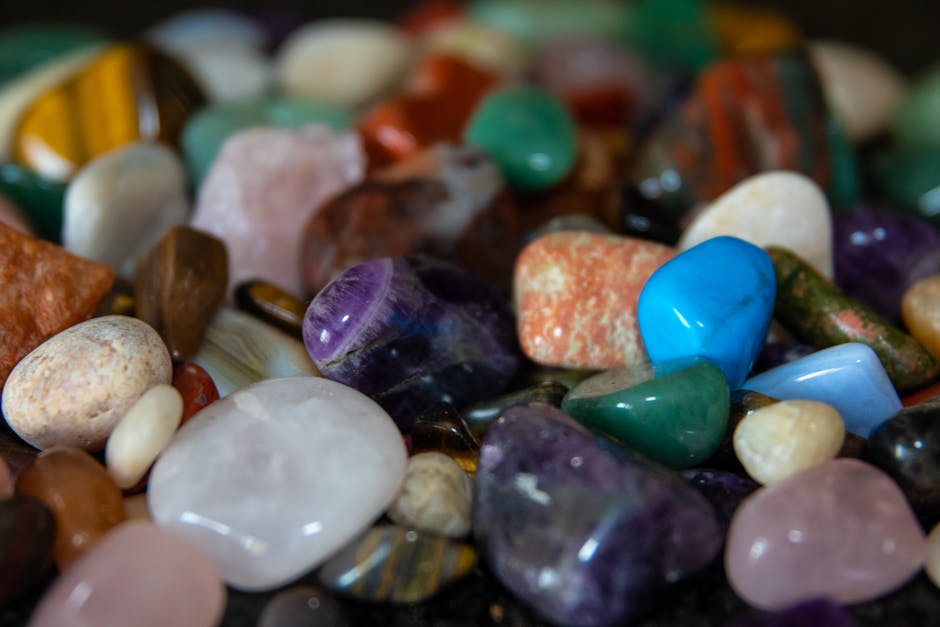
Walk into any crystal shop and the first thing that hits you is color. Racks of purple amethyst, shelves of pink rose quartz, bowls of green aventurine, trays of blue kyanite. It looks like a natural rainbow organized by mineral. The assumption most people make — that different minerals are different colors because they're made of different chemicals — is partially right but mostly missing the point. Because here's the thing: a lot of those differently-colored stones are chemically almost identical.
Amethyst, citrine, smoky quartz, rose quartz, and clear quartz are all the same mineral — SiO₂, silicon dioxide. The same basic crystal structure. The same atoms in the same arrangement. The color differences come from impurities so small they barely register in a chemical analysis. In some cases, the impurity concentration is measured in parts per million. We're talking about a few stray atoms among billions.
This is the central paradox of mineral color: tiny chemical differences can produce dramatic visual differences, while dramatically different chemistry can produce nearly identical colors. Understanding why requires knowing the three main mechanisms that produce color in minerals.
Mechanism one: idiochromatic color — the mineral colors itself
Some minerals are inherently colored because a key element in their chemical formula is a transition metal that absorbs specific wavelengths of light. These are called idiochromatic ("self-colored") minerals. The color is an intrinsic property of the mineral — it doesn't depend on impurities.
Malachite is always green because copper is an essential part of its formula (Cu₂CO₃(OH)₂). Rhodonite is always pink because manganese is essential (MnSiO₃). Peridot (olivine) is always green because iron is an essential component of its crystal structure (Mg₂SiO₄ with Fe substituting for Mg). These minerals cannot be colorless — their color comes from chemistry that's built into the mineral itself.
Altogether, idiochromatic minerals are a minority. Most colored minerals are allochromatic.
Mechanism two: allochromatic color — impurities change everything
Allochromatic ("other-colored") minerals are chemically pure (or nearly pure) and would be colorless if they stayed that way. They get their color from trace impurities — atoms that don't belong in the crystal lattice but got trapped there during formation. These impurity atoms are called chromophores ("color bearers"), and they work by absorbing specific wavelengths of visible light.
This is the mechanism that produces most of the gemstone colors people know and collect.
Corundum (Al₂O₃) in its pure form is colorless. Chromium replacing a small number of aluminum atoms turns it red — that's ruby. Iron and titanium together turn it blue — that's sapphire. Vanadium produces a violet color. Iron alone can produce yellow, green, or padparadscha (pink-orange) depending on the concentration and the charge state of the iron. All of these are corundum. The crystal structure is identical in every case. The only difference is which atoms are sitting in the aluminum sites.
Beryl (Be₃Al₂Si₆O₁₈) tells a similar story. Pure beryl is colorless (called goshenite). Chromium produces emerald green. Iron produces aquamarine blue. Manganese produces morganite pink. Uranium (in tiny amounts) produces heliodor yellow. The base mineral is the same. The chromophore changes everything.
The concentration required is remarkably small. A ruby needs only about 1 to 2% chromium to develop a deep red color. For some color effects in beryl, the impurity concentration is well under 1%. At that level, the impurity atoms are isolated — each chromium atom is surrounded by the normal aluminum atoms of the corundum lattice, with no chromium neighbors. The color comes from the interaction between the isolated chromium atom and the surrounding crystal field, not from chromium-chromium interactions.
Crystal field theory: why impurities absorb light
Here's where it gets interesting from a physics perspective. Transition metal ions (chromium, iron, manganese, titanium, vanadium, cobalt, nickel, copper) have partially filled d-orbitals. When these ions sit inside a crystal lattice, the surrounding oxygen atoms create an electric field — the "crystal field" — that splits the energy levels of the d-orbitals into different groups.
When white light hits the mineral, photons with energies matching the gap between these split d-orbital levels get absorbed. The remaining light — the wavelengths that weren't absorbed — is what reaches your eye and becomes the perceived color.
Here's the critical detail: the same impurity ion can produce completely different colors in different host minerals, because different crystal structures create different crystal field strengths. Chromium in corundum produces red (ruby). Chromium in beryl produces green (emerald). Same chromophore, different color, because the corundum lattice and the beryl lattice split the chromium d-orbitals differently.
This is not an abstract physics curiosity — it's the reason ruby and emerald look nothing alike despite both owing their color to chromium. The host mineral determines the color as much as the impurity does.
Mechanism three: color centers and physical defects
Not all mineral color comes from chemical impurities. Some comes from physical defects in the crystal lattice — missing atoms, extra electrons, or structural irregularities that absorb light. These are called color centers, and they're responsible for some of the most distinctive colors in the mineral world.
Smoky quartz gets its brown-to-black color from color centers, not from iron. Natural radiation (from uranium, thorium, or potassium-40 in surrounding rock) knocks electrons out of their normal positions in the quartz lattice. These displaced electrons get trapped at sites where aluminum atoms have substituted for silicon, creating an absorption band in the visible spectrum that produces the smoky color. Heat the smoky quartz above about 300–400°C, and the electrons return to their normal positions. The color disappears. The crystal structure is undamaged — you just erased the color.
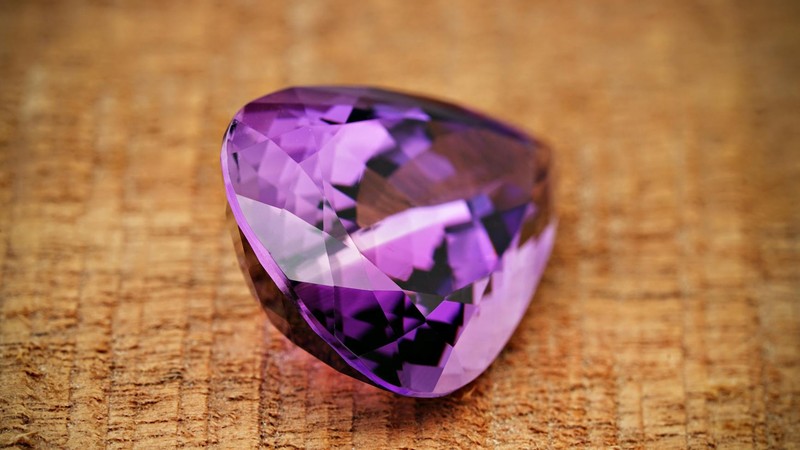
Amethyst works similarly. Iron impurities (Fe³⁺) in the quartz lattice get irradiated, and the radiation converts some of the iron from Fe³⁺ to Fe⁴⁺ with an associated hole (missing electron) trapped nearby. This iron-hole pair absorbs yellow-green light, leaving the purple you see. Heat amethyst to about 470°C, and the color center is destroyed. The amethyst turns yellow or colorless — which is exactly how most citrine is produced commercially.
Maxixe beryl (a deep blue beryl discovered in Brazil in 1917) has a color center that's stable in the dark but fades rapidly in sunlight. The original stones lost their color within days of being brought to the surface. Modern maxixe-type beryl is created by irradiation, but the color still isn't permanent. Color centers are inherently less stable than chromophore-based colors.
Fluorite provides perhaps the most dramatic example of color center variety. Fluorite (CaF₂) comes in virtually every color — purple, blue, green, yellow, pink, colorless, and even black — and many of these colors come from different types of lattice defects and color centers. Some fluorite colors are stable. Others fade with prolonged light exposure. Some specimens even change color when heated or irradiated. A single mineral, one chemical formula, an entire spectrum of colors driven by structural physics.
Inclusions: when the color isn't in the crystal at all
Some minerals look colored, but the color isn't coming from the crystal lattice or from color centers. It's coming from microscopic inclusions of other minerals trapped inside.
Rose quartz gets its pink color from microscopic inclusions of dumortierite, a blue aluminum borosilicate mineral. The dumortierite fibers are so small and so densely distributed that they scatter light to produce a uniform pink appearance. If you examine rose quartz under a microscope, you can see the tiny fibers — but to the naked eye, it looks like the quartz itself is pink.
Blue aventurine quartz gets its color from inclusions of dumortierite or crocidolite (a blue asbestos mineral). Green aventurine gets its color from fuchsite (a chromium-rich mica) inclusions. Red aventurine gets its color from hematite inclusions. In all cases, the host quartz is colorless. The color comes entirely from the included mineral particles.
Sunstone (a variety of oligoclase feldspar) displays a characteristic spangled appearance from tiny platelets of hematite, goethite, or native copper within the stone. These inclusions reflect light in a way that produces a metallic sheen. The aventurescence effect — a glittering or spangled appearance — is purely a physical phenomenon caused by the included particles.
Pleochroism: one stone, multiple colors
Some minerals display different colors when viewed from different angles. This is called pleochroism, and it happens when the crystal structure absorbs different wavelengths of light along different crystallographic directions.
Iolite (cordierite) is the classic example. It can appear violet-blue, pale blue, or nearly colorless depending on the viewing angle. The Vikings supposedly used thin slices of iolite as a polarization filter for navigation — looking through the stone in different directions would reveal the position of the sun on cloudy days. Whether or not that story is accurate, the pleochroic effect is dramatic and easy to observe.
Tanzanite is another strong pleochroic stone, showing blue, violet, and burgundy-red depending on the viewing direction. The cut of a tanzanite is deliberately chosen to show the blue-to-violet face-up view, because that's what the market values. The reddish-brown direction gets hidden on the back of the stone.
Kyanite is unusual because its pleochroism is so strong that the color difference between perpendicular directions can be dramatic — near-colorless in one direction and deep blue in another. It's one of the few minerals where pleochroism is obvious to anyone who picks it up and turns it.
Why any of this matters
Understanding the chemistry of mineral color makes you a better collector and a more informed buyer. When someone tells you that amethyst and citrine are "different stones," you know they're not — they're the same quartz with different color centers, and you can convert one to the other with a kitchen oven and enough time. When a seller markets "strawberry quartz" as a rare variety, you can look at it and ask whether the color is from included iron oxide particles (which it almost always is) or from chromium in the lattice (which would actually be remarkable).
Color is the most immediately obvious property of any mineral, and it's the one most subject to misunderstanding and marketing manipulation. The chemistry behind it is well-established, well-documented, and genuinely fascinating once you get past the idea that it's complicated. It is complicated — but it's the kind of complicated that rewards attention, because once you understand the mechanisms, the entire mineral kingdom makes more sense.
Every colored crystal is a story about physics, chemistry, and geological history, encoded in wavelengths of light. You just need to know how to read it.
Comments