What the Mohs Scale Does Not Tell You About
May 14, 2026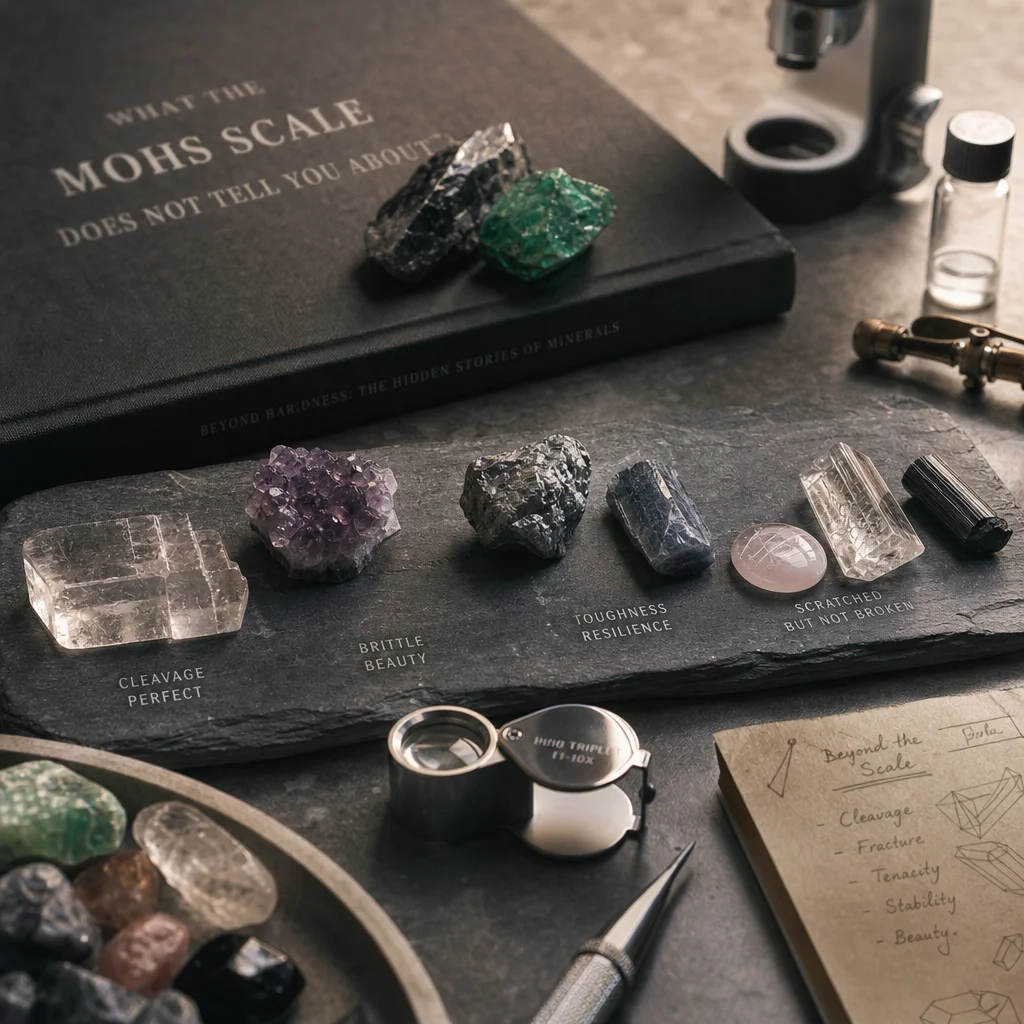
What the Mohs Scale Doesn't Tell You About Your Crystals
Most crystal guides mention the Mohs hardness scale and leave it there. "Quartz is a 7, diamond is a 10." Useful, sure — but only if you understand what those numbers actually mean for daily handling, storage, and cleaning. The scale has real gaps that matter when you own more than one type of stone.
The Logarithmic Reality Nobody Mentions
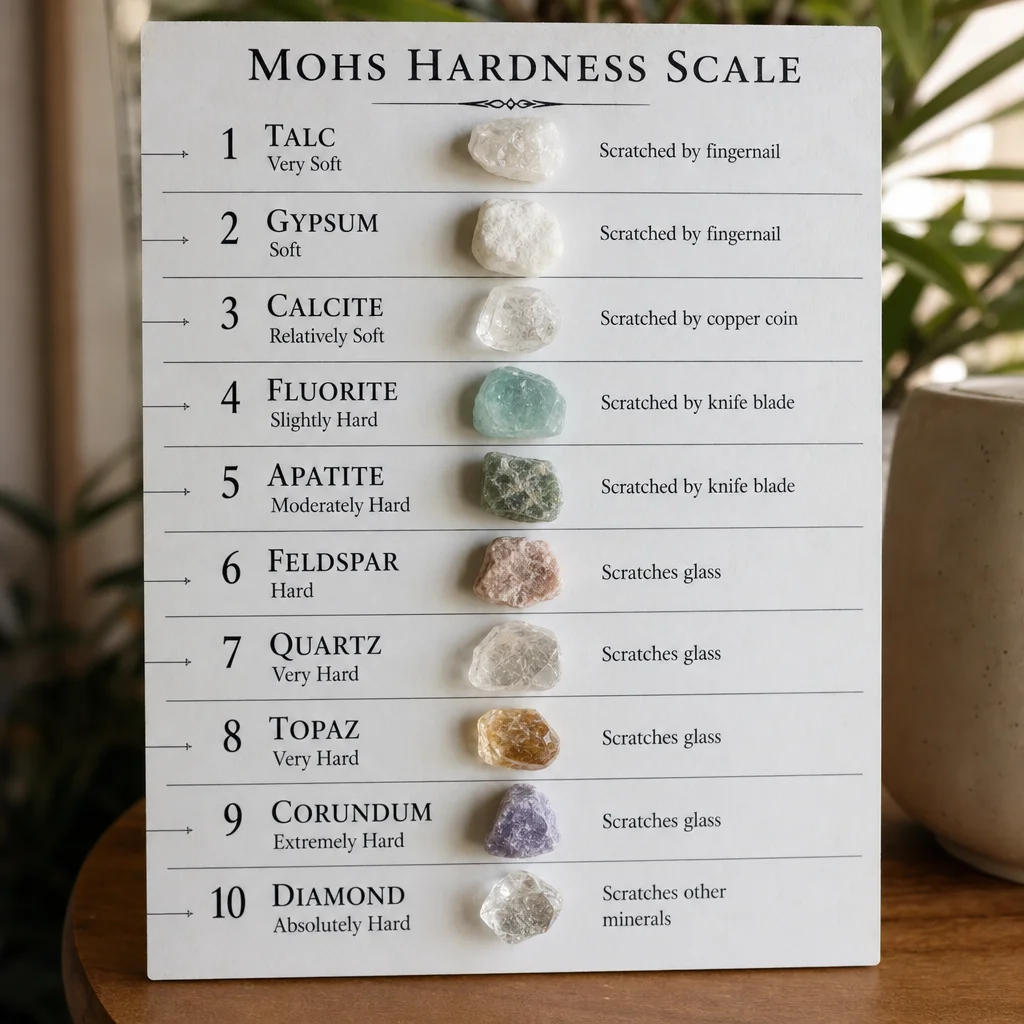
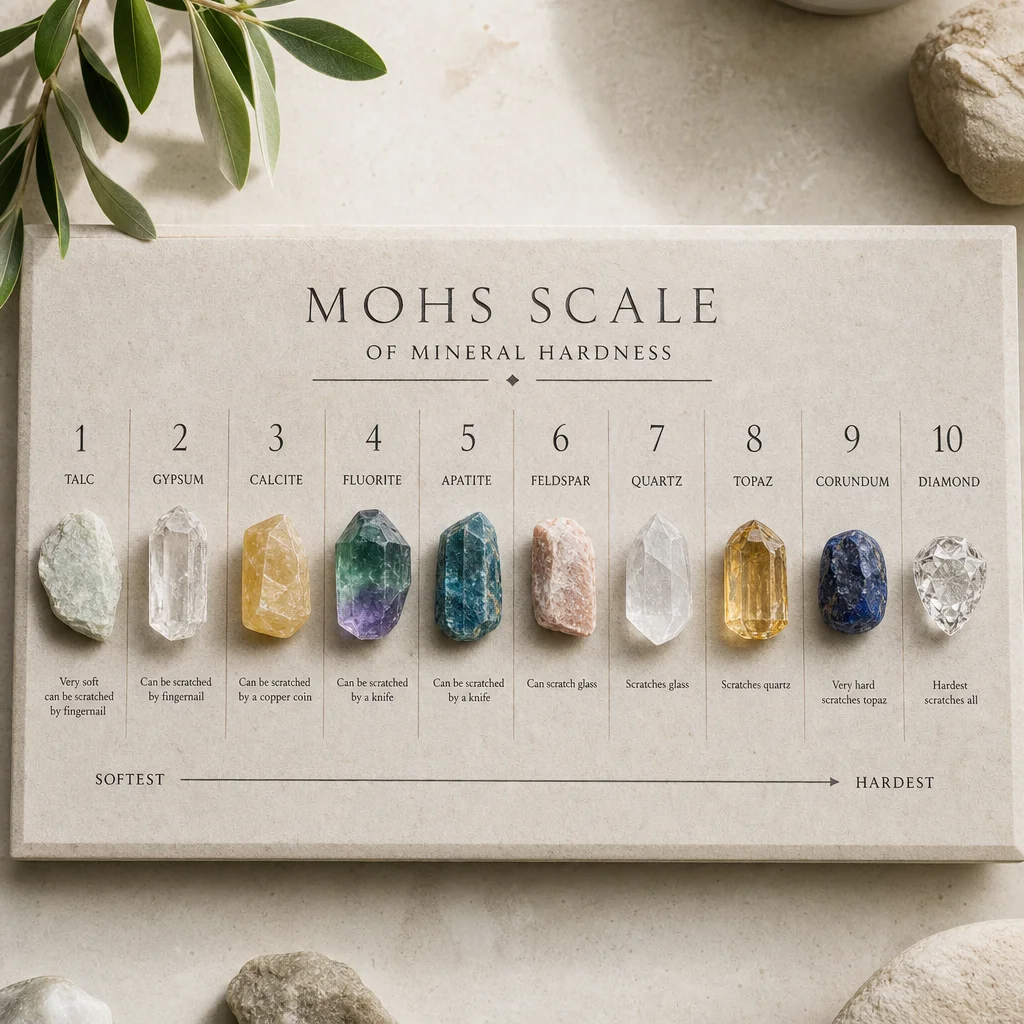
The Mohs scale is ordinal, not linear. The jump from 9 (corundum) to 10 (diamond) represents a fourfold increase in actual hardness. Meanwhile, the difference between 1 and 2 is almost negligible in practical terms. This matters because people assume a "7" is roughly 70% as tough as a diamond. It is not. A 7 scratches a 6 easily. A 10 scratches a 9 with barely more effort.
For collectors, this means the real danger zones are between adjacent numbers, not the extremes. Your fluorite (4) will scratch your calcite (3) if they rub together in a storage box, even though both seem "soft" relative to quartz.
Hardness Changes With Direction
Here is something most reference charts skip: kyanite has two different hardness values depending on which axis you test. Along its length, it registers around 4.5 to 5. Across the width, it hits 6.5 to 7. This is called directional hardness, and it is not unique to kyanite. Disthene, the mineral kyanite was once called, literally means "two strengths."
Practical takeaway: if you drop a kyanite blade, it might chip differently depending on the angle of impact. Wrapping it along its length protects the weaker axis.
Toughness Is Not Hardness
This distinction causes more damage than anything else in crystal collections. Hardness measures scratch resistance. Toughness measures resistance to breaking, chipping, or shattering. They are completely different properties.
- Nephrite jade scores only 6-6.5 on Mohs but is exceptionally tough — early civilizations made weapons from it for good reason.
- Topaz ranks 8 on Mohs but has perfect cleavage in one direction. A light tap at the wrong angle splits it cleanly in two.
- Diamond at 10 is the hardest natural material but has cleavage planes. Diamond cutters exploit these exact planes to split rough stones with a single precise strike.
If you store topaz and jade together, the jade will not scratch the topaz. But if the box gets jostled, the topaz is far more likely to chip.
Why Your Opal Keeps Cracking
Opal sits around 5.5-6.5 on Mohs, which seems reasonable. But opal contains up to 20% water. It is not just soft — it is hydroscopic and thermally sensitive. An opal that dries out develops crazing (a network of tiny cracks) regardless of how carefully you handle it physically. No amount of protective padding stops chemical degradation.
People blame themselves when an opal cracks in storage. Often the real cause was the heating vent nearby, or a particularly dry winter, not mishandling.
The Cleavage Trap
Cleavage describes how a crystal breaks along flat, smooth planes dictated by its atomic structure. Minerals with perfect cleavage break cleanly; those without fracture unevenly. This matters enormously for display and storage:
- Fluorite (Mohs 4) has perfect octahedral cleavage — it splits into triangle-based pyramids under pressure.
- Calcite (Mohs 3) has perfect rhombohedral cleavage in three directions.
- Galena (Mohs 2.5) cubes itself apart along three perfect planes.
If you stack these minerals, their own weight can initiate cleavage over time. Store them flat, not standing on edges.
What About Stability?
Hardness and toughness are mechanical properties. Stability is chemical — how well a mineral resists light, heat, moisture, and chemical exposure. A stone can be hard, tough, and still fall apart from environmental factors:
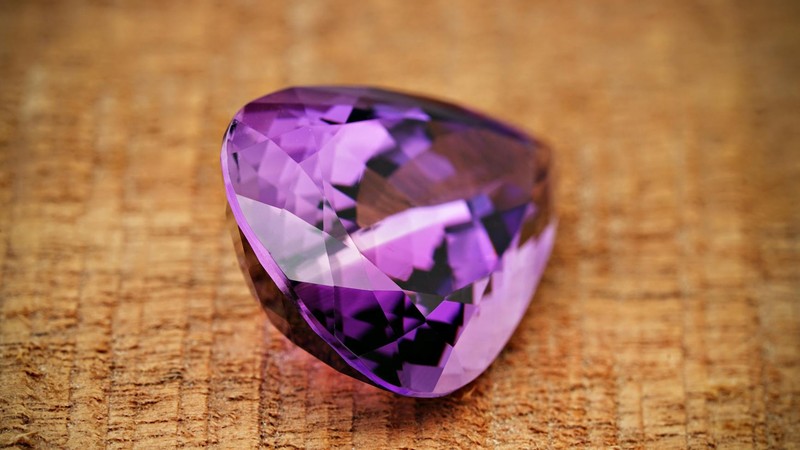
- Amethyst fades under prolonged UV exposure despite being a 7 on Mohs.
- Pyrite (Mohs 6-6.5) develops "pyrite disease" in humid conditions, slowly crumbling to sulfuric acid and iron sulfate.
- Realgar (Mohs 1.5-2) converts to powder (pararealgar) under ordinary indoor lighting over months.
Museums store realgar in complete darkness. Most crystal shops do not.
Practical Storage Pairings
Based on actual mineral properties, here are safe and unsafe pairings most guides never mention:
Safe Together
- Quartz varieties (amethyst, citrine, rose quartz, smoky quartz, milky quartz)
- Feldspar group (moonstone, labradorite, sunstone, amazonite)
- Beryl family (emerald, aquamarine, morganite — though emerald needs extra care due to inclusions)
Never Store Together
- Calcite + anything harder than 3 (almost everything)
- Selenite + water-adjacent stones (selenite dissolves)
- Pyrite + anything in humid conditions
- Malachite + acids (including acidic skin oils from frequent handling)
Testing Hardness at Home Safely
You do not need a professional kit to get useful hardness data. A few common objects cover the key thresholds:
- Fingernail (2.5) — scratches talc and gypsum
- Copper coin (3-3.5) — scratches calcite
- Steel knife (5.5) — scratches apatite and below
- Glass plate (5.5) — same threshold, useful because you can see the scratch clearly
- Quartz point (7) — scratches feldspar and below
Always test on an inconspicuous area. Draw the test material across the specimen with light pressure, then blow away dust and check for a permanent groove. A visible streak that wipes away is not a scratch — it is residue from the softer material.
When Hardness Matters Most
Three scenarios where Mohs hardness directly impacts your collection:
Jewelry Wear
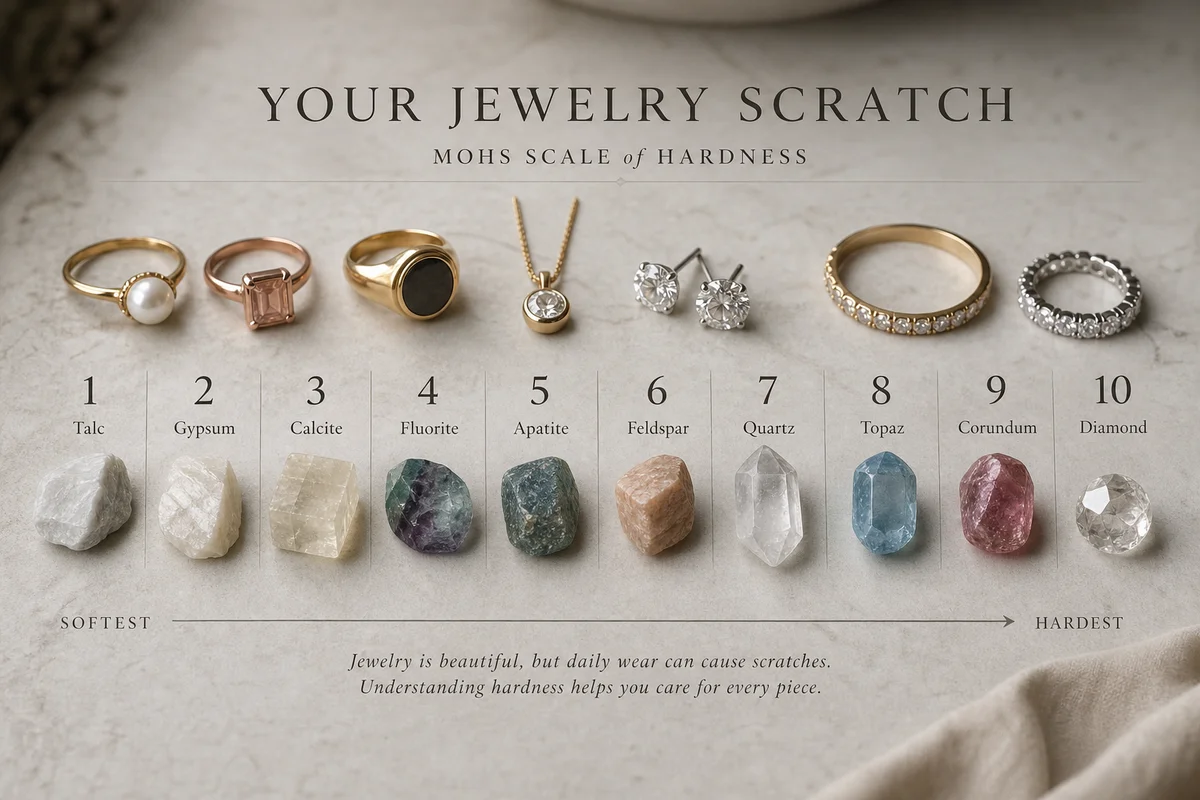
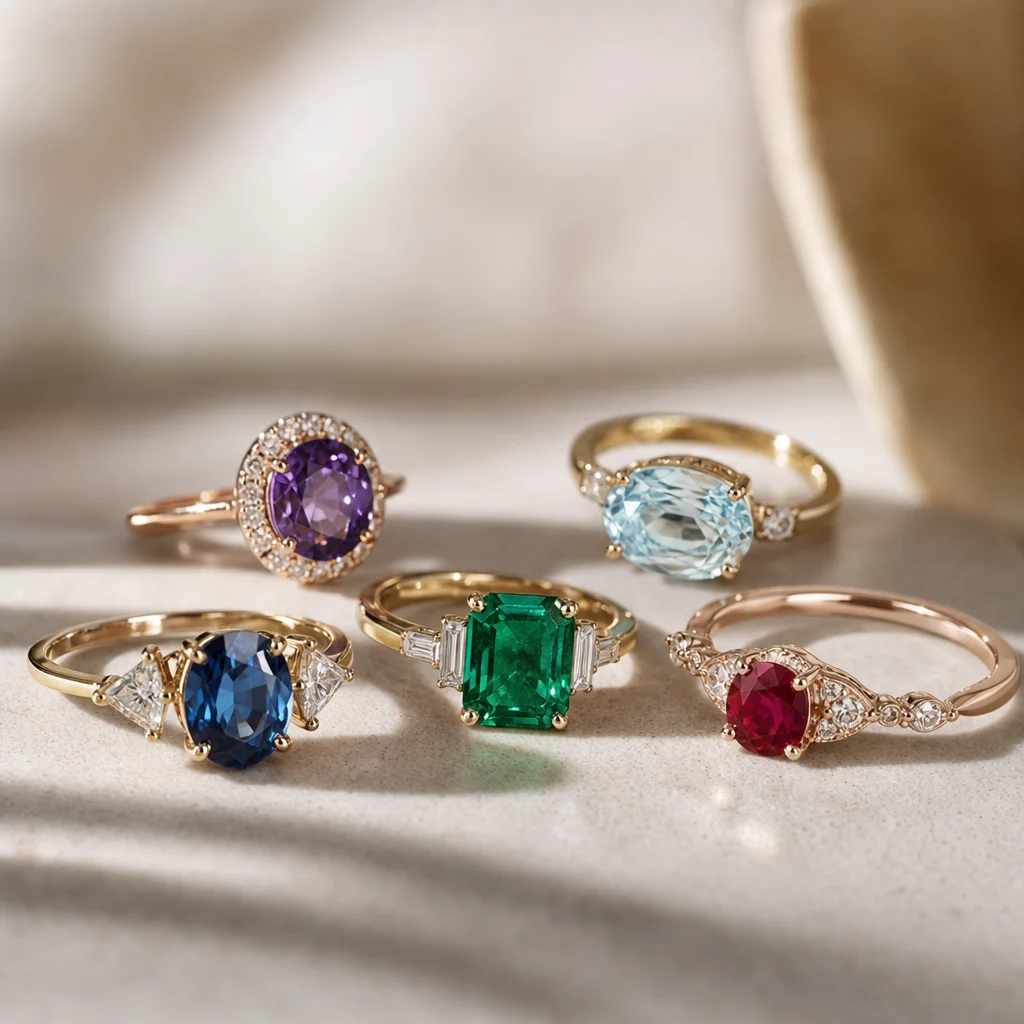
Rings take daily abuse. A stone below 7 on Mohs will accumulate micro-scratches from dust (mostly quartz particles) within months of daily wear. Opal rings, turquoise rings, and moonstone rings all show this pattern. Pendant and earring stones face less abrasion, so hardness matters less.
Crystal Elixirs
Soft or water-soluble minerals should never go directly in drinking water. Selenite (2), halite (2-2.5), and celestine (3-3.5) dissolve or leach. The indirect method — placing the stone beside the water rather than in it — works for any mineral regardless of hardness.
Tumbling
Successful rock tumbling requires stones within roughly 1-2 Mohs points of each other. Mix a 7 (quartz) with a 3 (calcite) and the calcite will be dust before the quartz even rounds. This is why most tumbling mixes are single-mineral or carefully curated pairs.
Beyond Mohs: Other Scales Worth Knowing
The Mohs scale dominates hobbyist references, but professionals also use:
- Vickers hardness — measures indentation resistance with a diamond pyramid. Gives precise numerical values rather than ordinal rankings.
- Rockwell hardness — common in metallurgy, less useful for minerals.
- Absolute hardness (Rosiwal) — converts Mohs to linear values. Shows that diamond is roughly 1,500 times harder than talc, not 10 times.
For crystal collectors, the Rosiwal conversion is most enlightening. It reveals just how deceptive the 1-10 Mohs numbers are. Talc (1) to gypsum (2) is barely a change. Corundum (9) to diamond (10) is a chasm.
Summary: A Better Mental Model
Instead of memorizing Mohs numbers in isolation, group your collection by behavioral traits:
- Soft and soluble (selenite, halite, hanksite) — handle with gloves, store dry, never submerge
- Soft but stable (calcite, fluorite, rhodonite) — scratch risk from harder neighbors, handle carefully
- Hard but fragile (topaz, diamond, fluorite crystal clusters) — cleavage risk, pad individually
- Hard and tough (quartz, jade, agate) — the lowest-maintenance group, suitable for daily wear and rough handling
- Chemically unstable (pyrite, realgar, amber) — environmental control matters more than physical protection
This framework tells you more about storage, cleaning, and display decisions than any single Mohs number ever could. The scale is a starting point, not the whole picture.
For a comprehensive overview, see our Ultimate Crystal Guide for Beginners.
Understanding Crystal Luster: A Key Factor Often Overlooked
While hardness and toughness are crucial, the luster of a crystal is equally important. Luster describes how light reflects off the surface of a mineral. It can range from metallic to pearly, glassy, silky, and even dull. This characteristic not only affects the aesthetic appeal but also provides clues about the mineral's composition and formation process.
For example, the luster of malachite is rich and velvety, which is a sign of its composition of copper and lime. Conversely, a glassy luster in quartz can indicate a higher purity level. Knowing your crystal's luster can help you differentiate between similar-looking minerals and appreciate the unique qualities of each stone.
Crystal Transparency: More Than Meets the Eye
Transparency is another property often overlooked in the Mohs scale discussion. It refers to how light passes through a crystal. Crystals can be transparent, translucent, opaque, or even phantasmagoric. Understanding transparency can help you determine the best use for a crystal in your collection.
- Transparent crystals, like diamonds and sapphires, allow light to pass through and are perfect for use in jewelry.
- Translucent crystals, like moonstone, are ideal for meditation and divination due to their ethereal appearance.
- Opaque crystals, like obsidian, are often used for protective purposes, as they do not allow light to pass through.
Transparency also plays a role in crystal healing, as it can influence the flow of energy through the stone.
Crystal Formation and the Environmental Influence
Crystal formation is a fascinating process influenced by environmental factors such as temperature, pressure, and the presence of other minerals. This unique process results in a wide variety of crystal shapes and structures, each with its own unique properties.
For instance, moss agate forms in sedimentary rock layers and often contains inclusions that resemble moss or vegetation, hence its name. On the other hand, citrine forms in geodes and is typically a yellow or gold color, representing abundance and prosperity.
Understanding the geological history behind your crystals can deepen your appreciation for their natural beauty and enhance your ability to choose stones that resonate with you.
Crystal Healing and Personal Resonance
While we must avoid medical/energy/healing claims, it's worth discussing the cultural and historical perspectives of crystal healing. Crystals have been used for thousands of years for various purposes, from spiritual rituals to physical healing. The concept of crystal healing is based on the belief that each crystal emits a specific energy vibration that can influence our well-being.
When selecting crystals for healing purposes, it's essential to consider not only their properties but also your personal resonance with them. For example, if you're drawn to the deep blue of labradorite, you might find that it enhances your intuition and emotional balance.
Expert Tips for Crystal Care
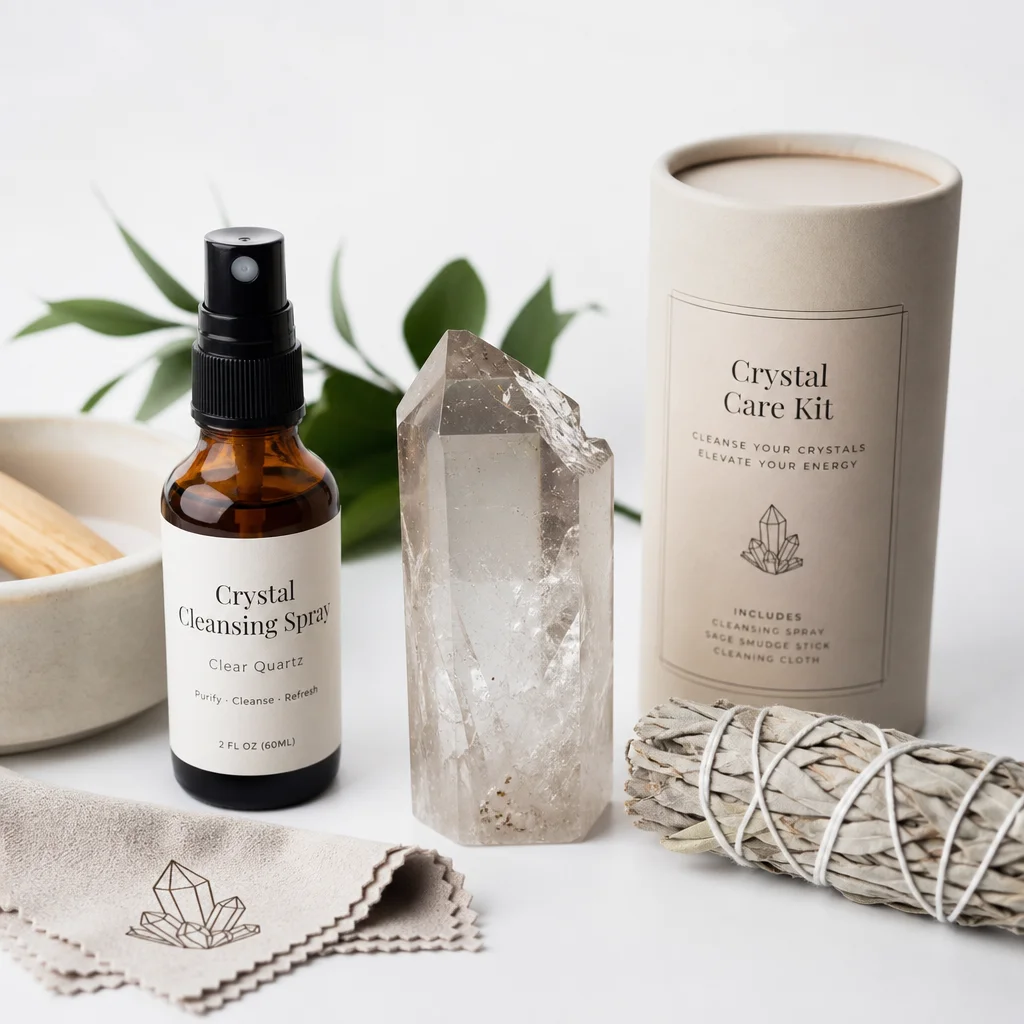
- Clean Your Crystals Gently: Use a soft cloth and water for cleaning, or a solution of warm water and mild dish soap. Avoid abrasive cleaners and never soak crystals that are sensitive to water.
- Store Your Crystals Properly: Store your crystals in a cool, dry place away from direct sunlight and other harsh environmental factors. Consider using a crystal storage box or soft pouch to protect them from scratches and breakage.
- Avoid Extreme Temperatures: Sudden temperature changes can cause cracks or even shattering in some crystals. Keep your collection away from heating vents and air conditioning units.
- Respect the Energy of Your Crystals: Treat your crystals with care and respect. They are natural, living entities that respond to your energy. Spend time with your crystals and get to know them.
Common Mistakes to Avoid in Crystal Care
- Overcleaning: Some crystals are sensitive to cleaning solutions and water. Overcleaning can cause damage, so always use the appropriate method for each type of stone.
- Ignoring the Importance of Storage: Proper storage is crucial for maintaining the integrity of your crystal collection. Neglecting this aspect can lead to scratches, breakage, or even loss of luster.
- Assuming All Crystals Are Durable: Not all crystals are as tough as they may look. Some, like opal and moonstone, require special care and handling to avoid damage.
- Using Harsh Chemicals: Harsh chemicals can cause permanent damage to crystals. Always opt for gentle cleaning solutions and methods.
- Ignoring Environmental Factors: Environmental factors like temperature and humidity can impact the longevity of your crystal collection. Be mindful of these elements and take appropriate precautions.
FAQ Section: Common Questions About Crystal Care
Can I use soap and water to clean my crystals?
Can I use soap and water to clean my crystals?
Yes, you can use warm water and mild dish soap to clean your crystals. However, be sure to rinse them thoroughly and pat them dry with a soft cloth to avoid any soap residue.
Are all crystals sensitive to water?
Are all crystals sensitive to water?
No, not all crystals are sensitive to water. However, some, like opal and malachite, can be damaged by water. Always check the specific care instructions for each type of crystal before cleaning them.
How often should I clean my crystal collection?
How often should I clean my crystal collection?
The frequency of cleaning depends on how often you handle your crystals and their environment. A general guideline is to clean your crystals every few months, or more often if they become visibly dirty.
Can I use ultrasonic cleaners for my crystals?
Can I use ultrasonic cleaners for my crystals?
No, ultrasonic cleaners are not suitable for all crystals. Some stones, like opal and jade, can be damaged by the intense vibration and heat generated by ultrasonic cleaners. Always check the care instructions before using an ultrasonic cleaner on your crystals.
How do I know if a crystal is genuine?
How do I know if a crystal is genuine?
Identifying genuine crystals can be challenging, especially for beginners. Look for the following signs: consistent color, clarity, and luster; a solid, natural-looking structure; and no visible signs of paint or dye. It's always best to purchase crystals from reputable sources and ask for certification if possible.
Comparison Table: Crystal Hardness vs. Scratch Resistance
| Crystal | Mohs Hardness | Scratch Resistance |
|---|---|---|
| Quartz | 7 | Good |
| Apatite | 5 | Fair |
| Amber | 2.5-3 | Poor |
| Diamond | 10 | Excellent |
| Opal | 5.5-6.5 | Variable |
Final Thoughts
Crystals are not just beautiful objects; they are complex, living entities with a rich history and diverse properties. By understanding the nuances of crystal care and the various factors that influence their appearance and behavior, you can appreciate and care for your collection to the fullest. Remember to respect the natural beauty and energy of your crystals and enjoy the journey of learning more about these fascinating stones.
Comments