Birthstone Engagement Rings: A Complete Guide to Going Non-Traditional
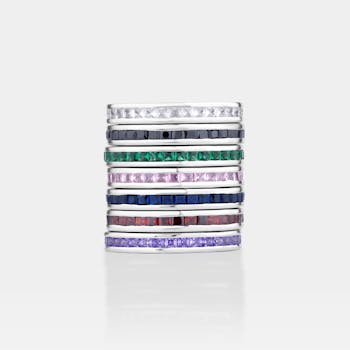
Diamonds Are Great, But They're Not the Only Option
When my sister got engaged last year, she showed me the ring and I said "oh that's beautiful" while thinking "I have no idea what stone that is." It turned out to be a sapphire — her birthstone — and she'd spent weeks picking it out after deciding she didn't want a diamond. Her now-husband was relieved. He'd been stressing about diamond prices and felt weird about the whole industry.
Birthstone engagement rings aren't new, but they've gotten way more common in the past few years. The diamond industry would prefer you not know this, but a growing number of couples are choosing stones that have personal meaning instead of defaulting to the traditional diamond solitaire.
If you're considering a birthstone engagement ring — or just curious about the option — here's what you need to know before you start shopping.
What Makes a Good Engagement Ring Stone?
Not every birthstone can handle daily wear as a ring. Engagement rings take more abuse than almost any other piece of jewelry. They're on your hand 24/7, exposed to water, soap, cleaning chemicals, door handles, keyboards, and everything else your hands touch. The stone needs to be tough enough to survive all of that without chipping, scratching, or falling out.
Two factors determine this: hardness (measured on the Mohs scale) and toughness (resistance to breaking or chipping). They're different things. Diamond is the hardest natural material (Mohs 10) but can still chip if hit at the right angle along its cleavage plane. Jade is relatively soft (Mohs 6-7) but extremely tough — it's hard to break.
For an engagement ring, you want a stone that scores at least a 7 on the Mohs scale and has good toughness. That narrows the field significantly.
The Birthstones That Work (And the Ones That Don't)
January: Garnet (Mohs 6.5-7.5)
Garnet is borderline for daily wear. The Mohs hardness range is wide because there are many types of garnet — almandine and pyrope are harder (7-7.5), while spessartine is softer (6.5-7). A harder garnet variety can work for an engagement ring, especially in a protective setting like a bezel. But it's not as durable as sapphire or diamond, and it will show scratches over time.
The color range is a plus. Most people think of garnet as dark red, but it comes in almost every color, including rare green tsavorites that look incredible in ring settings. If you're set on a January birthstone, go for a harder variety and a protective setting.
February: Amethyst (Mohs 7)
Amethyst is right at the minimum hardness for daily wear. It'll work as an engagement ring, but it's not ideal. The main risk is chipping — amethyst has good hardness but only fair toughness. A hard knock against a countertop edge or door frame can chip it.
The other issue is color. Amethyst fades with prolonged sun exposure. Since you'll be wearing this ring every day, that's a real concern. Keep it out of direct sunlight when you're not wearing it.
If you love amethyst and want it as an engagement stone, choose a setting that protects the stone (bezel or halo with protective prongs) and be prepared to be more careful with it than you'd need to be with a sapphire.
May: Emerald (Mohs 7.5-8)
This one's tricky. Emerald has decent hardness (7.5-8) but poor toughness. Almost all natural emeralds have internal inclusions (called "jardin" in the trade) that create structural weaknesses. They chip and crack more easily than almost any other commonly used gemstone.
Jewelers know this, which is why emeralds in rings are almost always set in protective styles with minimal prong exposure. Even with careful setting and careful wear, emeralds are higher-maintenance than sapphires, rubies, or diamonds.
If emerald is your birthstone and you want it for an engagement ring, it can work — but go in with realistic expectations. Consider a lab-grown emerald (fewer inclusions, slightly tougher) or an emerald-cut diamond as an alternative if you like the look but want more durability.
June: Alexandrite or Pearl (Mohs 8.5 or 2.5-4.5)
June has two birthstones, and they're worlds apart in durability.
Alexandrite is excellent for engagement rings — it's hard (8.5), tough, and has the bonus of changing color under different lighting (green in daylight, red under incandescent light). The problem is price and availability. Natural alexandrite is rare and expensive. Lab-grown alexandrite is more accessible and still has the color-change effect, though the colors tend to be less vivid.
Pearl is absolutely not suitable for a daily-wear engagement ring. Pearls are soft (2.5-4.5 on the Mohs scale), sensitive to chemicals, easily scratched, and can dissolve in acidic environments (including perfume and some skin types). Save pearls for earrings and necklaces.
September: Sapphire (Mohs 9)
Sapphire is the best non-diamond option for engagement rings. Full stop. It's nearly as hard as diamond (9 vs 10), it's tough, it comes in every color (not just blue — yellow, pink, green, and white sapphires are all natural), and it's been used in royal engagement rings for centuries.
Princess Diana's engagement ring (now Kate Middleton's) is a sapphire. That single ring probably did more to normalize non-diamond engagement rings than anything else in modern history.
Sapphires are also more affordable than diamonds of similar size and quality. You can get a beautiful 1-carat sapphire engagement ring for significantly less than a 1-carat diamond of equivalent clarity and color. The value proposition is strong.
October: Opal or Tourmaline (Mohs 5.5-6.5 or 7-7.5)
Opal is not great for daily wear. It's soft (5.5-6.5), contains water (which means it can crack if it dries out), and is sensitive to temperature changes. Beautiful, but better suited to occasional-wear pieces.
Tourmaline is a better option. At 7-7.5 on the Mohs scale, it's similar to garnet — workable for daily wear but not as tough as sapphire. Tourmaline comes in an incredible range of colors (the name comes from the Sinhalese word for "mixed colors"), and some varieties like Paraíba tourmaline are genuinely stunning.
December: Turquoise, Zircon, or Tanzanite
December has three birthstones, and turquoise (Mohs 5-6) and tanzanite (Mohs 6-7) are both too soft for daily ring wear. They'll scratch and chip.
Zircon (not cubic zirconia — that's a different thing entirely) is the standout here. Blue zircon has a Mohs hardness of 6-7.5, which puts it in the "possible but not ideal" range. High-zircon specimens are harder (up to 7.5) and can work for an engagement ring in a protective setting. The color is similar to blue topaz or aquamarine, and it has impressive fire (the way it splits light into spectral colors).
Settings Matter As Much As the Stone
A good setting can make a borderline stone work for daily wear. A bad setting can ruin even a durable stone.
Bezel settings wrap the metal around the stone's edge, protecting it from side impacts. This is the safest setting for softer stones. The trade-off is that less of the stone is visible, and it can look bulkier.
Halo settings surround the center stone with smaller diamonds or other stones. They provide some protection and make the center stone look larger. Good for stones in the 7-8 Mohs range.
Prong settings hold the stone with minimal metal contact, showing off the most of the stone. Standard for diamonds and sapphires. Risky for softer stones because they're more exposed to impacts.
Channel settings set the stone into a groove in the band. Very protective but usually used for accent stones rather than center stones.
The Cost Question
Birthstone engagement rings are often cheaper than diamond equivalents, but not always. A high-quality alexandrite, emerald, or Paraíba tourmaline can cost as much as or more than a diamond. Sapphires and garnets tend to be more affordable. Amethyst and turquoise are the budget options.
The real savings come from not feeling pressured to buy a specific carat weight or clarity grade. Diamond pricing follows rigid tiers based on the 4 Cs, and crossing a threshold (like going from 0.99 to 1.00 carat) can mean a significant price jump. Colored gemstone pricing is more fluid and based more on overall appearance and personal preference.
What If Your Birthstone Isn't Ring-Friendly?
Some months just don't have great options for daily-wear rings. If your birthstone is pearl, opal, or turquoise, you have alternatives:
Use the birthstone as an accent stone around a more durable center stone. Set the birthstone in a pendant or earrings instead of the ring. Choose a lab-created version, which can sometimes be harder or more durable than the natural stone. Pick a different stone entirely and don't stress about the birthstone thing.
The engagement ring should work for your life, not the other way around.
Resale and Long-Term Value
Diamonds hold resale value better than most colored gemstones. This isn't because diamonds are inherently more valuable (they're not, really — the market is heavily controlled) but because there's an established secondary market with clear pricing benchmarks.
Colored gemstones are harder to resell because pricing is less standardized. A sapphire you bought for $2,000 might resell for $500-1,500 depending on the buyer and the market. An emerald's value depends heavily on treatment (oiled vs. untreated) and origin (Colombian vs. other).
If resale value matters to you, sapphire is the best non-diamond option. If it doesn't, buy what you love and don't worry about what it'll be worth in 20 years.
The Bottom Line
Birthstone engagement rings work well for some months (September sapphire is essentially perfect) and require compromises for others (June pearl is a non-starter). The key is matching the stone to your lifestyle, choosing an appropriate setting, and being honest about how hard you are on your jewelry.
The best engagement ring stone is the one that means something to you and holds up to how you actually live. If that's a diamond, great. If it's a sapphire in your favorite color, also great. If it's an emerald in a bezel setting because you love green and you're willing to be careful, that works too.
Comments