Why Some Labradorite Glows: Flash Explained
May 29, 2026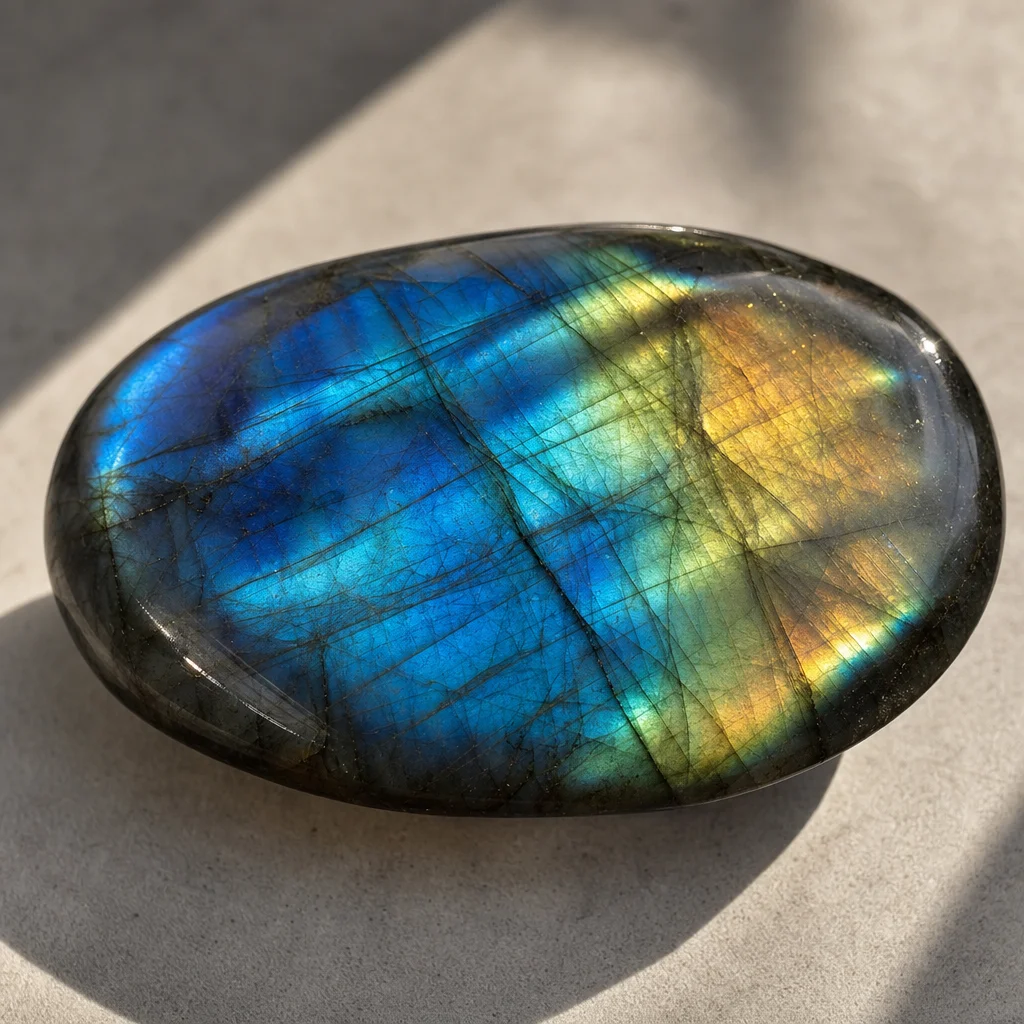
You have seen it happen. Someone picks up a dull gray stone, tilts it under the light, and suddenly a sheet of electric blue fire rolls across the surface. They tilt it back and the color vanishes — just gray rock again. That is labradorescence, and it is one of the most dramatic optical effects in the mineral world.
But not every piece of labradorite does this. Some flash brilliantly, some barely glow, and some sit there stubbornly gray no matter how you angle them. The difference comes down to geology, crystal structure, and — when it comes to the stone you are holding — the skill of the person who cut it.
What Labradorescence Actually Is
Labradorescence is not fluorescence (which requires UV light) or iridescence (which is a surface thin-film effect). It is a type of schiller — an optical phenomenon caused by light interacting with internal structures in the stone.
Labradorite is a plagioclase feldspar with the approximate formula (Ca,Na)(Al,Si)₄O₈. As the crystal grows, it sometimes develops microscopic lamellae — alternating layers of slightly different chemical composition within the same crystal. These layers form during a process called "exsolution," where the crystal structure separates into calcium-rich and sodium-rich zones as it cools from its formation temperature.
The layers are incredibly thin — typically 100 to 300 nanometers apart, which happens to be close to the wavelength of visible light. When white light enters the stone and hits these layers, some light reflects off each boundary. The reflected waves interfere with each other: wavelengths that are in phase add together and become brighter, while wavelengths that are out of phase cancel out.
The result is that you see specific colors reflected back — but only at specific angles. Move the stone a few degrees, and different wavelengths constructively interfere, showing you a different color or no color at all.
Why the Flash Varies So Much
Three factors determine how much flash a piece of labradorite shows:
1. The Internal Layering
Not all labradorite has well-developed exsolution lamellae. The layering depends on the exact composition and cooling history of the individual specimen. Slowly cooled labradorite from certain deposits develops thicker, more regular lamellae that produce strong, coherent color flashes. Rapidly cooled material may have thin or irregular layering that produces weak or muddy colors.
This is why locality matters. Labradorite from Madagascar and Finland (spectrolite) tends to have better-developed layering than material from some other sources. But even within a single deposit, there is enormous variation — two pieces from the same mine can look completely different.
2. The Cut Orientation
This is the factor most people overlook, and it is the one that makes the biggest practical difference.
Labradorescence depends on the angle between the viewer, the light source, and the orientation of the internal lamellae. A skilled cutter aligns the finished face of the stone so that it is roughly parallel to the lamellae layers. This maximizes the surface area that can show color flash at normal viewing angles.
If the cutter is inexperienced — or if the rough material was inexpensive and cut quickly in a factory — the face might be oriented at a suboptimal angle. The stone has the internal structure for a great flash, but the cut does not align with it. The result is a piece that shows color only at awkward angles that nobody naturally holds it at.
You can test this. Take a piece of labradorite and slowly rotate it under a single light source. Note the angle at which you see the strongest flash. If you have to hold the stone nearly perpendicular to your line of sight to see color, the cut is poorly oriented. A well-cut piece shows strong color when held at a comfortable viewing angle.
3. Background Color and Transparency
The base color of labradorite ranges from nearly black to dark gray to light gray. Darker base material provides better contrast for the color flash — bright blue or gold against a dark background is visually more striking than the same colors against a light gray background.
Some high-end labradorite has a semi-translucent quality where light penetrates a few millimeters into the stone before reflecting off the lamellae. This gives the flash a sense of depth — the color seems to float inside the stone rather than sitting on the surface. Opaque material with surface-level flash can still be attractive, but it lacks that three-dimensional quality.
Colors of Labradorite Flash
Blue is the most common and widely available color. Blue flash labradorite from Madagascar is abundant and affordable. The blue ranges from pale sky blue to deep electric blue to blue-violet.
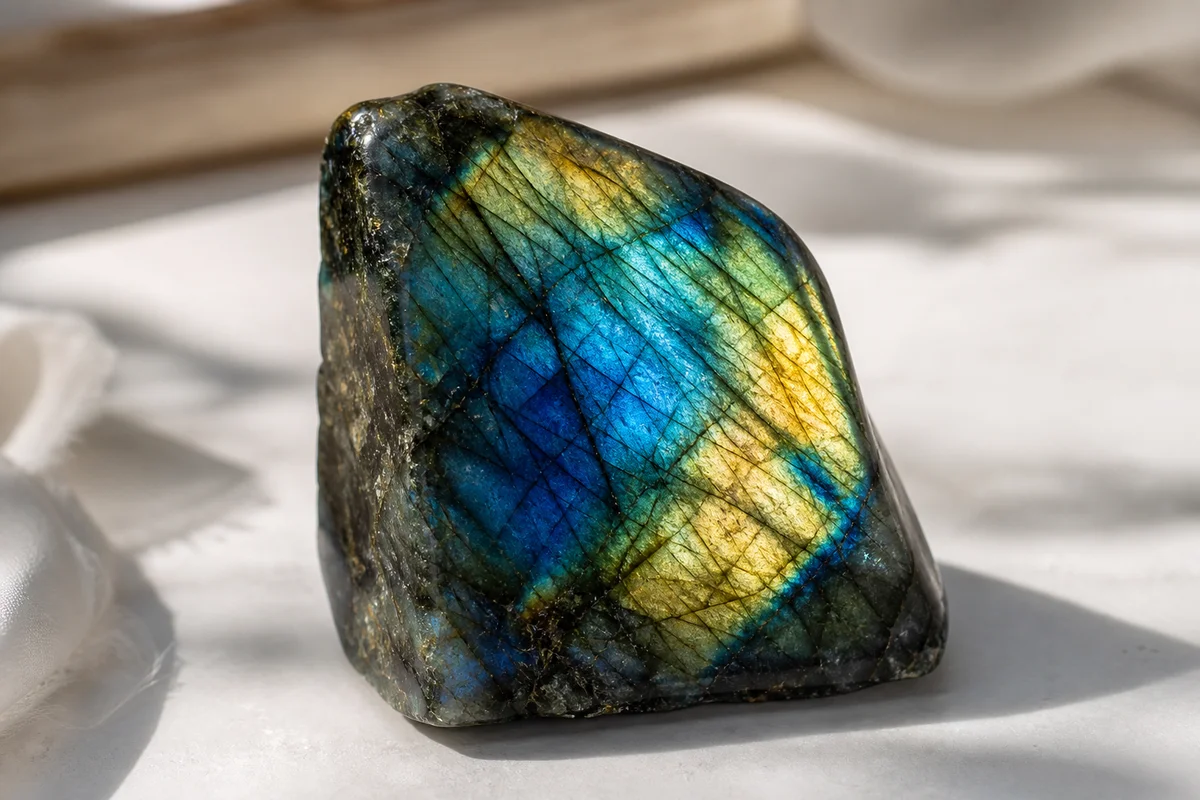
Gold and yellow flash is less common but not rare. It is often found alongside blue in the same specimen — one zone flashes blue, another zone flashes gold. Some collectors specifically seek out pieces with both colors.
Green flash occurs when the lamellae spacing reflects green wavelengths. It is less common than blue and adds variety to a collection.
Red, orange, and pink flashes are the rarest and most sought-after. These colors require a specific range of lamellae spacing and are typically found in spectrolite from Finland. A piece showing strong red flash commands a significant premium.
Multi-color or "rainbow" labradorite shows two or more distinct colors from different zones of the same specimen. The color zones follow the internal structure — they are not random patches.
Spectrolite vs Labradorite
Spectrolite is a trade name for labradorite from Finland that shows particularly vivid, multi-color flashes. The original spectrolite deposit is in southeastern Finland, near the town of Ylämaa.
Geologically, Finnish spectrolite is the same mineral as any other labradorite — there is no separate species called spectrolite. The difference is that the Finnish material tends to have a very dark (nearly black) base color, well-developed lamellae, and a wider range of flash colors than most other sources. The dark base makes the flash colors pop dramatically.
Spectrolite commands premium prices — often 3-10 times the price of comparable-quality blue-flash labradorite from Madagascar. Whether it is worth the premium depends on your budget and how much you value the rarity of the full-color spectrum.
Buying Guide: How to Pick a Good Piece
Price guidelines:
- Entry-level (moderate blue flash, partial coverage, light gray base): $5-15 for a tumbled stone or small freeform
- Mid-range (strong blue or blue-gold flash, good coverage, darker base): $15-40 for a palm-size piece
- Premium (multi-color flash, full coverage, dark base, well-cut): $40-100+ for a display piece
- Spectrolite (Finnish, full-spectrum colors): $50-200+ for a specimen
Caring for Labradorite
Labradorite has a hardness of 6-6.5, which means it is suitable for jewelry but will scratch with prolonged daily wear. Store it away from harder stones (quartz, topaz, sapphire). Clean with warm soapy water — avoid ultrasonic cleaners if the stone has internal fractures (common in larger pieces).
The flash does not fade over time under normal conditions. It is a structural feature of the crystal, not a surface coating. However, if the stone is chipped or scratched on the display face, the damage can interrupt the lamellae and reduce the flash in the affected area.
Frequently Asked Questions
Why does my labradorite look gray in some lighting?Labradorescence requires directional light. Under diffuse lighting (overcast sky, fluorescent ceiling panels), the stone will look gray because light hits the lamellae from all angles simultaneously, washing out the constructive interference. Direct sunlight, a desk lamp, or a phone flashlight will show the flash best.
Can labradorite flash be enhanced artificially?Some low-grade labradorite is treated with oil, resin, or polymer coatings to improve surface luster and make weak flash more visible. These treatments are not always disclosed. An oiled piece will feel slick or waxy and may have a slightly unnatural gloss. Natural labradorite has a more subdued, satiny luster.
Is spectrolite always better than regular labradorite?Not necessarily. A top-quality piece of Madagascar labradorite with strong, full-surface blue flash and a dark base can be more visually striking than a mediocre piece of spectrolite with patchy, weak flash. Judge each piece individually rather than relying on the origin label.
Labradorite is proof that geology does things no human artist could. All you need is a thin slice of rock with layers a few hundred nanometers apart, and you get sheets of colored light that roll across the surface like northern lights trapped in stone.
Crystals are not a substitute for medical treatment. The cultural and traditional associations described in this article are for informational purposes.
Frequently Asked Questions
Does labradorite flash fade over time?
No, the labradorescence in your SagStone jewelry will not fade over time. The flash is caused by light interacting with microscopic internal layers within the natural crystal structure. As long as the stone is kept clean and protected from hard impacts that could scratch its surface, its magical optical illusion will remain just as vibrant and breathtaking as the day you first wore it.
Can labradorite jewelry be worn every day?
Yes, labradorite is an excellent stone for everyday wear in our handcrafted SagStone jewelry. It ranks at 6 to 6.5 on the Mohs hardness scale, making it quite durable. To keep your artisan ring or pendant looking its best, simply remove it during rigorous activities or when using harsh chemicals to protect the natural polished finish and ensure your crystal's beautiful flash lasts a lifetime.
Why does my labradorite look dark from some angles?
The base color of natural labradorite is typically a dark gray or charcoal
Frequently Asked Questions
How can I tell if my labradorite crystal is real?
Genuine labradorite features a natural, dynamic flash that shifts as you move the stone under the light. If the color looks painted on, remains static from all angles, or has tiny bubbles inside, it is likely glass. At SagStone, our artisans hand-select each natural crystal to ensure your handcrafted jewelry showcases only authentic, high-quality labradorescence.
What is the rarest color of labradorite flash?
While the classic blue and green flashes are beautiful and highly popular, rarer colors include vibrant violet, golden yellow, and sunset orange. Some exceptional stones even display multiple colors at once. Our artisans love sourcing these unique, multi-colored crystals to create one-of-a-kind handcrafted pendants and rings that truly stand out in your jewelry collection.
Comments