5 Practical Tests to Tell Real Crystals From
May 14, 2026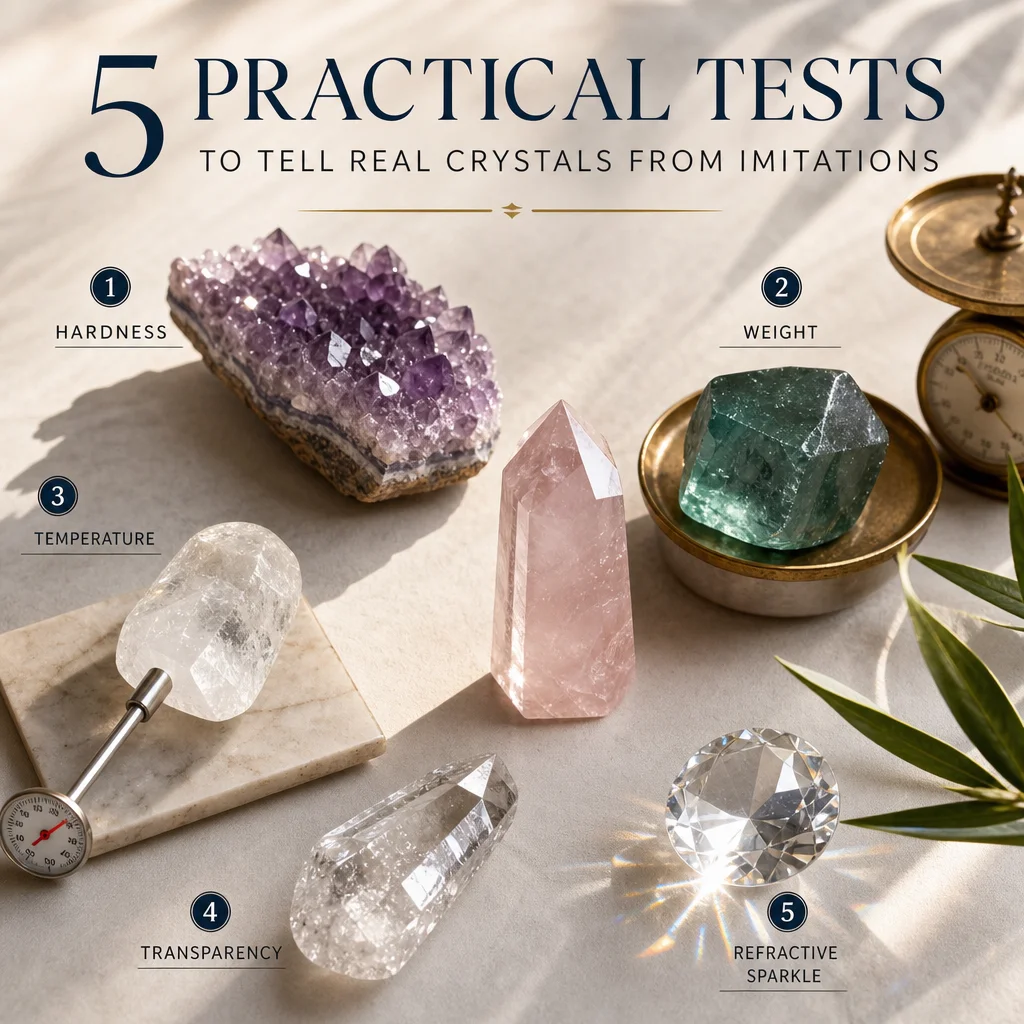
5 Practical Tests to Tell Real Crystals From Fakes — No Lab Required
The crystal market is flooded with imitations. Glass sold as quartz, dyed howlite passed off as turquoise, and resin castings shaped to look like raw mineral specimens — these are common in online marketplaces and even some physical shops. Knowing how to spot a fake saves you money and frustration.
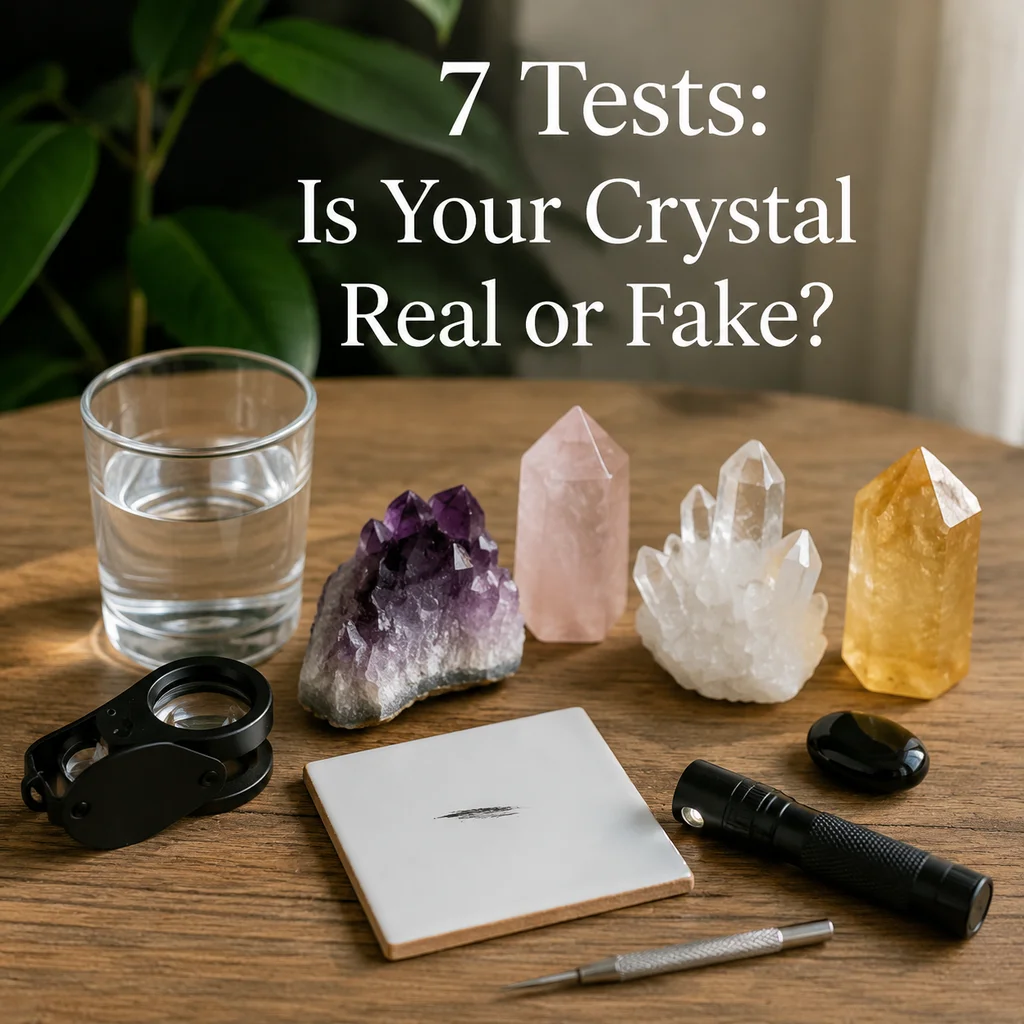
This guide walks through five tests you can do at home using basic tools, plus a few red flags that should make you think twice before buying.
Why Fake Crystals Are So Common
Unlike diamonds, most crystals and gemstones don't come with certification paperwork. A natural amethyst geode and a piece of dyed glass can look remarkably similar in a photo. Online sellers exploit this gap constantly.
The problem has gotten worse as demand for "crystal healing" and home decor crystals has surged. Instagram and TikTok sellers often source from the same wholesale factories in China that produce both genuine stones and manufactured imitations, sometimes mixing them in the same shipment.
Common fakes include:
- Glass passed off as clear quartz — similar hardness but bubbles give it away
- Dyed agate or howlite sold as turquoise or lapis lazuli
- Lab-grown quartz marketed as natural (technically real quartz, but not from the earth)
- Resin or plastic replicas of raw crystal clusters
- Heat-treated amethyst sold as citrine (natural citrine is pale yellow, not deep orange)
Test 1: The Temperature Test
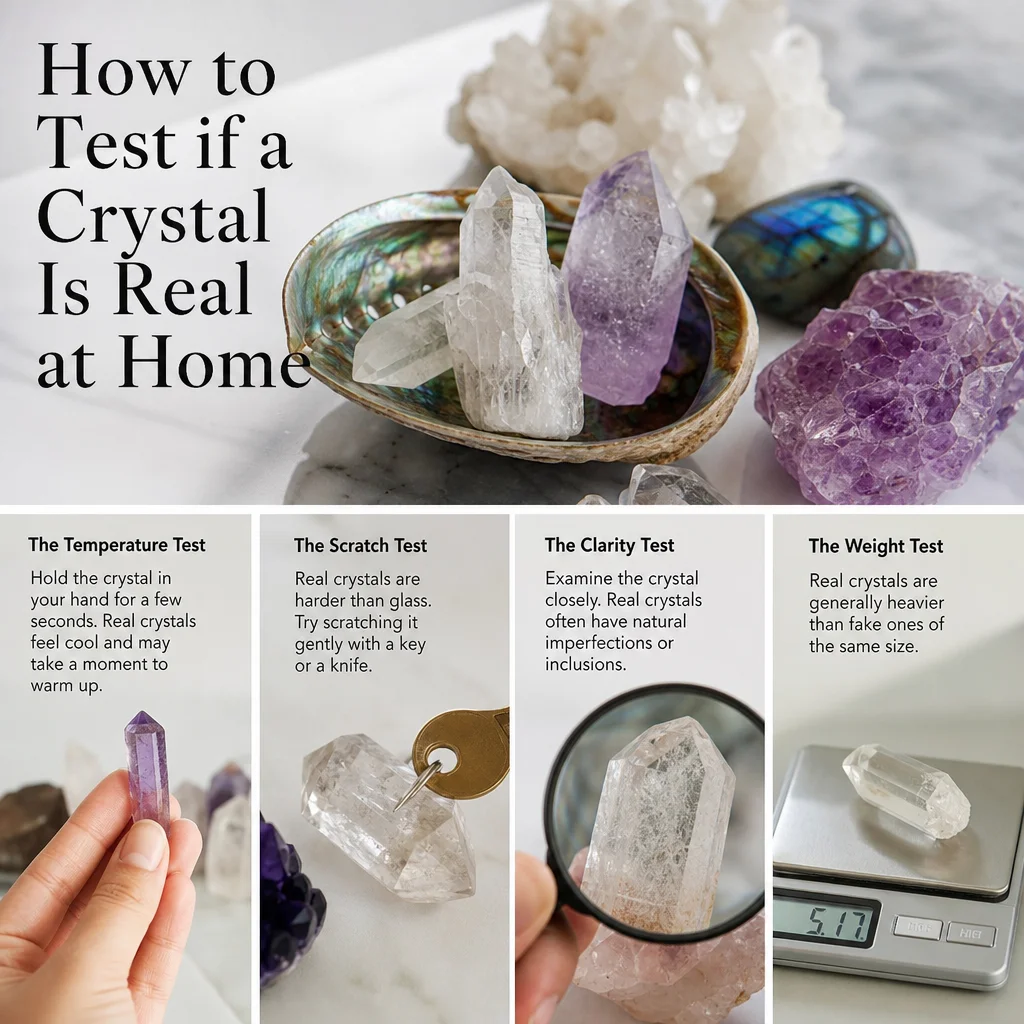
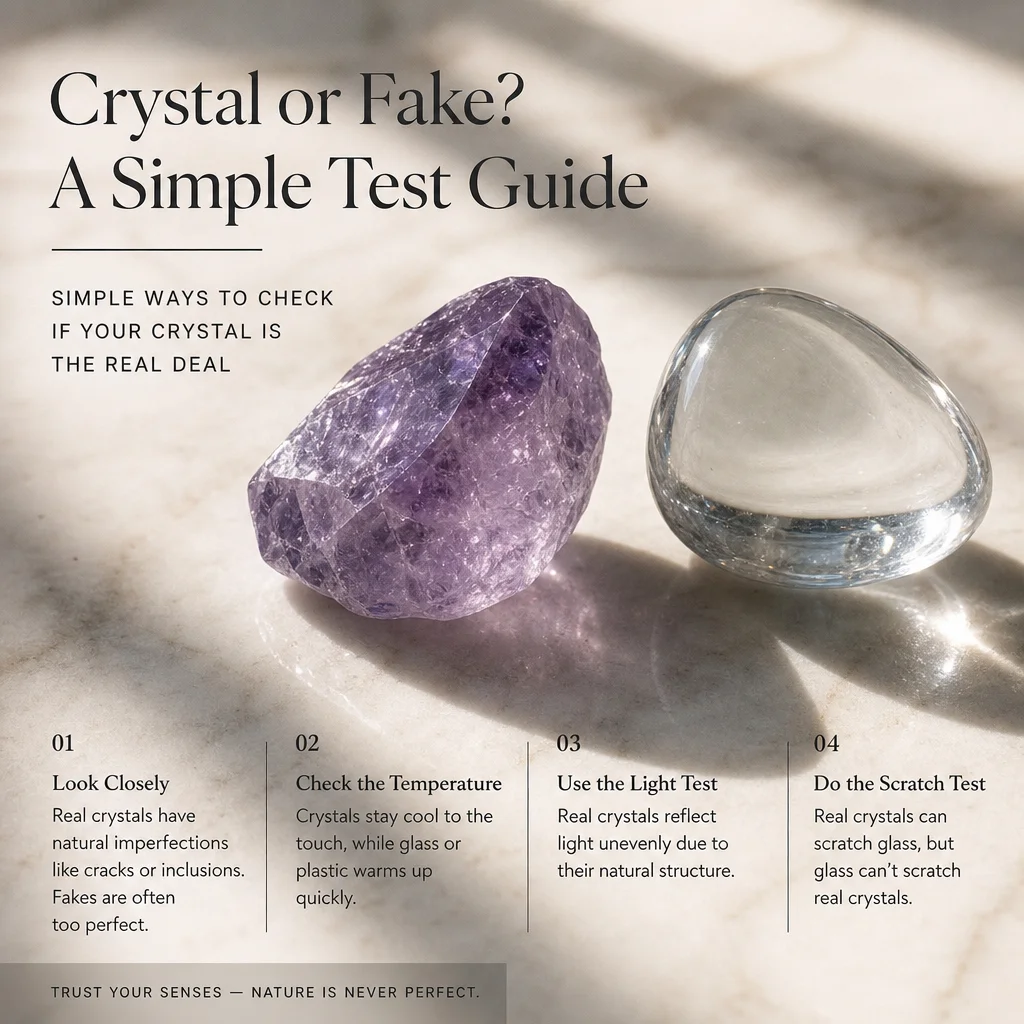
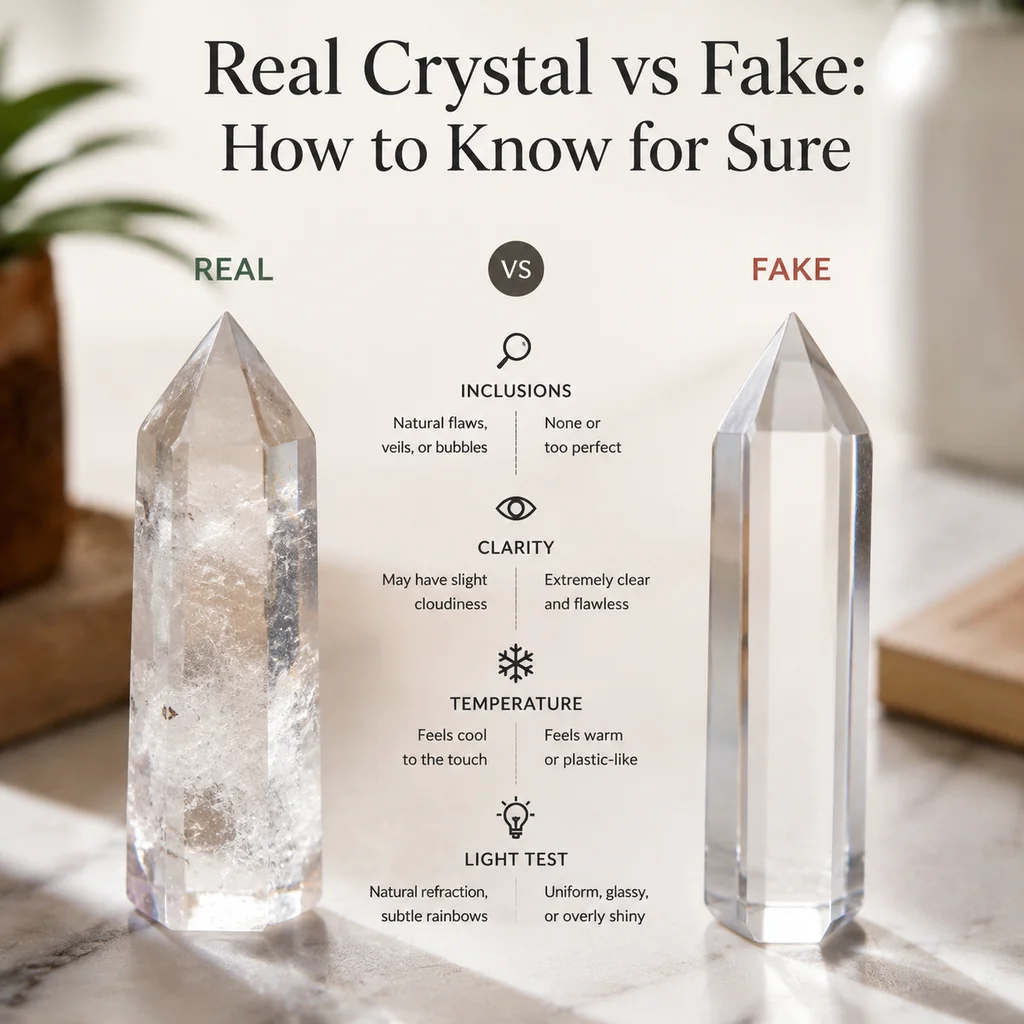
Natural crystals are thermally conductive. They feel noticeably cold when you first pick them up, and they take time to warm in your hand. Glass and plastic warm up much faster.
How to Do It
Pick up the crystal and press it against your inner wrist or cheek. A genuine quartz, fluorite, or calcite specimen will feel distinctly cool for several seconds. If it reaches skin temperature almost instantly, that's a warning sign.
This test works best with larger pieces — a tiny tumbled stone is hard to judge because its low thermal mass means it warms quickly regardless of material. For small stones, combine this with other tests.
Limitation: Some natural minerals (like amber, which is technically a fossilized resin) genuinely feel warm. Know what you're testing.
Test 2: Check for Bubbles and Inclusions
This is one of the most reliable visual indicators. Hold the crystal up to a bright light source — a phone flashlight works — and look inside.
What You're Looking For
Perfect, round bubbles are a dead giveaway of glass. For more details, check out rainbow inclusions in quartz. Molten glass traps air bubbles during manufacturing, and they freeze into tiny spheres as the material cools. Natural quartz sometimes has inclusions, but they're irregular — wisps, fractures, mineral traces, or needle-like rutile formations. They don't form perfect spheres.
Plastic and resin fakes may also have bubbles, but they tend to be larger and fewer. Glass bubbles are usually tiny and numerous, sometimes visible only with magnification.
A jeweler's loupe (10x magnification) makes this test much easier. You can pick one up for under $10 online.
Note: The absence of bubbles doesn't prove authenticity. High-quality glass and well-made resin can be bubble-free. This test catches sloppy fakes, not sophisticated ones.
Test 3: The Scratch Test (Mohs Hardness)
Every mineral has a specific hardness on the Mohs scale, which ranges from 1 (talc) to 10 (diamond). Genuine quartz rates a 7. Glass sits around 5.5. This difference is exploitable.
How to Do It
Find a piece of plain window glass or a glass bottle. Try to scratch it with the crystal in question. Genuine quartz will leave a visible scratch on the glass because it's harder. Glass imitations won't scratch the glass at all — instead, the "crystal" itself may get damaged or leave a powdery residue.
For softer genuine stones like calcite (Mohs 3) or fluorite (Mohs 4), the scratch test works in reverse: a steel knife (Mohs 5.5) should scratch them easily. If your "calcite" resists a knife blade, something's wrong.
Important: Don't damage valuable specimens. Test on an inconspicuous edge or a small shard, not the display face. And don't use this test on finished jewelry where scratching would ruin the piece.
Test 4: The Weight Test
Density is hard to fake. A natural quartz crystal of a given size will have a consistent weight. Glass is slightly less dense, and plastic is dramatically lighter.
How to Do It
If you have a genuine crystal of similar type and size, compare them in your hands. The fake will often feel noticeably lighter or, in the case of resin-cast pieces with added metal powder, inconsistently heavy in some areas and light in others.
For a more precise approach, measure the crystal's volume (water displacement in a graduated cylinder) and weight (kitchen scale), then calculate density. Quartz should come in around 2.65 g/cm³. Glass is roughly 2.4-2.5 g/cm³. Plastic is usually well under 2.0 g/cm³.
This test pairs well with the temperature test — if a piece feels too light and warms up fast, it's almost certainly not natural stone.
Test 5: UV Light and Color Consistency
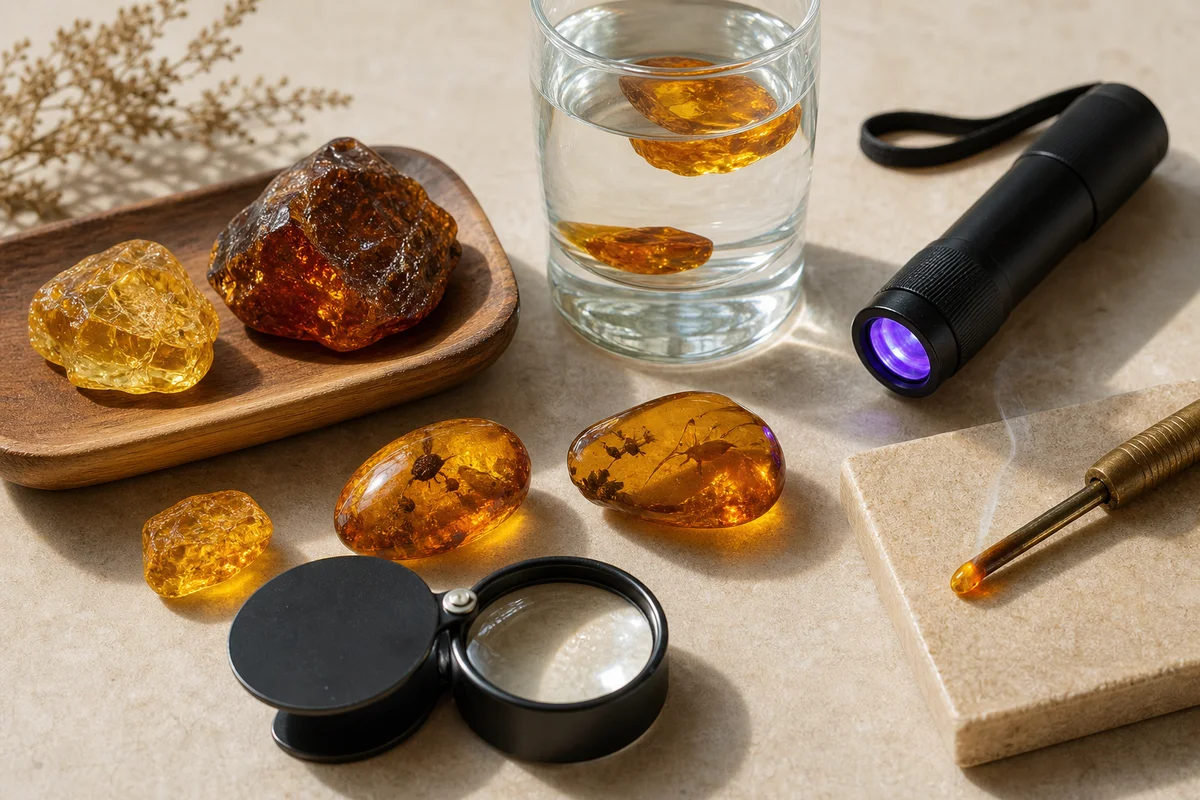
Many natural minerals fluoresce under ultraviolet light, and this fluorescence is difficult to replicate in fakes. A cheap UV flashlight (365nm wavelength) is a useful tool for crystal collectors.
What to Look For
Fluorite often glows blue or green. Calcite can glow red, pink, or blue. Some quartz varieties show faint fluorescence. If a stone that should fluoresce doesn't, or if the fluorescence looks unnaturally uniform, investigate further.
Beyond fluorescence, UV light can reveal dye. Many fake turquoise and fake lapis lazuli specimens are dyed howlite or magnesite. Under UV, the dye may appear patchy or concentrated in surface cracks — something you wouldn't see in natural coloration.
Also examine color under normal light. Natural crystals rarely have perfectly even color distribution. A piece of "lapis lazuli" with completely uniform blue and no visible pyrite flecks or white calcite veins is almost certainly dyed or synthetic.
Commonly Faked Crystals and How to Spot Them
Some crystals get faked more often than others, usually because the genuine material is expensive or scarce. Here are the most frequently counterfeited types and what to watch for:
Turquoise is probably the most faked stone in the world. Genuine turquoise is a phosphate mineral with a characteristic waxy luster and matrix patterns — those dark veins running through the blue-green body. Fakes are usually dyed howlite, a white mineral with natural dark veins that absorbs dye readily. Check the color distribution: if the blue is concentrated along the veins and lighter in between, it's almost certainly dyed howlite. Real turquoise has color throughout the stone itself, not just on the surface. Another tell: genuine turquoise is relatively soft (Mohs 5-6) and will develop a patina over time. Plastic fakes stay glossy indefinitely.
Citrine is frequently manufactured by heat-treating amethyst. Natural citrine is pale yellow to honey-colored and relatively rare. Most "citrine" on the market — especially those bright orange clusters sold online — started life as amethyst heated to 400-500°C. The color is a giveaway: natural citrine is muted and warm, while heat-treated material is a vivid, almost neon orange-yellow. Heat-treated amethyst also tends to have white bases where the color didn't fully penetrate.
Black tourmaline (schorl) is sometimes replicated using black plastic or painted quartz. Real schorl has visible striations — parallel ridges running along the length of the crystal. It's also quite heavy for its size and brittle, often with natural chips and fractures. Plastic fakes are too lightweight and have smooth, uniform surfaces.
Labradorite fakes are usually just regular stones with a holographic film or coating applied to the surface. Genuine labradorite's flash (labradorescence) comes from internal crystal structure, so it shifts as you move the stone. Surface coatings look flashy from one angle and dull from every other angle. If the color sits on top of the stone rather than seeming to come from within it, walk away.
Red Flags When Shopping for Crystals
Beyond physical tests, your purchasing habits matter. Here are signs that should make you cautious:
- Prices that seem too good to be true — natural specimens have real mining and shipping costs
- Perfectly uniform color in "raw" or "natural" specimens — nature doesn't do uniform
- Massive quantities of rare stones — a seller with 200 "natural moldavite" pendants is suspicious; genuine moldavite is finite and increasingly scarce
- No origin information — reputable dealers know where their stock comes from
- "Crystal" descriptions that sound too good — "super AAA grade natural citrine cluster, perfect golden color" is likely heat-treated amethyst
- Only stock photos — a seller who won't photograph the actual piece you're buying may be hiding quality issues
When to Get a Professional Opinion
For expensive pieces or anything you plan to resell, consider professional testing. Gemological laboratories can identify materials with certainty using refractive index measurement, spectroscopy, and microscopic analysis.
The cost of testing ($20-$100 depending on the lab and method) is worth it for specimens over $50 or when building a collection with documented provenance.
Some local gem and mineral clubs offer free or low-cost identification sessions. These clubs often have experienced members who can spot fakes quickly and may have testing equipment available.
A Quick Reference Chart
- Glass fakes: bubbles inside, warms fast, doesn't scratch glass, density ~2.4-2.5
- Plastic/resin fakes: very light, warm instantly, soft (easily scratched), may smell like chemicals when warmed
- Dyed stones: color concentrated in cracks, uneven under magnification, may rub off on a damp cloth
- Natural quartz: cold to touch, scratches glass, irregular inclusions, density ~2.65
- Lab-grown quartz: passes most tests (it IS quartz) but may look too perfect — very clear with minimal inclusions and unusually consistent geometry
No single test is definitive. The best approach combines several methods and develops with experience. After checking a few dozen pieces, you'll start recognizing fakes instinctively — the weight feels wrong, the color looks off, or the texture doesn't match what you've handled before.
Want a broader overview? Our The Complete Crystal Guide: Identification, Meanings, and Properties covers identification, meanings, and properties for 100+ stones — a solid reference for anyone building a crystal collection.
Related Guides
- Crystal Pricing: 7 Tricks Shops Use to Make You Overpay
- Complete Crystal Guide: Identification and Meanings
- Crystal Shapes Explained: Tumbled, Raw, Points, Spheres
- Essential Jewelry Storage Tips
- 15 Creative Ways to Display and Store Your Crystal Collection
- Colored Gemstones Buying Guide for Beginners
- Clear Quartz: The Universal Crystal Guide
Frequently Asked Questions
Do real crystals feel cold to the touch?
Yes, natural crystals typically feel noticeably colder than room temperature when you first pick them up, unlike plastic or glass which warm up quickly in your hands. At SagStone, we love this test because it highlights the natural thermal conductivity of our handcrafted jewelry. If the stone stays warm or feels unnaturally light, it might be acrylic or manufactured glass.
Are air bubbles inside a crystal a sign of a fake?
In most cases, perfectly round air bubbles inside a clear crystal indicate that it is actually glass or resin, not a natural stone. Natural crystals form deep within the earth under intense pressure, creating unique internal feathers, fractures, or mineral inclusions. If a clear quartz or amethyst looks flawless with tiny trapped bubbles, it is likely a manufactured fake.
Will a real crystal scratch glass?
It depends on the specific stone! Quartz crystals—like clear quartz, amethyst, and citrine—rank high on the Mohs hardness scale and will easily scratch standard glass. However, softer genuine crystals like calcite or malachite will not. When testing our handcrafted SagStone pieces, always research your specific stone's hardness to avoid accidentally damaging your beautiful jewelry.
Do real crystals glow under UV light?
Many natural crystals do exhibit fluorescence and will glow under a UV light, but this varies heavily by mineral type. For example, genuine fluorite can glow vibrantly, while clear quartz might not glow at all. Conversely, some dyed fakes will show an unnatural, cloudy glow. While UV light is a fun tool for crystal lovers, it shouldn't be your only method for verifying authenticity.
How can I tell if my crystal has been dyed?
Dyed crystals often have unnaturally bright, neon colors you would never find in nature. When examining a piece, look for uneven color distribution or dye concentrated in the cracks of the stone. Natural crystals have subtle variations. If a piece looks like a perfect, vibrant block of color without any natural depth, it has likely been artificially treated.
Comments