Why Hematite Rings Break: The Truth Exposed
May 31, 2026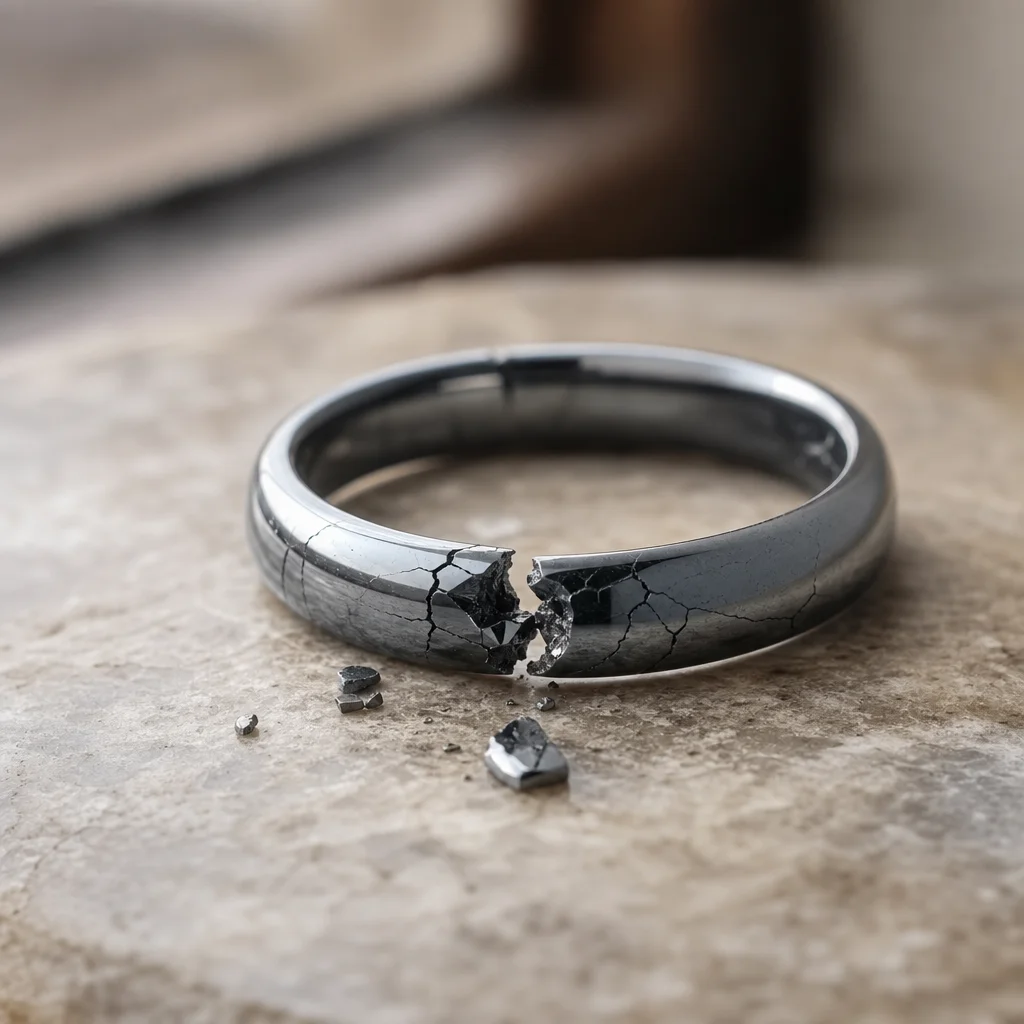
There's something jarring about a ring breaking — especially when it's a hematite ring. Unlike a metal band that might bend or scratch, hematite rings tend to snap cleanly, often falling apart into two or more pieces with almost no warning. If it just happened to you, understanding why can help you decide whether to replace it and how to take better care of the next one.
The Nature of Hematite: Heavy and Brittle
Before getting into why hematite rings break, it helps to understand what hematite actually is. Hematite is iron oxide, Fe₂O₃, one of the most abundant iron ore minerals on Earth. In its natural crystalline form, hematite has a metallic gray to silver-black appearance and a specific gravity of about 5.26 — meaning it's roughly five times as dense as water. For comparison, quartz is about 2.65 and diamond is 3.52.
That density is what makes hematite rings feel noticeably heavier than stone rings of the same size. A standard hematite ring weighs roughly twice what a similarly sized quartz or agate ring would weigh. This heft gives hematite rings a satisfying, substantial feel on the finger — but it also means that when the ring hits a hard surface, it hits with considerably more force than a lighter stone would.
The hardness is where things get counterintuitive. Hematite rates 5-6.5 on the Mohs scale, which is moderate. It scratches glass easily and can be scratched by a steel knife. But hardness and toughness are not the same thing. Hematite is hard (resists scratching) but not tough (resists breaking). Its crystal structure has distinct planes of weakness — it lacks cleavage in the traditional geological sense, but its closely packed rhombohedral lattice is inherently brittle. When force exceeds a critical threshold, the stone fractures rather than deforms.
The Real Reasons Hematite Rings Break
After looking at hundreds of broken hematite rings and reading through collector forums, the causes fall into a few clear categories.
Impact Against Hard Surfaces
This is the single most common cause, and it makes perfect sense given the physics. You're wearing a dense stone ring, you reach for something, and your ring taps against a granite countertop, a ceramic mug, a metal door handle, or a car steering wheel. Because of hematite's high density, that seemingly gentle tap concentrates a surprising amount of kinetic energy into a small contact point. If the ring has even a microscopic internal flaw (and most natural stones do), that impact creates a stress concentration that propagates into a crack.
People who work with their hands — mechanics, chefs, construction workers, anyone who grabs handles, tools, and hard surfaces regularly — go through hematite rings much faster than office workers.
Water Exposure and Rust
Yes, hematite can rust. This surprises many people, but it shouldn't — hematite is literally iron oxide, which means it's already in a relatively stable oxidized state. However, prolonged exposure to water, especially water containing dissolved salts or acids, can cause surface changes that weaken the stone over time.
What actually happens is more subtle than orange rust flakes. Water infiltrates microscopic cracks and pores in the hematite, and over weeks or months, the trapped moisture promotes a slow chemical alteration at the crystal boundaries. The stone doesn't visibly rust, but the internal grain boundaries weaken, making the ring substantially more prone to fracture. This is why hematite rings that are worn while swimming, showering, or washing dishes tend to break more quickly than those that are removed for water activities.
Temperature Changes
Rapid temperature changes create differential expansion and contraction within the stone. A hematite ring that goes from a warm indoor environment to a cold outdoor one, or that's left in a hot car and then plunged into cool water, experiences internal stress. While hematite isn't as thermally sensitive as opal or dioptase, it's not immune. Repeated thermal cycling weakens the crystal structure incrementally, and one day the ring simply gives way.
Manufacturing Defects in Reconstituted Hematite
Here's something most sellers won't tell you: many of the hematite rings on the market aren't cut from solid natural hematite at all. They're made from reconstituted hematite — essentially hematite powder mixed with a binding agent and pressed into shape under high pressure. These manufactured rings look identical to natural hematite at a glance, but they lack the structural integrity of a solid stone.
Reconstituted hematite rings often have internal voids, uneven distribution of binding agent, and planes of weakness where the powder layers meet. They're significantly more prone to breaking than solid natural hematite, and they tend to fail along clean, straight lines that follow the pressing pattern rather than the irregular fracture surfaces you'd see in natural stone.
Magnetic Hematite: A Different Material Entirely
Many hematite rings sold online are actually magnetic hematite, which is not natural hematite at all. Natural hematite is only weakly magnetic (it's attracted to magnets but isn't itself magnetic). Magnetic hematite is primarily man-made material — it's usually a ceramic compound containing barium ferrite (BaFe₁₂O₁₉) or strontium ferrite, manufactured to look like hematite and be strongly magnetic.
These magnetic "hematite" rings have their own failure modes. They chip more easily than real hematite because the sintered ceramic structure is porous at a microscopic level. They also tend to lose their magnetic charge over time with repeated impacts, and the dark gray surface can wear away to reveal a lighter, duller material underneath.
What to Do When Your Hematite Ring Breaks
The first thing to consider is whether the break is clean enough for repair. If the ring broke into two clean pieces with matching fracture surfaces, a jeweler experienced with stone repair might be able to rejoin them using a high-strength epoxy designed for mineral work. The repair will be visible under close inspection — there's no invisible way to fuse broken hematite — but the ring will be wearable again.
If the ring shattered into multiple fragments, repair is impractical. Some people keep the pieces as pocket stones or incorporate them into crystal grids. Others simply buy a replacement and take more precautions with the new one.
Before replacing, consider whether a hematite ring is the right choice for your lifestyle. If you're hard on your jewelry or work with your hands frequently, a solid metal ring (stainless steel, titanium, or tungsten carbide) might be more practical. Hematite's appeal is aesthetic and symbolic, not structural.
How to Make Your Next Hematite Ring Last Longer
If you want to keep wearing hematite, these habits significantly extend a ring's lifespan.
Remove it before water exposure. Take the ring off before washing hands, showering, swimming, or doing dishes. A few seconds of extra effort each day adds months to the ring's life.
Avoid hard impacts. This sounds obvious but is easy to forget in practice. Be conscious of which hand you wear the ring on, and avoid using that hand to grip hard objects, open doors, or support yourself on countertops.
Buy solid natural hematite. When shopping, ask specifically whether the ring is cut from a single piece of natural hematite or is reconstituted. Real hematite costs more ($15-40 for a good quality ring versus $5-10 for reconstituted), but it's substantially more durable. Natural hematite feels heavier for its size, has a more consistent metallic luster, and typically shows some natural surface texture or slight color variation.
Store it properly. When you're not wearing it, keep the ring in a soft pouch or padded compartment, not loose in a jewelry box where it can bang against other pieces. Hematite-on-hematite contact is particularly damaging because of the equal hardness and high density.
Inspect regularly. Every few weeks, look at your ring under good light for tiny hairline cracks or chips that weren't there before. Early detection means you can switch the ring to a less active hand or start being more careful before it fails completely.
The Cultural Side: What Does a Broken Hematite Ring Symbolize?
In crystal healing traditions, a broken stone is often interpreted as having absorbed negative energy or fulfilled its protective purpose. Hematite's association with grounding and protection makes this interpretation particularly common — the idea being that the ring "took the hit" for you, absorbing an energetic impact that would otherwise have affected you.
Whether or not you find meaning in this interpretation, there's something psychologically useful about reframing a loss. A broken ring doesn't mean you wasted money or made a bad choice. Natural materials have finite lifespans, and appreciating them for the time they lasted is arguably healthier than fixating on the break.
Frequently Asked Questions
Why did my hematite ring break?
Hematite rings can break due to various factors such as metal fatigue, stress from regular wear, or a single, strong impact. Hematite is a relatively hard and durable mineral, but it is not indestructible. Regular use and handling can lead to micro-fractures over time, eventually causing the ring to break.
Can a broken hematite ring be repaired?
It depends on the break. Clean breaks into two pieces can often be reattached with mineral-grade epoxy, though the repair line will be visible. Shattered rings with multiple fragments are generally not worth repairing. A jeweler who works with stones can assess whether repair is feasible.
How long should a hematite ring last?
With careful wear (removed for water, protected from impacts), a solid natural hematite ring can last years. Reconstituted hematite rings typically last 3-12 months. Magnetic hematite rings fall somewhere in between, depending on use patterns.
Is my hematite ring real if it's magnetic?
Possibly, but probably not entirely. Natural hematite is weakly attracted to magnets but is not itself magnetic. If your ring sticks strongly to a magnet and can actually pick up small metal objects, it's likely a man-made magnetic ceramic product, not natural hematite.
Does hematite actually rust?
Not in the same way as iron metal. Hematite is already an oxide form of iron, so it doesn't convert to rust in the traditional sense. However, prolonged water exposure can alter its surface chemistry and weaken the stone from within through chemical changes at microscopic grain boundaries.
Frequently Asked Questions
Q1 Why do hematite rings break easily?
A1 Hematite rings break easily due to their inherent brittleness. Hematite is a form of iron oxide, which can be fragile and prone to cracking or breaking under stress or impact.
Q2 Can hematite rings be strengthened to prevent breakage?
A2 While it's challenging to strengthen hematite rings due to their brittle nature, they can be treated with protective coatings or encased in a durable material like plastic or metal to reduce the risk of breakage.

Comments