Druzy Quartz Jewelry: Sparkling Crystal Beauty..
June 2, 2026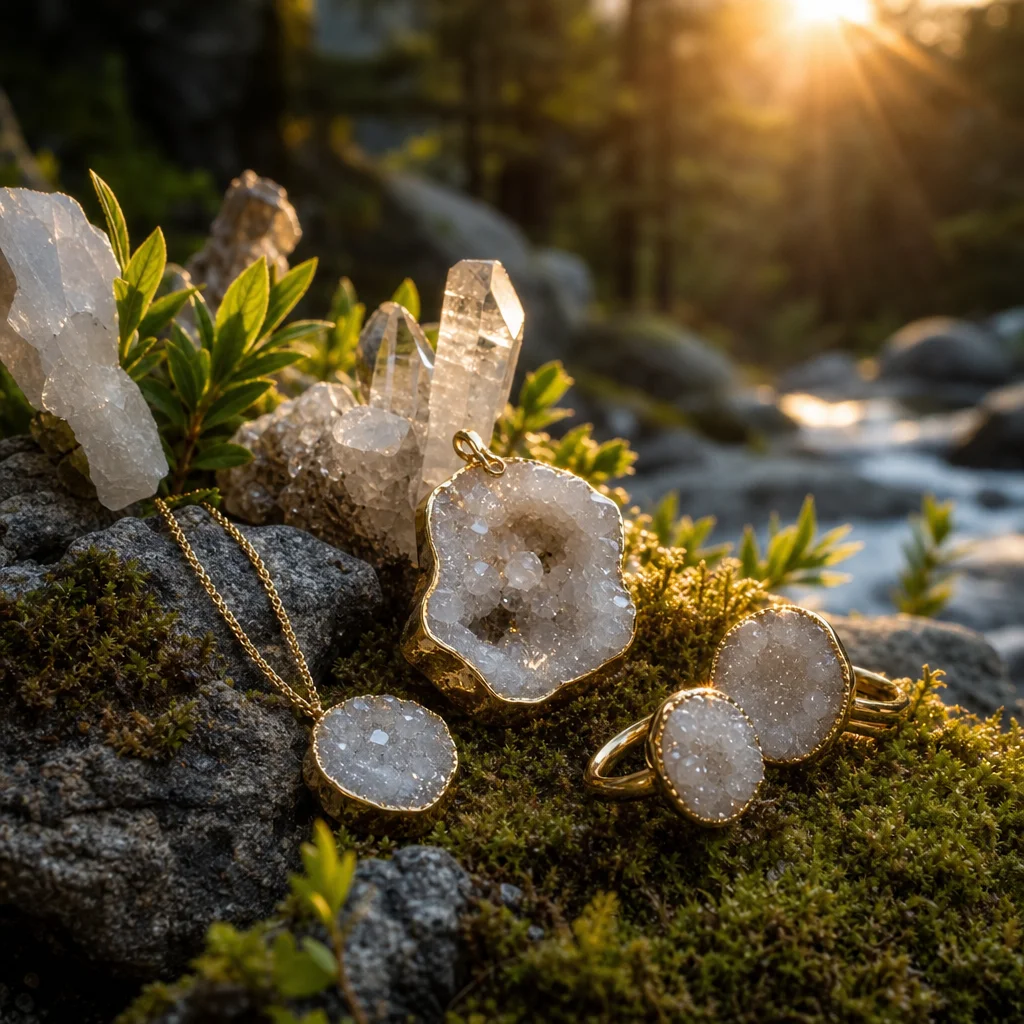
What Is Druzy Quartz?
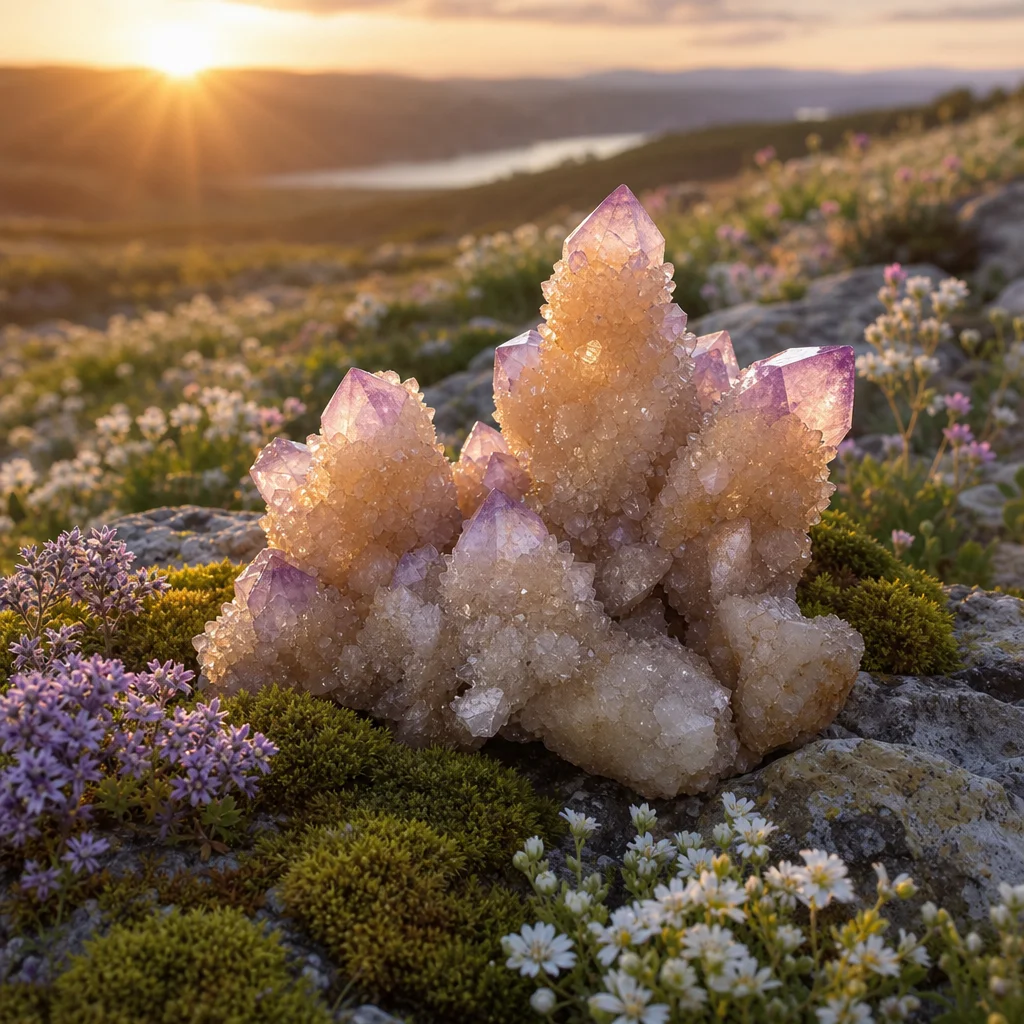
Run your fingers across a druzy quartz pendant and you'll feel something unique — a fine, sugary texture that catches light from every angle. Unlike smooth cabochons or faceted gemstones, druzy (also spelled druse or drusy) consists of thousands of microscopic quartz crystals growing together on the surface of a host stone. This crystal-covered surface creates a shimmering, almost ethereal sparkle that has made druzy quartz one of the most popular choices in contemporary crystal jewelry.
The term "druzy" refers specifically to a coating of fine crystals on a fracture surface, cavity, or matrix rock. When quartz is the mineral forming these crystals, we call it druzy quartz. But druzy formations aren't limited to quartz — agate, chalcedony, malachite, hematite, and other minerals can also develop druzy surfaces. Among all druzy varieties though, quartz druzy remains the most widely used in jewelry due to its excellent hardness, attractive sparkle, and relative affordability.
How Druzy Formations Develop
Understanding how druzy forms helps explain why each piece is unique and why certain types are more durable than others. The formation process begins when mineral-rich water flows through cracks and cavities in host rocks. As the water slowly evaporates or cools, dissolved minerals begin to precipitate out of solution, forming tiny crystal nuclei on the cavity walls.
Over thousands to millions of years, these microscopic crystals continue to grow, building up layer by layer until they create the characteristic sugar-like surface. The size, shape, and arrangement of the individual crystals depend on several factors: the mineral composition of the solution, the temperature during growth, the availability of space, and the rate at which the solution evaporates or cools.
In the case of druzy quartz, the host rock is typically agate or chalcedony — both forms of microcrystalline silica. The quartz crystals growing on the surface share the same chemical composition as the host (silicon dioxide, SiO₂) but form in a macroscopic crystalline structure rather than the microcrystalline structure of the host. This shared chemistry means the druzy crystals bond strongly to the matrix, creating a durable surface that resists chipping better than druzy formed on unrelated host minerals.
Growth Environment Factors
- Solution chemistry: High silica concentration favors quartz druzy formation
- Temperature: Moderate temperatures (50-200°C) produce finer crystal structures
- Space availability: Larger cavities allow bigger individual crystals to form
- Growth rate: Slower growth produces better-formed, more uniform crystals
Types of Druzy Quartz by Color
One of the most appealing aspects of druzy quartz jewelry is the remarkable range of colors available. While natural druzy quartz is typically white or colorless, various treatments and naturally occurring impurities create an entire spectrum of options.
Natural Colors
White/Clear Druzy: The most common and arguably the most classic variety. These pieces display a clean, diamond-like sparkle against the white or translucent matrix. Natural white druzy has an understated elegance that works well with both casual and formal outfits.
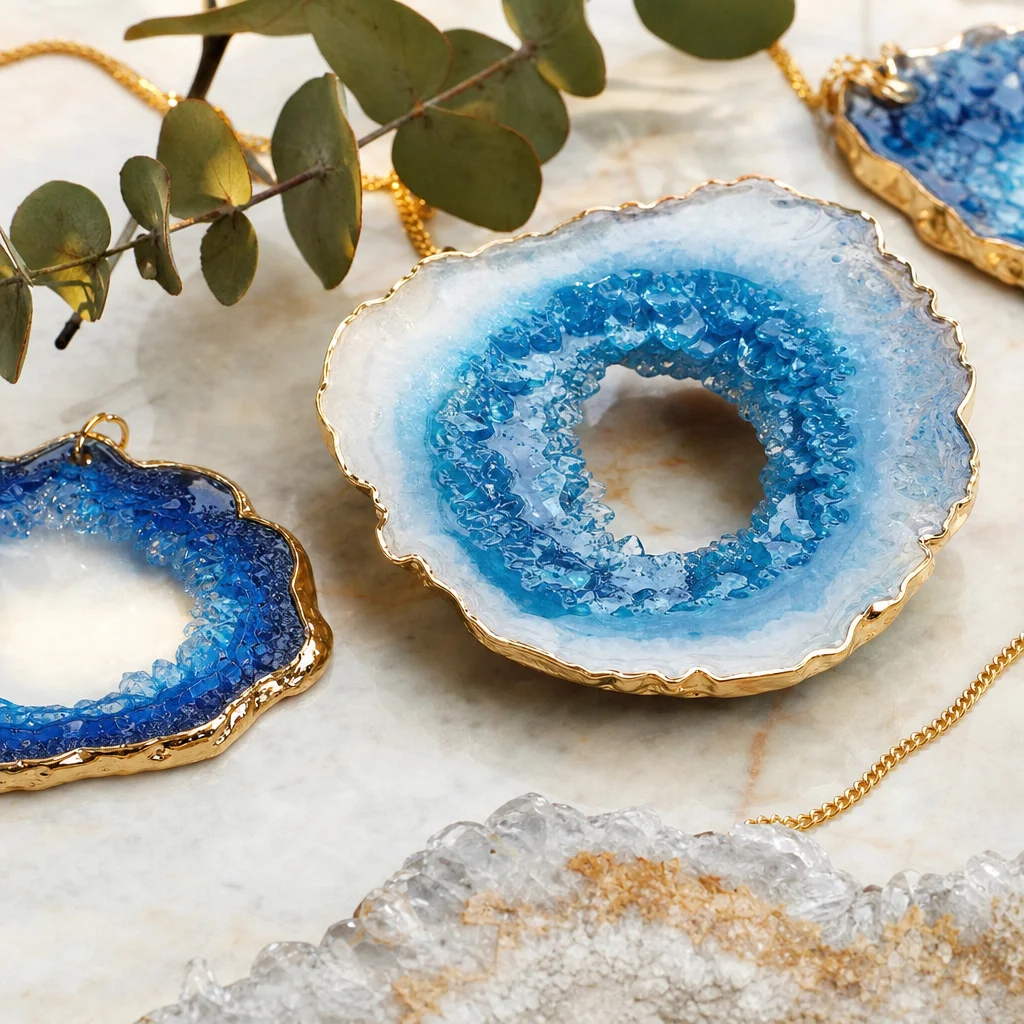
Blue Druzy: Natural blue druzy is relatively rare. When it occurs, the blue coloration comes from trace amounts of titanium or other minerals within the crystal lattice. Most commercially available "blue druzy" has been treated, which we'll discuss separately.
Pink Druzy: Pink hues can occur naturally from manganese inclusions or from the underlying host stone (such as pink agate) showing through the druzy layer. Natural pink druzy tends to have a soft, feminine quality that's highly sought after.
Grey/Silver Druzy: Grey druzy gets its color from microscopic inclusions or from iron oxides within the crystal structure. The silvery sparkle of grey druzy has a sophisticated, modern feel.
Enhanced and Treated Colors
Titanium-Coated Druzy: This is the process behind most of the vivid blues, purples, greens, and rainbow colors you'll see in the market. A thin layer of titanium atoms is deposited onto the druzy surface through a process called physical vapor deposition (PVD). The titanium layer is incredibly thin — just a few nanometers — but it interferes with light to create brilliant, iridescent colors. This is a permanent treatment that won't wear off or fade with normal use.
Platinum or Gold-Plated Druzy: Similar to titanium coating but using precious metals, these treatments create warm golden or cool platinum hues. The effect is less iridescent than titanium but more subtle and elegant.
When shopping for druzy jewelry, always ask whether the color is natural or treated. Both have their place — natural druzy has geological authenticity, while treated druzy offers incredible color variety. The key is knowing what you're getting and paying accordingly.
Druzy in Jewelry: Styles and Applications
Druzy quartz's natural beauty translates well into various jewelry forms. The key is matching the druzy type and size to the jewelry application for both aesthetics and durability.
Pendants and Necklaces
Druzy pendants are the most popular application and for good reason. A large druzy cabochon set in a simple silver or gold bezel creates a statement piece that draws the eye. The flat back of the druzy slab makes it ideal for setting, and the sparkling surface catches light beautifully when worn at the neckline where it moves naturally with the body.
For maximum impact, look for pendants where the druzy surface is oriented to face outward when worn. Some designers cut druzy slices at angles that show both the druzy surface and the banded patterns of the underlying agate — a two-for-one visual effect that showcases the material's complexity.
Bracelets
Druzy bracelets come in several forms: large statement cuffs with druzy accents, chain bracelets with druzy charm drops, and beaded bracelets with small druzy beads. The cuff style works particularly well because the druzy faces outward and stays visible during wear. For everyday bracelets, be aware that druzy on the inside of a cuff can rub against your skin — the crystal texture is not uncomfortable but can snag on delicate fabrics.
Rings
Druzy rings are eye-catching but require careful consideration. The druzy surface faces upward, which means it's exposed to hard surfaces when you use your hands. While quartz druzy is relatively hard (Mohs 7), the tiny individual crystals can still chip or break off if they strike a hard surface with enough force. If you choose a druzy ring, consider it occasion wear rather than an everyday piece, or select a protective setting (like a halo setting or high bezel) that shields the druzy surface.
Earrings
Earrings are perhaps the ideal druzy jewelry application. They stay visible, catch light beautifully as you move, and are relatively protected from impacts. Druzy stud earrings offer a subtle sparkle for everyday wear, while druzy drop earrings make a bolder statement. The lightweight nature of druzy (it's essentially a thin slice of agate with a crystal coating) makes even large druzy earrings comfortable to wear.
Durability: What You Need to Know
The durability of druzy quartz jewelry depends on several factors that aren't immediately obvious. Understanding these will help you choose pieces that last and care for them properly.
Crystal-Host Bond Strength
When druzy quartz grows on an agate or chalcedony host (which are both forms of silica), the bond between the druzy crystals and the host is chemically strong — they're essentially the same material in different crystal structures. This creates a durable surface where individual crystals resist being knocked off.
However, when druzy grows on a chemically different host mineral (such as calcite, malachite, or galena), the bond is purely mechanical — the crystals are essentially embedded in a soft matrix. These specimens are dramatically less durable and should never be used in jewelry that sees any wear. Unfortunately, it's not always easy to tell the difference by looking, so buying from reputable dealers who disclose the host mineral is important.
Crystal Size Matters
Larger individual crystals in the druzy surface are more prone to breakage than finer crystal formations. A druzy surface with tiny, sugar-fine crystals is more durable than one with larger, well-defined points. If you're choosing druzy jewelry for regular wear, finer druzy textures are the safer bet.
Setting Quality
The quality of the jewelry setting significantly affects longevity. A well-made bezel setting that securely holds the druzy piece along its edges protects the crystal surface from edge impacts. Prong settings leave more of the druzy exposed but can create stress points if the prongs are too tight. For rings specifically, a protective bezel or halo setting is strongly recommended.
Caring for Druzy Jewelry
With proper care, druzy quartz jewelry can maintain its sparkle for years. Here's what you need to know:
Cleaning: The textured surface of druzy is a dust trap. Regular gentle cleaning is important to maintain sparkle. Use warm water with a drop of mild soap and a very soft brush (a baby toothbrush works well) to gently clean between the tiny crystals. Rinse thoroughly and pat dry with a soft cloth. Avoid soaking druzy jewelry for extended periods — prolonged water exposure can weaken some settings and potentially affect treated druzy surfaces.
Chemical exposure: Remove druzy jewelry before swimming, bathing, or using household chemicals. Chlorine can damage the metal settings and may affect titanium-coated druzy over time. Perfumes, hairsprays, and lotions can leave a film on the druzy surface that dulls the sparkle.
Storage: Store druzy pieces individually in soft pouches or separated compartments. Druzy can scratch other jewelry and vice versa. Avoid tossing druzy pieces into a jewelry box where they'll rub against harder gemstones or metal clasps.
What to avoid: Ultrasonic cleaners are generally not recommended for druzy jewelry. The intense vibrations can loosen individual crystals, especially in pieces where the druzy-host bond isn't perfect. Steam cleaning carries similar risks. Stick to gentle manual cleaning for best results.
Buying Guide: What to Look For
When shopping for druzy quartz jewelry, keep these quality indicators in mind:
- Symmetry and coverage: The druzy coating should be even across the visible surface. Patches without crystal coverage or with significantly different crystal sizes look inconsistent.
- Crystal quality: Look for well-formed, reflective crystals that catch light uniformly. Dull or cloudy patches suggest incomplete crystal growth or damage.
- Color consistency: For treated druzy, the color should be even across the surface without obvious patches or streaks of different hues.
- Setting quality: Check that the druzy piece is securely held with no loose movement. The edges should be protected from chipping.
- Thickness: Thicker druzy slices are more durable than paper-thin ones. If you can see light passing through the entire piece easily, it may be fragile.
- Origin disclosure: Reputable dealers will tell you whether the druzy is natural or treated, and ideally where it was sourced.
Druzy vs. Other Sparkling Stones
Druzy quartz is often compared to other sparkling gemstones, but the comparison isn't always fair because they achieve their sparkle through completely different mechanisms.
Unlike diamonds, which sparkle through superior refractive index and precision faceting, druzy sparkles through the collective light scattering of thousands of tiny crystal faces. The effect is softer and more diffused than diamond brilliance — think of the difference between a disco ball and scattered glitter. Both catch light beautifully, but the quality of the sparkle is fundamentally different.
Compared to other druzy materials, quartz druzy offers the best combination of beauty, durability, and value. Druzy malachite and druzy hematite are stunning but softer and more fragile. Druzy amethyst and druzy citrine (where the druzy surface happens to be amethyst or citrine rather than clear quartz) offer color variety but tend to be more expensive.
Is Druzy Jewelry Right for You?
Druzy quartz jewelry occupies a sweet spot between casual everyday sparkle and special-occasion glamour. Its organic, natural look appeals to those who prefer gemstones with geological character over perfectly uniform synthetic stones. The wide range of colors and styles means there's a druzy piece for virtually every taste and budget.
If you're drawn to jewelry that tells a geological story, that catches light in a uniquely soft and diffused way, and that offers genuine variety from piece to piece, druzy quartz deserves serious consideration. Just remember to match the piece to its intended use — statement pendants and earrings for maximum impact, well-protected rings for occasional wear, and always proper care to keep those thousands of tiny crystals sparkling.
Frequently Asked Questions
Is druzy quartz durable enough for everyday jewelry?
Druzy quartz ranks at a 7 on the Mohs scale of hardness, making it quite resistant to scratches and suitable for daily wear. However, because the tiny surface crystals can be chipped upon hard impact, it is best to avoid wearing druzy rings or bracelets during rigorous physical activities.
How do you properly clean and care for druzy quartz jewelry?
To clean druzy quartz, gently wipe the surface with a soft, damp cloth and a mild soap, strictly avoiding harsh chemicals, steam, or ultrasonic cleaners. It is also highly recommended to store these pieces individually in a soft pouch, as the rough crystalline surface can easily scratch other softer gemstones in your jewelry box.
How do jewelers set druzy quartz given its uneven texture?
Because druzy stones lack a flat, uniform surface, jewelers frequently use custom bezel settings, prongs, or electroforming techniques to secure the delicate crystals. The irregular backside of the host rock is typically stabilized with epoxy within the setting to ensure the piece sits comfortably and safely against the skin.
What are the metaphysical benefits associated with wearing druzy quartz?
In the crystal healing community, druzy quartz is believed to amplify the body's natural healing properties and promote deep relaxation. Many wearers use it to help reduce stress, stimulate creativity, and balance their emotional energy while providing a gentle shielding effect against negativity.
What factors determine the value of druzy quartz pieces?
The value of druzy quartz is primarily determined by the overall brilliance of the crystal coating, the size and uniformity of the crystals, and the visual appeal of the host stone. Additionally, the craftsmanship of the jewelry setting, the weight of the metals used, and the rarity of the specimen significantly influence the final retail price.
Comments