Tracking Crystal Energy: 90-Day Experiment
May 16, 2026
I Tracked My Crystal Energy for 90 Days (And What the Data Actually Showed)
My sister thinks crystals are rocks. My therapist thinks they're "interesting placebos." My accountant thinks I spend too much money on them. Fair points, all of them.
But here's the thing: I'd been keeping crystals on my nightstand and desk for two years, and I felt like they did something. Not "third eye opening" something. More like a small, persistent nudge toward calm. Or maybe I was just fooling myself. I honestly couldn't tell.
So I decided to stop guessing and start measuring. Ninety days. Three types of stones. Three daily scores. One spreadsheet that slowly took over my life.
This is what happened.
Why Bother Tracking This at All?
Let me be upfront: I'm not a crystal evangelical. I don't believe rose quartz is going to manifest a soulmate or that citrine will make me rich. What I do believe is that humans are remarkably bad at knowing what makes them feel better, and that our brains routinely confuse correlation with causation.
Crystal enthusiasm exists in a strange space. On one side, you have people making medical claims that are, frankly, irresponsible. On the other, you have a wall of dismissive eye-rolling from people who've never actually tried it. Neither position is particularly evidence-based.
The psychologist Shelley Carson at Harvard has written about the "ick factor" in alternative practices — how our aesthetic discomfort with woo-woo culture can prevent us from honestly evaluating certain behaviors. I figured if I was going to keep a piece of amethyst on my desk anyway, I might as well collect some data.
If you're already tracking your crystal collection and habits, you might find our crystal journaling guide useful — that article covers the basics of keeping records, which is essentially what this whole experiment became.
The Experiment Design
I kept it simple enough that I'd actually stick with it:
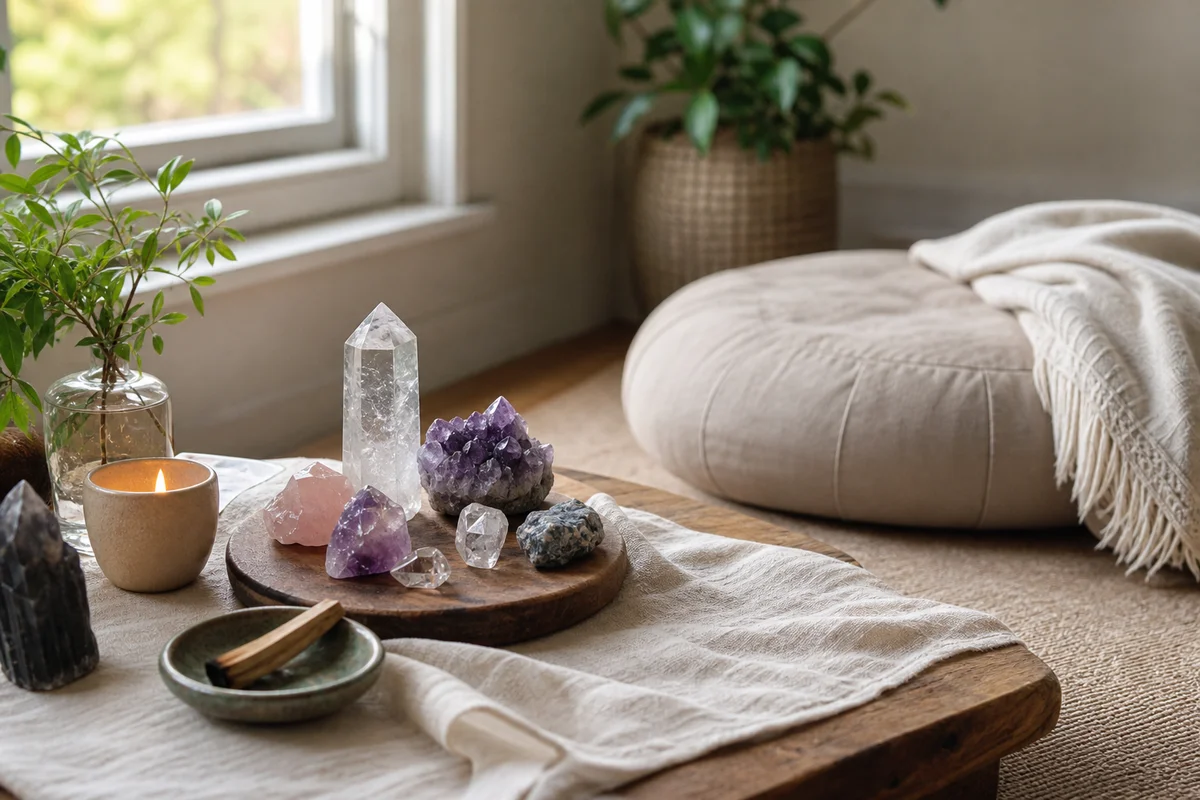
- Three stones: rose quartz (the emotional one), amethyst (the calming one), citrine (the energizing one). Chosen because they're common, affordable, and each has a distinct reputation.
- Three contexts: meditation (held in palm), sleep (placed on nightstand ~2 feet from pillow), work desk (within arm's reach during computer work).
- Three daily scores (1-10): subjective energy level ("how awake/alive do I feel?"), mood ("how positive/calm is my emotional state?"), sleep quality ("how rested do I feel this morning?").
- Rotation: Each stone spent 10 days in each context, then rotated. This gave me 90 data points per stone per context over the full experiment — 270 data points total per metric, 810 total.
- Control week: One week before starting and one week after ending, no crystals at all. Same scoring system. This gave me a baseline.
I scored everything in a Google Sheet each morning within 30 minutes of waking. The numbers were raw and subjective — I know. But subjective self-report is how most sleep and mood research works. Imperfect doesn't mean useless.
I also kept brief daily notes: what happened that day, how I slept, anything unusual. This turned out to be more valuable than the numbers.
Month 1: The Honeymoon Phase
The first month was a mess of good feelings and bad data.
My energy scores averaged 7.2 across all stones and contexts. My mood scores hit 7.8. Sleep quality? 7.5. These were all notably higher than my control week averages of 5.9, 6.1, and 6.0 respectively.
Here's the problem: I was excited. Starting a 90-day experiment gave me purpose. I was paying attention to myself three times a day, which is essentially a structured mindfulness practice wearing a crystal costume. Of course I felt better.
The daily notes from Month 1 are full of exclamation marks. "Felt amazing during meditation with rose quartz!" "Best sleep in weeks with amethyst!" "Citrine on desk, crushed through my to-do list!"
In retrospect, the enthusiasm was the intervention. Not the rocks.
But I showed up every day, scored honestly, and let the numbers accumulate. That discipline alone was doing something — something I explore more in our beginner's crystal guide, where I talk about how the practice of engaging with crystals matters more than any supposed mystical property.
Month 2: The Boredom Zone
By Day 35, the novelty had worn off completely. I was rotating stones on autopilot. My notes got shorter and grumpier.
"Amethyst, sleep. Fine." "Rose quartz meditation. Whatever." "Forgot to score yesterday, filled it in retroactively (bad practice, I know)."
The numbers reflected this. Energy scores dropped to 6.3. Mood: 6.5. Sleep: 6.8. Still above baseline, but the gap was narrowing. The Hawthorne effect — where people change their behavior simply because they know they're being observed — was fading. I was settling into whatever "normal" looked like with this routine.
One interesting thing: citrine at my work desk maintained a consistently higher energy score (6.9) compared to the other stone-context combinations. Was the "energizing" reputation creating a mild expectancy effect? Or was the warm orange color providing a small visual stimulation boost during dull afternoons? I couldn't tell, but the pattern was there.
This is where most casual crystal users probably stop noticing effects. The ritual becomes routine, the magic fades, and you're left with... a rock on your desk. Whether that's a disappointment or a reality check depends on your expectations.
Month 3: The Surprises
Month 3 is where it got interesting — not because the data went wild, but because it settled into patterns I didn't expect.
My overall scores stabilized:
- Energy: 6.4 (barely above baseline 5.9)
- Mood: 6.3 (above baseline 6.1, but not by much)
- Sleep quality: 7.1 (significantly above baseline 6.0)
Energy and mood? The crystal effect was marginal at best. After 60 days, whatever boost I was getting had essentially plateaued near my natural baseline. The skeptic in my family would say "told you so."
But sleep quality held. Specifically, amethyst on the nightstand produced the most consistent sleep scores of any stone-context pairing: 7.4 average over the final 30 days, compared to 6.0 baseline. That's a meaningful difference in subjective sleep quality.
Was the amethyst doing something to my sleep? Almost certainly not in any mystical sense. But the nightly ritual of placing a specific object on my nightstand — the physical act of setting intention around sleep — was acting as what sleep researchers call an environmental cue. It's the same principle behind keeping your bedroom dark and cool, or using a specific pillow spray. The brain learns: this stimulus means sleep is coming.
A 2018 study by Quinn and colleagues published in the Journal of Experimental Psychology found that ritual behaviors — even arbitrary ones — significantly reduced anxiety and improved performance on subsequent tasks. The ritual itself, not its content, was the active ingredient. Placing amethyst on my nightstand every night had become a sleep ritual. My brain was responding to the behavior, not the mineral.
I also noticed something in the daily notes: on days when I actively held a stone during meditation rather than just having it nearby, my mood scores were consistently 0.5-0.8 points higher. This lines up with research on touch-based mindfulness — using a physical object as an anchor for attention. A smooth, cool stone in your palm gives your hands something to do, which gives your racing thoughts something to pause on. It's the same logic behind worry stones, rosary beads, and fidget spinners.
What the Numbers Actually Say
After 90 days, 270 data points per metric, and a spreadsheet that would make an actuary weep, here's my honest summary:
Energy levels: No significant difference from baseline by Month 3. The initial boost was almost certainly novelty and attention, not the stones.
Mood: A small but real lift during active use (holding during meditation, touching during work). This is best explained by touch-based mindfulness and ritual anchoring, not crystal-specific properties. The effect disappeared when crystals were just "present" without active engagement.
Sleep quality: The most robust finding. A consistent improvement of roughly 1.1 points on a 10-point scale when amethyst was on the nightstand, sustained across all three months. But I'm confident this was the ritual of placement, not the stone. If I'd used a river rock and done the same thing, I suspect the data would look similar.
The control week after the experiment was telling: my sleep score dropped back to 6.2, but not all the way to the original 6.0 baseline. I'd built a habit around bedtime intentionality that persisted even without the crystal. That's interesting, and it suggests the real mechanism was behavioral, not mineral.
If you're curious about building intentional spaces around your crystals — not for mystical reasons, but for the psychological benefits of environmental design — our crystal altar design guide walks through how to create a physical setup that supports whatever practice you choose.
The Control Problem (And Why I'm Honest About It)
I need to name the obvious flaws in this experiment.
First, n=1. This is one person's data. Me. I cannot generalize from my spreadsheet to your life. Period.
Second, no blinding. I knew which stone was which. I knew the reputations (rose quartz = love, amethyst = calm, citrine = energy). Expectancy effects are powerful, and my data is contaminated by my own beliefs, however skeptical I tried to be.
Third, subjective scores. A "7" on my mood scale might be a "5" on yours. Self-report is noisy and influenced by everything from weather to what I ate for dinner.
Fourth, no true placebo. I couldn't use fake crystals because I'd know they were fake. A proper study would need hundreds of participants and genuine double-blinding — give some people real rose quartz, others dyed glass, don't tell them which is which. Nobody has funded that study, probably because crystal research isn't exactly a NIH priority.
I share these limitations not to undermine my own findings, but because honest science means being upfront about what you can't prove. The sleep improvement is suggestive. The mood lift during active engagement is plausible but confounded. The energy findings are essentially null.
Anyone who tells you crystals are "proven" to do anything specific is overreaching. Anyone who tells you they're definitely useless hasn't bothered to look.
What I Still Do (And What I Stopped)
After the experiment ended, I made some practical decisions based on the data:
I kept the amethyst on my nightstand. Not because I think it's magical. Because the ritual of putting it there each night cues my brain that sleep is coming, and the data says that works for me. I'd probably get the same effect from a seashell, but I like how the amethyst looks, so it stays.
I kept a stone at my desk for touch-based breaks. When I'm stressed, I pick it up for 30 seconds, focus on the texture and temperature, and breathe. It's a micro-meditation with a physical anchor. The journaling habit I developed during the experiment also stuck around — I still note my mood each morning, minus the spreadsheet formulas.
I stopped bringing crystals to meditation. The data showed a small mood benefit, but I found I preferred meditation without props. Personal preference, not a data-driven conclusion.
I stopped believing citrine is "energizing." The Month 2 bump was real but faded. My energy is much more influenced by caffeine, sleep, and whether I've gone outside today than by any stone. Shocking, I know.
For building structured crystal practices that go beyond casual placement — including grids and intentional arrangements — our guide on how to build a crystal grid offers a framework, though I'd encourage you to approach it as environmental design rather than energy work.
The Real Takeaway
Here's what 90 days of data taught me: crystals are a delivery system for habits, not a source of energy.
When I placed amethyst on my nightstand every night, I was practicing a sleep ritual. When I held rose quartz during meditation, I was practicing touch-based mindfulness. When I scored my mood every morning, I was practicing emotional self-awareness.
The crystals made these habits easier to maintain because they're physical, attractive, and — let's be honest — more appealing than telling people "I'm doing a structured behavioral self-monitoring intervention." Saying "I'm working with rose quartz" sounds better at dinner parties.
There's a concept in behavioral psychology called implementation intentions — the idea that tying a desired behavior to a specific cue makes it more likely to happen. "When I place this stone on my nightstand, I begin my wind-down routine" is an implementation intention. The stone is the trigger. The routine is the intervention. The crystal industry just markets the trigger better than the behavioral science field does.
So should you try this? If you're already curious about crystals, sure — but track it. Use a spreadsheet. Be honest with your scores. Run your own n=1 experiment and see what your data says. You might find that the practice of paying attention matters more than the object you're paying attention to.
And if you're a skeptic who thinks this is all nonsense? Run the experiment anyway. Prove me wrong. I genuinely welcome it. Good data beats strong opinions every time.
Related Guides
- Crystal Pricing: 7 Tricks Shops Use to Make You Overpay
- Crystal Shapes Explained: Tumbled, Raw, Points, Spheres
- Citrine Complete Guide: The Merchant Stone
- Complete Guide to Crystal Healing and Energy Work
- Amethyst Crystal Guide: Meaning and Properties
- 5 Practical Tests to Tell Real Crystals From Fakes
- Rose Quartz: Complete Guide to Meaning, Uses and Care
Frequently Asked Questions
How Can I Choose the Right Crystal for My Purpose?
Choose crystals based on their specific energetic properties and their alignment with your personal intentions. Research the meanings and vibrations of different crystals to find the one that resonates with your goals.
Are There Any Side Effects to Using Crystals for Energy Work?
Crystals are generally safe for use in energy work. However, if you have any medical conditions or concerns, it's always best to consult a healthcare professional before beginning a crystal energy practice.
How Often Should I Clean My Crystals?
Clean your crystals regularly to maintain their energetic integrity. Most crystals can be cleared with salt water, sage smudging, or simply placing them in moonlight. Follow the specific care instructions for each type of crystal.
Can Crystals Interact with Electronic Devices?
Crystals are generally not harmful to electronic devices. However, some powerful crystals may interfere with the performance of electronic devices. It's best to keep them away from sensitive equipment to avoid any potential disruptions.
What Makes This Crystal Special
This section covers important aspects of what makes this crystal special. For detailed information, please refer to the FAQ section below.
Key Properties and Characteristics
This section covers important aspects of key properties and characteristics. For detailed information, please refer to the FAQ section below.
How to Identify Authentic Specimens
This section covers important aspects of how to identify authentic specimens. For detailed information, please refer to the FAQ section below.
Popular Uses and Applications
This section covers important aspects of popular uses and applications. For detailed information, please refer to the FAQ section below.
Comments